SEVEN GATES RESEARCH · PORTFOLIO CONSTRUCTION · NIGERIA
Gun to Head at 252,000
The unknown gunman wants five Nigerian stocks before Christmas. GTCO, MTN Nigeria, Aradel, Zenith and NAHCO: the evidence has improved; the prices have improved faster.
By Seven Gates Research · Published 30 September 2026
Five stocks, three ghosts, and a market that got dearer while the macro got more interesting.
| AT A GLANCE | 29 SEPTEMBER 2026 CLOSE | |||
|---|---|---|---|
| NGX All-Share Index | 251,913.20 | 2026 YTD return | +61.88% |
| US$ YTD return* | ~+74.7% | Market capitalisation | N163.53tn |
| NFEM, 29 Sep | N1,330.47/US$ | Headline CPI, Aug | 15.39% |
| Food inflation, Aug | 19.57% | MPR, 22 Sep | 23.00% |
| FTSE Frontier | Live since 21 Sep | Pres./NASS election | 16 Jan 2027 |
Disclosure: I own GTCO and MTN Nigeria as at publication. This remains a portfolio thought experiment, not a recommendation to buy, sell or hold any security. *US$ return is a Seven Gates reconstruction; methodology in the research notes.
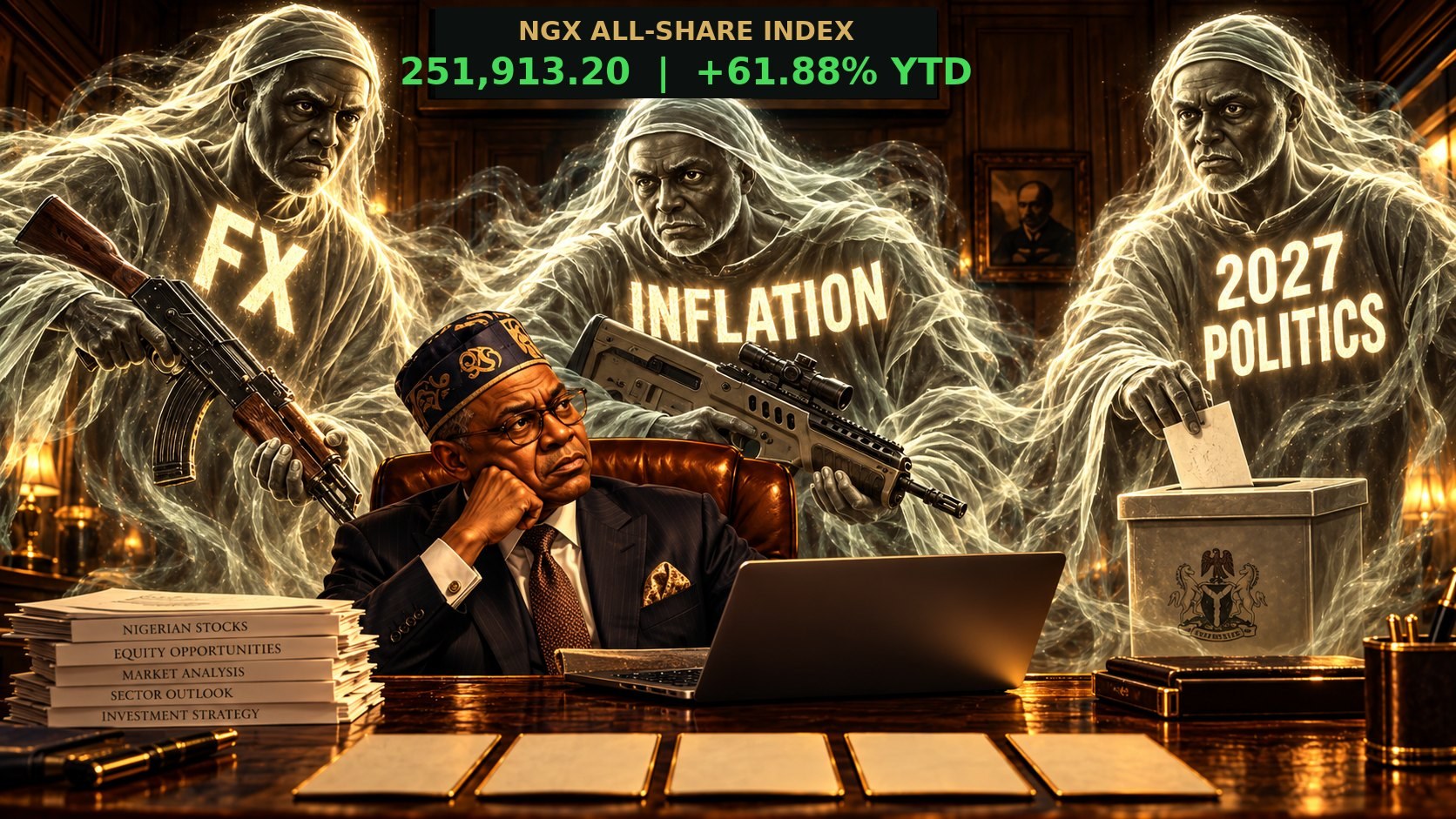
The ember months have started. From September the roads thicken, landlords remember your address, school fees and Christmas land in the same quarter, and everyone in Nigeria starts hustling for December. It is also the season when the headlines fill with unknown gunmen, the phrase for the man nobody can identify. He is coming for all of us. Mine is of the less lethal, more irritating variety. He carries no card, names no fund and never says who sent him. At the end of September he pressed something cold against the back of my head and asked for five Nigerian stocks. Not a sector view. Not a macro outlook. Five names, before Christmas.
He had plainly been reading the papers. The NGX is up 61.88% on the year. In September alone, FTSE Frontier status went live, the CBN reset the MPR to 23%, GTCO finally showed its half-year and the naira firmed. He did not ask about any of that. He wanted names.
Here they are: GTCO, MTN Nigeria, Aradel, Zenith and NAHCO. They do not all sit equally comfortably. The evidence behind them has improved this year. The prices have improved faster, and a gunman who turns up after a 60% rally, three months before the year-end scramble, is not a client whose timing anyone should admire.
The assignment
I still object to his methodology. A firearm is a poor research tool. Graham had balance sheets. Buffett has annual reports. I would settle for coffee, a quiet room and the right to say no.
I have started to wonder who he works for. A man who turns up at a market already up 61.88% for the year and demands immediate exposure looks less like a kidnapper and more like a momentum fund with poor manners. He has never said. I did not ask twice.
The three ghosts are at the table: foreign exchange, inflation and election-year policy. The third has been campaigning since 19 August and has moved the presidential vote forward to 16 January, which makes it the only ghost in Nigeria that arrives early. So I turn to Macbeth, the only man in the hall who could see the dead man. Everyone else carried on regardless. That is roughly how investors treat macro risk in a bull market.
Thy bones are marrowless, thy blood is cold;
Thou hast no speculation in those eyes
Which thou dost glare with!"
Unfortunately, Banquo leaves. The naira does not.
This year the naira has done something ghosts rarely manage. It has appreciated, and Figure 1 shows what that did to the dollar return.
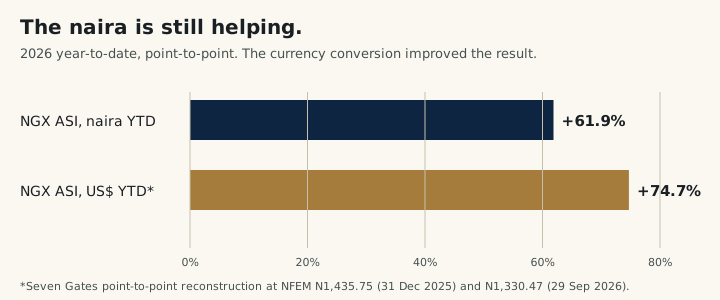
For once, currency translation has added to the Nigerian equity result instead of subtracting from it. Enjoy that. Do not build a house on it. Anyone who held naira assets through 2023 and 2024 remembers how fast that translation can reverse.
1. Where things stand
The market. The All-Share closed 29 September at 251,913.20, up 61.88% for the year, with market capitalisation at N163.53tn. This is a very good year for people who were already in it. Fresh money buys at a worse price than old money did, and should feel correspondingly less cheerful.
The currency. NFEM closed at N1,330.47/US$ on 29 September against N1,435.75 at end-2025, an appreciation of roughly 7.9% on those two endpoints. Stack that on the equity rally and the reconstructed dollar return rises to about 74.7%. The ghost is still behaving, but two endpoints do not make a trend.
Monetary policy. On 22 September the CBN reset the MPR from 26.5% to 23.0% and narrowed the standing-facility corridor. It then used its communiqué to explain that it had not, in any meaningful sense, cut anything: the move was an operational realignment to restore the MPR as the policy signal, and should not by itself be read as a change in the underlying stance. Central banks enjoy this sort of sentence. The charitable reading, which I think is also the correct one, is that the Bank moved the sign to where the road already ran. Either way, the printed hurdle fell 350 basis points. The economic hurdle did not fall 350 basis points on command.
Market access. For most of the last few years, the most important number for a foreign investor in Lagos was not a price. It was a place in the queue. You could own a very good Nigerian bank, receive a very good dividend, and then wait, month after month, to turn the naira into something you could take home. Index committees notice that sort of thing. On 21 September FTSE Russell restored Nigeria to Frontier status, after market participants reported that the FX queues had cleared and repatriation delays were no longer material, and after a summer review found no material problems with the new T+1 settlement cycle.
Good. The badge is live. It changes who is allowed to buy. It does not change what they should pay.
2. Five stocks, five jobs
The five were not picked to do the same thing. Each has one job in the book and one way of failing at it.
| Stock | Ref. price | Portfolio job | What breaks it |
|---|---|---|---|
| GTCO | N132.50 29 Sep | Capital + earnings quality | Tax drag, weaker core earnings, credit |
| MTNN | N863.00 28 Sep | Cash compounding + pricing power | Regulation, energy/capex, valuation |
| Aradel | N1,530.00 28 Sep | Hard-currency optionality | Oil, minorities, integration |
| Zenith | N134.00 29 Sep | Valuation + balance sheet | Stale H1 data, dilution, credit |
| NAHCO | N152.00 28 Sep | Scarce aviation infrastructure | Valuation, cost normalisation, cycle |
Figure 2. Current price is not the thesis, but it sets the margin for error. Source: Investing.com / StockAnalysis delayed NGX closes, dated per stock.
3. Gun to head: the five
The rule has not moved. I do not know where the naira, oil or the policy rate will sit in January 2027, and I would treat anyone who claims to know with polite suspicion. So I do not want five stocks that all need the same forecast to come true. I want collected cash, balance-sheet room and five different ways of being wrong.
1. GTCO: late homework, heavy tax
Reference price N132.50, 29 September
For weeks the most interesting thing about GTCO's half-year was that nobody had seen it. Late accounts invite imagination, and in Nigerian banking imagination rarely runs towards good news. The numbers arrived at the end of September and turned out to be dull at the top and awkward at the bottom. PBT was N603.0bn, up 0.4%. PAT fell 7.8% to N414.2bn. EPS fell 17.8% to N11.2, because there are now more shares to spread it across and the tax authority took a bigger slice before anyone got to spread anything. Interest income rose 7.5% and trading income 24.7%, while fair-value losses absorbed N46.2bn.
The reassurance lives on the balance sheet. Group CAR was 34.9%. Stage-3 loans improved to 4.6% from 5.0% at FY2025, and cost of risk fell to 0.6%. There was no hidden hole, which was the fear that silence had been feeding.
The market's first verdict was a 3.28% fall on 29 September. At roughly 5.9x trailing earnings, a shareholder is still paid for the untidiness. The lesson of the half-year is plainer than the wait for it. Capital strength protects the franchise. It does not produce earnings per share by itself, and a bank that has just issued a great many new shares has to earn on every one of them.
2. MTN Nigeria: data that runs on diesel
Reference price N863.00, 28 September
MTN Nigeria sells something that looks weightless, data, and depends on things that are extremely heavy: diesel, generators, fibre, towers and permits. In the first half the heavy things behaved. Service revenue rose 25.9% to roughly N3.0tn. EBITDA rose 39.2% to N1.7tn, taking the margin to 55.9%. PAT rose 70.6% to N707.5bn. Free cash flow reached N712.7bn and the interim dividend was N26.
It also ended the half with no foreign-currency loans. That reads like housekeeping until you remember what dollar debt did to the income statement in 2023 and 2024, when the company learned that a naira business borrowing in dollars is making a currency bet whether or not the board voted for one.
At around 12.9x trailing earnings and a free cash flow yield near 10.3%, this is still the cleanest operating case of the five. The price, though, has stopped doing much of the protective work. At this multiple the business has to supply most of the safety margin itself. Data demand is structural. Electricity, fibre cuts, capex and regulation remain stubbornly physical, and none of them depend on what the stock did last month.
3. Aradel: an oil company inside a corporate nesting doll
Reference price N1,530.00, 28 September
The headline numbers are large and cheerful. H1 revenue was N2.49tn, EBITDA N1.39tn, operating cash flow N975.6bn and cash N1.72tn. Net debt fell to N46.5bn. On trailing earnings the shares look cheap, at about 8.7x.
Then you open the doll. Pre-tax profit was N752.7bn; after a N561.7bn tax charge, profit after tax was N191.0bn, and only N153.7bn of that belonged to Aradel's own shareholders. ND Western and the majority interest in Renaissance bring scale, and with it minority shareholders, acquisition accounting and years of integration work. A consolidated figure tells you what the group controls. It does not tell you how much of it belongs to you.
The same acquisitions explain why 8.7x looks cheap. FY2025 profit included N610.3bn of one-off accounting gains from the deals: N217.1bn from a bargain purchase and N393.2bn from a translation gain. Annualise the first half of 2026 instead, N35.37 a share attributable to Aradel's owners, and the multiple at N1,530 is about 21.6x. That half also carried heavy underlift and currency losses that may not recur, so the true run-rate probably sits somewhere between the two. Either way, this is not a cheap oil company. It is a fully priced one with a large, promising and complicated balance sheet. The consolidated free cash flow is kinder, although part of that, too, belongs to the minorities.
Aradel stays because a naira portfolio needs at least one business whose economics are priced in dollars. It stays small in my mind for a simpler reason: consolidated EBITDA is not a personal bank balance.
4. Zenith: priced in a dim room
Reference price N134.00, 29 September
Zenith is the cheapest of the five and the least currently known, and those two facts are probably related. The stock trades around 5.3x trailing earnings and 1.08x book. The 2025 recapitalisation added about 9.7 billion new shares, which is the recapitalisation arithmetic that matters: new capital is welcome, but per-share earning power must eventually justify the new owners.
The board approved the H1 accounts on 29 July. Publication still awaits clearance from the primary regulator, and NGX granted a six-week extension; the bank has said it expects to publish on or before 9 October. So the latest hard operating snapshot remains Q1, when PBT was N360.9bn and PAT N314.0bn. That is a long time to value a bank from one quarter.
At this price the valuation is forgiving. The evidence is not yet complete. Part of the discount is a fee for sitting in a room without the half-year numbers, and I would rather collect that fee than pretend the room is well lit.
5. NAHCO: somebody has to push the plane back
Reference price N152.00, 28 September
Before the first departures leave Lagos in the morning, somebody has to load the bags, fuel the tugs, stack the cargo and push each aircraft back from the stand. There are only so many companies licensed and equipped to do that work at Nigerian airports, and airlines do not change their ground handler lightly. That is the whole NAHCO thesis, and it is a good one.
The half-year supports it, with one footnote worth reading. Revenue rose 9.4% to N35.36bn and PAT 22.2% to N10.85bn, with adjusted EPS of N4.87. Operating profit rose 25.4%. Gross profit, however, slipped 1.6%, because operating costs rose faster than revenue. The rescue came partly from a sharp fall in administrative expenses. Admin costs can fall sharply once. They rarely fall sharply every year.
The shares trade at roughly 17.4x trailing earnings and 15.1x free cash flow, one of the two most valuation-sensitive positions in the book. The other is Aradel, once its accounting gains are taken out. The licences, airline relationships and equipment are still scarce. Scarcity has not made them immune to price. If one of the five has to go because the share outran the business, this is the one I watch hardest.
Sources: GTCO H1 2026 audited results, 28 Sep; MTN Nigeria H1 2026 earnings release; Aradel H1 2026 results; Zenith Bank Q1 2026 and NGX extension notice; NAHCO H1 2026 filing summaries; S&P Global Market Intelligence via StockAnalysis; latest verified NGX closes.
4. The five were chosen to fail differently
| Stock | FX shock | Rates / inflation | Regulation | Oil | Dilution / capital | Election liquidity |
|---|---|---|---|---|---|---|
| GTCO | Medium | High | High | Low | Medium | High |
| MTNN | Medium | Medium | High | Low | Low | Medium |
| Aradel | Positive hedge | Medium | Medium | High | Medium | Low |
| Zenith | Medium | High | High | Low | High | High |
| NAHCO | Medium | Medium | Medium | Low | Low | Medium |
Figure 3. Qualitative sensitivity map. "Positive hedge" means the factor can improve reported economics under the stated shock; it does not mean the share price must rise. This is a portfolio-function map, not a forecast.
Safety was never on offer. What I was buying is a correlation of disappointment: when things go wrong, I would like them to go wrong in different offices. Ghosts seldom haunt one room at a time; the least I can do is give them separate rooms. Two banks still tie the book to one set of rates, one liquidity system and one regulator. Aradel adds oil. MTN adds regulation and physical infrastructure. NAHCO adds valuation and the aviation cycle. That is imperfect diversification, which is the only kind available to human beings.
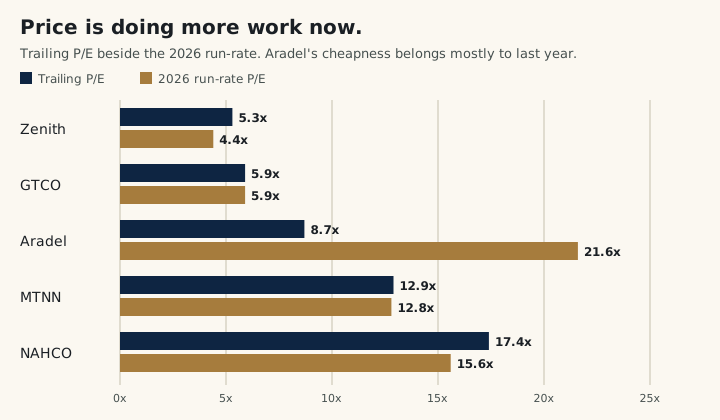
The index is up 61.88%, inflation is 15.39%, the naira has appreciated on the year and the MPR headline has been reset to 23%. That leaves little room for a merely adequate result. Each of the five therefore has to bring cash generation, balance-sheet resilience, hard-currency economics or genuine scarcity. A good company at a heroic price is still capable of administrative violence against a portfolio.
5. Five-year price context: the turnaround has already been noticed
The house standard now requires five years of price history. Its main use here is as a cure for the feeling of discovery. Look at these lines and ask who else has spotted the story. For most of the five, the answer is plenty of people, some time ago.
The panels use selected adjusted period-end closes rather than pretending a complete daily five-year series has been reproduced. Aradel is shown from its NGX listing on 14 October 2024. Cash dividends are excluded.





6. The strongest case against this book
An intelligent sceptic has an obvious objection. I have spent several pages explaining why a market up 62% calls for caution, and then kept all five stocks. Fair.
The defence is that the evidence has genuinely improved, and a research house that only updates towards gloom is not doing research. FTSE restored Frontier status because repatriation frictions eased. The naira is stronger on the year. Inflation is lower. MTN is producing large free cash flow. GTCO's delayed half-year showed a strong capital base, not a hidden balance-sheet event. Aradel is generating operating cash. Those are facts worth updating on. Old trauma, however well earned, is not an analytical method.
The counterweight is price and missing information. MTNN, NAHCO and Aradel have rerated, and Aradel's apparent cheapness is partly an echo of last year's acquisition accounting. GTCO's half-year EPS fell. Zenith still has not published its H1. The dollar return rests on two FX endpoints and says nothing about the path between them. And two banks in a five-stock book remains a large bet on one regulatory and liquidity system.
So the conclusion is narrower than it sounds. Nigeria has not become safe. The evidence has become better, and the prices have become less forgiving at roughly the same speed.
Gun to head: GTCO, MTN Nigeria, Aradel, Zenith Bank and NAHCO.
Five names, different degrees of comfort. GTCO is more sober after its H1. MTN remains the clearest operating machine, at a fuller price. Aradel still supplies hard-currency economics, at a price that is less cheap than it looks. Zenith stays because valuation pays for an incomplete H1 evidence set. NAHCO stays because the business is scarce, but the price has made the position distinctly less comfortable.
Gun removed, I still reserve the right to own cash. Portfolio construction under threat remains a poor substitute for patience.
What would change the view
I would revisit the five-name construction if the parallel/official FX gap widens materially, if the CBN reset starts feeding obvious inflationary or currency pressure, if GTCO shows continued per-share erosion without stronger core earnings, if Zenith's H1 undermines the book-value case, if oil moves far enough to impair Aradel's cash economics, or if NAHCO's valuation rises faster than operating cash flow can plausibly follow. Those are monitoring variables, not prophecies.
Hamlet, fresh from meeting his father's ghost, put the point better to Horatio, who had not believed in it: there are more things in heaven and earth, Horatio, than are dreamt of in your philosophy. There are certainly more than are dreamt of in a five-stock book.
His ghost also asked for more than Banquo's. Banquo's only glared. Hamlet's father said remember me, then left his son to do the work. Market ghosts keep the same habit. They seldom leave; they wait for the week you stop checking.
7. The ones that got away
Katy Perry's "The One That Got Away" sat on Teenage Dream, the 2010 album that had already tied Michael Jackson's record for number-one singles. Released as the sixth single, it stalled at No. 3. Even a record-equalling run leaves something good on the cutting-room floor, and every five-stock book keeps its own list of exes: companies I admired, nearly chose and let go for reasons that seemed sensible at the time. Here are four. None of them did anything wrong. Most will probably do fine without me, which is the most painful part of any break-up.
Seplat: the one who earned in dollars
Seplat has what most Nigerian companies can only admire from across the room: dollar revenue, dollar reporting and a London listing. We have called it an excellent company at a demanding price. It missed the cut for a reason that has nothing to do with Seplat. Aradel already does the hard-currency job in this book, and two oil producers would not diversify the portfolio. They would simply invite the oil ghost to bring a friend.
Dangote Refinery: the celebrity you have never actually dated
Nobody doubts the asset. Our own work called it magnificent, and at N525 the IPO asks investors to underwrite rich refining margins, high uptime and a $14.3bn expansion with little room for error. It also has no five years of share-price history, which our house standard now requires, so it could not even complete the paperwork. A single-train refinery is a single point of failure with a very large fan club.
NGX Group: the one selling the shovels
In every gold rush someone suggests owning the shovel shop instead of the mine. We suggested it too, and the franchise is improving: FTSE is back, IPOs are arriving and turnover has woken up. The trouble, as we wrote on 14 September when the stock closed at N149.90, is that the price had already moved into our bull case. Buying a turnover business after a 62% rally is not a hedge against the market. It is the market with a smaller logo.
Okomu: the one who got expensive
Okomu grows palm oil on a 33,000-hectare estate, runs better mills than it used to and has recovering yields. We liked it enough to write about it on 28 September. We also rated it Watch, with a base fair value of about N1,000 against a N1,276.20 reference price, and noted that the share price assumes the border will stay reasonably friendly. It is a lovely estate. It is simply asking more than we would pay.
Pop music has a perfect line for this kind of regret, but it is copyrighted, and the research notes have enough footnotes already. The plainer version: each of these four could have made the book, and any of them may yet beat the five that did. That is what makes them the ones that got away rather than the ones I was right to leave. The ghosts, as ever, reserve judgement.
So the firearm can go back in the drawer. It was never an agreeable research tool, and the man holding it will probably want it back in December.
Related research
- At 26.5%, Nigeria's CBN Is on the Brake. Who Is on the Accelerator? · 18 Sep
- Nigeria Is Back at the Frontier · 26 Sep
- NGX Liquidity Paradox: The Market Is Back. Where Are the Buyers? · 24 Sep
- The Naira Is Not a Footnote in Your Valuation · 2 Aug
- The Time Is Out of Joint. So Are the Bank Results. · 29 Sep
- GTCO: The Bank That Keeps Its Shirt Buttoned · 2 Aug
- MTN Nigeria: The Data Is Flying. The Generator Has Sent Its Invoice. · 28 Aug
- Aradel: The Little Oil Company Has Acquired an Empire · 22 Aug
- Zenith Bank 2026: The Red Tie Has to Earn Its Keep · 6 Sep
- NAHCO: The Bags Still Have to Move · 3 Sep
- SAHCO: More Passengers. Less Margin? · 28 Sep
- Seplat Energy: Excellent Company, Demanding Price · 2 Aug
- Dangote Refinery IPO: Three Valuations Before Shift Change · 10 Sep
- NGX Group: The Lady Selling Shovels · 14 Sep
- Okomu: The Price of Red Oil · 28 Sep
Research notes and selected sources
Market. NGX ASI 251,913.20, YTD +61.88%, market cap N163.53tn at 29 Sep 2026 close: Network Capital daily market report; corroborated by Investing.com.
FX reconstruction. End-2025 NFEM N1,435.75/US$ from CBN data cited by CSEA; 29 Sep 2026 NFEM N1,330.47/US$ from Proshare. The ~74.7% US$ equity return converts the implied end-2025 ASI and 29 Sep ASI at those two endpoint FX rates only. It excludes dividends, withholding tax, FX dealing spreads and the path between endpoints.
Inflation. NBS August 2026: headline 15.39% y/y, food 19.57% y/y.
Monetary policy. CBN 307th MPC, 21-22 Sep 2026: MPR reset to 23%; standing facility corridor recalibrated to +50/-300bp from +50/-450bp; DMB CRR retained at 45%. CBN communique says the recalibration is an operational realignment and should not by itself be construed as a change in the underlying stance.
FTSE. FTSE Russell: Nigeria restored from Unclassified to Frontier status effective from the open on 21 Sep 2026, after market feedback that FX queues had cleared and repatriation delays were no longer material. The final confirmation (market notice, 27 Aug 2026) followed a review of the T+1 settlement cycle that found no material settlement, operational or funding issues.
Election. INEC revised timetable (February 2026, following the Electoral Act 2026): Presidential/National Assembly 16 Jan 2027; Governorship/State House 6 Feb 2027; presidential campaigns opened 19 Aug 2026. The earlier timetable under the Electoral Act 2022 had set 20 Feb and 6 Mar 2027.
GTCO. GTCO audited H1 2026, released to NGX and LSE at end-September: PBT N603.03bn (+0.4%); interest income +7.5%; trading income +24.7%; fair-value loss N46.2bn; PAT N414.2bn; EPS N11.2; CAR 34.9%; Group Stage-3 loans 4.6%; cost of risk 0.6%; interim dividend N1.
MTNN. MTN Nigeria H1 2026: service revenue +25.9% to about N3.0tn; EBITDA +39.2% to N1.7tn; margin 55.9%; PAT N707.5bn; FCF N712.7bn; interim dividend N26.
Aradel. Aradel H1 2026 (unaudited): revenue N2.4915tn; EBITDA N1.3892tn; PBT N752.71bn; tax N561.67bn; PAT N191.04bn, of which N153.66bn attributable to owners of the parent; basic EPS N35.37 (H1 2025: N33.26). FY2025 audited: PAT N757.34bn; basic EPS N173.62, including a N217.10bn gain on bargain purchase and a N393.19bn translation gain on business combination (N610.29bn in total), partly offset by a N106.30bn fair-value loss on the step acquisition of ND Western. Trailing EPS = N173.62 − N33.26 + N35.37 = N175.73, or 8.7x at N1,530. Run-rate: N35.37 × 2 = N70.74, or 21.6x. Implied shares in issue about 4.34bn; market capitalisation about N6.65tn; operating cash flow N975.6bn; cash N1.7166tn; net debt N46.5bn; production 25.2mmboe.
Zenith. Board approved H1 2026 audited accounts on 29 Jul 2026; publication awaits primary-regulator approval. NGX granted a six-week extension (notice of 18 Aug 2026) and the bank expects to publish on or before 9 Oct 2026. Q1 2026: PBT N360.92bn; PAT N314.02bn. The 2025 hybrid rights issue and public offer allotted 9.67bn new shares (5.23bn rights, 4.44bn public offer).
NAHCO. H1 2026: revenue N35.36bn; PAT N10.85bn; adjusted EPS N4.87. Gross profit declined 1.6% while administrative expenses fell sharply, a quality-of-growth caveat.
Valuation and prices. Trailing P/E and FCF ratios are S&P Global Market Intelligence data as displayed by StockAnalysis at late-September delayed prices. Cross-sector multiples are not directly comparable. Current closes used in the article are dated per stock.
Price-history panels. Selected adjusted period-end closes from StockAnalysis/S&P Global, not a complete daily series. Aradel listed on NGX on 14 Oct 2024 at N702.69 and is therefore shown since listing. No missing observations were interpolated.
Hero illustration. AI-generated. The ticker in the original image showed the 2 September edition's close; Seven Gates overlaid the verified 29 September close and YTD return.
Selected source links. networkcapitalltd.com/research/reports/daily-market-wrap-2026-09-29/ · cbn.gov.ng/MonetaryPolicy/decisions.html · nigerianstat.gov.ng · inecnigeria.org/elections/calendar · lseg.com (FTSE Russell country classification review) · GTCO press release, "GTCO Plc Releases 2026 Half Year Audited Results" (NGX/LSE) · doclib.ngxgroup.com (MTN Nigeria H1 2026 earnings release) · aradel.com (H1 2026 unaudited results) · stockanalysis.com/quote/ngx/
Disclaimer. This publication is provided for informational and educational purposes only. It does not constitute financial, investment, tax, legal, or other professional advice, nor does it constitute a recommendation, offer, solicitation, or invitation to buy, sell, or hold any security, financial instrument, or investment. The analysis may contain opinions, estimates, assumptions, forecasts and forward-looking statements based on information considered reliable at the time of publication. Such views may change without notice, and actual outcomes may differ materially. Investing involves risk, including the possible loss of principal. Readers should conduct their own independent research, verify the information presented, consider their individual circumstances and risk tolerance, and obtain advice from appropriately qualified professional advisers before making any investment decision. Seven Gates Research accepts no responsibility for investment decisions made solely on the basis of this publication.