SEVEN GATES RESEARCH · EQUITY RESEARCH · NIGERIA
Okomu: The Price of Red Oil
A 33,000-hectare estate, better mills, recovering yields and a share price that now assumes the border will remain reasonably friendly.
By The Lokoja Contrarian · Published 28 September 2026 · Seven Gates Research
The Okomu Oil Palm Company Plc | NGX: OKOMUOIL. Reference price: ₦1,276.20 at the 25 September 2026 close. Market capitalisation: about ₦1.22tn. Data cut-off: 27 September 2026.
At a glance
| Seven Gates view WAIT at ₦1,276.20 (25 September 2026 close). | Base fair value About ₦1,000 per share. Underwriting range about ₦700 to ₦1,350. |
| Concession area 33,113 ha, or 331 km², about 46,400 standard football pitches. Last major land acquisition: 2014. | Planted About 19,000 ha of oil palm and about 7,335 ha of rubber. |
| 2025 operations FFB yield 16.68 t/ha. Oil extraction rate 23.65%. CPO production 74,131 t. Palm mill capacity about 120 t FFB/hour. | 2025 results Revenue ₦198.2bn. Profit after tax ₦58.0bn. |
| Ownership Socfinaf 62.94%. | Principal risk Cheaper imported palm oil resetting the domestic scarcity premium faster than the estate can improve its own tonne. |
Football-pitch conversion uses 105m × 68m. The entire concession is not planted; conservation land, roads, waterways, housing and industrial infrastructure occupy part of the balance.
Horizon and review. The view runs six months from the ₦1,276.20 reference price of 25 September 2026. Review on the Q3 2026 results, and no later than 25 March 2027.
Before the accounts
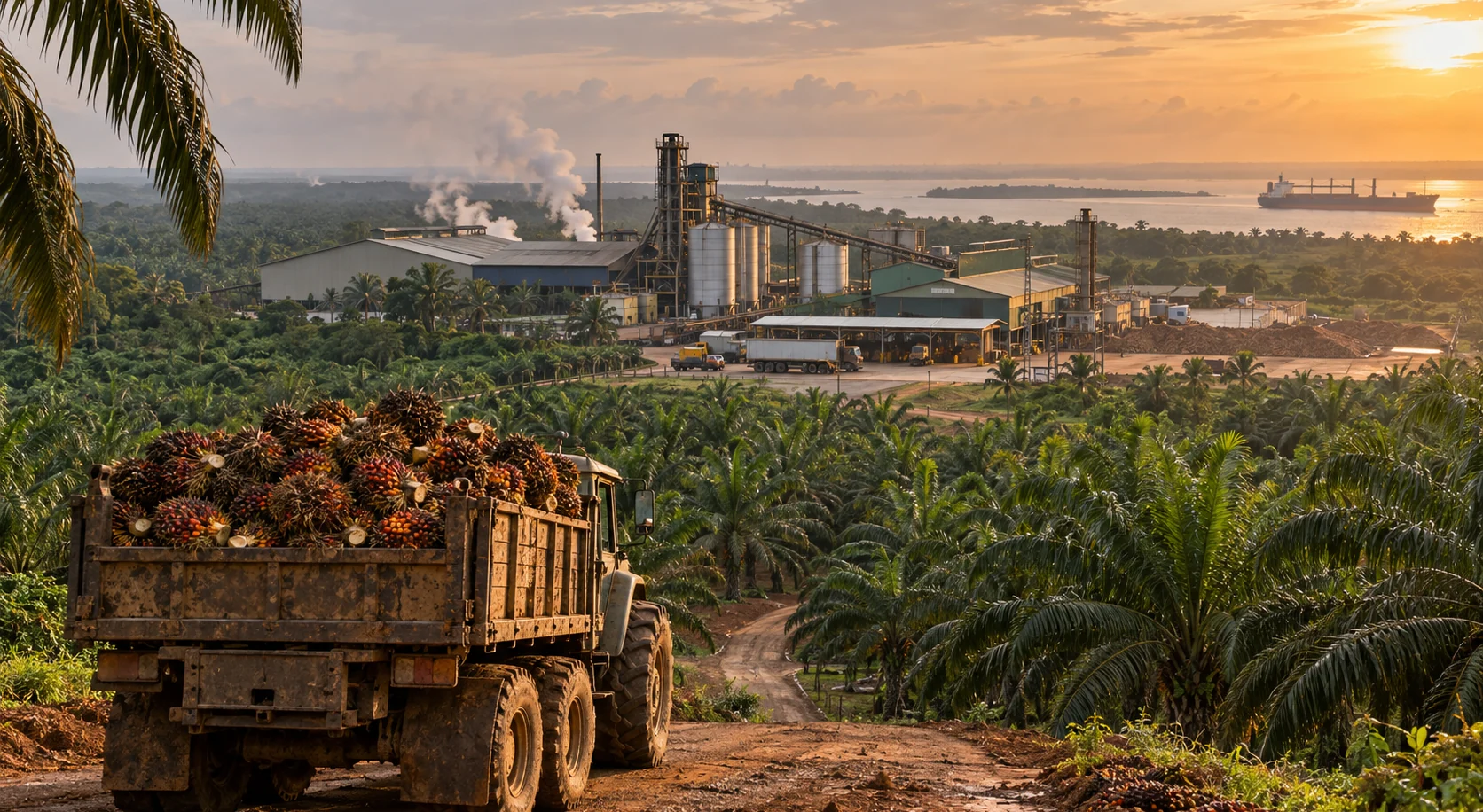
At Okomu, the work starts before the accounts. Heavy fruit bunches are cut from the palm, loaded, moved and processed quickly because harvested fruit begins to deteriorate. Trucks shuttle between field and mill. Steam, turbines and presses do the rest. By the time a line marked "revenue" appears in Lagos, a great deal of very physical work has already happened in Edo State.
Oil palm was a Nigerian export business long before crude oil was discovered at Oloibiri. By the early twentieth century, palm oil and kernels were among West Africa's great export commodities. Nigeria remained the world's leading exporter until the 1930s, before Malaysia and later Indonesia built plantation systems at a scale Nigeria never matched. That history makes Okomu tempting material for the usual national lament. It is better to resist it. Okomu is not a museum piece. It is a live industrial plantation with two mills, rubber production, a long-dated landbank and a stock market valuation above one trillion naira.
It is also not a descendant of the Royal Niger Company. The corporate line is much newer: Federal Government agricultural project in 1976, incorporation in 1979, privatisation in 1990, and Socfin control thereafter. The old palm trade is the landscape around the story, not the company genealogy.
The investment question in 2026 is therefore less romantic. Okomu has spent the last decade filling land it already owns, improving extraction and recovering field yields. Just as that work is bearing fruit, imported palm oil has become cheaper to land in Nigeria. The business now sits between two clocks: the slow biology of a plantation and the much faster movement of trade policy, FX and tariffs.
Three industrial palm-oil hubs in southern Nigeria
Okomu is highlighted at Okomu-Udo in Edo State. Presco is shown at Obaretin, also near Benin City. Wilmar is shown at Calaro in Cross River State.
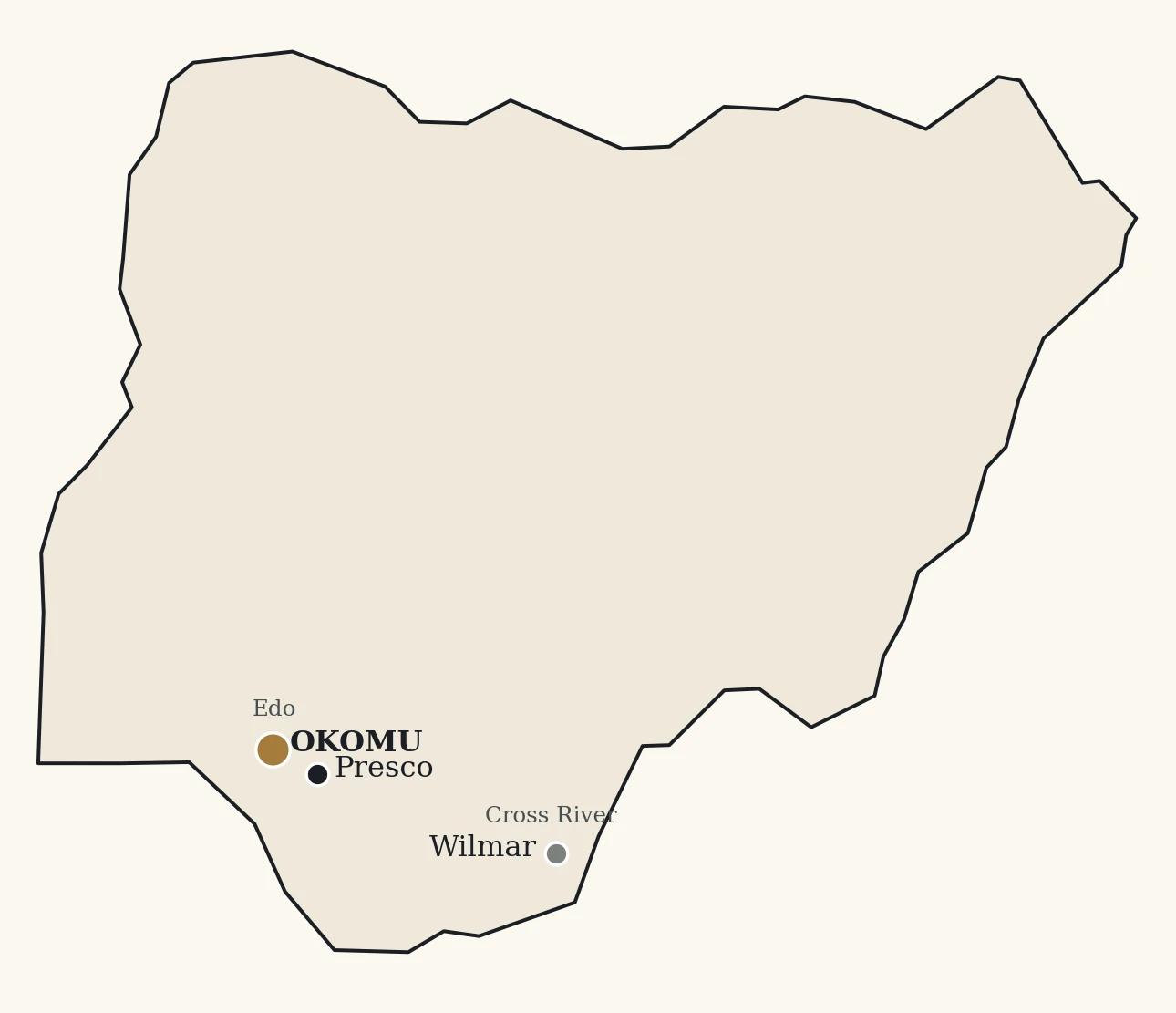
Figure 1. Source: Wilmar 2024 traceability report; Okomu and Presco company disclosures. Points show representative mill and estate hubs, not every plantation.
Okomu's three concessions are all in Edo State. The Main Estate and Extension 1 lie in Ovia South-West; Extension 2 reaches into Ovia North-East and Uhunmwonde. Presco's older core is also around Edo and neighbouring Delta, while Wilmar's plantation cluster sits farther east in Cross River.
That geography matters. Nigeria's industrial palm business is concentrated in the humid south, close enough to major consumer markets to enjoy a domestic logistics advantage, but exposed to the same ports and borders through which competing oil arrives.
1. Thirty-three thousand hectares, and apparently enough
Okomu began in 1976 on a de-reserved portion of the Okomu Forest Reserve. The initial surveyed concession was 15,580 hectares. A small 1.5 tonne-per-hour mill arrived in 1985. By 1989 about 5,500 hectares had been planted. Privatisation followed in 1990.
The two big additions came later. Okomu acquired 6,116 hectares in 2001, now Extension 1. In 2014 it acquired another 11,416 hectares from Hartman Ltd, together with an existing 10 t/h mill and 664 hectares of planted palms. That became Extension 2. Okomu then planted the acquired land heavily, including more than 4,000 hectares in 2016 and another roughly 2,300 hectares in 2018.
2014 was the last major land acquisition. The concession estate has effectively remained around 33,113 hectares since then. Palm planted area rose as Extension 2 was filled, but Okomu has not spent the last decade collecting farms. It has spent it developing the ones already bought.
Put 33,113 hectares into less agricultural language and the scale becomes easier to see. It is 331 square kilometres, or about 46,400 standard football pitches. The plantation itself is smaller because not every hectare is planted, but "farm" begins to sound a little modest.
2. The trees are recovering. The mill has quietly improved.
The field-yield record is encouraging without yet being heroic. Okomu produced about 17.2 tonnes of fresh fruit bunches per mature hectare in 2016. Yield fell to 12.97 t/ha in 2022, recovered to 15.34 in 2024 and reached 16.68 in 2025. That is a substantial recovery from the trough, but still slightly below the company's own 2016 level.
The mill story is stronger. Okomu's oil extraction rate was roughly 21.5% in 2016 and reached 23.65% in 2025. On 313,461 tonnes of fruit processed in 2025, a single additional percentage point of extraction would represent more than 3,100 tonnes of extra crude palm oil from substantially the same fruit. Better engineering cannot grow a bunch, but it can waste less of one.
The field has recovered; the mill has improved more clearly
FFB yield is tonnes of fresh fruit bunches per mature hectare. OER is the share of FFB weight recovered as crude palm oil.
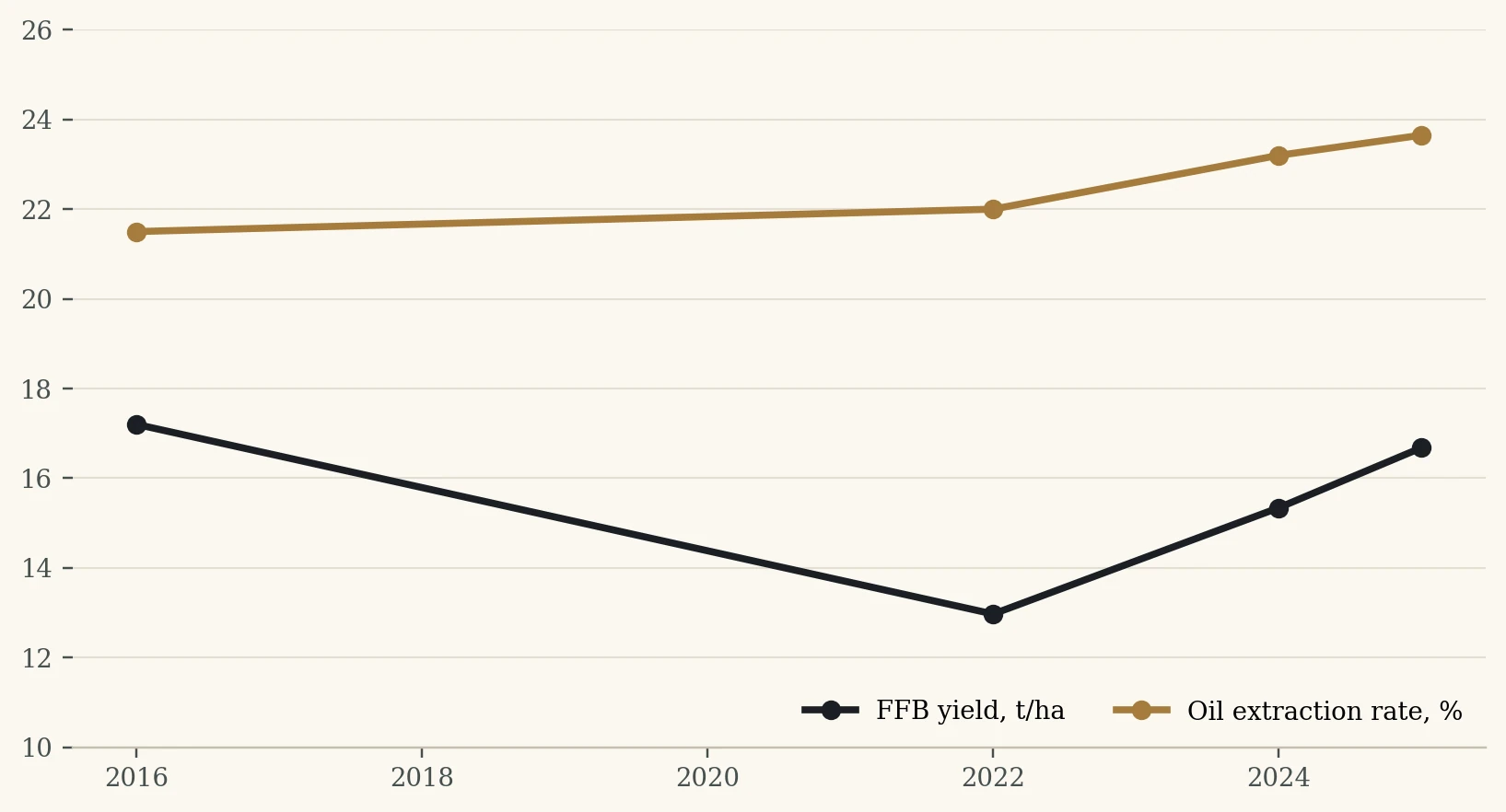
Figure 2. Source: Okomu annual reports 2016, 2022, 2024 and 2025; Seven Gates reconstruction. 2022 OER is rounded from company disclosure and shown for directional comparison.
In 2025 Okomu had roughly 17,162 mature palm hectares and about 1,851 hectares in immature or replanting stages. That age mix matters because a replanted hectare consumes cash before it contributes fruit. It is one reason plantation earnings should be read over a cycle rather than one harvest.
There is also a visible productivity gap to world-class Southeast Asian estates. IOI reported 20.49 t/ha in FY2025, comfortably above Okomu's 16.68. Okomu, however, achieved the better extraction rate, 23.65% versus IOI's 21.33%. The broad conclusion is useful: Okomu is very good at getting oil out of fruit; it still has room to get more fruit out of the land.
3. The neighbours, and the people who grow palm oil by the million tonnes
There are two useful peer groups. Presco faces largely the same Nigerian consumer, currency and import regime. The Southeast Asians show what palm economics look like much closer to world-market pricing and at much greater scale.
| Company | Footprint / scale | Yield / OER | Latest useful margin | Integration / relevance |
|---|---|---|---|---|
| Okomu | Nigeria; about 19k ha palm | 16.68 t/ha; 23.65% OER | 64.4% H1 2026 gross | Plantation and milling; highly exposed to Nigerian CPO |
| Presco | Nigeria and Ghana; 50,737 ha planted at June 2025 | Not directly comparable in H1 disclosures | 83.4% H1 2026 gross | More integrated: milling, kernel crush, refining, fractionation |
| Astra Agro | Indonesia; 280,325 ha planted | 15.66 t/ha nucleus yield (2025) | About 16% FY2025 gross | Much larger; closer to global commodity economics |
| IOI Corp | Malaysia and Indonesia; 172,459 ha planted | 20.49 t/ha; 21.33% OER | About 15.0% FY2025 PBIT | Highly integrated upstream and resource-based manufacturing |
| SD Guthrie | Malaysia, Indonesia, PNG and Solomon Islands; 568,323 ha planted | 17.92 t/ha group yield (2025) | About 12.0% FY2025 net margin | Global scale; 63 mills and multiple refineries |
Margins are not directly comparable across groups because business mix and accounting differ. Okomu and Presco are much more upstream-heavy than the large Southeast Asian groups; the table is intended to show the size of Nigeria's scarcity economics, not to claim identical cost structures. Sources: company annual and integrated reports for 2025 and FY2025; H1 2026 interim results for Okomu and Presco.
The Nigerian comparison is especially useful. We looked at Presco separately in Presco: The Plantation Is Excellent. The Price Has Heard. Presco now has more scale, more downstream processing and more geography. Those extra places to make money matter when raw CPO prices are under pressure.
The Asian comparison is less comfortable. IOI gets more fruit from a hectare. SD Guthrie processes more than ten million tonnes of FFB a year. Astra operates in the world's biggest producing country. Yet Okomu still earns margins they would regard with considerable affection.
That profitability cannot be explained by agronomy alone. Some of it is execution. Some of it is a deficit Nigerian market. Some of it is the cost of getting competing oil through the Nigerian border and into a customer's tank. Valuation needs to know roughly how much is which.
4. The border has done this before
Nigeria did not suddenly legalise palm-oil imports in 2026. There was no blanket import ban. In June 2015 the CBN made palm-oil products and a long list of other goods ineligible for official-market foreign exchange. Importers could still import them, but they had to find FX elsewhere. That raised the friction around foreign supply and helped domestic producers.
The shelter was never permanent. When FX became easier to obtain in 2017 and 2018, imports became more competitive and both Okomu and Presco felt the effect. Okomu's 2019 annual report then described an immense surge of illegal olein imports that clogged the market for nearly two quarters. The August 2019 land-border closure reduced those inflows and sales normalised.
Protection came through FX, borders and tariffs rather than a permanent ban
The sequence matters more than the labels: import frictions tightened, loosened and tightened again before the 2026 tariff change.
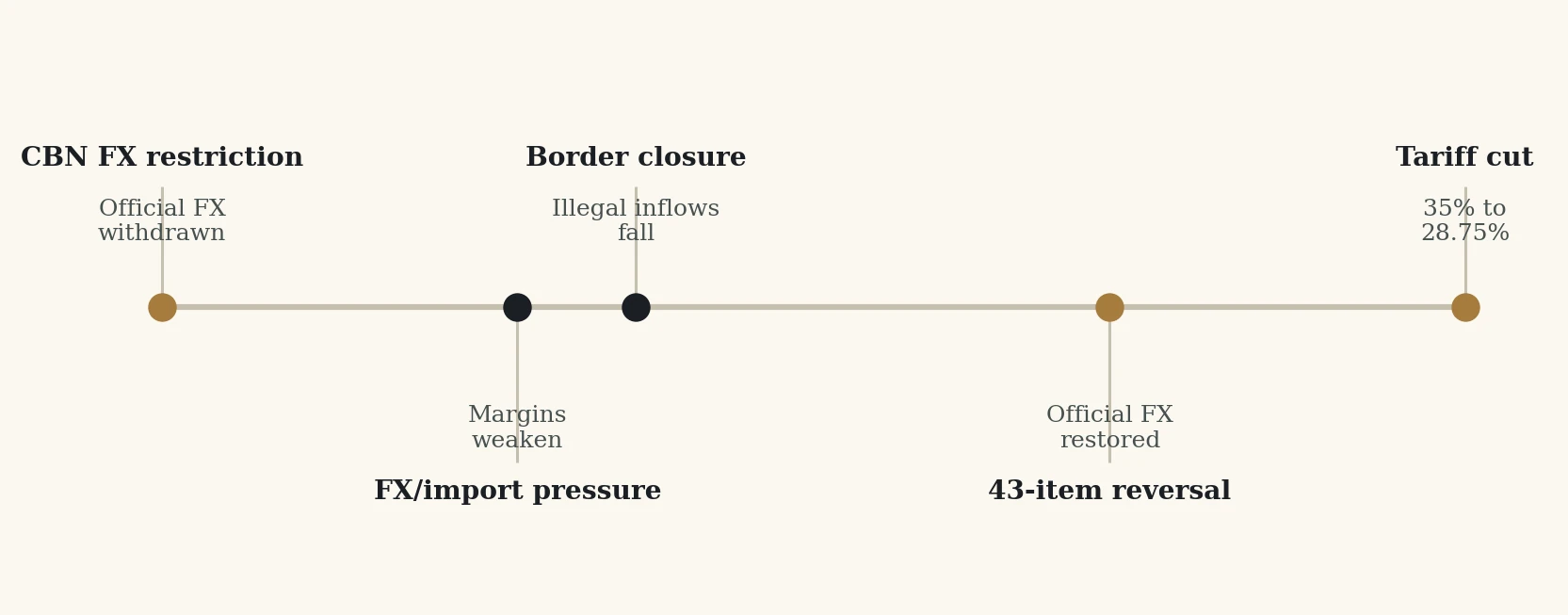
Figure 3. Source: CBN October 2023 FX-reform note; Okomu 2019 annual report; 2026 fiscal-policy reporting and company commentary.
The next major change came on 12 October 2023, when the CBN lifted the FX restrictions on the 43 categories. Palm oil could again access the official FX market. In 2026 the effective tariff on crude palm oil was reduced from 35% to about 28.75%. A firmer naira then improved import economics further.
By H1 2026 the pressure had reached the accounts. Okomu revenue fell 3.5% year on year to ₦125.3 billion. Cost of sales rose 3.8%. Gross margin fell to 64.4% and operating profit declined 12.4%. Management said import-driven competition was depressing CPO prices. Presco's revenue was broadly flat, but its much higher gross margin and downstream chain provided more insulation.
Management has also complained about waivers, smuggling and misclassification of refined product as crude oil. Those are management claims and should remain labelled as such. What is observable is simpler: imported oil became cheaper relative to domestic production, and Okomu's realised economics weakened.
5. The strange exporter that does not export palm oil
Okomu does export. It just mostly exports rubber.
The 2025 accounts contain an almost too-neat clue. Rubber revenue was ₦25.525 billion. Revenue from outside Nigeria was also ₦25.525 billion. To the nearest thousand naira, the export business is rubber. Palm oil stays home.
That has historically been rational. Nigeria is structurally short of palm oil, and the domestic market has often offered a better netback than shipping CPO abroad to compete against Indonesia and Malaysia. Rubber is different: it is naturally an export commodity and gives Okomu a useful foreign-currency revenue stream.
This is also where the moat needs careful language. Okomu is not obviously the world's lowest-cost palm-oil producer. It is an efficient producer inside a large deficit market where tariffs, FX, freight, ports and distribution have historically increased the landed cost of the competing tonne. If those frictions fall, the moat narrows even though not a single tree has moved.
6. The shareholder has done very well. The naira has done some of the talking.
Okomu has been one of the great NGX compounders. Nairametrics, using NGX data, calculates that ₦1 million invested at the end of 2015 would have become roughly ₦42.1 million by 24 September 2026, excluding dividends. The stock moved from ₦30.30 to ₦1,276.20, a price return of 4,112%.
The mandatory price chart: the last five years have been extraordinary
OKOMUOIL, naira per share. Year-end closes from 2021 to 2025 and the 25 September 2026 close of ₦1,276.20. The 27 April 2026 all-time high of ₦1,765 is shown separately.
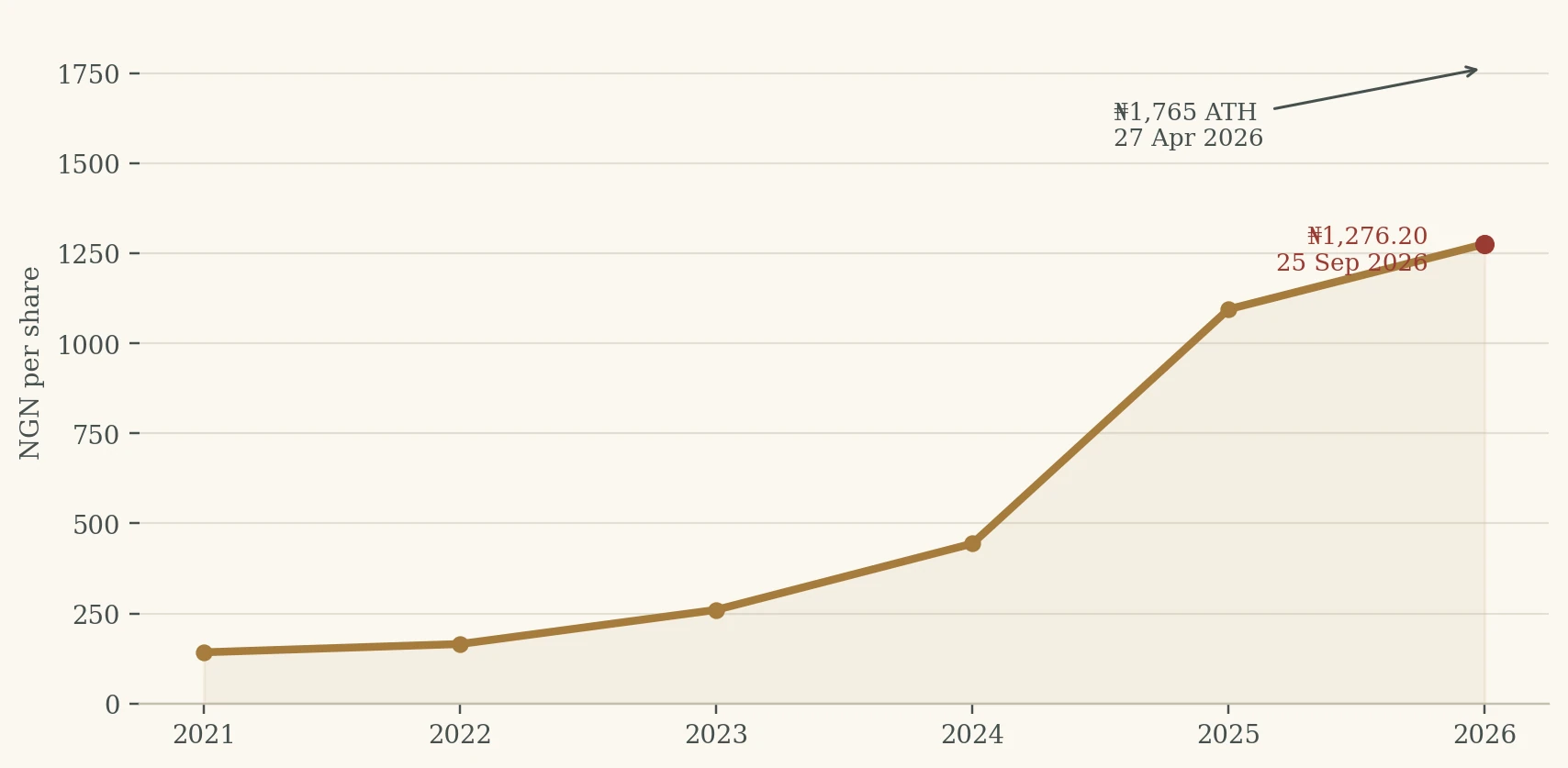
Figure 4. Source: NGX and Nairametrics historical prices; Investing.com latest close; Seven Gates chart. Sampling: annual year-end observations plus the latest verified close, disclosed because a verified daily or weekly full-span series was not available at the data cut-off. Price only; dividends excluded.
Measured in dollars, the result is still excellent but much less theatrical. A starting exchange rate around ₦197/$ and a September 2026 rate around ₦1,328/$ reduce the 42x naira multiple to roughly 6.2x in dollar terms, before dividends. That still works out near 19% annualised in dollars.
Naira wealth and dollar wealth are not the same thing
Price-only index, December 2015 = 100. FX translation follows the relevant official or tradable-market window for each period and is intended as an analytical comparison, not a claim of frictionless repatriation.
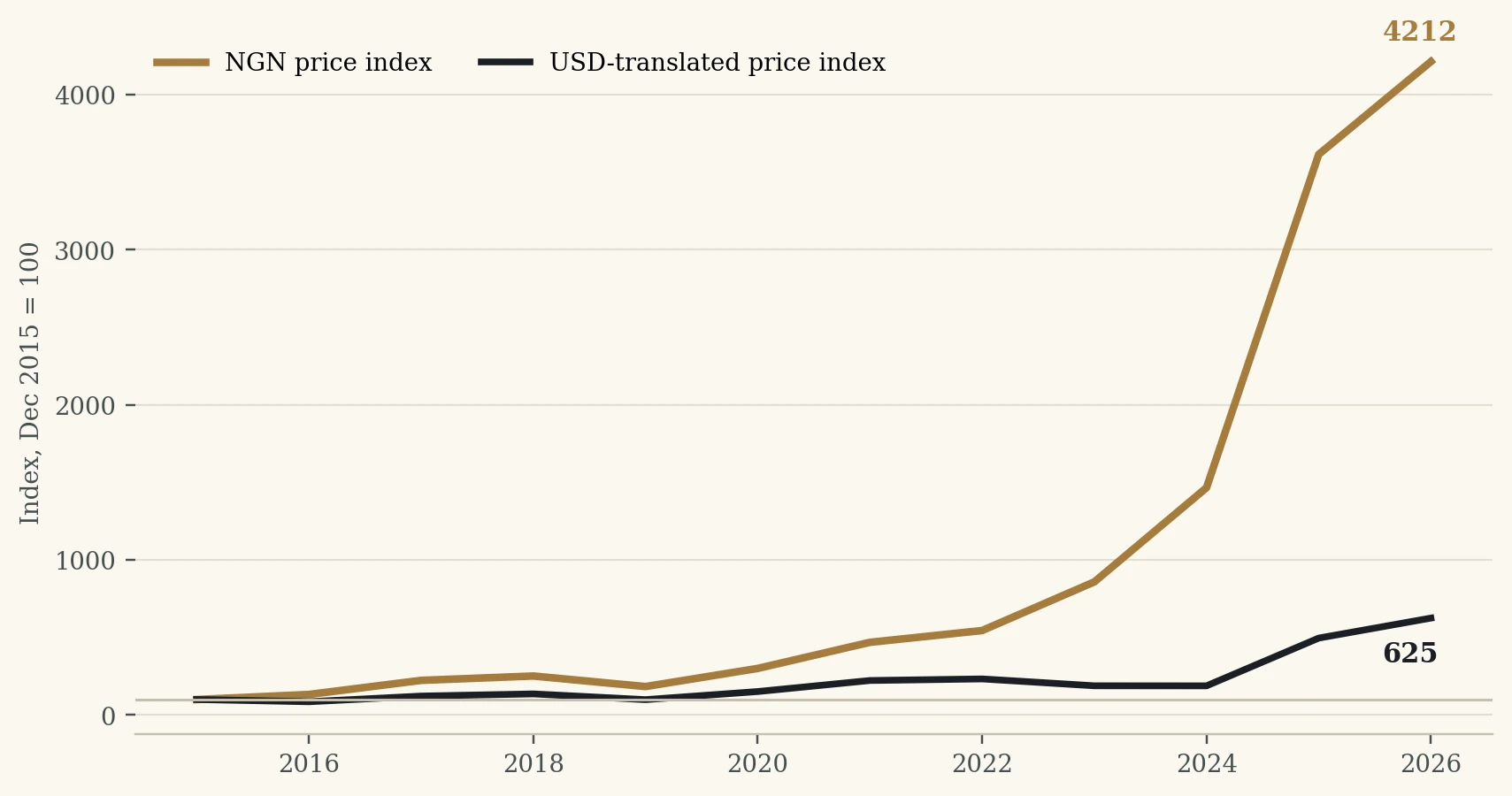
Figure 5. Source: NGX year-end prices; CBN and NFEM exchange rates; Nairametrics 10-year return reconstruction; Seven Gates calculations.
The clearest example is 2023 to 2024. Okomu rose from roughly ₦260 to ₦444, a gain of about 71% in naira. The naira weakened so sharply that the dollar-translated price barely moved. The shareholder ran hard and, in external purchasing power, nearly stayed put. 2025 was different. The rerating was real in both currencies.
7. The balance sheet is not the problem
Okomu's conventional debt load is small. At December 2025 it carried roughly ₦6.4 billion of interest-bearing borrowings against ₦13.0 billion of cash. By June 2026 long-term loans were down to about ₦3.9 billion while cash had risen to ₦21.4 billion. Lease liabilities are more substantial and should not be ignored, but solvency is not the current investment issue.
The related-party economics deserve more attention. Socfinaf controls 62.94% of Okomu. Socfinco provides technical know-how and management services under an arrangement that charges 3% of net sales as technical fees and 3% of profit before tax as management fees. Okomu incurred ₦8.714 billion of these costs in 2025, excluding another ₦1.759 billion of withholding tax and VAT.
That does not make the arrangement abusive. The fees are disclosed and the Socfin system clearly brings plantation expertise. But ₦8.7 billion is material relative to ₦58.0 billion of 2025 profit after tax. Minority shareholders should watch whether incremental plantation economics continue to accrue proportionately to them.
A second related-party tie sits in rubber. SOGESCOL, a Socfin sister company, acts as agent for Okomu's rubber sales. Those sales were ₦25.525 billion in 2025. Again, the disclosure is there. The job of the shareholder is simply to keep reading it.
8. What ₦1,276 already assumes
I would not value Okomu by multiplying 33,113 hectares by a heroic price per hectare and then adding an earnings multiple on top. Most of the land is held under concession arrangements, and the productive hectares are already generating the profits being capitalised. Counting the plantation twice does not make it more valuable.
A cleaner SOTP starts with normalised earnings from the palm and rubber businesses. Okomu's 2025 segment profit after tax was about ₦49.1 billion for palm and ₦8.65 billion for rubber. 2025 palm pricing was unusually strong, so the base case trims the palm number before applying a premium multiple.
| Business | Normalised earnings | Multiple | Equity value |
|---|---|---|---|
| Palm | ₦47.0bn | 18x | ₦846bn |
| Rubber | ₦8.5bn | 12x | ₦102bn |
| Processing / other | about ₦0.2bn | 10x | about ₦2bn |
| Total | about ₦950bn | ||
| Shares | 953.9m | ||
| Base value per share | about ₦1,000 |
Seven Gates estimates. Multiples are applied to normalised equity earnings, so the table is an earnings-based SOTP rather than a replacement-cost appraisal. Segment earnings from the Okomu 2025 annual report.
At ₦1,276, the market is already close to the bull case
Bear: sustained import pressure and flat yields. Base: yield recovery with lower but healthy local pricing. Bull: 19 to 20 t/ha yields, strong OER and a durable domestic scarcity premium.
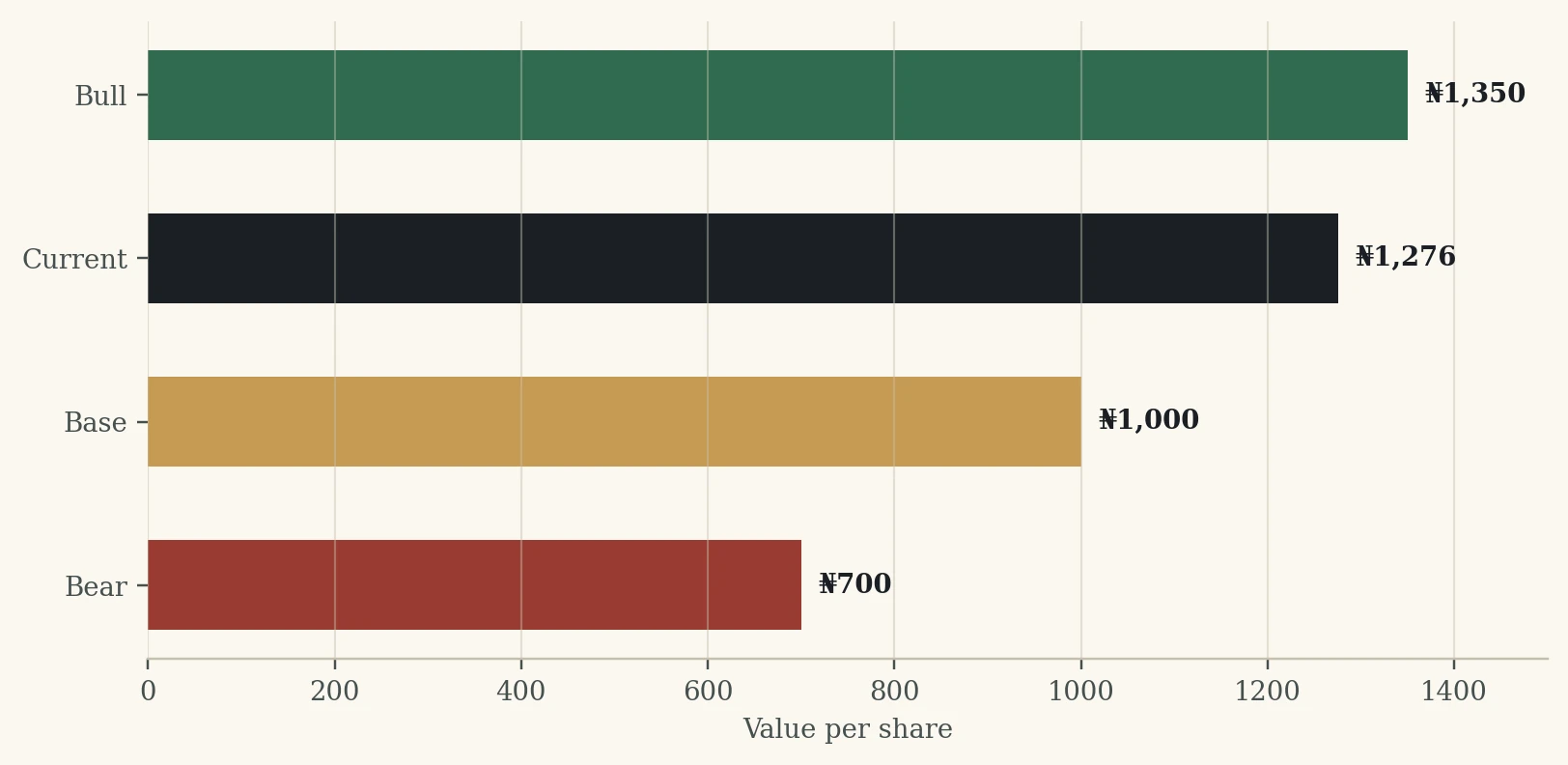
Figure 6. Source: Seven Gates scenario valuation; current price at the 25 September 2026 close.
The valuation is deliberately broad. Bear value is around ₦700. Base value is around ₦1,000. Bull value is around ₦1,350. At the current ₦1,276.20, investors are being asked to underwrite something close to the optimistic operating path.
There is upside if mature-hectare yield moves toward 19 to 20 t/ha, the 1,800-odd hectares in replanting or immature stages mature well, OER holds near 24%, and imported oil does not permanently reset the Nigerian scarcity premium. There is downside if the price of the imported tonne falls faster than Okomu can improve the tonne coming off its own land.
That is why I would wait. Not because the farm is poor. Because the farm is good enough that the price has become part of the risk.
The verdict
Okomu is an unusually good Nigerian agricultural asset. The company has not bought a major new estate since 2014. It has filled the land it already owns, expanded milling capacity, improved extraction and recovered much of the field yield lost earlier in the decade. Conventional debt is modest. Cash generation is strong. Rubber provides an export leg. The operating asset deserves respect.
But a meaningful portion of Okomu's historical profitability has been earned inside a Nigerian market protected not by one wall but by several frictions: FX availability, tariffs, logistics, borders and a domestic supply deficit. Those frictions are changing. H1 2026 was the first clean warning in this cycle.
A Malaysian or Indonesian plantation does not need to buy a hectare in Edo State to compete with Okomu. Its oil only needs to arrive cheaply enough.
Okomu can improve the grove. It can squeeze more oil from the mill. It can bring replanted hectares back into production and buy fruit from neighbouring farmers. It cannot control the tariff schedule or the exchange rate.
Seven Gates view: WAIT. Base fair value about ₦1,000 per share; underwriting range about ₦700 to ₦1,350; reference price ₦1,276.20 at the 25 September 2026 close. Horizon six months. Review on the Q3 2026 results, and no later than 25 March 2027.
Wonderful farm. Very good business. Price needs pruning.
A short guide to the palm-oil arithmetic
FFB means Fresh Fruit Bunches. These are the heavy bunches cut from the oil-palm tree and taken to the mill. The individual fruits contain the oil. Harvested fruit deteriorates, so speed from field to mill matters.
CPO means Crude Palm Oil. This is the reddish oil extracted from the flesh of the fruit after sterilising, stripping, pressing and separation. It is then refined into edible oils and other downstream products.
OER means Oil Extraction Rate. It asks a simple question: of every tonne of FFB entering the mill, how much crude palm oil came out? Okomu's 2025 OER was 23.65%. Very roughly, one tonne of FFB produced 236.5 kg of CPO.
A hectare is 10,000 square metres. Okomu's 33,113-hectare concession therefore covers about 331 square kilometres. Using a 105m × 68m football pitch, that is roughly 46,400 pitches. Again, not all of it is planted.
The operating equation underneath the article is simple enough to keep in your head:
mature hectares × FFB yield × OER × CPO price, less costs
The first three variables are mostly about agronomy and engineering. The fourth is where Nigeria, the naira and the border enter the mill.
Research notes
Primary sources are preferred throughout. Figures described as Seven Gates estimates or reconstructions are calculations from those sources. Market price is the 25 September 2026 close. The 10-year return comparison is price-only and excludes dividends, taxes and brokerage. FX translation follows official and tradable-market reference windows and should not be read as frictionless historical repatriation. Management statements on waivers, smuggling and misclassification of imports are management claims, not verified facts. The five-year price chart uses annual year-end observations plus the latest verified close; the sampling frequency is disclosed in the figure note.
Principal sources
- Okomu Oil Palm Company, 2025 Annual Report and Financial Statements.
- Okomu Oil Palm Company, corporate history.
- Okomu Oil Palm Company, company profile and plantation figures.
- Nigerian Exchange company profile and filings.
- CBN, lifting of FX restrictions on 43 items, October 2023.
- Nairametrics, cheap imports undercut Okomu and Presco, 7 August 2026.
- Nairametrics, Okomu H1 2026 results, 29 July 2026.
- Nairametrics, Presco and Okomu 10-year return study, 25 September 2026.
- Seven Gates Research, Presco: The Plantation Is Excellent. The Price Has Heard.
- Presco Plc, plantation profile.
- Presco Plc, 2025 Rights Issue circular.
- IOI Corporation, FY2025 financial and operational statistics.
- Astra Agro Lestari, 2025 Annual Report.
- SD Guthrie, 2025 Integrated Report.
- Wilmar, Nigeria traceability report with supplying mill coordinates.