SEVEN GATES RESEARCH · THE BRAKE, THE ACCELERATOR AND THE RAT
At 26.5%, Nigeria's CBN Is on the Brake. Who Is on the Accelerator?
How Taylor, McCallum, two strategic straits and one very Nigerian monetary-policy problem tell us whether the CBN's 26.5% MPR is actually tight.

By The Lokoja Contrarian · 18 September 2026 · Seven Gates Research
Seven Gates has spent weeks thinking about the Taylor rule.
This has involved equations, arguments about r*, and an attempt to estimate an interest rate that cannot actually be observed, which went about as well as that sentence suggests.
Nassim Nicholas Taleb once offered some useful advice for precisely this sort of behaviour:
"If you hear a 'prominent' economist using the word 'equilibrium,' or 'normal distribution,' do not argue with him; just ignore him, or try to put a rat down his shirt."
Nassim Nicholas Taleb, The Black Swan
This presents an immediate problem.
We are about to spend several thousand words discussing an equilibrium real interest rate.
Readers who have brought rodents may therefore wish to keep them nearby.
We had nevertheless persisted. For weeks.
There had been Taylor rules. There had been arguments about r*. At one point Kasali, my entirely imaginary mechanic, became responsible for explaining potential GDP.
Then Iran's parliamentary speaker joined the research team.
Not formally, obviously.
Mohammad Bagher Ghalibaf appeared on X with something he called the "Straits Taylor Rule", having taken one of monetary economics' most famous equations and added the Strait of Hormuz and Bab el-Mandeb.
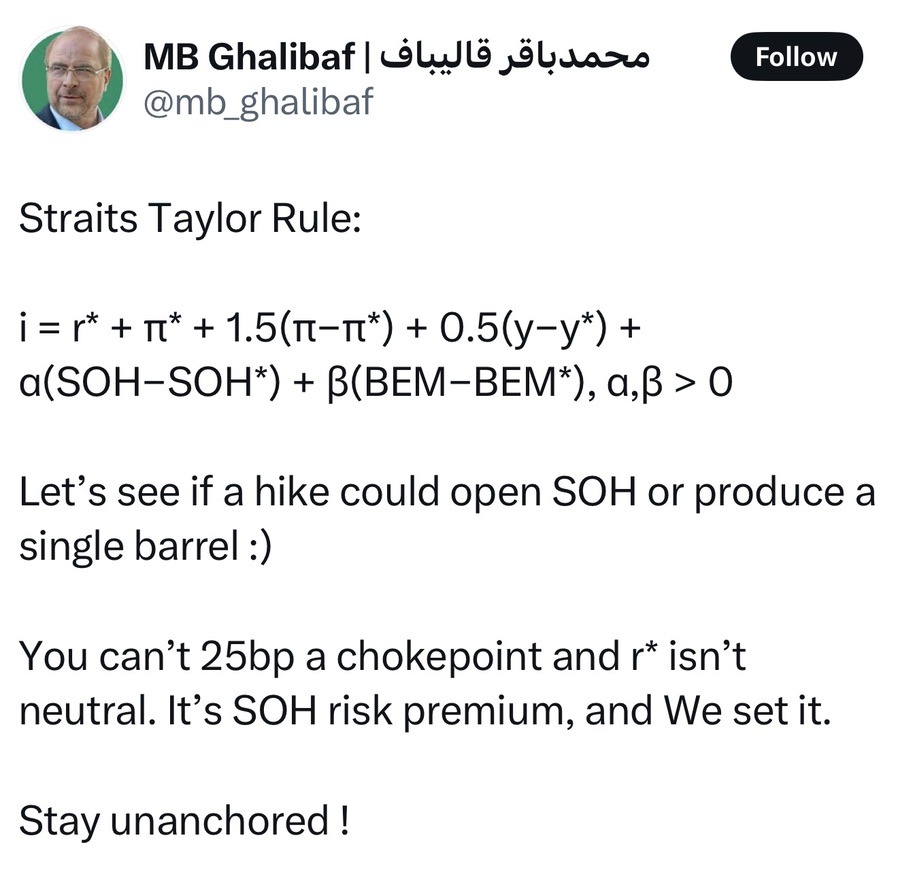
Economists have spent three decades arguing about the correct value of r*. Ghalibaf apparently decided the equation's real problem was insufficient shipping.
He then asked whether a rate increase could "open SOH or produce a single barrel", before delivering the line that caused Seven Gates to put down its calculator:
"You can't 25bp a chokepoint."
This is, regrettably, very funny.
It is also a much better introduction to monetary economics than it has any right to be.
Because underneath the geopolitical trolling sits a serious problem.
A central bank controls the price of domestic liquidity.
It does not command oilfields. It cannot insure a tanker. It cannot order ships through Hormuz. It cannot manufacture diesel, repair a Nigerian transmission line, make rain fall on a tomato farm or politely ask a container vessel to arrive in Apapa before Christmas.
Yet all of those things can affect inflation.
And when they do, the central bank is eventually handed the bill.
That is the problem we had already been circling in Nigeria: the instrument and the original source of the inflation need not live in the same room.
Ghalibaf has merely arrived with a tanker.
1. The joke is better economics than the equation
The first four terms are the familiar Taylor construction written in an equivalent form. The central bank raises its policy rate when inflation moves above target and when output moves above sustainable capacity. The final two terms are the joke: strategic maritime chokepoints acquire positive coefficients.
The intuition is easy to see:
So why not add Hormuz directly to the Taylor rule?
Because the same shock may simultaneously do this:
Now the equation is arguing with itself.
Inflation says tighten.
Output says ease.
The tanker, meanwhile, remains unimpressed by both.
There is therefore no theorem saying the correct coefficient on the chokepoint itself must be positive. It depends on persistence, expectations, wage and price propagation, exchange-rate effects, fiscal response and credibility.
There is also a double-counting problem. If Hormuz has already raised inflation, reduced output and altered expectations, adding another positive Hormuz term may charge the economy twice for the same shock.
Which would be unfortunate.
The tanker has already done enough.
2. And r* has been kidnapped
Ghalibaf's other line is even more useful: "r* isn't neutral. It's SOH risk premium, and We set it."
Excellent politics. Rather less excellent monetary economics.
The neutral real rate is not simply a geopolitical-risk premium. It is the real policy rate consistent, in the longer run, with an economy operating around sustainable capacity and stable inflation. It is unobservable, estimated with uncertainty, and largely shaped by structural forces rather than set by whoever currently controls a shipping lane.
A persistent geopolitical shock can affect financial conditions and, eventually, some structural determinants of neutral rates. But the immediate shipping-risk premium is conceptually cleaner as a separate wedge:
This distinction matters enormously for Nigeria.
Because we have our own version of Hormuz every Tuesday.
3. Enter Kasali
Suppose Kasali needs an imported alternator.
The alternator becomes more expensive because the naira weakens. Shipping insurance rises. Diesel rises. The container arrives late. Kasali eventually raises his price from ₦80,000 to ₦110,000 because Kasali, unlike economists, cannot operate indefinitely at a negative gross margin.
Inflation has occurred.
The CBN responds by raising the MPR 100 basis points.
Kasali's overdraft becomes more expensive.
The container does not become cheaper.
This is the instrument-target mismatch.
But stopping there would be too easy, and wrong.
Because monetary policy may be unable to prevent the original shock while remaining extremely important in determining what happens after it.
MPR ↑ → inflation expectations ↓ → second-round effects ↓
MPR ↑ → aggregate demand ↓ → pricing power ↓
And that gives us a much better question than whether a central banker can reopen a shipping lane with a basis point.
They cannot.
How much of the inflation process remains controllable by monetary policy after the original shock has occurred?
Now we are doing economics.
4. Origin is not propagation
A fuel or shipping shock can originate inflation. Naira depreciation can propagate it. Excess liquidity and nominal-demand growth can accommodate it. Unanchored expectations can perpetuate it.
Monetary policy may be virtually powerless over the first event while retaining considerable influence over the next three.
That distinction is the bridge into the paper we were already writing.
Taylor asks whether the price of money is sufficiently restrictive.
McCallum asks whether monetary quantities are consistent with the desired nominal path.
And Nigeria gives us the awkward possibility that the gauges disagree:
What if the price of money says TIGHT while quantities say NOT QUITE?
The rat has already warned us what happens when economists become too fond of equilibrium.
The rest of us have a more practical problem.
Nigeria's Monetary Policy Rate is 26.5%. Headline inflation was 15.39% in August 2026. Prices are still rising, merely more slowly than before. Meanwhile, the Cash Reserve Requirement for deposit money banks is 45%.
Is 26.5% therefore high? Obviously. Is it too high? Ah. That is a completely different question.
To answer it properly, we need to meet two economists, several equations, one interest rate that nobody can actually observe, another variable nobody can observe either, and eventually a problem peculiar enough to Nigeria that a perfectly respectable monetary-policy rule requires us to open the bonnet.
Fortunately, I know a mechanic. His name is Kasali.
At a glance
Fact: MPR 26.5%; DMB CRR 45%; August headline inflation 15.39%. Scenario: with a 7.5% inflation anchor and a zero output gap, a simple Taylor rule gives 19.34% + r*. At r* = 1.2%, that is 20.54%, but our identification work does not support publishing 1.2% as an estimated current Nigerian r*. The honest conclusion is a range, not a magic decimal. Ghalibaf's joke adds the missing first question: what caused the inflation, and which part of its subsequent propagation can monetary policy actually touch? McCallum then supplies the quantity-side test.
5. Taylor gives economics a speed limit
John Taylor's famous 1993 rule is one of those economic ideas that manages the unusual feat of being both useful and understandable.
Do not flee. There are only five moving parts.
i is the interest rate the rule thinks the central bank should set. π is inflation. π* is where we would prefer inflation to be. ỹ is the output gap, which measures whether the economy is running above or below sustainable capacity. And r*, pronounced 'r-star', is the equilibrium real interest rate.
The clever part is what happens when inflation rises. Suppose inflation increases by one percentage point while everything else stays put. The nominal rate rises by the one point needed merely to keep the real interest rate unchanged plus another half point from the inflation-gap term.
So the policy rate rises by 1.5 percentage points. The central bank is not merely chasing inflation up the stairs. It is trying to get ahead of it. Economists call this the Taylor principle. Normal people might call it applying the brake harder when the car starts going faster. Both are acceptable. Only one requires a PhD.
6. Let us put Nigeria into the machine
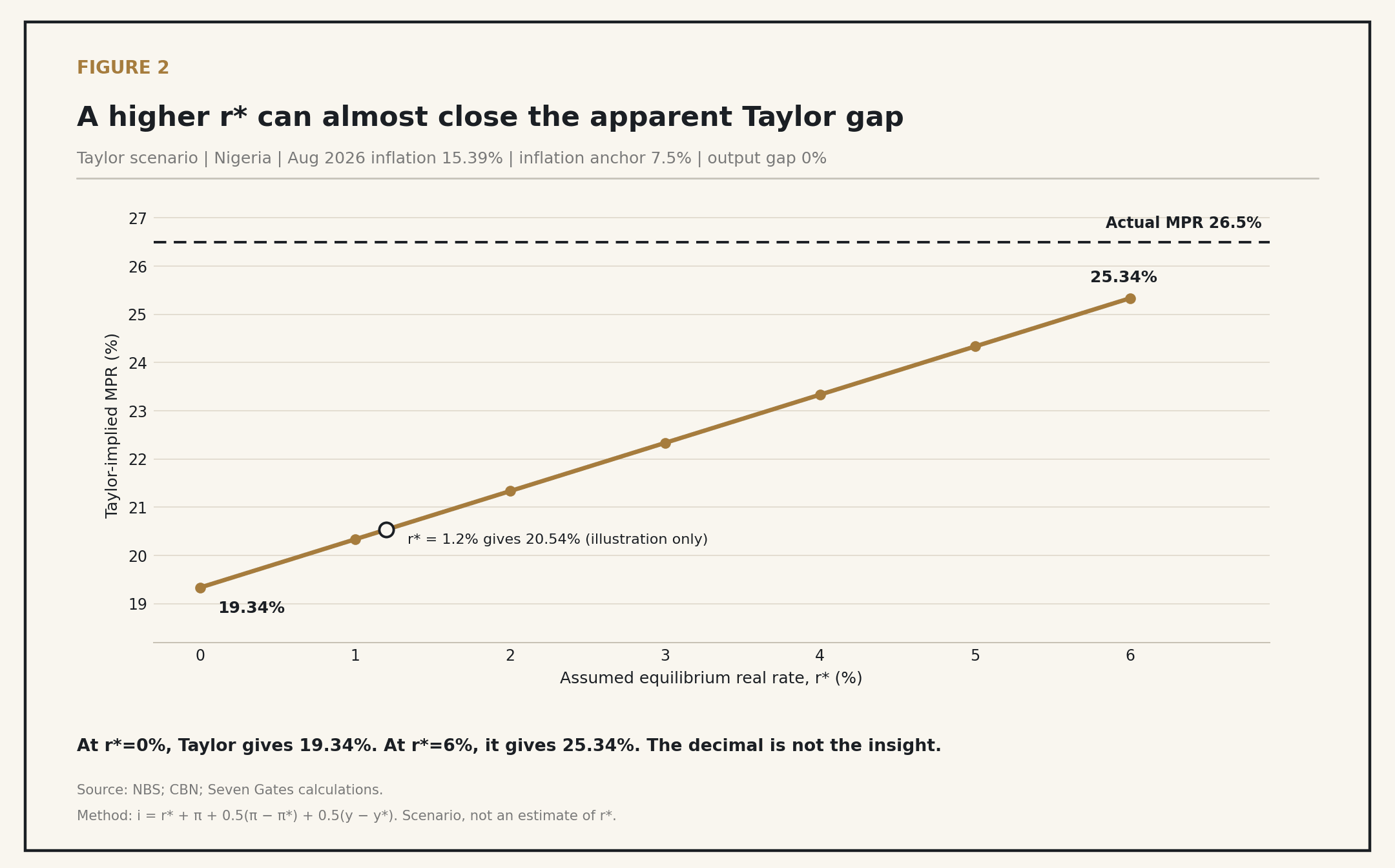
Nigeria's August 2026 headline inflation rate was 15.39%. The July MPC retained the MPR at 26.5%. For a transparent illustration, suppose we use a 7.5% inflation anchor, temporarily set the output gap to zero, and plug in r* = 1.2%.
i* = 20.535% ≈ 20.54%
Define the Taylor deviation:
TD = 26.50 − 20.54 ≈ +5.96 percentage points
On that scenario, Nigeria's policy rate sits almost six percentage points above the Taylor benchmark. That sounds dramatic. It is also where we need to become suspicious of ourselves.
7. Please do not telephone the CBN yet
A spreadsheet has just told us the policy rate 'should' be 20.54%. It would be tempting to declare victory, publish CBN OVER-TIGHT BY 600 BASIS POINTS, and spend the afternoon congratulating ourselves.
We will not.
The Taylor rule is a benchmark, not a monetary-policy oracle. It does not know that Nigeria imports a great deal of what it consumes. It does not see the foreign-exchange market. It cannot price renewed naira depreciation feeding into domestic prices. It knows nothing about capital flows, fiscal injections, banking-system liquidity, financial stability or credibility.
Most importantly, two numbers in our equation are not actually observable. The first is r*. The second is the output gap. Unfortunately, together they help determine the answer.
Welcome to economics.
8. The interest rate nobody has ever seen
Think of r* as the real interest rate at which the economy is neither being encouraged to spend more nor being told to calm down. Below it, monetary policy is pushing the accelerator. Above it, policy is pressing the brake. At r*, theoretically, your foot is doing neither.
Simple idea. Horrendously difficult number to observe.
There is no r* column in the CBN statistical bulletin. Nobody conducts a survey on Tuesday morning and discovers that Nigeria's neutral real rate has moved from 1.17% to 1.23%. It must be estimated.
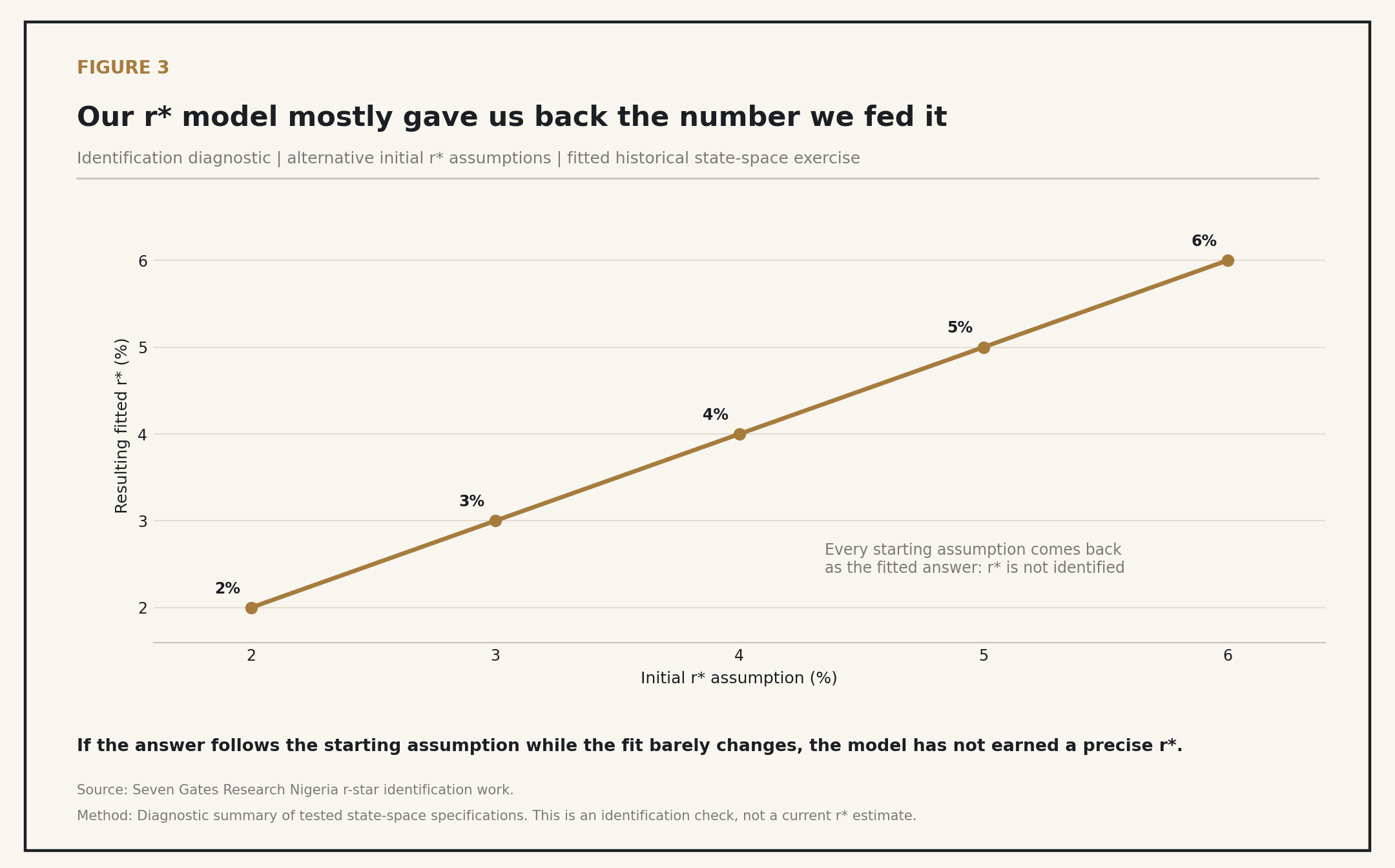
We tried. An adapted Laubach-Williams-style state-space exercise was fitted to the available Nigerian data. Under the tested specifications, r* was not usefully identified. Changing the starting assumption from 2% to 6% moved the resulting r* by roughly the same four points while leaving the fit effectively unchanged.
The easiest way for Kasali, my mechanic, to understand this is to ask him what the correct tyre pressure is without telling him whether we are discussing a Corolla, a Hilux or a trailer. He can give you a number. It may even contain a decimal place. But the apparent precision does not make the missing vehicle disappear.
The responsible response is therefore not to pick 1.2% because it makes the equation look tidy. It is to show the sensitivity.
9. What if r* is wrong?
With inflation at 15.39% and the illustrative inflation anchor at 7.5%, the Taylor equation simplifies nicely:
If r* = 0% and the output gap is zero, the implied rate is 19.34%. At r* = 2%, it is 21.34%. At r* = 4%, 23.34%. At r* = 6%, 25.34%. Suddenly 26.5% does not look quite as extraordinary.
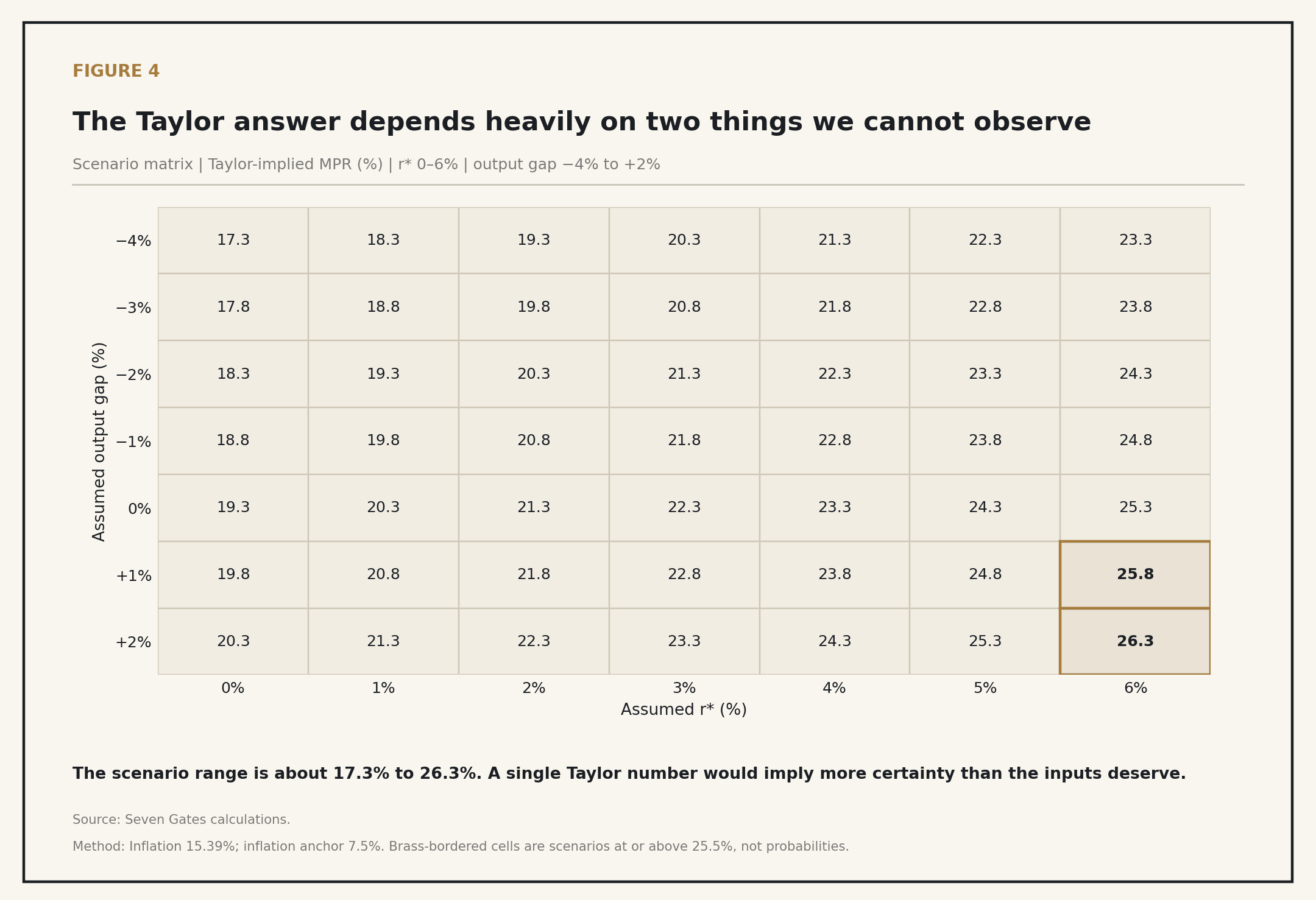
Allow the output gap to move as well and the range widens further. In our scenario grid, r* from 0% to 6% and an output gap from −4% to +2% produce Taylor prescriptions from about 17.34% to 26.34%.
That range is not a probability distribution. We imposed the assumptions. It tells us something narrower and more useful: the Taylor conclusion is extremely sensitive to what you believe about neutral rates and spare capacity.
10. And then there is the output gap
The output gap sounds complicated. It isn't.
Kasali's workshop can comfortably service ten cars a day. If twelve arrive, everybody is working late, the apprentice is running around, and somebody will eventually misplace a 10mm spanner. The workshop is operating above normal capacity.
If only six cars arrive, two ramps are empty and Kasali has time to discuss Arsenal at unnecessary length. It is operating below capacity.
Economists attempt roughly the same calculation for an entire country.
The difficulty is that nobody knows exactly how many cars Nigeria's workshop can service. Potential GDP cannot be observed directly. Oil production, electricity constraints, insecurity, exchange-rate shocks, informal activity, rebasing and revisions can all change our estimate of what output could have been.
Our historical state-space exercise produced an output-gap estimate around 1.06 log percentage points for Q4 2024, but with a conditional band running from roughly −5.83 to +7.96. That is wide enough to make even the sign uncertain. We therefore do not quietly carry that old-data estimate forward into September 2026 and call it current.
Again: less elegant. More useful.
11. But interest rates are only half the story
Taylor gives us a way of asking whether the price of money is too high or too low. Useful. But Nigeria has a small complication.
Interest rates are only half the story.
A central bank can set a very high policy rate while other parts of the monetary system are creating, releasing, absorbing or sterilising liquidity. Nigeria's institutional history makes this especially relevant. The CBN introduced the MPR in December 2006 to replace the MRR, while quantity management remained part of the framework.
This gives us an unusually useful second test.
Meet Bennett McCallum.
Taylor watches the price of money. McCallum watches the quantity.
12. McCallum goes downstairs to inspect the plumbing
This looks worse than Taylor. It is not.
Δb* is how quickly the monetary base should grow. Δx* is the desired growth path of nominal GDP. The velocity term adjusts for changes in how quickly base money circulates. The final term asks whether nominal GDP has fallen behind or run ahead of its desired path.
The intuition is wonderfully mechanical. If money starts circulating faster, McCallum says you need less base-money growth to achieve the same nominal-spending path. If nominal GDP falls below its desired path, the rule allows faster base-money growth to help close the gap.
Taylor says: What should the interest rate be? McCallum says: How much base money should we be creating? Same patient. Different blood test.
13. Put some actual naira into the equation
Abstract equations become much friendlier once money is involved.
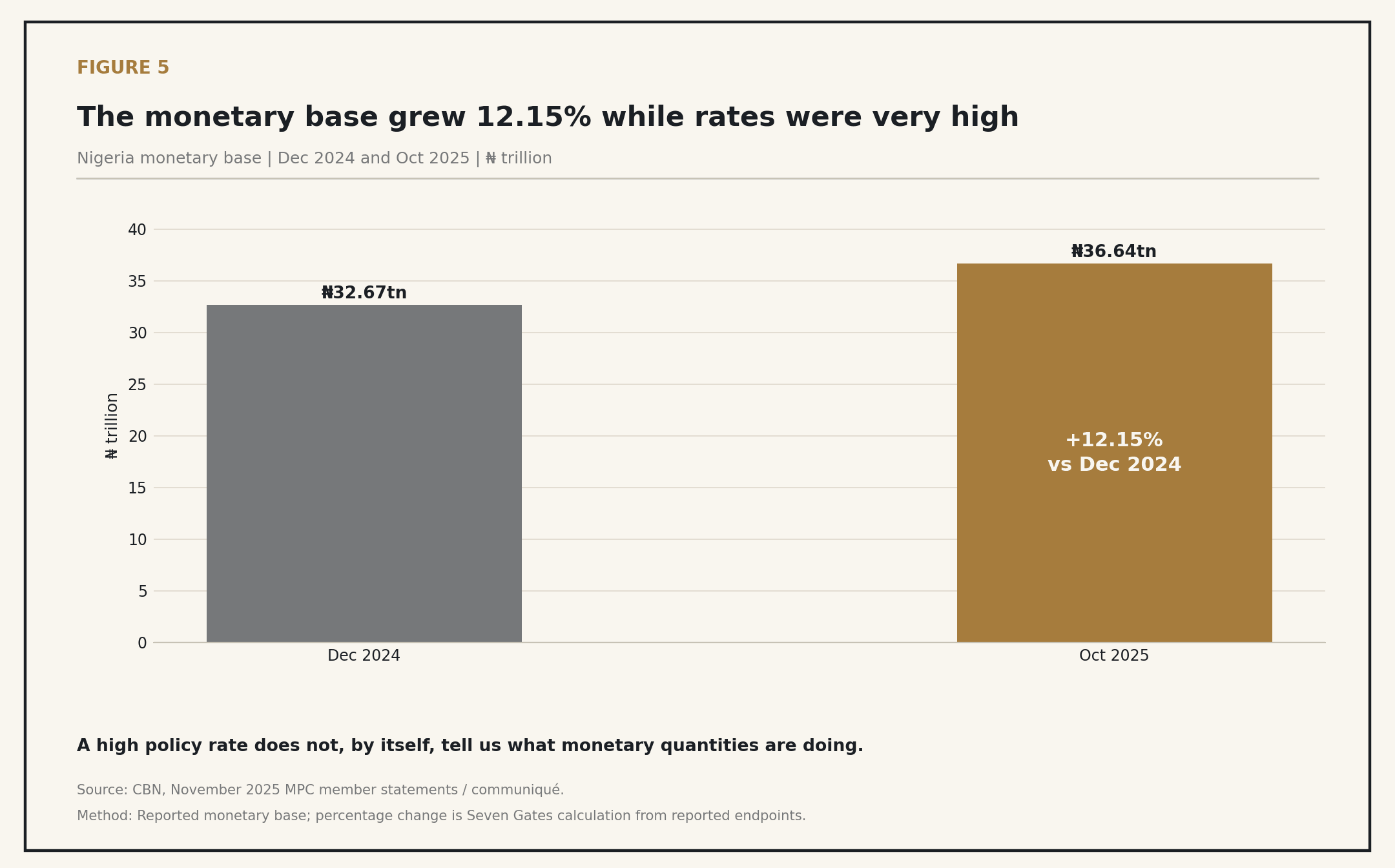
The CBN reported that Nigeria's monetary base rose from ₦32.67 trillion in December 2024 to ₦36.64 trillion by October 2025. That is growth of 12.15%.
Now define our McCallum deviation:
Suppose, purely to demonstrate the arithmetic, that the McCallum rule prescribed 8% base-money growth over an equivalent observation period.
McCallum asked for 8%. Nigeria delivered 12.15%. A positive MD therefore means looser on the quantity dimension relative to the McCallum benchmark.
And notice the word suppose. The 8% is an explanatory example. It is not a Seven Gates empirical estimate. We will not smuggle an illustration into the findings section wearing a tie.
14. Nigeria now ruins our perfectly good equation
At this point, McCallum appears almost suspiciously convenient.
Then Nigeria arrives.
The DMB CRR is 45%. Through much of 2025 it was 50%. Large required reserves mean measured reserve money is not necessarily telling us the same thing as freely deployable banking liquidity.
Imagine Kasali has twenty litres of petrol in the workshop. Ten litres belong to customers and he is forbidden to touch them. An economist arrives, counts twenty litres and announces that Kasali has plenty of fuel.
Kasali may respond in language unsuitable for publication.
That is approximately our reserve-money problem.
A rise in measured reserves can coexist with severe restrictions on what banks can actually deploy. So the empirical work needs at least two quantity specifications: a canonical official-base version for comparability and a reserve-adjusted robustness version. Broad money and credit remain separate diagnostics.
We do not quietly redefine McCallum until it produces the result we like.
That is not robustness. That is kidnapping.
15. Nigeria has seen this film before
There is a useful historical reason to take quantities seriously. In 2006, the CBN was explicitly targeting monetary aggregates. The new MPR framework took effect on 11 December that year.
The CBN reported broad-money growth of 30.6% against a 27.8% target, while reserve money ended December at ₦974.9 billion against an ₦820 billion target.
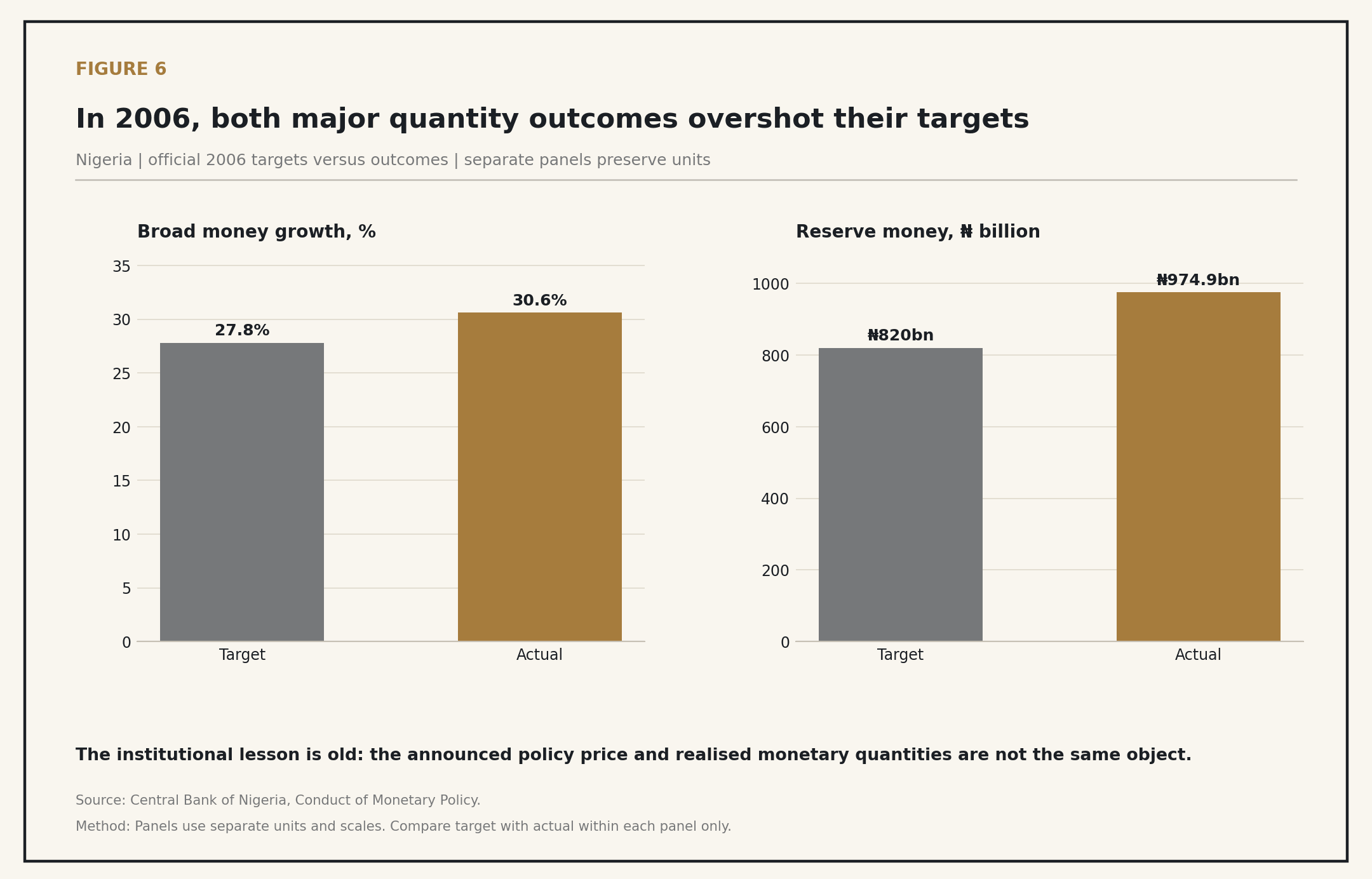
The historical point is not that 2006 equals 2026. It plainly does not. The point is institutional: Nigerian monetary policy has long had to manage both the price and the quantity of liquidity.
A central bank can announce a price. The banking system, fiscal system and monetary plumbing can still produce a quantity outcome that deserves attention.
16. Now we can ask the interesting question
Once the historical McCallum series is completed, we will have two gauges.
Positive TD means the actual policy rate is tighter than the Taylor benchmark.
Positive MD means base-money growth is looser than the McCallum benchmark.
Different units. Opposite directional meanings. So standardise them in a common tightness direction:
QTt = −(MDt − mean(MD)) / σMD
RQDt = RTt − QTt
We call this Rate-Quantity Divergence.
We deliberately resisted calling it another 'wedge'. Economics already contains enough wedges to furnish IKEA.
17. What does Rate-Quantity Divergence actually mean?
If RQD is positive, the interest-rate signal is tighter than the quantity signal. If negative, quantities are tighter than the rate signal suggests. Around zero, the two gauges broadly agree.
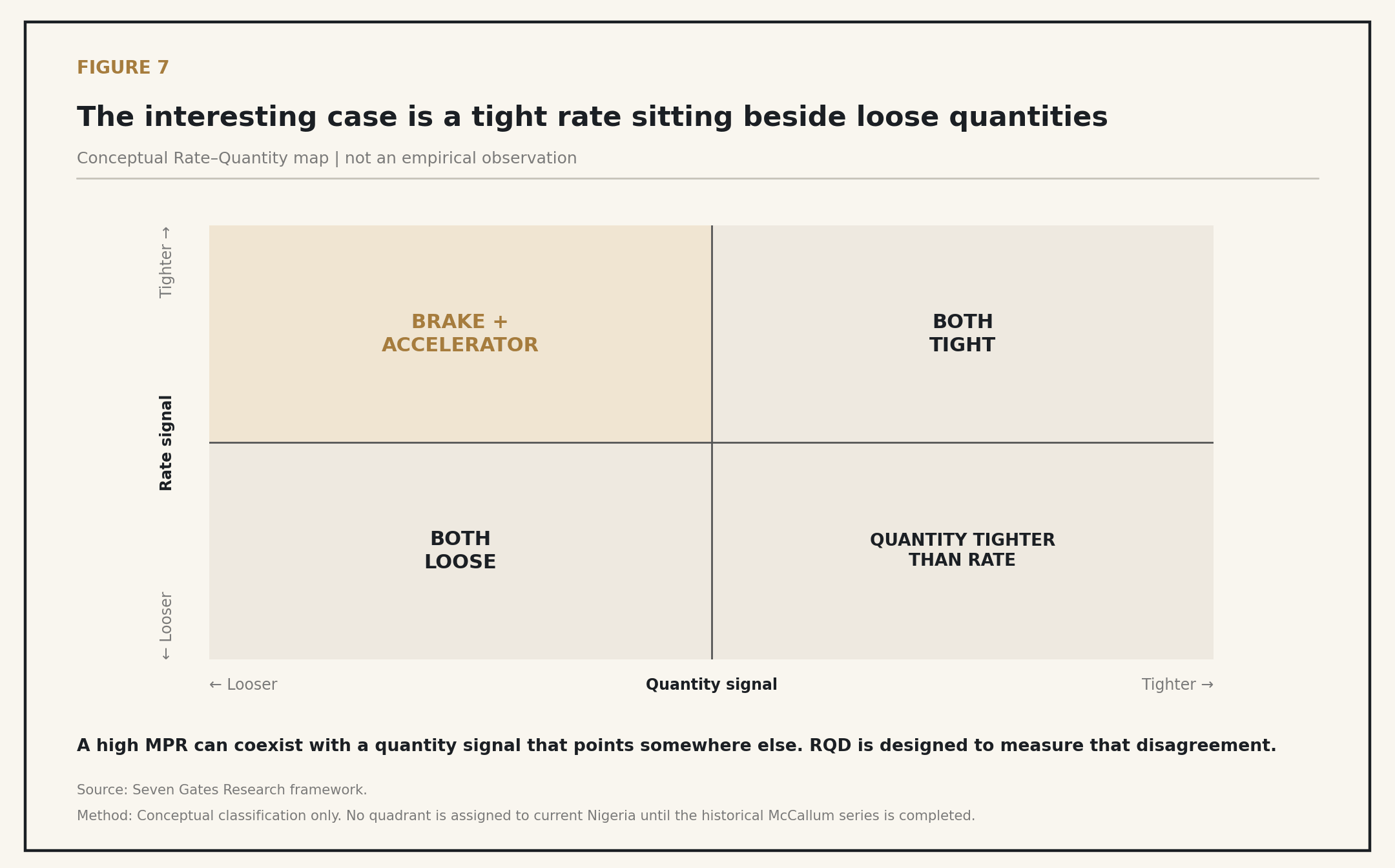
The interesting quadrant is a very high policy rate while monetary quantities behave more loosely than the quantity rule prescribes.
The interest-rate channel says BRAKE. The quantity channel says NOT QUITE.
The engine becomes noisy. Fuel consumption is impressive. Everybody begins arguing about why the car is not slowing down as expected.
18. What does any of this have to do with your life?
Quite a lot.
Suppose the CBN keeps the MPR substantially above a Taylor benchmark. Treasury and money-market yields matter. Bank funding and opportunity costs matter. Credit pricing matters. The hurdle rate for investment rises.
A manufacturer deciding whether to finance three months of inventory now has to ask whether the margin on those goods can outrun the financing cost.
An SME with an overdraft discovers that monetary-policy transmission is not an abstract concept after all.
It is the relationship manager calling.
For savers and investors, higher nominal rates can make fixed-income assets more attractive. For government, high domestic rates can make debt service more expensive as borrowing reprices. For the currency, sufficiently attractive naira yields can influence the incentive to hold naira rather than foreign currency, although exchange rates are influenced by considerably more than one policy rate.
But if the quantity side of the system is less restrictive than the headline interest rate implies, transmission can be weaker, slower or simply different.
Which brings us to perhaps the simplest sentence in this entire article:
The MPR is a price. It is not the entire monetary system.
19. There is another Nigerian complication: inflation itself
The 15.39% number deserves respect, but not worship.
Falling inflation does not mean falling prices.
If garri rises from ₦1,000 to ₦1,500 and then to ₦1,650, inflation has slowed dramatically. Kasali still needs ₦650 more than he did at the beginning.
A household experiences the price level, not merely the rate at which that level is changing.
It also matters for Taylor. Should policy react to headline inflation? Core? Expected inflation? A forecast? A smoothed measure? Different answers produce different prescriptions.
The equation is simple. Choosing what deserves to go inside it is not.
20. Nor is Nigerian inflation entirely a demand problem
Imagine onions become expensive because transport costs rise.
The Taylor rule observes inflation and says, in effect: raise the price of money.
Fair enough.
But a higher interest rate does not manufacture diesel. It does not repair a road. It does not grow tomatoes. It cannot produce dollars.
Monetary policy can restrain second-round demand, credit growth, expectations and exchange-rate pressure. It can help stop a supply shock becoming a general inflation process.
But asking interest rates to solve every Nigerian price shock is rather like asking Kasali to fix the air conditioner because the landlord has increased the rent.
He is technically competent. It is simply not his department.
The rule is a diagnostic instrument. It is not the Governor.
21. The strongest objection
There is an obvious objection to everything above, and it is a good one.
A Taylor rule can be badly incomplete for a small open economy experiencing exchange-rate shocks, imported inflation, fiscal impulses and structural supply constraints. A McCallum rule can mislead if the monetary base is distorted by reserve requirements or velocity is unstable.
Combining two imperfect rules does not automatically create one perfect rule.
So the eventual divergence measure has to earn its keep. It must add information beyond the MPR or Taylor deviation alone. It must survive alternative inflation measures, r* assumptions, output-gap methods, monetary-base definitions, structural breaks and the CPI/GDP rebasing problem.
The data must be allowed to be rude.
22. The test that can ruin the clever story
If Rate-Quantity Divergence genuinely contains information about Nigerian monetary conditions, today's divergence ought to tell us something about tomorrow.
Does divergence help explain subsequent inflation? Naira depreciation? Nominal spending? Credit growth?
More importantly, does it add information after we already know the policy rate or Taylor deviation?
Because if RQD does nothing that TD does not already do, we have invented an elegant index with limited incremental value. There are enough of those in finance already.
If the divergence survives the tests, we have something. If it does not, that result is still useful. It means the brake-and-accelerator story was better prose than economics. Seven Gates should then have the decency to kill it.
23. So, is 26.5% too high?
Our evidence supports a narrower answer than the seductive 20.54% calculation.
Under many transparent Taylor scenarios, 26.5% lies above the implied rate. But our r* exercise does not identify a usable current Nigerian neutral rate, and the current output gap cannot be carried forward honestly from an unreconciled historical data vintage.
So we should not say 'the correct rate is 20.54%'. We can say something more defensible: the headline MPR looks restrictive under a broad set of simple Taylor scenarios, but the exact degree of restrictiveness is not identified by our current model.
That is less exciting than a 600-basis-point verdict. It is also much harder to knock over.
And even that leaves our larger question unanswered.
If the rate says tight, what do the quantities say?
24. Two economists are better than one, which is admittedly a low bar
Taylor's great contribution here is not that he gives Nigeria the correct interest rate to two decimal places.
He forces discipline.
If somebody believes the MPR should be 26.5%, Taylor lets us ask: what inflation anchor are you implicitly using? What do you think r* is? What is the output gap? Which coefficient tells you how aggressively policy should respond?
Put the assumptions on the table.
McCallum performs a different service. He asks whether the monetary quantities underneath the interest-rate architecture are behaving consistently with the stance advertised by the policy rate.
For Nigeria, that is especially useful because the country has moved through direct controls, monetary targeting, MRR, MPR, extraordinary reserve requirements, FX interventions and an evolving policy framework.
A single interest rate cannot summarise all of it.
25. The thing we actually learned
We began with a seemingly simple question: Is Nigeria's 26.5% policy rate too high?
Taylor gave us an equation.
Then r* misbehaved.
The output gap became slippery.
The sensitivity analysis widened the answer.
McCallum reminded us that interest rates are only one side of monetary policy.
CRR reminded us that even 'money' requires a definition.
And Nigeria, as usual, declined to fit neatly inside the textbook.
This leaves us somewhere more useful than where we began.
What combination of rates, liquidity and monetary quantities constitutes the actual stance of Nigerian policy?
That is a harder question. It is also a better one.
A 26.5% policy rate may indeed represent extremely tight monetary policy. Or it may represent an extremely tight price signal operating inside a monetary system whose quantities, reserve architecture, fiscal flows and foreign-exchange channels tell a more complicated story.
Taylor lets us inspect the brake. McCallum makes us look under the bonnet. Rate-Quantity Divergence asks whether they are connected to the same car.
And somewhere in Lokoja, Kasali would probably have told us to check that first.
The rat can go home.
Table 1. Two rules, two questions
| Taylor rule | McCallum rule | |
|---|---|---|
| Primary signal | Price of money | Quantity of base money |
| Policy question | How high should the rate be? | How fast should the base grow? |
| Fragile inputs | r*, potential output / output gap | Velocity, nominal-GDP path |
| Nigeria complication | FX pass-through; supply shocks; r* identification | CRR; reserve composition; unstable velocity |
| Status here | Scenario analysis with explicit assumptions | Framework; historical series not yet published as a finding |
Research note
This article deliberately separates fact, scenario, estimate and unfinished research. The 7.5% inflation anchor is an illustrative assumption. The 20.54% Taylor number is what the rule produces if r* = 1.2% and the output gap is zero; it is not presented as the identified Nigerian policy rate. Our state-space work does not support a precise current r* estimate under the tested specification. The historical McCallum and RQD series remain work in progress and are therefore explained conceptually rather than plotted as if complete.
The Ghalibaf detour is used as a mechanism test, not as evidence for a new Taylor coefficient. The central analytical distinction is between the origin of an inflation shock and its subsequent propagation, accommodation and persistence. The r-star exercise uses a matched historical estimation sample ending in Q4 2024. No September 2026 r-star or output-gap point estimate is claimed.
Selected sources
- Central Bank of Nigeria, Monetary Policy Decisions, 20-21 July 2026: MPR 26.5%; DMB CRR 45%.
- National Bureau of Statistics, Consumer Price Index, August 2026: headline inflation 15.39%.
- Federal Reserve Board, Principles for the Conduct of Monetary Policy; Policy Rules and How Policymakers Use Them.
- Federal Reserve Board, Monetary Policy Report, July 2026: neutral real rate and simple policy rules.
- Central Bank of Nigeria, Monetary Policy Decisions, 28 November 2006: MPR introduced to replace the MRR, effective 11 December 2006.
- Central Bank of Nigeria, Conduct of Monetary Policy: 2006 M2 growth 30.6% vs 27.8% target; reserve money ₦974.9bn vs ₦820bn target.
- Central Bank of Nigeria, November 2025 MPC member statements / communiqué: monetary base ₦32.67tn in Dec 2024 to ₦36.64tn in Oct 2025, +12.15%.
- Seven Gates Research, Nigeria r-star identification work, 16 September 2026.
- Nassim Nicholas Taleb, The Black Swan: The Impact of the Highly Improbable (2007).
- Contemporary reporting on Mohammad Bagher Ghalibaf's September 2026 'Straits Taylor Rule'; screenshot reproduced as supplied.
Disclaimer. This publication is for research and educational purposes only. It is not an official monetary-policy recommendation and does not constitute financial, investment, legal or tax advice. Model outputs are conditional on assumptions and data vintages and may be materially wrong. Current policy decisions require information, mandates and judgement beyond the simplified rules discussed here.