SEVEN GATES RESEARCH · MARKET STRUCTURE · NIGERIA
Nigeria Is Back at the Frontier. Please Do Not Buy Everything With a Ticker.
FTSE has switched Nigeria back on. The first rebalance has given us something better than forecasts: a tape. Turnover surged in the obvious names, prices moved selectively, and willing sellers were waiting.
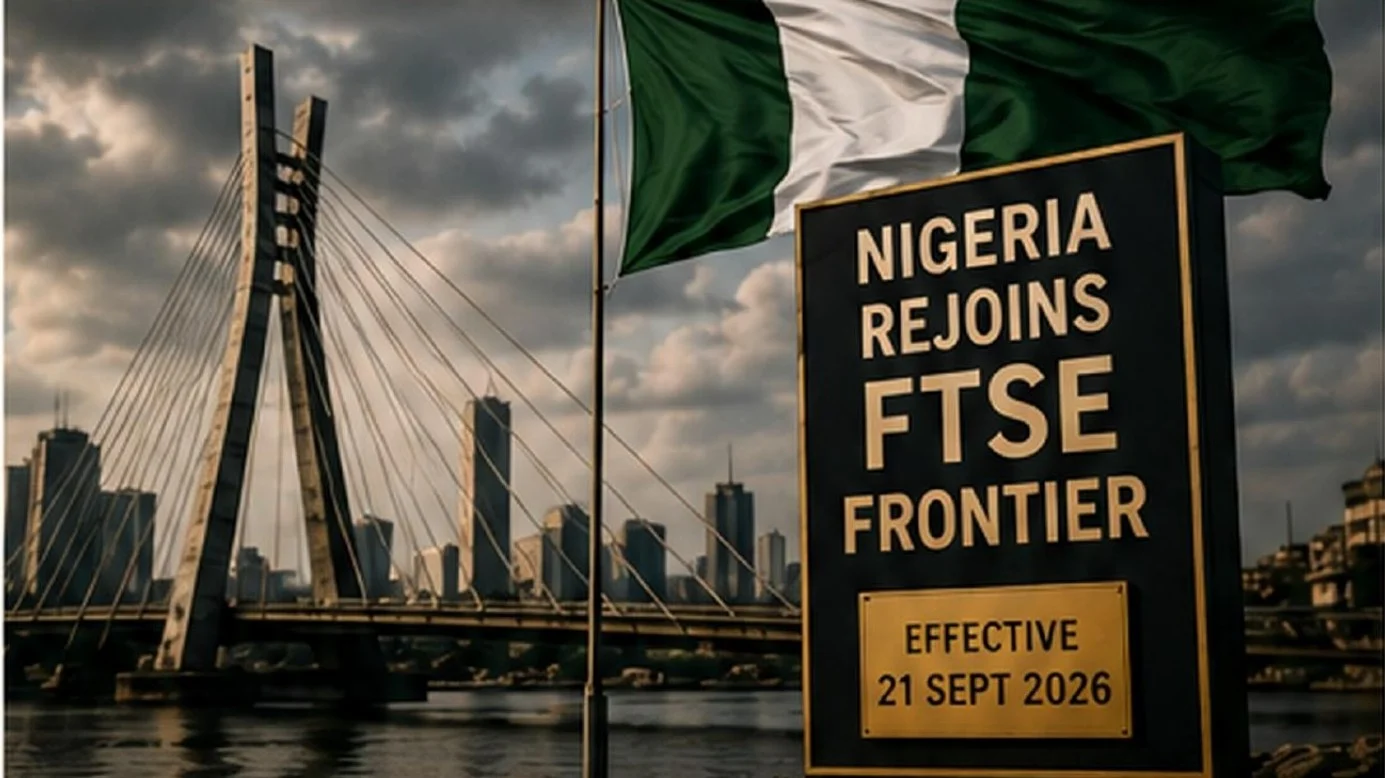
By The Lokoja Contrarian · Published 26 September 2026 · Seven Gates Research
Broad-market data: 25 September 2026 close. Pre-event scorecard snapshot: 2 September 2026. Article type: Thematic / Market Structure.
At a glance
| FTSE status Frontier, live from 21 Sep 2026 | Frontier 50 Nigeria 6: Aradel, Dangote Cement, FirstHoldCo, GTCO, MTNN, Zenith |
| September broad review 31 names reported across Large / Mid / Small | Implementation wrinkle NGX says 30 live names; public count difference unresolved |
| NGX ASI, 25 Sep 252,113.41 | Market cap, 25 Sep ₦163.66tn |
| ASI since Watch List +73.9% | ASI since April confirmation +24.8% |
| ASI since 18 Sep rebalance close +0.9% | 21 Sep standout Zenith volume 3.58x 30-day average |
| Same-week macro shock CBN reset MPR to 23% | Seven Gates view Plumbing confirmed; persistence is the next test |
On Monday 21 September, the Nigerian Exchange opened for the first time in three years with international index funds obliged to own it. By the close, 77.07 million Zenith Bank shares had changed hands. That was about 3.58 times the stock's 30-day average, roughly ₦9.9 billion of paper moving from one set of owners to another in a single session.
The share price rose 0.2%.
Sit with that for a moment. A buyer arrives who is required by his rulebook to buy. Volume nearly quadruples. The price barely clears its throat. That is not what a stampede looks like. It looks like a queue of sellers who knew exactly which morning the buyer was coming, had been holding the stock for months, and were waiting at the door with it already wrapped.
Most of this article is contained in that one line of tape. The pipes work. The buyer came. The seller was there first.
Three years ago the problem ran the other way. Marty Byrde from Ozark (one of our favourite series, although I do not approve of the shenanigans) would have understood Nigeria's 2023 problem immediately. Making money is one operation. Moving it is another. Nigeria had quoted shares, profitable companies, banks with branches from Lagos to London, cement plants capable of blotting out the horizon and an exchange perfectly capable of matching a buyer with a seller. What it did not have, reliably enough for international institutions, was the boring final act: turn the proceeds into foreign currency and take the money home.
FTSE Russell eventually lost patience. Nigeria had been on the Frontier Watch List because international investors reported an inability to repatriate capital from December 2020. By September 2023, FTSE said there had been no material improvement. Nigeria was reclassified from Frontier to Unclassified, and Nigerian constituents were deleted from affected indices at ₦0.0001 for benchmark purposes. A ten-thousandth of a naira. Index providers rarely write poetry, but that number came close.
SKIN IN THE GAME
One of the burns was personal. I had some of my money in NGE, the Global X MSCI Nigeria ETF. I barely made it out of the gate before the fund stopped trading on 25 March 2024 and was liquidated. It was a useful lesson in market plumbing: an ETF wrapper can package exposure; it cannot manufacture an exit when the underlying market cannot deliver one. Market-structure tuition, as usual, was payable in cash.
Global X's own notice said the liquidation timetable had to accommodate the orderly unwinding of Nigerian assets and their conversion into US dollars. Read that sentence twice. The fund was not closing because Nigerian companies had stopped making money. It was closing because turning their shares back into dollars had become a project with a timetable. MSCI later moved Nigeria from Frontier to Standalone and deleted Nigerian securities from its Frontier indices at effectively zero. Nobody was claiming that GTCO's vault contained cobwebs or that Dangote Cement had forgotten the recipe for clinker. The judgement was narrower and more damning: the exit door did not work. FTSE 2023 review; Global X NGE liquidation notice; MSCI 2023 decision.
The wrapper existed. The exit was still the hard part.
Global X MSCI Nigeria ETF (NGE), reconstructed max-history path to the last quoted level before liquidation.
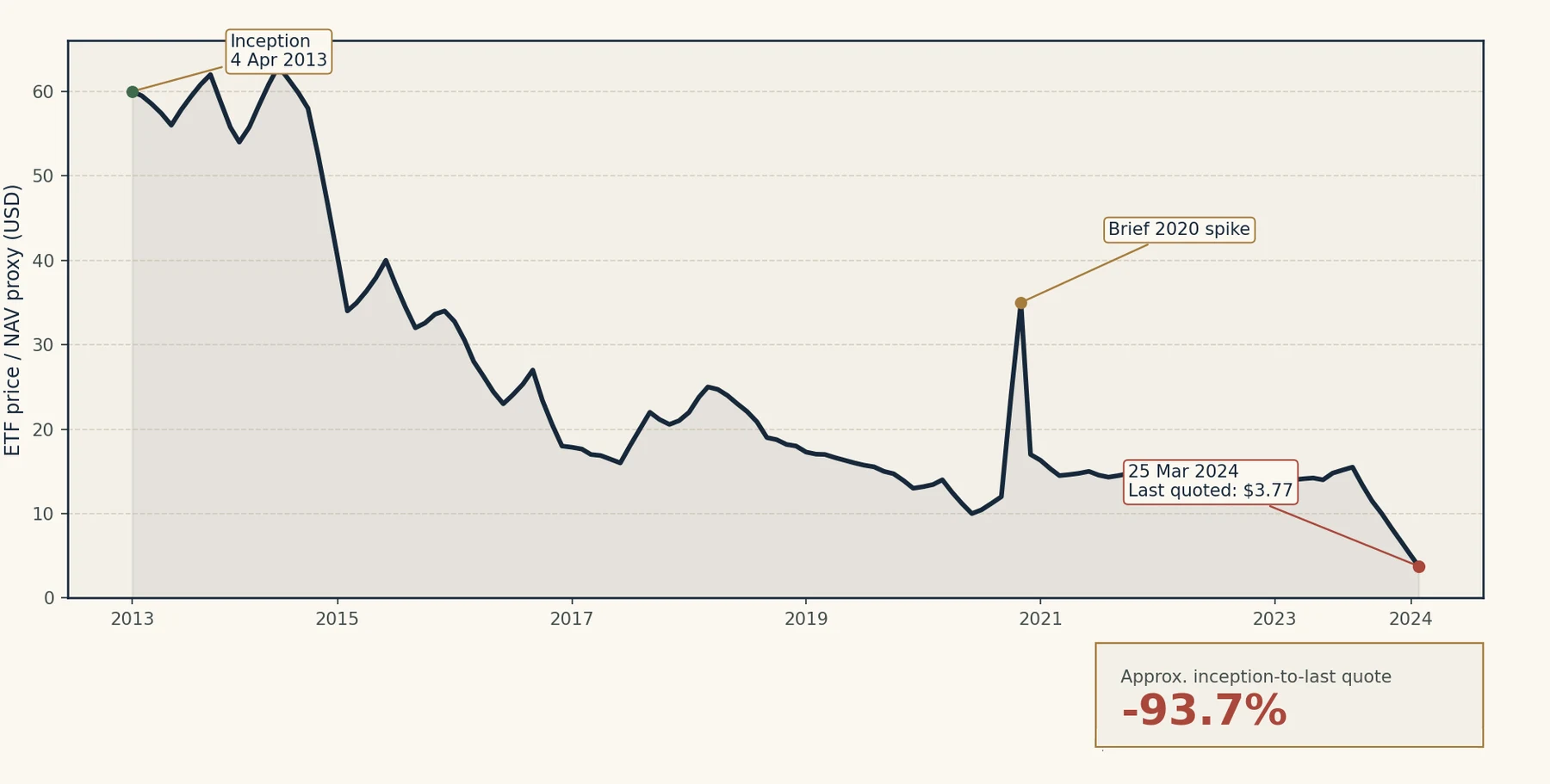
Seven Gates reconstruction of the Global X MSCI Nigeria ETF (NGE), redrawn in the house chart format. The wrapper existed; the exit was still the hard part. Source: user-provided Global X NGE max-history snapshot; Seven Gates reconstruction. Method: reconstructed directional history from the displayed vendor chart. Not a trading database; dividends not included.
Now the gate is open. Nigeria returned to FTSE Russell's Frontier Market classification at the market open on 21 September 2026. FTSE had concluded that the FX and repatriation problems behind the 2023 expulsion had improved sufficiently, and its follow-up review of T+1 settlement found no material operational or funding issue that blocked the move. On implementation day, NGX said Nigerian companies were once again featuring in the Frontier Index Series. NGX implementation notice; FTSE Frontier Index Series.
THE ANSWER BEFORE THE SERMON
The reclassification has happened. The first-week evidence is positive for market access, but far less theatrical than the pre-event headlines. The six Nigerian Frontier 50 names are now the clearest concentrated benchmark channel. On the first session, Zenith traded 3.58 times its recent average volume yet rose only 0.2%, while GTCO gained 3.9%. That looks more like a large transfer of inventory than a stampede. The long-run prize remains the same: keep the FX exit open, deepen ordinary liquidity, improve governance and earn a permanently lower cost of equity.
1. START WITH THE ENGLISH TRANSLATION
What does "Frontier" actually mean?
Markets enjoy turning simple plumbing into liturgy. "Frontier", "free float", "foreign inclusion factor", "tracking error" and "index replication" can sound like the password to an underground society. They are mostly answers to one question: can a large institutional investor own this market in the quantities and manner required by its rules?
| Term | What it means without the conference badge |
|---|---|
| Index | A rules-based shopping list of securities. |
| Benchmark | The ruler against which a fund manager is judged. |
| Passive fund | A fund whose job is largely to copy the shopping list, including its weights. |
| Tracking error | How far the portfolio deviates from the benchmark. If Nigeria becomes a meaningful benchmark weight and the manager owns none, that is an active bet whether he intended one or not. |
| Frontier market | An investable market that clears a minimum accessibility bar but lacks the scale, depth or market infrastructure of higher tiers. |
| Emerging market | A higher market-accessibility category. It is not a certificate of economic virtue. |
| Free float | The portion of shares genuinely available to public investors. The founder's locked stake does not become investable because a terminal can multiply it by today's price. |
| ADV | Average daily value traded. Roughly, how much money normally changes hands each day. |
| Days of liquidity | Estimated index buying divided by normal daily trading. Ten days of ADV trying to enter a small float can become a social event. |
| Price discovery | The process through which information, anticipation, buyers and sellers become an actual market price. |
| T+1 | A trade settles one business day after it is executed. |
| Repatriation | Converting Nigerian proceeds into foreign currency and moving the capital out. The villain of the 2023 story. |
| Cost of equity | The return investors demand for bearing the risks of owning a company. Lower perceived risk can support a higher valuation for the same earnings. |
The FTSE Frontier Index Series is designed as a benchmark and for index-tracking products, but it sits apart from FTSE's Global Equity Index Series. Nigeria is not being parachuted into the much larger FTSE All-World or mainstream Emerging-market pool. It is entering a smaller room, albeit one containing investors who previously had a formal reason not to own it. FTSE Frontier Index Series.
Hamlet, walking towards a duel with a bad feeling about it, settles on the right line: "The readiness is all." FTSE is saying Nigeria is ready enough to be replicated again. It is not saying Nigerian equities are cheap enough to be bought without looking.
2. BULLISH, YES. BUT BULLISH FOR WHAT?
A plumbing certificate is not an earnings forecast
The FTSE decision is best understood as a reduction in institutional friction. A foreign manager who tracks or is benchmarked against Frontier can once again treat Nigeria as part of the permissible universe. A pure index tracker eventually has to buy the qualifying Nigerian constituents in roughly their index weights. An active, benchmark-aware manager does not have to buy, but a zero Nigeria weight can now create meaningful tracking risk if Nigeria receives a substantial benchmark allocation.
That is why the decision is bullish. The universe of potential owners broadens. Research coverage can widen. Turnover can deepen. Bid-ask spreads can compress. The market begins to rebuild an institutional history of "I bought, I sold, I got my dollars". If that history survives a real stress test rather than a sunny quarter, the required risk premium can fall.
But an index committee cannot manufacture earnings. Marty Byrde would recognise the distinction: Nigeria has repaired part of the distribution system for capital, not the business being distributed. That makes the security easier to own. It does not make MTN's cash flow grow faster, Zenith's loan book cleaner or a 24x multiple sensible by decree.
Classification changes the marginal buyer. Valuation still decides whether that buyer is getting a bargain or volunteering as exit liquidity.
3. PRICE DISCOVERY HAS HAPPENED
Now we have the tape
There are two different stories in the index. The first is the long anticipation trade. The second is what happened when the index event finally became real.
FTSE put Nigeria on the Watch List on 7 October 2025, when the NGX All-Share Index closed at 144,995.26. Formal confirmation came on 7 April 2026 at 202,023.10. On the Friday before implementation, 18 September, the ASI was 249,804.56. One week later, on 25 September, it closed at 252,113.41. That is about +73.9% from Watch List to the latest close, +24.8% from formal confirmation, and only +0.9% from the rebalance close. The market did most of its running before the foreign benchmark formally arrived. Nairametrics, 25 Sep 2026.
The market front-ran FTSE. The first live week was quieter.
Selected verified NGX All-Share Index event-date closes. Connecting lines show chronology, not unobserved daily values.
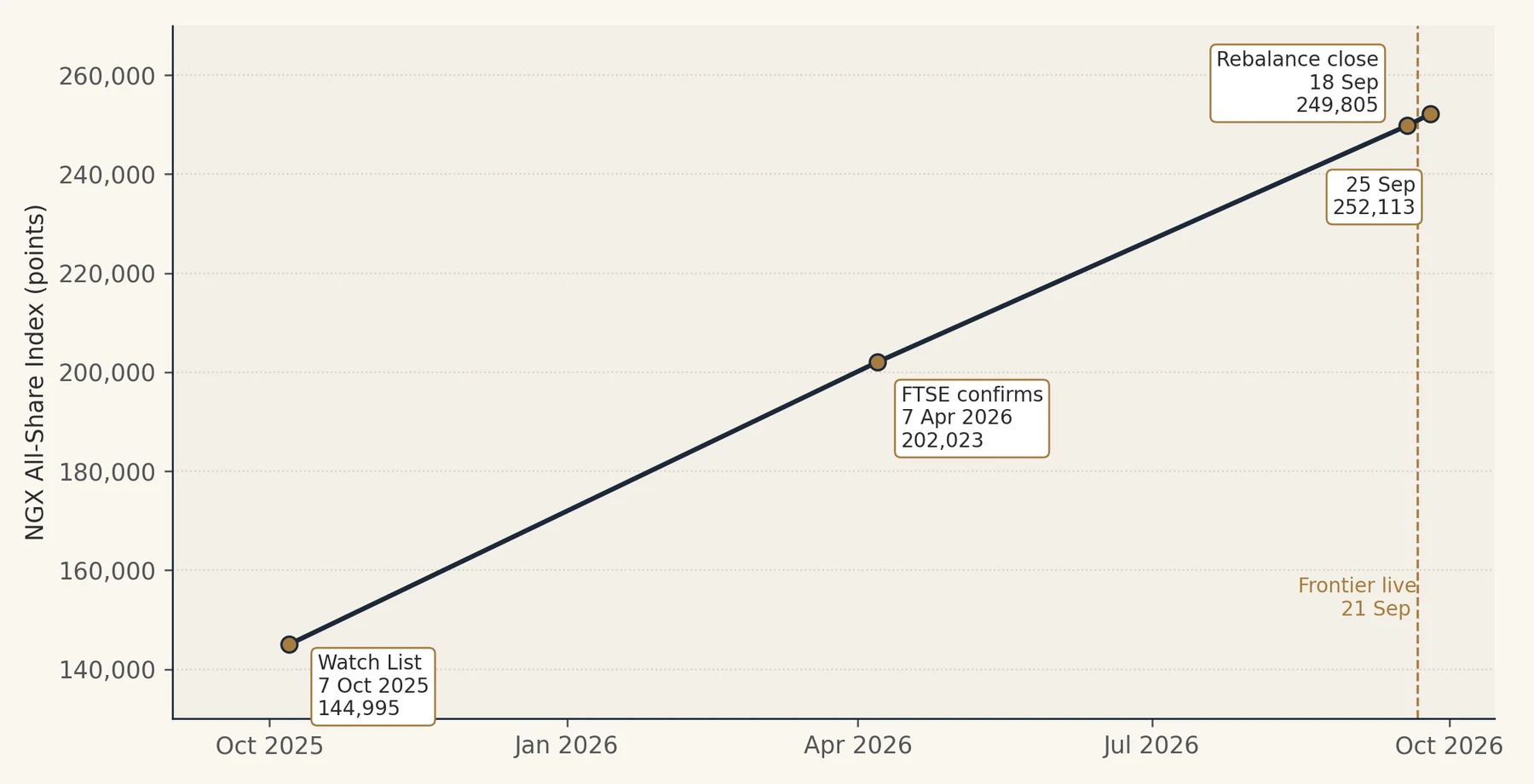
The broad market has already moved hard. The useful question is no longer "will FTSE be bullish?" but "which part of the move is FTSE-specific, which constituents still face a meaningful forced buyer, and which have already charged admission twice?" Sources: AIICO Capital; FTSE/NGX event dates; Kobo Terminal; Nairametrics; Seven Gates calculations. Latest close: 25 Sep 2026. Price index only; not total return. Chart redrawn by Seven Gates from the cited closes.
None of the 73.9% belongs exclusively to FTSE. Earnings, bank recapitalisation, local liquidity, FX improvement, changing interest-rate expectations and a broad Nigerian bull market are all mixed into the return. But the sequence matters. The information was tradable for almost a year before implementation.
Then came 21 September, and the tape supplied the more useful evidence. Zenith Bank traded 77.07 million shares, about 3.58 times its 30-day average, for roughly ₦9.9 billion. The share price rose only 0.2%. GTCO traded 25.85 million shares, around 33% above its recent average, for ₦3.41 billion, and gained 3.9%. FirstHoldCo traded 12.18 million shares, worth ₦1.87 billion, and finished flat. Its traded value exceeded Access and UBA combined that day. MoneyCentral, 21 Sep 2026.
The first signal was turnover, not fireworks.
Re-entry day value traded: three Frontier 50 banks versus two Mid Cap banking peers. Zenith volume: 3.58x its 30-day average.
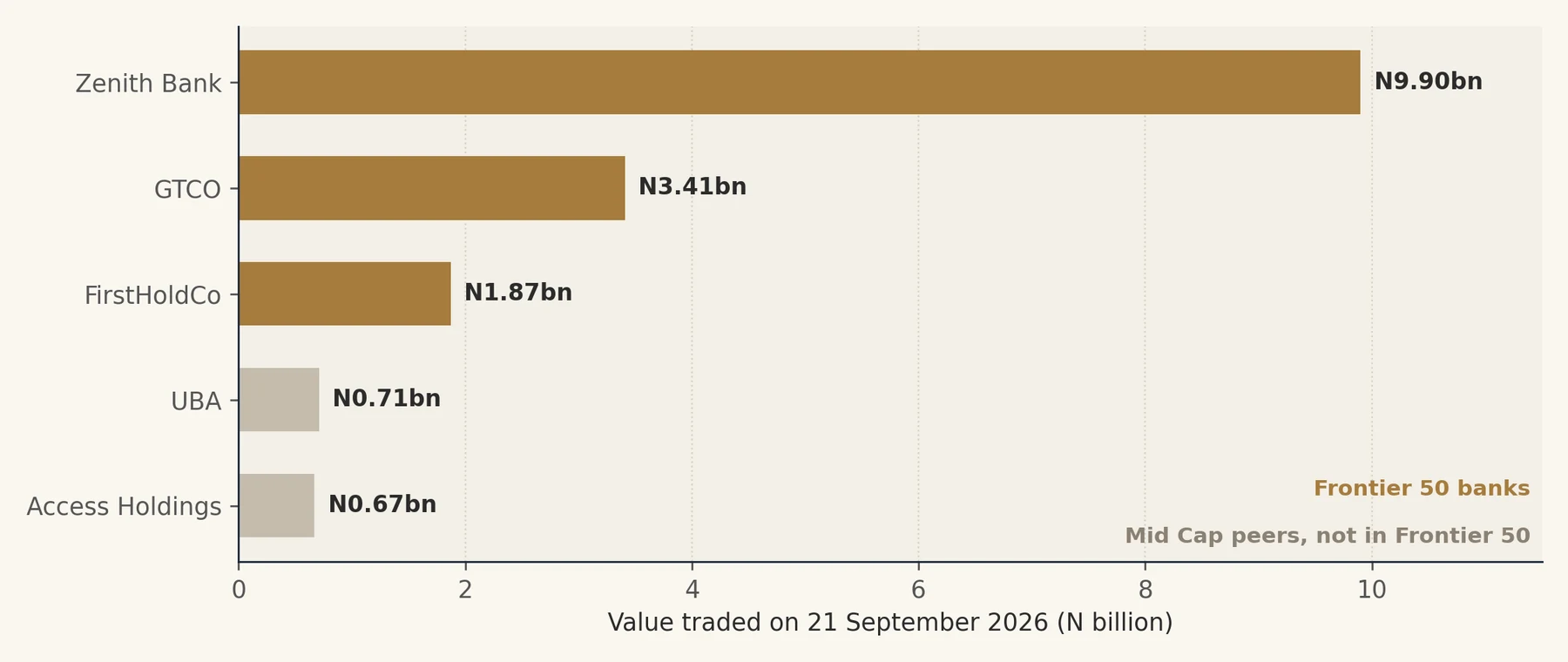
Zenith's enormous volume with a 0.2% price move is close to a textbook picture of substantial demand meeting substantial supply. Source: MoneyCentral, 21 Sep 2026. Zenith 77.07m shares vs 21.52m 30-day average; GTCO 25.85m vs 19.5m. Interpretation: index activity was visible, but willing sellers absorbed much of the demand. One session is not proof of durable foreign flow. Chart redrawn by Seven Gates from the cited figures.
That supports the article's original front-running hypothesis. The compulsory buyer did arrive. So did the seller who had been waiting for him. The index event produced liquidity, not a uniform squeeze.
There is one further complication. On 21 and 22 September, the CBN also reset the Monetary Policy Rate to 23% from 26.5%. That is a large domestic valuation event in the same week as FTSE implementation. Any attempt to attribute the following sessions entirely to foreign index flow would be analytically unserious. CBN monetary policy decisions.
4. HISTORY IS IMPOLITE
The announcement can be the trade; inclusion can be the hangover
A Financial Analysts Journal study covering 17 MSCI reclassifications found that upgraded markets rose an average 23.2% between announcement and effective inclusion, then returned -12.4% over the following year. The sample is modest and the episodes differ. Still, the mechanism makes sense. Once index membership becomes reasonably predictable, arbitrageurs and benchmark-aware investors buy before the mechanical flow. The index fund arrives at the party carrying a mandate and discovers everyone else already knows the chorus. CFA Institute.
Qatar, the UAE and Pakistan were particularly theatrical. In the roughly one-year windows between MSCI announcing their Frontier-to-Emerging promotions and implementing them, their markets rose about 54%, 99% and 28% respectively. In the subsequent twelve months, Seafarer's reconstruction shows losses of roughly 22%, 23% and 29%.
The same plot plays out in single stocks, where it is easier to watch. On 16 November 2020, S&P Dow Jones Indices announced that Tesla would join the S&P 500. Over the next five weeks the shares rose about 70%. On Friday 18 December, the last session before inclusion, index funds bought so heavily that close to $60 billion of stock changed hands at $695 a share, most of it in a single trade in the closing seconds. On Monday 21 December, Tesla's first day as a member, the shares fell 6.5%. The index funds bought at the top because the rulebook told them to. Everyone else had read the rulebook too.
The announcement is often the trade; inclusion can be the hangover.
MSCI Frontier-to-Emerging promotions and the 17-upgrade average.
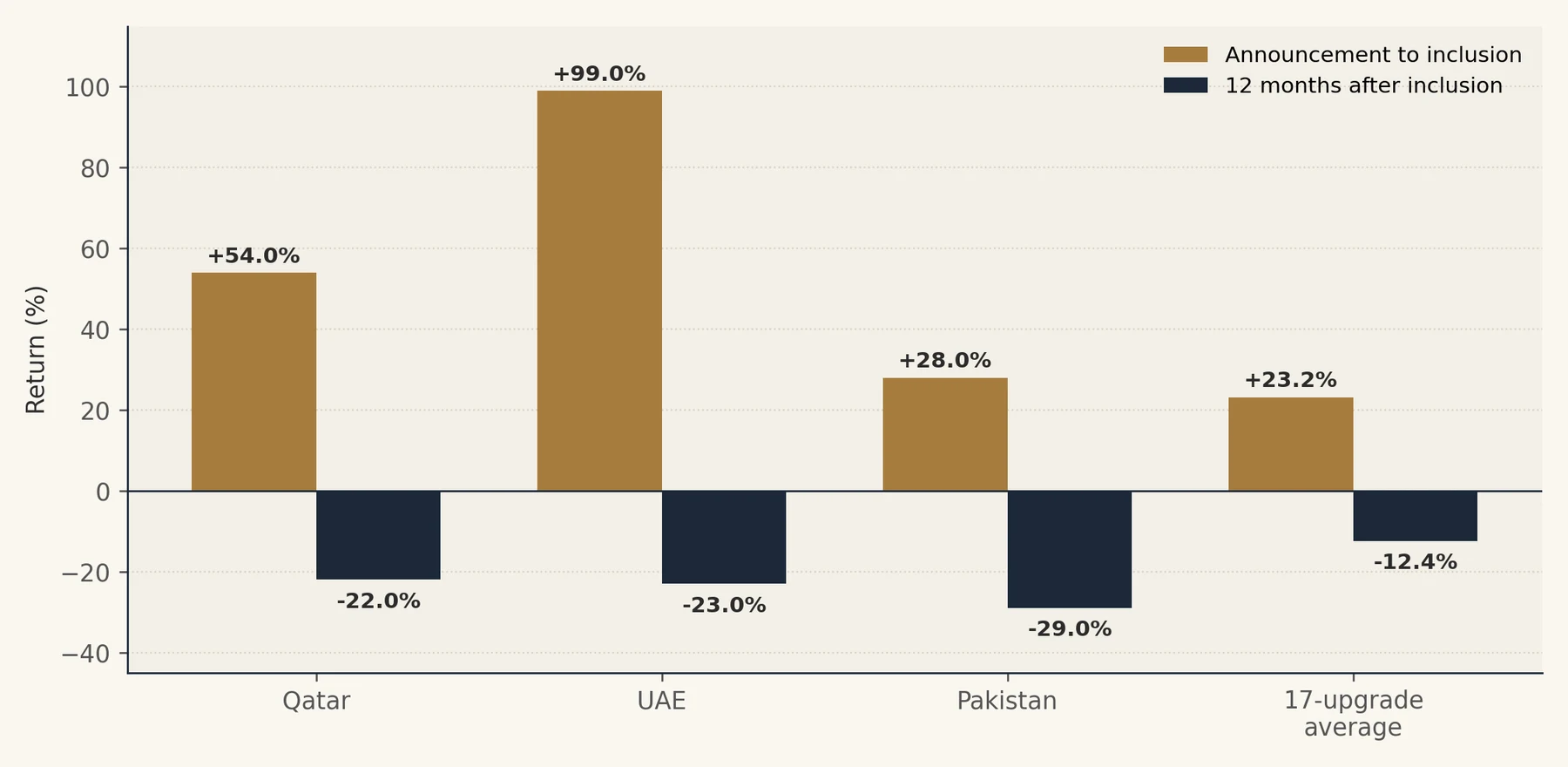
Historical reclassifications frequently rewarded the anticipation phase. They did not guarantee a pleasant first anniversary. Nigeria has now supplied an early version of the same lesson: the pre-event move dwarfed the first-week move. Source: Seafarer Funds for Qatar/UAE/Pakistan event windows; CFA Institute summary of 17 MSCI upgrades. Event studies are not forecasts for Nigeria. Chart redrawn by Seven Gates from the cited figures.
| Market | Move | Announcement to inclusion | 1st full year after | 2 years compounded | 5 years compounded |
|---|---|---|---|---|---|
| Qatar | Frontier → Emerging | +54% | -19.5% | -14.5% | -2.7% |
| UAE | Frontier → Emerging | +99% | -17.9% | -6.8% | -8.0% |
| Pakistan | Frontier → Emerging | +28% | -34.8% | -28.5% | -71.9% |
| Saudi Arabia | Standalone → Emerging | N/M, phased | +0.7% | +38.7% | +46.5% |
| Kuwait | Frontier → Emerging | N/M, COVID timing | +30.9% | +44.1% | +81.6% |
Methodology: announcement windows for Qatar/UAE/Pakistan are Seafarer's event-window figures. The 1/2/5-year columns compound the first full calendar years after effective inclusion using MSCI USD net-return annual series. They are not exact anniversary returns. Kuwait's announcement window is not treated as meaningful because COVID disrupted the scheduled implementation.
The conclusion is not that index upgrades are bearish. Saudi Arabia and Kuwait did well. The conclusion is that classification changes flows, while subsequent returns still answer to earnings, currency, politics and the price paid. A new benchmark label is a catalyst. Nobody should mistake it for a sacrament.
5. NIGERIA HAS BEEN FRONTIER BEFORE
The previous spell did not save the foreign investor
Nigeria was classified as Frontier in FTSE's framework from 2014 until the 2023 expulsion. If classification alone produced wealth, we would not need the rest of this article.
Using the MSCI All Nigeria USD net-return index as a consistent proxy for the international investor's broad Nigerian equity experience, the eight full calendar years from 2015 through 2022 compounded to approximately -40.8%, or about -6.3% a year. Over the same calendar years, MSCI Frontier Markets compounded to roughly +2.2%. This is not a direct FTSE constituent return and should not be presented as one. It is a useful reminder that the dollar owns the final joke. MSCI All Nigeria factsheet.
| 2015-2022 USD net return proxy | Cumulative | Approx. CAGR |
|---|---|---|
| MSCI All Nigeria | -40.8% | -6.3% |
| MSCI Frontier Markets | +2.2% | +0.3% |
That record should inoculate investors against category worship. Frontier membership can improve access. It cannot stop a currency devaluation, repair bad governance, convert accounting profit into cash, make an overleveraged balance sheet survivable or turn an expensive security into a cheap one.
6. OZYMANDIAS COMES TO THE NGX
Small float is both rocket fuel and governance warning
FTSE's rule is blunt: a security with free float of 5% or below is excluded from the Frontier Index Series. Surviving that rule does not guarantee inclusion, because size, liquidity, nationality, foreign ownership headroom and other tests still matter. But failing it is a very efficient way to end the conversation. FTSE Frontier ground rules.
That turns Nigeria's very large, very tightly held companies into a useful lesson. BUA Cement reported free float of 2.31% at June 2026. Dangote Cement reported 5.73% at June 2026. BUA Foods' latest reported figure is below 5%. FTSE's own investability weight can differ from issuer-reported float because FTSE applies its own investability and foreign-ownership adjustments, but the order of magnitude is the point.
Shelley's Ozymandias has finally acquired a Bloomberg terminal: look on my market capitalisation, ye index funds, and discover that almost none of it is for sale. That is adaptation, not quotation, and it is also market microstructure.
Headline market cap is not what the index can buy.
Approximate market capitalisation against reported free float; dashed line marks FTSE's 5% exclusion threshold.
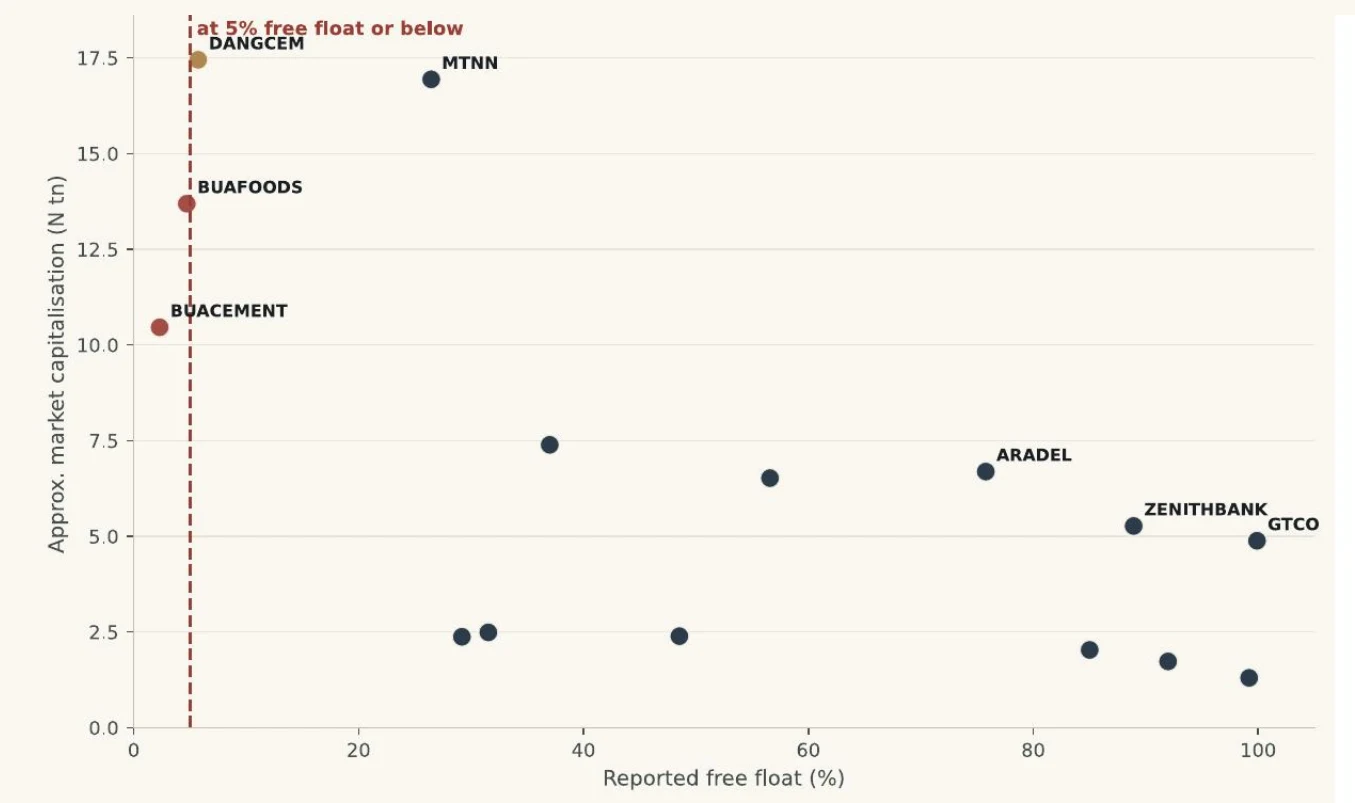
BUA Cement and BUA Foods show why Nigerian headline market-cap rankings can mislead an index investor. Dangote Cement is the knife-edge case: its reported 5.73% float sits only just above FTSE's 5% exclusion threshold. Source: Company filings and market-data snapshots; FTSE Frontier ground rules. Free-float definitions may differ from FTSE IWF and foreign-ownership headroom.
A ₦17 trillion company with 5.7% available to the market is not the same object as a ₦17 trillion company with 70% available. A relatively modest forced order can be enormous when measured against the shares that actually trade. Conversely, a massive headline market capitalisation can produce a modest index weight after float adjustment.
This is why the central technical measure in the Seven Gates scorecard is not market capitalisation. It is:
Estimated forced buying / 20-session average daily value traded = days of liquidity
If the theoretical order equals 15 days of normal turnover, the market may need time, blocks, willing local sellers or a substantially different price to clear it.
Small float also raises governance questions. Thin public ownership can weaken price discovery, magnify volatility, widen spreads and leave minority investors in a market where the controlling shareholder supplies almost all of the gravity. Indexability may therefore create a useful incentive: controlling owners can increase free float through secondary placements and, in doing so, deepen liquidity and broaden the institutional shareholder base.
7. THE LIST IS LIVE
The broad universe matters. The Frontier 50 matters more.
We have moved from "who might qualify?" to "who actually matters inside which benchmark?" That is progress, but there is an important distinction between the broad Frontier Index Series and the narrower FTSE Frontier 50.
The September review identified 31 Nigerian securities across 10 Large Cap, 10 Mid Cap and 11 Small Cap names. At implementation, NGX's own 21 September release said 30 Nigerian companies were featuring in the Frontier Index Series. Publicly accessible material reviewed for this update does not resolve that one-name difference, so we do not manufacture a reconciliation. The September review list remains in our data appendix, while the live implementation count is reported exactly as NGX stated it. September review list; NGX implementation release.
| Bucket | Nigerian names | What matters now |
|---|---|---|
| Frontier 50: 6 | Aradel Holdings; Dangote Cement; FirstHoldCo; GTCO; MTN Nigeria; Zenith Bank | The concentrated benchmark. The clearest focal points for benchmark-aware demand. |
| Broad Large Cap: 4 more | Nestle Nigeria; Nigerian Breweries; Presco; Stanbic IBTC | Large Cap in the broader Frontier series, but not in the Frontier 50. |
| Mid Cap: 10 in Sep review | Access; Dangote Sugar; FCMB; Fidelity; Guinness; Oando; Okomu Oil; Unilever; UBA; Wema | Broad benchmark exposure, generally smaller index footprint. |
| Small Cap: 11 in Sep review | Custodian; Fidson; Julius Berger; NASCON; NAHCO; NGX Group; Sterling; Transcorp; UAC Nigeria; United Capital; Vitafoam | Important for breadth and market accessibility, less likely to dominate concentrated passive flows. |
The biggest upgrade to our original thesis is that the Frontier 50 is no longer a forecast. FTSE's 4 September semi-annual review put six Nigerian names into the 50-stock benchmark: Aradel, Dangote Cement, FirstHoldCo, GTCO, MTN Nigeria and Zenith. Three are banks. The six-name list is more useful for concentrated event analysis than treating every broad-series constituent as though it receives the same mechanical demand. FTSE Frontier 50 review notice.
Two old lessons survived intact. BUA Cement remains absent, consistent with the free-float problem above. Seplat also remains absent from the Nigeria review list. We still have not found a primary FTSE explanation for that omission, so the dual-listing or nationality explanation remains inference rather than fact.
The scorecard below is therefore best read as an accountability document. The eligibility columns are no longer our guess. The flow arithmetic is still a Seven Gates sensitivity, not a leaked index file in borrowed tailoring.
Stock-by-stock FTSE re-entry scorecard: pre-event model meets the live benchmark
How to read this: FTSE tier status follows the September review reporting; Frontier 50 status is now confirmed for Aradel, Dangote Cement, FirstHoldCo, GTCO, MTNN and Zenith. Market cap, valuation, free-float and return fields remain the 2 September pre-event snapshot so readers can see what was priced before implementation. Model investable cap, illustrative US$120m flow and Days/ADV are Seven Gates sensitivities, not official FTSE weights.
| Ticker | FTSE tier | F50 | Free float | Days / ADV* | Since Watch List | Live read |
|---|---|---|---|---|---|---|
| GTCO | Large | Yes | 99.9% | 12.0d | 40.6% | F50; demand + price response |
| ZENITHBANK | Large | Yes | 88.9% | 9.2d | 87.0% | F50; 3.58x volume; supply absorbed |
| MTNN | Large | Yes | 26.5% | 8.3d | 79.3% | F50; concentrated benchmark |
| DANGCEM | Large | Yes | 5.7% | 8.8d | 95.1% | F50; float is hinge |
| STANBIC | Large | No | 31.5% | 46.6d | 41.9% | Broad Large; thin ADV |
| FIRSTHOLDCO | Large | Yes | 56.6% | 4.4d | 373.2% | F50; front-run; flat day one |
| NESTLE | Large | No | 29.2% | 6.7d | 60.2% | Broad Large; valuation watch |
| NB | Large | No | 27.0% | 4.5d | N/M | Broad Large |
| PRESCO | Large | No | 48.5% | 54.1d | 38.2% | Broad Large; thin ADV |
| ARADEL | Large | Yes | 75.8% | 9.5d | 148.4% | F50; heavily repriced |
| ACCESSCORP | Mid | No | 92.0% | 5.9d | 25.0% | Mid; not F50 |
| UBA | Mid | No | 85.0% | 8.8d | 12.7% | Mid; not F50 |
| FIDELITYBK | Mid | No | 99.2% | 19.7d | -0.2% | Mid; thin ADV |
| SEPLAT | Not in Nigeria file | No | 37.0% | 0.0d | 108.2% | Absent from Nigeria list |
| BUACEMENT | Not in Nigeria file | No | 2.3% | 0.0d | 93.1% | Absent; float screen |
*Days/ADV is the frozen 2 Sep Seven Gates US$120m pre-event sensitivity, not an official FTSE weight or realised order. Source: FTSE September 2026 review reporting; FTSE Frontier 50 review; company filings; NGX/market data; Seven Gates calculations. Valuation and price snapshot remains 2 Sep 2026; live event evidence is discussed separately.
Preserve this as the pre-event stress test, not as a forecast of exact ETF orders. The live tape validated the mechanism in the most important way: benchmark demand showed up first as turnover, while the price response depended on available supply.
8. READ THE LIVE BENCHMARK CORRECTLY
Six names now carry the clearest concentrated index signal
GTCO, Zenith and FirstHoldCo have already given us the cleanest observable test. All three sit in the Frontier 50. On 21 September their combined traded value was about ₦15.18 billion, and they told three different stories. Zenith: huge turnover, almost no price chase. GTCO: above-average volume plus a 3.9% gain. FirstHoldCo: meaningful turnover and a flat close.
MTN Nigeria, Dangote Cement and Aradel complete the six-name Frontier 50 group. Their relevance is now structural rather than hypothetical. But concentrated benchmark membership should not be confused with valuation support at any price. Aradel and Dangote Cement had already appreciated dramatically before the event; MTN's float-adjusted footprint remains far smaller than its headline market capitalisation.
Stanbic, Presco, Nestle and Nigerian Breweries are broad Large Cap constituents but not in the Frontier 50. That is a meaningful demotion from the lazy "all large caps get the same forced buyer" story. They may benefit from the wider Frontier series, but they do not share the concentrated 50-stock channel.
Access, UBA and Fidelity remain useful controls. Access and UBA are major Nigerian banks outside the Frontier 50. On implementation day, FirstHoldCo alone traded more by value than Access and UBA combined. That is exactly the sort of within-sector divergence an index event should create if the benchmark designation matters.
BUA Cement remains the cleanest free-float lesson. Seplat remains the awkward omission. Neither should be treated as a bad business because an index methodology did not select it. The event trade and the investment case are different animals.
9. WHO IS THE FOREIGNER BUYING FROM?
Every inflow has a seller, usually with better timing than Twitter
The first day answered this question more elegantly than any flow model. The foreign benchmark buyer was not purchasing shares from the atmosphere. He was purchasing them from somebody who had inventory.
ILLUSTRATION
Picture a portfolio manager at a Lagos asset manager in April, the week FTSE confirms the date. She has read the same notice as everyone else, so she buys Zenith, a little at a time, through the summer. She is not a genius. She owns a calendar. On the morning of 21 September her dealer works the order into the closing auction, where a passive fund in London is taking whatever the index says it must own. Her shares cross at a price that barely moves. The fund manager in London records a successful rebalance. She records a profit. Both of them are telling the truth.
Zenith is the useful case study. A 3.58-times jump in volume with only a 0.2% price gain says demand was large, but supply was not scarce enough to force a dramatic repricing. That can happen when local institutions, event-driven desks and brokers have spent months accumulating precisely because the implementation calendar was public.
The price impact therefore often happens during inventory formation. The benchmark date becomes a transfer date. The foreign flow is real, but the alpha may have been harvested by the person who bought before the mandate arrived.
J.P. Clark's "Night Rain" is a better liquidity metaphor than the usual "wall of money": in the poem the rain finds its way through the roof, drip by drip, into whatever vessel is waiting. Liquidity finds every weak seam in the order book. On 21 September, some seams were busy. They did not all break.
This also keeps the old US$75m-US$170m passive-flow estimates in their proper place. They were scenario inputs, not an FTSE cheque. The live market now gives us a better monitoring variable: persistent abnormal turnover and foreign participation after the rebalance, not merely the theoretical size of the order.
10. VIETNAM OUT. NIGERIA IN.
The same date, opposite journeys
On 21 September, the symbolism became literal. Vietnam entered FTSE's Emerging-market universe while Nigeria returned to Frontier. Same date, opposite direction. Reuters described Vietnam's move as the culmination of years of market reforms, with inclusion phased into the Emerging benchmark. Nigeria's move was a rehabilitation after a market-access failure. Reuters, 21 Sep 2026.
Nigeria
Direction: Unclassified → Frontier.
What it proves: market access has repaired enough for benchmark replication.
What remains: prove the FX exit, settlement and ordinary liquidity through stress, not merely through implementation week.
Vietnam
Direction: Frontier → Secondary Emerging.
What it proves: market infrastructure can compound into classification upgrades.
Why Nigeria should care: Frontier is a station, not a nationality.
Stations run in both directions. MSCI promoted Pakistan from Frontier to Emerging in 2017; in 2021 it moved Pakistan back down, having run out of enough companies large and liquid enough to keep it there. The contrast between Hanoi and Lagos is more useful now that both moves have happened. Vietnam shows the destination is not fantasy. Nigeria shows that losing access can erase years of index progress. The dull work remains the valuable work: reliable FX, settlement, free float, foreign ownership access, custody and governance.
A lower required return can reprice the whole market.
Illustrative valuation sensitivity. Same cash flow, same growth, lower required return.
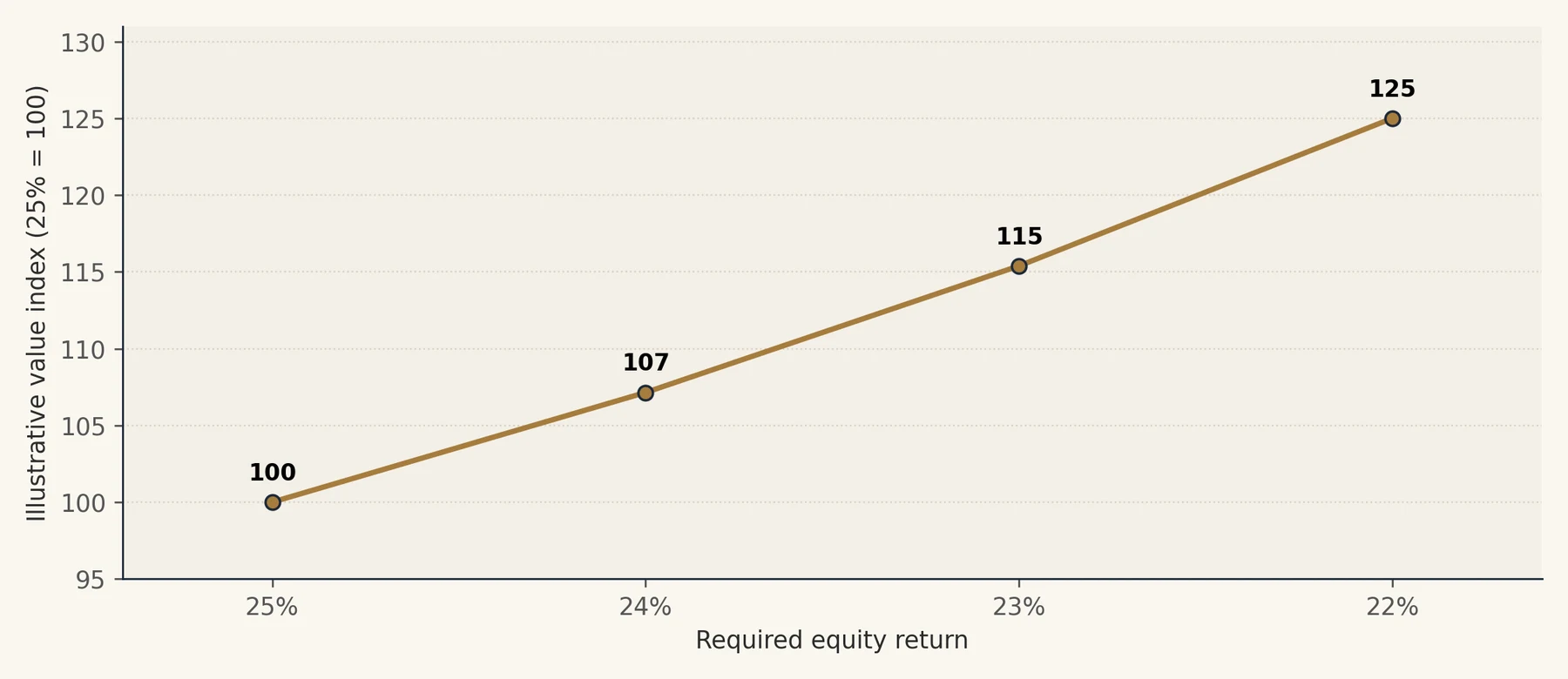
The rebalance was one week. The cost-of-equity thesis is measured in years. If Nigeria turns restored access into a lower persistent risk premium, the structural value can dwarf the implementation-day order. Illustration: value proportional to 1 / (r - g), with perpetual growth g = 10%. Source: Seven Gates illustrative valuation arithmetic. Mechanism demonstration, not a Nigeria market forecast.
11. THE PRIZE NOBODY CAN PHOTOGRAPH
A lower cost of equity can be worth more than the ETF order
Suppose a Nigerian business generates a stable stream of cash flow and investors require a 25% nominal equity return because of FX convertibility risk, market illiquidity, institutional uncertainty and ordinary business risk. Now imagine several years of functioning FX, reliable repatriation, deeper liquidity and better institutional behaviour reduce that required return to 22%.
Using a deliberately simple perpetual-growth mechanism, value is proportional to 1 / (r - g). Hold long-run growth at 10%. Moving the required return from 25% to 22% raises the illustrative valuation by about 25% without a single additional naira of current earnings.
This is not a forecast, and 10% perpetual growth is not an investment assumption for the NGX. It is a mechanism demonstration. A persistent fall in the country's equity risk premium can support higher P/E and P/B multiples for exactly the same earning power.
That is potentially a much bigger economic prize than US$120 million of passive flow. A one-off index purchase is an event. A permanently lower required return changes the price at which the entire market finances itself.
It can also change corporate decisions. A company that once regarded a secondary placement as needless dilution may discover that increasing float unlocks index eligibility, institutional ownership and cheaper equity capital. The controlling shareholder can sell a little more and, paradoxically, make the remaining stake more valuable by making the market around it more credible.
12. GOVERNANCE ARRIVES THROUGH THE SIDE DOOR
Indexability can alter corporate behaviour
FTSE inclusion is not a certificate that Nigerian boards have entered a monastery. FTSE's March 2026 Quality of Markets matrix still shows gaps relative to higher-tier markets across areas such as the developed FX market criterion, stock lending, short selling, derivatives, off-exchange transactions and parts of market and custody infrastructure. Nigeria clears the Frontier minimum. It does not ace the full paper. FTSE Africa Quality of Markets matrix.
But shareholder composition changes incentives. A company with a founder, related entities and a narrow local register behaves differently from one regularly questioned by international managers, global custodians, governance teams and sell-side analysts who have careers attached to the answers. More international institutional ownership can increase pressure for clearer disclosures, more credible independent directors, predictable capital allocation, better investor relations and fewer surprises involving related parties.
Institutions love ritual: the board committee, the policy document, the investor call, the governance code. Ritual becomes valuable only when the actors cannot quietly leave the stage and do the opposite. Index inclusion enlarges the audience. It does not write management's script.
The more interesting governance signal may therefore be free-float behaviour. Watch whether tightly held companies deliberately sell down stakes, whether placements broaden the register or merely reshuffle friendly holders, and whether investor-relations quality improves after foreign ownership rises.
13. FOREIGN MONEY HAS TWO DOORS
Internationalisation imports foreign selling too
There is a small problem with celebrating foreign investors as though they possess only Buy buttons. The same integration that can deepen Nigerian liquidity also links the NGX more closely to global risk-off episodes.
When US yields jump, the dollar strengthens, a Frontier fund suffers redemptions or a global allocator decides to cut "high beta", Nigerian shares can be sold for reasons that have nothing to do with Nigerian earnings. Better access makes Nigeria easier to buy. It also makes it easier to sell.
That is not an argument against integration. It is the price of joining a larger capital system. Domestic dominance can make a market insular. International ownership can make it more efficient, and more exposed to somebody else's bad Tuesday.
14. THE PICKS-AND-SHOVELS TRADE
Who benefits without being an index star?
In May 1848, the story goes, a San Francisco shopkeeper named Samuel Brannan walked through the town holding up a bottle of gold dust and shouting about the American River. He had already stocked his store with picks, pans and shovels. Plenty of prospectors went home poorer. Brannan is often remembered as California's first millionaire.
There is a Brannan trade hiding behind the glamorous constituents: the plumbing providers themselves. More foreign participation means more brokerage, custody, settlement, nominee services, research, FX conversion and market-data demand. NGX Group, brokers, custodian banks and institutions that intermediate foreign portfolio flows can capture recurring economic activity even if their own shares do not receive equivalent index weight.
This deserves separate underwriting because the linkage is not automatic. More turnover must actually translate into fee income and returns on capital; competitive pricing can hand the benefit to clients instead. But the consequence chain should not stop at the stock that receives the ETF order.
15. WHY FRONTIER AND NOT EMERGING?
Because GDP is not the exam
FTSE is not classifying Nigeria's importance to Africa, its population or its 2030 GDP aspirations. It is classifying the market from the perspective of an international investor attempting to operate at scale. That is a much less romantic test.
FTSE's hierarchy runs Frontier → Secondary Emerging → Advanced Emerging → Developed. A move into Secondary Emerging requires more demanding Quality of Markets outcomes and enough investable securities. FTSE's April 2026 process document says a Secondary Emerging entrant must have combined eligible investable market capitalisation above 10 basis points of the FTSE Emerging All Cap Index. At the 31 December 2025 reference point, that was about US$10.54bn. It also needs at least five securities meeting Emerging All Cap eligibility, including at least three meeting Large/Mid eligibility. Frontier itself has no equivalent minimum country-size requirement. FTSE classification process.
Nigeria therefore has a genuine path upward, but it requires more than a large economy. It requires enough investable companies. Tiny floats can sabotage the mathematics. Weak liquidity can sabotage the screens. Market-access failures can sabotage the classification before valuation enters the conversation.
16. THERE ARE TWO LADDERS
FTSE and MSCI do not share a staircase
FTSE and MSCI are separate index providers with different methodologies. Nigeria's FTSE restoration does not automatically change MSCI's view. MSCI still classifies Nigeria as Standalone in 2026. Its framework evaluates economic development, size and liquidity, and market accessibility, with accessibility covering foreign ownership, capital flows, operational efficiency, investment instruments and institutional stability. MSCI classification framework.
MSCI Standalone (today) → Frontier → Emerging → Developed
The first major future catalyst may therefore be surprisingly modest: MSCI putting Nigeria back under review for Frontier. That would signal that the improvements FTSE currently accepts are surviving long enough and broadly enough to alter another index provider's judgement.
The larger prize comes later: FTSE Secondary Emerging or MSCI Emerging. Those categories open much larger benchmarking pools and can shift Nigeria from a specialist allocation into mainstream emerging-market portfolios. But one should not price that option as though promotion is scheduled. Vietnam spent years doing the infrastructure work. Nigeria has just repaired the gate that failed.
17. WHAT COULD GET NIGERIA EXPELLED AGAIN?
The bear case has already happened. Twice.
There is no need to invent an exotic catastrophe. Nigeria has been shown the door before, and not only by FTSE. In January 2015 JPMorgan put Nigeria's local bonds on negative watch in its GBI-EM indices, the most widely followed emerging-market local debt benchmark, because investors could not reliably transact in the naira. By October that year Nigeria had been phased out. The 2023 equity expulsion was the same lesson delivered to a different asset class, eight years later.
The disconfirming evidence is therefore the history book:
- persistent FX queues return;
- international institutions cannot repatriate capital at a usable market rate;
- capital controls or administrative restrictions make benchmark replication unreliable;
- settlement or custody failures become material;
- foreign ownership or operational rules deteriorate;
- regulatory interventions make ordinary institutional trading impossible.
Nigeria would not be alone. In 2021 MSCI moved Argentina from Emerging to Standalone, citing capital controls that had been in place since 2019. FTSE's 2023 deletion at ₦0.0001 was an unusually vivid reminder that an index provider's first obligation is replicability, not national pride. Holders of NGE learned what the end of replicability looks like: a liquidation notice with a currency-conversion timetable. There is no diplomatic immunity in a methodology document.
18. HOW DOES ONE TAKE ADVANTAGE NOW?
The event trade has become a monitoring problem
The event trade has changed
Before 21 September, the question was who would be included and how much forced buying might hit a thin order book. After 21 September, the better question is whether the abnormal activity persists. Watch foreign participation, block trades, closing-auction concentration, bid-ask spreads, ADV and whether Frontier 50 names keep trading differently from comparable non-Frontier-50 stocks.
The first session already tells us not to chase "index inclusion" as a slogan. Zenith produced extraordinary turnover with almost no price response. GTCO produced a stronger price response. FirstHoldCo was flat. Same benchmark event, three different microstructures.
The five-year investment
For the longer horizon, strip FTSE out of the thesis. Which companies would you still own? Durable earnings, cash conversion, balance-sheet resilience, governance, returns on capital, valuation, dividends and FX exposure remain the engine. FTSE can improve liquidity and the risk premium. Treat it as the accelerant. The combustion chamber is the business.
The excluded-stock trade
If benchmark capital concentrates in six obvious names, good companies outside the Frontier 50 can become relatively neglected. Index inclusion creates beneficiaries; it also creates orphans. Once the technical premium becomes excessive, the better value may sit just outside the lighthouse.
The sell-the-news test is now observable
From the 18 September rebalance close to 25 September, the ASI gained only about 0.9%, against roughly 73.9% from the October 2025 Watch List. One week is not a verdict, especially with the CBN rate reset landing at the same time. But the burden of proof has shifted. The next leg needs earnings, sustained foreign demand or a genuine fall in the required return. The calendar itself has already paid most of what it can pay.
19. THE QUESTIONS INVESTORS STILL ARE NOT ASKING
Where the next piece of edge may live
- Does foreign participation remain elevated after the rebalance week, or was 21 September largely a one-off transfer?
- Do Frontier 50 names show persistently higher ADV and narrower spreads than comparable Nigerian peers?
- How much of the first week's market move came from FTSE versus the CBN's reset of the MPR to 23%?
- Does Zenith's 3.58x volume spike repeat, or does turnover normalise immediately?
- Who supplied the stock on implementation day, and did domestic institutions use index demand as an exit?
- Will controlling shareholders increase free float now that indexability has an observable value?
- Does the broad Frontier list settle at 30 or 31 Nigerian names in publicly accessible final files?
- Does the naira remain liquid enough for repatriation during the next genuine stress episode?
- Do brokers, custodians and NGX-linked infrastructure businesses convert higher activity into higher returns on capital?
- Which excluded stocks become relatively cheap as benchmark attention concentrates elsewhere?
- Does MSCI move Nigeria from Standalone back towards Frontier?
- Can Nigeria eventually satisfy the scale and market-quality tests for FTSE Secondary Emerging?
- What do international investors actually earn after FX, dividends, withholding, custody and transaction costs?
- Most importantly: does restored access lower Nigeria's cost of equity, or merely create a busier trading floor?
20. VERDICT
FTSE has opened the gate. It has not abolished arithmetic.
Nigeria's return to FTSE Frontier is no longer an announcement. It is an operating fact. That is the first important update. The second is that the first day behaved less like a stampede and more like institutional plumbing: very large turnover in selected Frontier 50 names, modest or uneven price moves, and plenty of willing sellers.
That is healthier than a one-day melt-up. A market that can absorb benchmark rebalancing without becoming ridiculous is demonstrating depth. It also means investors should be careful about paying a heroic premium for a forced buyer who may already have been supplied.
The broad market closed 25 September at 252,113.41, up about 73.9% from the October 2025 Watch List and only 0.9% from the 18 September rebalance close. Meanwhile the CBN reset the policy rate to 23% in the same week, explicitly describing the move as an operational realignment rather than a simple change in stance. The easy narrative, FTSE arrived and therefore stocks rose, has already become too simple.
The structural thesis is more interesting. If foreign ownership broadens, ordinary liquidity deepens, FX repatriation stays boring, boards respond to a more demanding register and the risk premium falls, Nigeria can turn a classification repair into cheaper permanent equity capital. That is worth far more than a single ETF order.
The sceptic's case remains alive. The NGX has already had a spectacular run. The locals had almost a year to front-run the ceremony, and the portfolio manager in Lagos has already been paid. If earnings and cash flows cannot carry today's valuations, Frontier status will prove to be exactly what it is: a certificate that the market can be owned, not a certificate that every stock should be owned.
Three years ago, the problem was getting money out. On 21 September, 77 million Zenith shares moved and the price barely noticed. The pipes held. The next test is quieter and slower: whether they still hold on a bad Tuesday, when the buyer is gone and somebody wants their dollars back.
The gate is open. Now watch who keeps coming through it after the photographers leave.
FTSE has opened the gate. It has not abolished arithmetic.
INTERESTING FIRST. CORRECT ALWAYS.
Research notes
The portfolio-manager passage in Section 9 is a labelled illustration of a common pre-positioning trade, not a reported case. Historical references (JPMorgan's removal of Nigeria from its GBI-EM indices, January to October 2015; Tesla's S&P 500 inclusion, November to December 2020; MSCI's reclassification of Pakistan to Frontier and of Argentina to Standalone, 2021; Samuel Brannan and the 1848 gold rush) are drawn from the public record and support the argument, not the scorecard.
Figures 2, 3, 4 and 6 were redrawn by Seven Gates from the data cited in their source lines; values are unchanged. Figure 1 is a Seven Gates reconstruction from a vendor chart, not a trading database. The scorecard's Days/ADV column is a frozen 2 September Seven Gates sensitivity, not an official FTSE weight or realised order.