SEVEN GATES RESEARCH · NOTE
MTN Nigeria: The Data Is Flying. The Generator Has Sent Its Invoice.
MTN Nigeria H1 2026: earnings, data growth, diesel costs, capex, MoMo, governance and Seven Gates valuation, with seven charts.
H1 was strong, Q2 looked slower for mostly optical reasons, and the real fight is now between structural demand for data and a diesel bill that behaves like a non-executive director with too much confidence.
By The Lokoja Contrarian · 28 August 2026 · MTN Nigeria Communications Plc (NGX: MTNN)
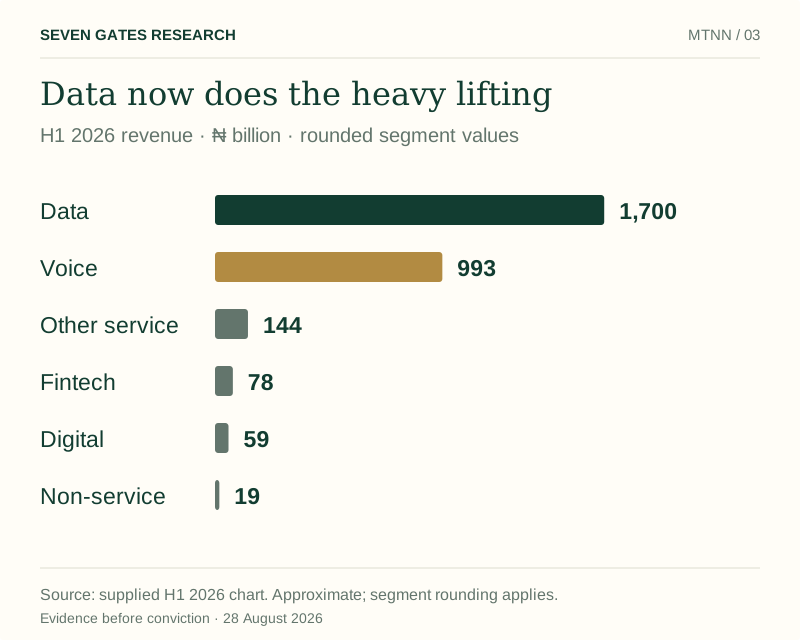
Reference price₦779
Seven Gates viewBUY / ACCUMULATE
Preferred buy zone≤ ₦720
Base value / SOTP₦950 / ~₦935
Research edition · 28 August 2026 · Chart presentation revised; historical observations rounded. Investment thesis unchanged.
The verdict before the sermon
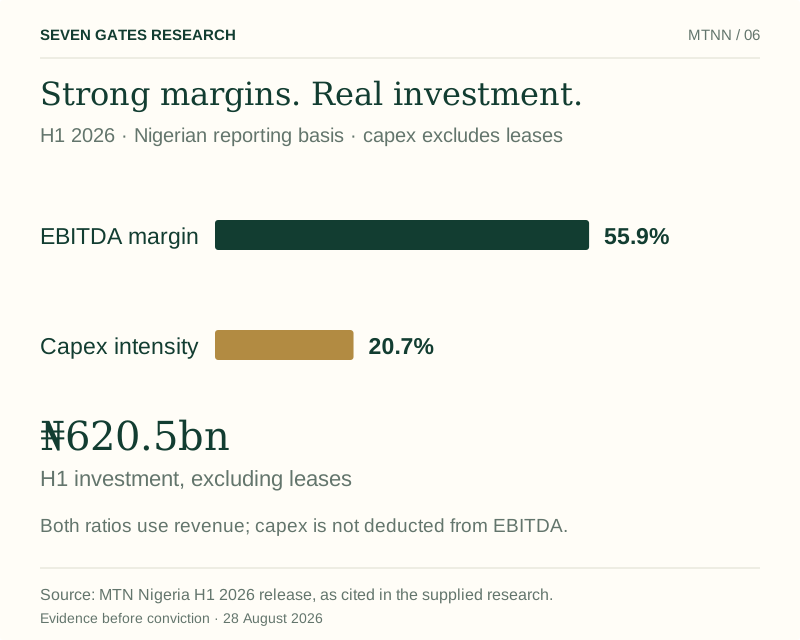
MTN Nigeria has come through the worst of its recent trials and now looks more like a repaired cash machine than a patient on a drip. H1 2026 service revenue rose 25.9% to ₦3.0 trillion, EBITDA rose 39.2% to ₦1.67 trillion, EBITDA margin improved to 55.9%, profit after tax rose 70.6% to ₦707.5 billion, and free cash flow climbed to ₦712.7 billion. Capex excluding leases was ₦620.5 billion, with capex intensity at 20.7%. MTN also closed the half with positive net cash of ₦116.3 billion and no outstanding foreign-currency loans.
The H1 headline was strong. The more useful information came from the subsequent MTN Group results discussion. Q2 service-revenue growth slowed because MTN began lapping the 2025 tariff reset and because the temporary suspension of airtime and data credit services hit fintech. Excluding the airtime-advance disruption, service revenue grew about 28.7%. The service has since restarted through a multi-vendor model.
The investment question has changed. MTN no longer needs to prove it can survive the FX shock. It now needs to prove that data growth, pricing and operating leverage can outrun energy costs and capex.
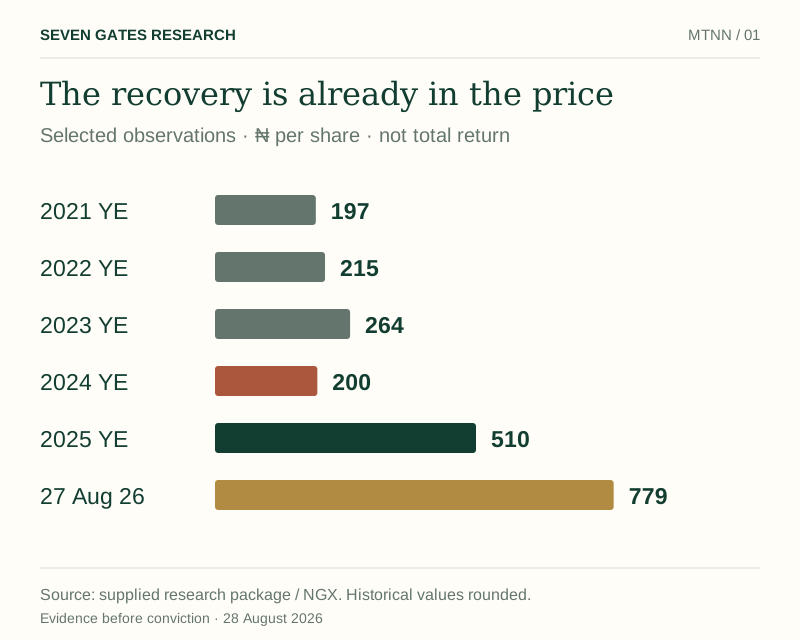
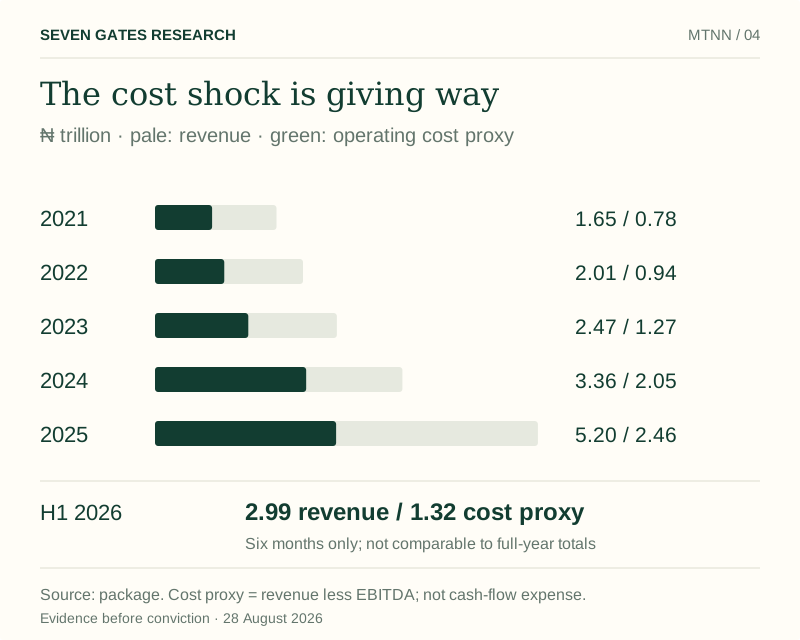
The operating business never stopped growing. Profit briefly vanished.
The clearest way to understand MTN’s last few years is to separate the franchise from the accounting damage. Revenue kept climbing while FX losses and inflation broke the bridge between operating performance and shareholder profit. In 2025, that bridge was repaired. H1 2026 suggests the repair is holding.
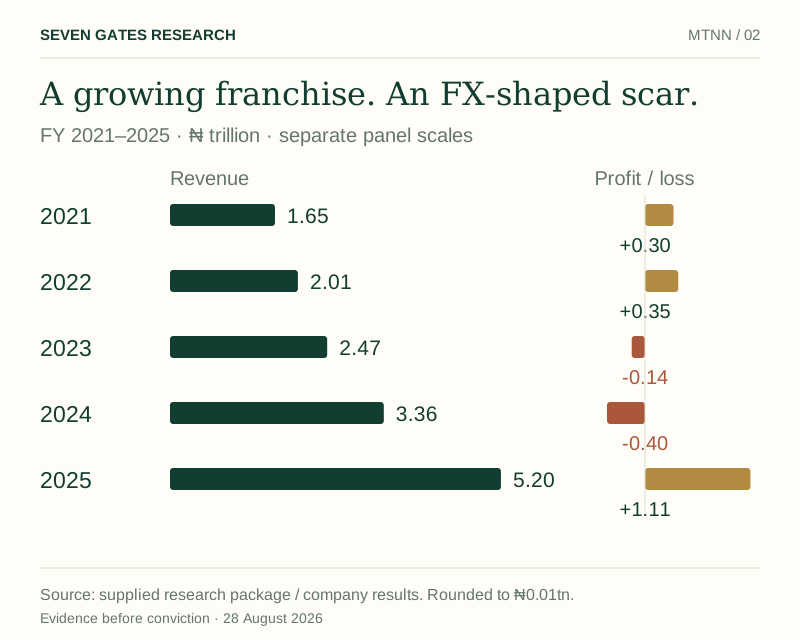
The telecom business never stopped growing. The naira simply arrived with a machete.
Q2 looked slower. Demand did not suddenly disappear.
H1 service revenue grew 25.9%, but Q2 growth was only 13.2%. Two effects explain most of the moderation. The first was the annualisation of the major tariff increases implemented in H1 2025. The second was the temporary suspension of airtime advance from mid-April to early July 2026. MTN Group said neither effect reflected a change in underlying demand. Data revenue still grew strongly, and the eligible airtime-advance base is rebuilding.
This distinction matters. A company whose revenue slows because customers have stopped using its product is one problem. A company whose comparison gets harder while a regulator briefly unplugs one service is another. We are underwriting the second problem.
Data has eaten the telephone company
Data revenue increased 38.4% in H1. Network data traffic rose 25.8%. Average usage per subscriber increased 15.2% to 14.8GB. Active data users reached 55.7 million, while smartphone penetration reached 66.4%. MTN itself calls data its largest structural growth opportunity.
The Nigerian market is therefore not saturated in the way the word is usually deployed. SIM acquisition is maturing. Usage is not. The important staircase remains: feature phone to smartphone, smartphone to 4G and 5G, larger data bundles, home broadband, payments and enterprise services.
The generator has entered the earnings model
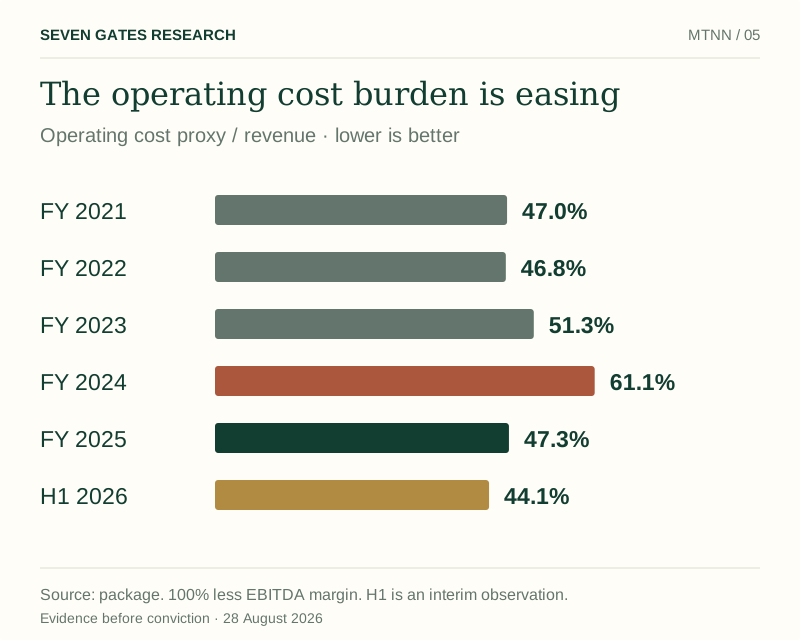
The immediate H2 risk is not customer demand. It is power. Nigerian tower power costs increased in Q2 and are expected to flow into MTN’s site costs during H2 under existing indexation and pass-through arrangements. MTN Group said H1 diesel averaged about ₦1,100/litre, while the Q2 diesel price governing Q3 costs was below ₦1,800/litre. Management has also disclosed that a ₦2,000/litre H2 diesel assumption could materially reduce full-year margins from the H1 run-rate.
What the customer wants
Signal · streaming · payments · cloud · broadband
→
What MTN must provide
Tower · radio · fibre/microwave · compute · cooling · reliable power
Power is therefore not an ESG footnote. It is margin engineering. Better batteries, lower diesel consumption, renewable power, improved grid access and smarter tower-energy contracts can all translate directly into shareholder economics.
Capex is high because the product is physical
MTN spent ₦620.5 billion on capex excluding leases in H1 2026. Capex intensity was 20.7%. Management expects it to moderate in H2. The correct question is not whether capex is high. It is whether incremental capex is producing incremental data traffic, broadband customers, network quality and cash flow.
For now, the answer is sufficiently positive. H1 free cash flow reached ₦712.7 billion despite the investment burden. Capital expenditure is not automatically bad. Bad capex is bad. MTN is putting steel, fibre and radios behind observable demand.
Where the next naira comes from
Core growth
- Mobile data
- Smartphone adoption
- Higher usage and ARPU
- Home broadband
Optionality
- MoMo payments
- Enterprise cloud
- Digital services
- Data infrastructure
Not paid for yet
- 6G fantasies
- A Nigerian digital-credit empire
- Hyperscaler economics
- Every fashionable AI noun
Home broadband
MTN is scaling FTTH and 5G fixed wireless access. That is sensible because fixed broadband remains underpenetrated and households increasingly want reliable high-speed connectivity. FWA allows MTN to monetise existing mobile spectrum and radio infrastructure without digging up every road between Ikoyi and Kano. Fibre remains valuable where density and economics justify the trench.
Enterprise
Enterprise revenue declined marginally in H1 because MTN deliberately cleaned up parts of the portfolio. That is acceptable if low-quality revenue was removed. It becomes less attractive if enterprise remains stagnant into 2027 while MTN invests heavily in cloud, fibre and data infrastructure. Management expects a return to growth. We want evidence.
What comes after 5G?
The commercially relevant answer is not 6G. The investable technology stack over the next five years is 5G + fixed wireless + fibre + cloud/edge infrastructure + AI-assisted network operations + fintech APIs. The important technological change is convergence. The mobile network is becoming an access layer for phones, homes, merchants, enterprises and compute.
MoMo: interesting at last, but still optionality
Fintech revenue declined 7.2% in H1 because the airtime and data credit suspension hit an important contributor. Underneath that disruption, however, the mobile-money business improved sharply. Underlying mobile-money revenue rose about 132% and active wallets increased by 1.3 million to 5.0 million.
That is encouraging. It is not sufficient to value MoMo as though Nigeria were an empty fintech field. The country already has banks, OPay, Moniepoint, PalmPay and enough payment propositions to require crowd control. The metrics that matter next are transaction frequency, merchant activity, take rate, retention and contribution margin, not registrations.
MTN Nigeria is also progressing a structural separation of the fintech business, subject to regulatory approvals. That could create more funding flexibility and make the value of fintech easier to see. We are assigning value to MoMo today, but not much fantasy.
Competition: Airtel has arrived properly dressed
Airtel Africa’s latest quarter was strong. Nigerian revenue grew 29.8%. Group data revenue grew 27.2% in constant currency, EBITDA margin reached 50.1%, and Airtel accelerated network investment sharply, adding more than 920 sites in the quarter across the Group and expanding fibre to 82,100 km.
Airtel is the competitor worth worrying about. It does not need to destroy MTN. It merely needs to force MTN to spend more, subsidise more or surrender some pricing freedom. MTN’s defence remains scale, distribution, spectrum, brand, network utilisation and enterprise relevance.
Telecom moats are unusual because the customer can carry two SIMs. One does not need to storm the castle if the castle has dual-SIM slots.
Governance: the IHS issue deserves minority-shareholder attention
MTN Group is pursuing the acquisition of the roughly 75% of IHS Holdings it does not already own. The FCCPC has conditionally approved the transaction in Nigeria, including a requirement for MTN Group to sell down up to 30% of the Nigerian component over time.
Operationally, greater alignment between network operator and tower infrastructure could be useful. Governance becomes more interesting. If the controlling shareholder also controls a major tower landlord, minority MTN Nigeria shareholders should pay attention to lease pricing, energy charges, capex sharing, renewal terms and related-party approvals.
Vertical integration can remove a quarrel between tenant and landlord. It can also move the quarrel into Note 45.
Geopolitics: mostly an energy transmission mechanism for MTNN
MTN Group still has broader geopolitical exposure, but MTN Nigeria investors should focus on the channels that actually reach this income statement. Middle East disruption can lift oil-product prices, which lifts diesel and tower-energy charges. Global technology disputes can affect device affordability, network equipment and semiconductors. FX volatility can raise imported capex costs.
The good news is that MTN Nigeria has eliminated its outstanding foreign-currency loans. That does not make the company immune to FX. It removes the nastiest version of the problem.
Sum of the parts: paying for the network, not the PowerPoint
A DCF can manufacture decimals faster than it manufactures certainty. A simple SOTP is cleaner here.
| Component | 2026E basis | Multiple | Implied value |
|---|---|---|---|
| Core connectivity | ₦3.2tn EBITDA | 6.0x EV/EBITDA | ₦19.20tn |
| MoMo / fintech | ₦0.15tn revenue | 2.0x EV/Revenue | ₦0.30tn |
| Net cash | H1 2026 reported | 1.0x | ₦0.116tn |
| Total equity value | ₦19.62tn | ||
| Per share | 20.996bn shares | ~₦935 |
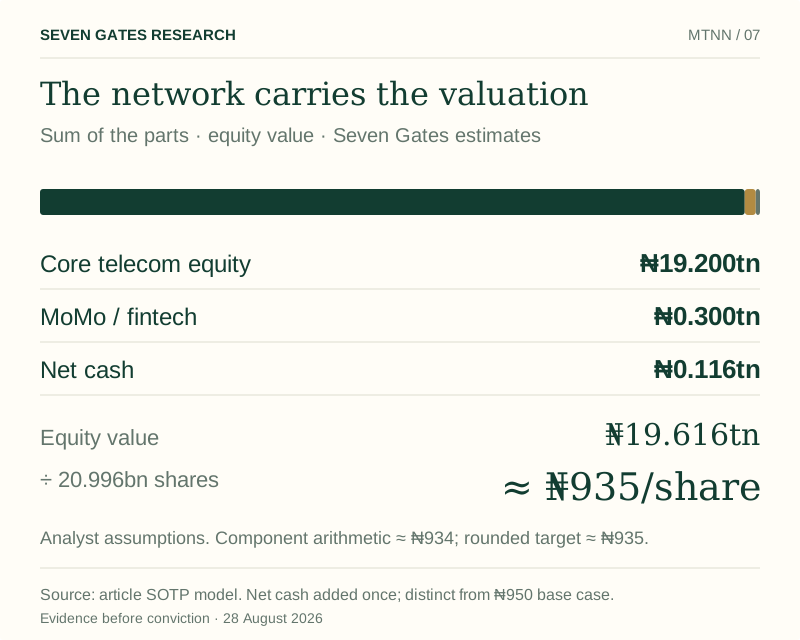
The SOTP is deliberately conservative. We use 6.0x forward EBITDA for the core connectivity business, 2.0x revenue for MoMo/fintech, and add reported H1 net cash. We assign no material standalone value to data centres, enterprise upside surprise or speculative technology optionality.
Scenario valuation
| Case | What happens | Value / share |
|---|---|---|
| Bear | Energy remains expensive, margin falls, capex stays high, Airtel pressures monetisation. | ₦650 |
| Base | Low-20s service growth, mid-50s margin, data remains strong, cash conversion holds. | ₦950 |
| Bull | Energy normalises, broadband and fintech outperform, capex intensity moderates. | ₦1,150 |
What can break the thesis?
| Risk | Severity | What to watch |
|---|---|---|
| Energy / diesel | High | Site-power costs, diesel, EBITDA margin |
| Regulation | High | NCC, FCCPC and CBN actions |
| Airtel competition | Medium-high | Data share, bundle pricing, capex |
| Capex creep | Medium-high | Capex/revenue, free cash flow |
| MoMo disappointment | Medium | Activity per wallet, merchant economics |
| IHS related-party economics | Medium | Lease and energy disclosures |
| FX / imported equipment | Medium | Naira, device affordability, network equipment |
The final judgment
MTN Nigeria is no longer primarily a turnaround. It is becoming a growth-and-cash-return story again. Tariff repair restored the economics. H1 2026 showed what the repaired system can produce. Data demand remains structural, the balance sheet has been de-risked, home broadband provides another runway, and MoMo is finally interesting enough to value without being important enough to rescue the thesis if it disappoints.
The price is no longer absurdly cheap. That gift has gone. But at around ₦779, the shares still trade below our ~₦935 SOTP and ₦950 base value. We would accumulate here and become materially more aggressive at ₦720 or below.
Seven Gates view: BUY / ACCUMULATE.
Stronger buy zone: ≤ ₦720 · Base value: ₦950 · SOTP: ~₦935 · Bear: ₦650 · Bull: ₦1,150.
MTN is no longer trying to prove that it can survive. It is trying to prove that it can grow, invest, pay dividends and still keep the generator from eating the family silver.
That, in Nigeria, is not a trivial ambition.
Sources
- MTN Nigeria, H1 2026 Earnings Release, 30 July 2026.
- MTN Group, H1 2026 results and Nigeria operational review, August 2026.
- Airtel Africa, Q1 FY2027 results, 23 July 2026.
- Nigerian Exchange, MTNN company profile and market data.
- Nigerian Communications Commission, industry statistics.
Research note, not personalised investment advice. Valuation assumptions and scenario values are Seven Gates Research estimates, not company guidance. Market price reference is the NGX price of ₦779 as at 27 August 2026, accessed 28 August 2026. Historical financial charts combine reported annual figures with clearly labelled interim data where applicable.