SEVEN GATES RESEARCH · ESSAY
The Naira Is Not a Footnote in Your Valuation
A 60% gain in Lagos can still leave a dollar investor looking like he attended the wrong party.

At a glance
| Early judgement | Real rally. Wrong unit if used alone. |
| NGX, 2021 to July 2026 | +509% in naira |
| Same NGX move | +83% in US dollars |
| S&P 500, same window | +99% in US dollars |
| Base case | Managed depreciation |
| Investor action | Measure liabilities in their currency |
The Nigerian Exchange is hot. Not warm. Not “showing encouraging signs.” Hot.
The All-Share Index closed July at roughly 245,284 points, having climbed more than 50% in 2026. The S&P 500, that expensive American congregation of artificial intelligence prophets and seven very large companies pretending to be an index, was up about 9.4%.
On the surface, Nigeria has flogged America. Ring the bell. Bring the champagne. Invite D’banj. Mobolowowon.
Except, as every Nigerian discovers sooner or later, the bill may be written in naira but the reckoning has a foreign accent.
The NGX reports in naira. Your Dangote petrol price per litre, your solar panels, your school fees may not. Your summer holiday certainly does not. The machinery imported by the company you own does not care about patriotic sentiment. Neither do aviation fuel, cloud subscriptions, medical equipment, industrial chemicals, or the respectable London hotel that charges £26 for breakfast and then asks whether you enjoyed “the experience.”
So before we declare the NGX champion of the known world, we must ask the vulgar question: champion in what currency?
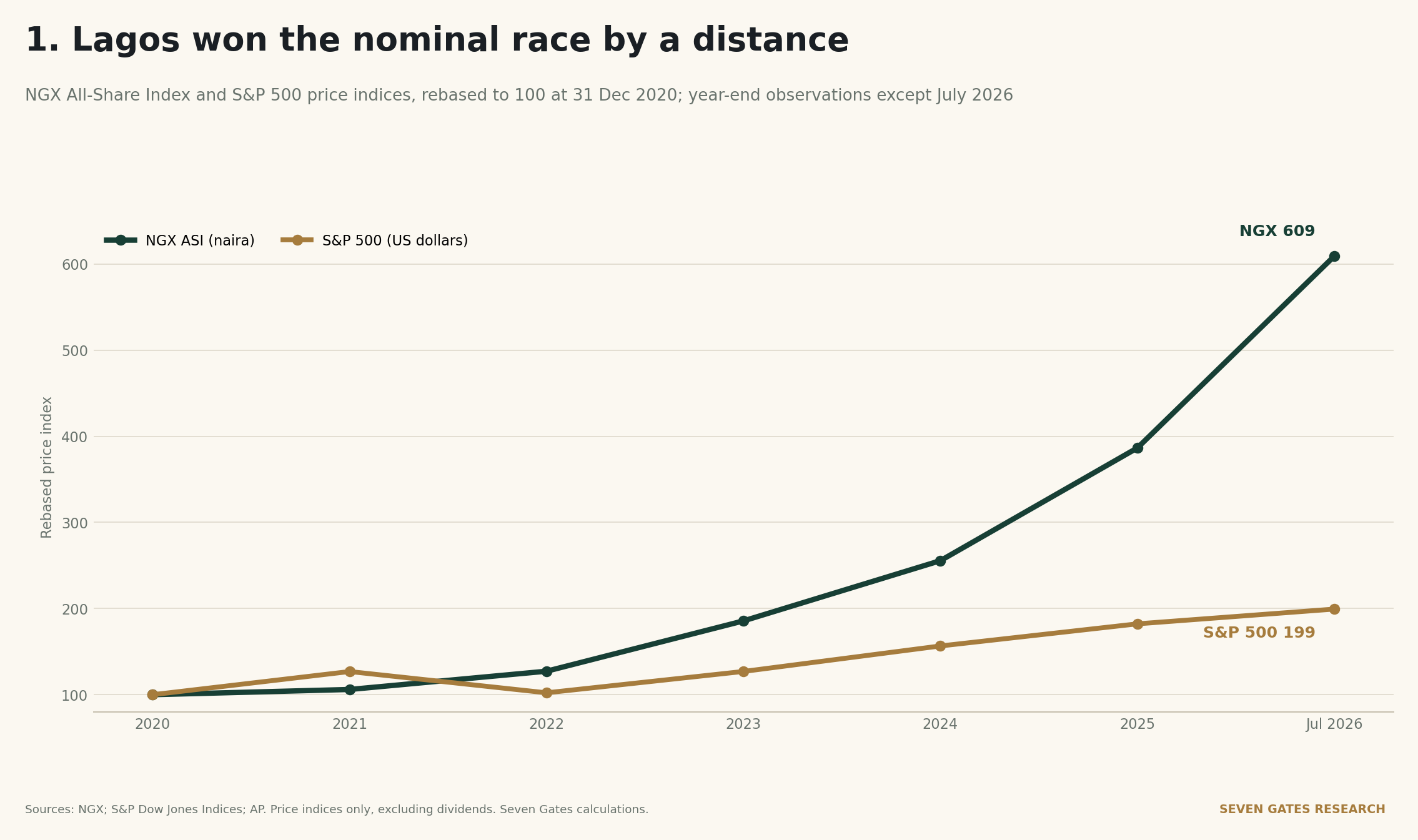
Figure 1. Lagos won the nominal race by a distance. In local index points, this was not a contest. Price indices exclude dividends.
The arithmetic beneath the agbada
A Nigerian stock can rise 40% while the naira falls 25% against the dollar. Your dollar return is not 15%. Currency arithmetic is less generous than that:
This is why the naira is not a footnote in a Nigerian valuation. It is one of the principal characters, usually entering in the third act with documents nobody has read.
Now for the inconvenient wrinkle: in 2026 the currency has helped rather than hurt. From the end of 2025 to July 2026, the NGX rose about 57.6% in naira while the official naira strengthened from roughly ₦1,429 to ₦1,368 per dollar. The translated dollar gain was therefore about 64.6%. Even the naira is entitled to the occasional character reference.
Stretch the lens back to the end of 2020, however, and the sermon returns. The NGX gained roughly 509% in naira, but only about 83% after translation at official end-period exchange rates. The S&P 500 gained about 99% over the same period, before dividends. Lagos won the headline. New York narrowly won the hard-currency bill.
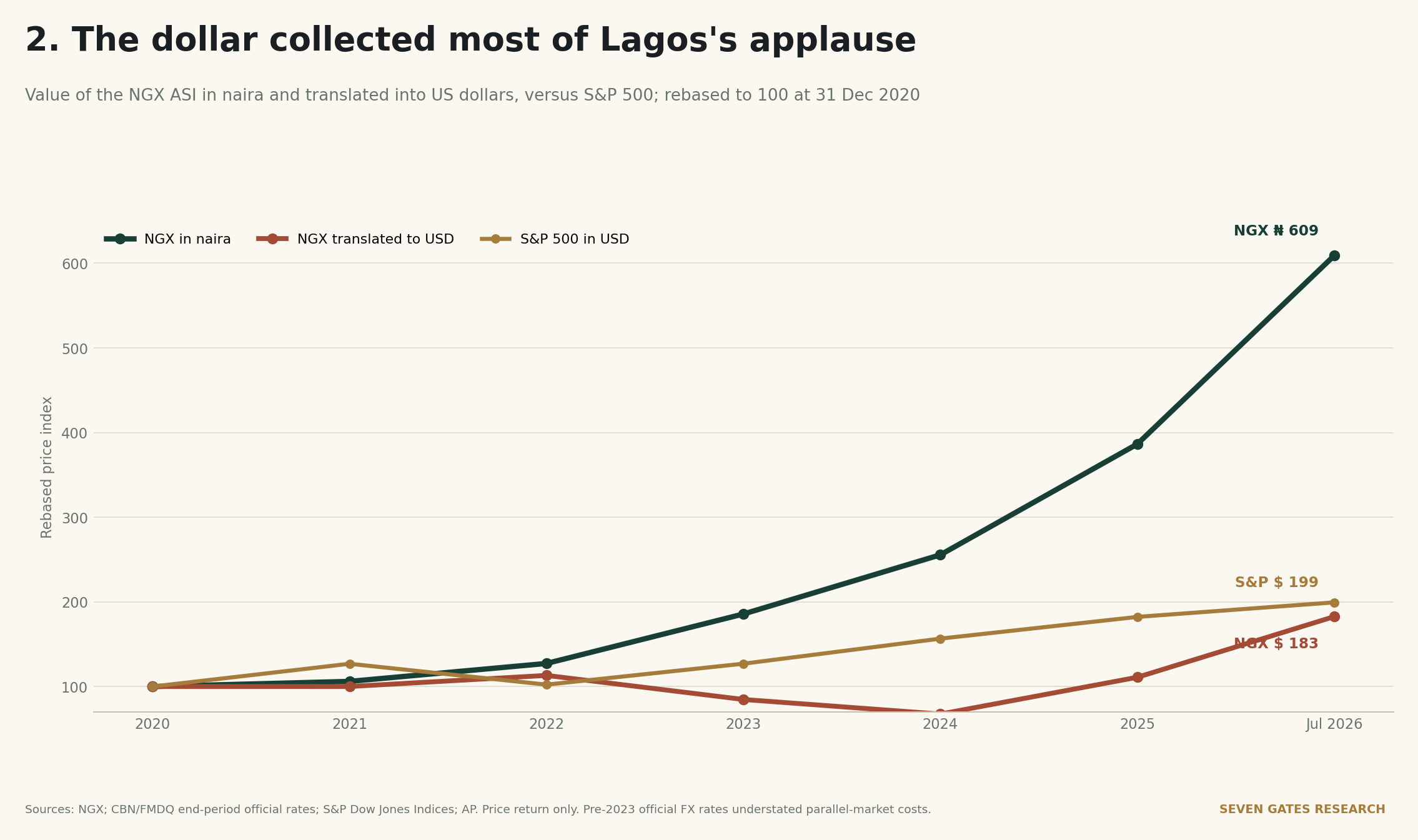
Figure 2. The dollar collected most of Lagos's applause. Currency translation reduces the NGX index from 609 in naira terms to 183 in dollar terms. The S&P 500 reaches 199.
The annual scorecard
Price return only. The NGX dollar return translates the index using official end-period FX rates.
| Period | NGX return | S&P 500 return | ₦ per US$ | NGX return in US$ |
|---|---|---|---|---|
| 2021 | +6.1% | +26.9% | 435 | +0.0% |
| 2022 | +20.0% | -19.4% | 462 | +13.1% |
| 2023 | +45.9% | +24.2% | 899 | -25.1% |
| 2024 | +37.7% | +23.3% | 1,554 | -20.3% |
| 2025 | +51.2% | +16.4% | 1,429 | +64.4% |
| Jan to Jul 2026 | +57.6% | +9.4% | 1,368 | +64.6% |
Sources: NGX, CBN, FMDQ, S&P Dow Jones Indices and AP. Pre-2023 official exchange rates materially understated the parallel-market cost of dollars, so those translated returns are generous to an NGX investor who could not obtain dollars officially.
There is a temptation to dismiss this as the complaint of Nigerians who travel. After all, do you buy your mama put in dollars? Does the woman in Nyanya price akara against the Bloomberg Dollar Spot Index? Does the farmer in Agenebode consult Jerome Powell before selling garri?
No. Mama put is priced in naira. But she is also trading the dollar.
Her cooking oil contains imported inputs. The generator drinks fuel priced against international markets. Fertiliser, spare parts, packaging, transport and medicine all carry some memory of the dollar. The exchange rate enters local life disguised as something else, like a Lagos landlord arriving at your door to “discuss developments in the area.”
You may eat in naira. You travel in dollars. Nigeria produces some things in naira, imports many things in dollars and earns too few dollars outside oil. That contradiction is the national marriage, and King Sunny Adé and Onyeka Onwenu already warned us to wait for me. The naira keeps saying it will catch up. We have been waiting with admirable family discipline.
Credit where it is due
The Central Bank deserves more credit than fashionable cynicism permits.
Nigeria’s gross reserves climbed above $50 billion during 2026, while net reserves had risen to $34.8 billion by the end of 2025, from only $3.99 billion two years earlier. The verified $7 billion FX backlog was cleared. The official foreign-exchange market is more transparent. The gulf between official and parallel rates has narrowed. At the end of July, the official rate was approximately ₦1,368 to the dollar.
This is not nothing. Indeed, in Nigerian public administration, “not nothing” can occasionally qualify as a minor Italian Renaissance.
Under Olayemi Cardoso, the CBN has returned to recognisable central banking. Monetary policy is being conducted with fewer theatrical props. The exchange rate is no longer officially ₦460 while every sentient adult knows the dollar lives elsewhere. Price discovery has improved. Arbitrage has been reduced. The reserves contain fewer stories and more money.
Governance matters. A central bank cannot manufacture crude oil, electricity or exports, but it can stop behaving like a badly supervised development bank with a printing press and an agricultural side hustle.
Still, reserves are not national savings in the way many political speeches suggest. They are an external liquidity buffer. They help defend confidence, settle obligations and smooth disorderly currency movements. They do not belong in a large Ghana-Must-Go bag waiting to fund every road, refinery and gubernatorial inspiration.
Strong reserves buy time. They do not abolish economics.
Managed is not the same as fixed
The naira has been managed over the past few years. Every currency is managed to some degree, including the dollar, which is possibly managed better even if the Fed board does not wear better suits compared to Nigerian bankers.
The relevant question is whether the CBN is smoothing excessive volatility or defending an exchange rate that the balance of payments cannot sustain.
At around ₦1,368 per dollar, the naira appears more stable. But stability can come from several places: genuine dollar inflows, higher oil receipts, remittances, portfolio capital attracted by high interest rates, CBN intervention, or demand that has collapsed because Nigerians can no longer afford imports. Only some of these are flattering.
Hot money is particularly well named. It enters quickly, admires the yields, photographs the buffet and leaves before the chairman’s speech.
Nigeria’s local bond yields have attracted foreign investors. That supports the naira and helps finance government. It also means taxpayers are paying handsomely for the privilege. If US yields rise, oil falls, political risk increases or investors simply become frightened, some of that money can leave with Ebenezer Obey’s calm assurance that the world is a marketplace. Nobody is obliged to sleep in the stall.
The naira therefore looks better managed, not permanently cured.
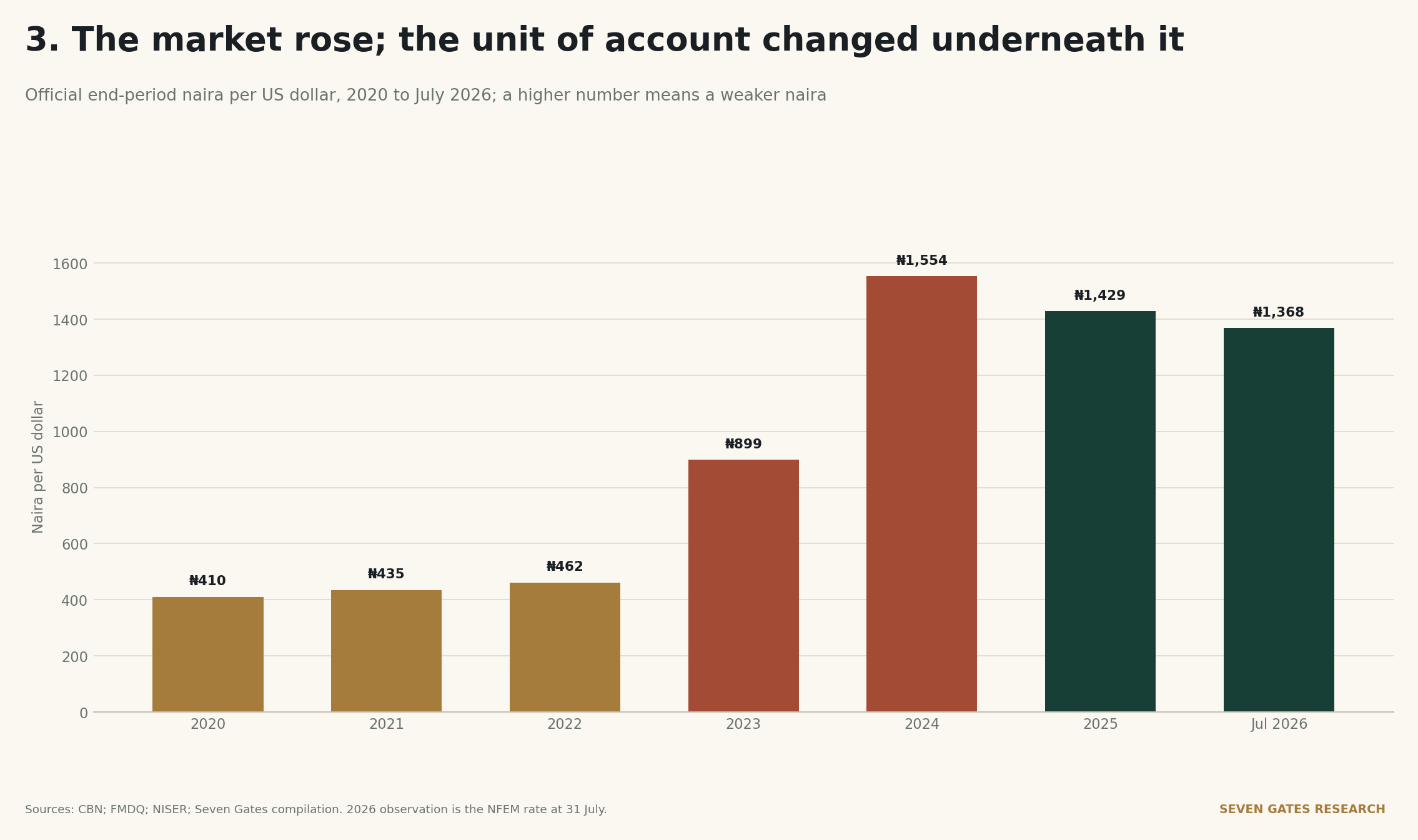
Figure 3. The market rose; the unit of account changed underneath it. Recent strengthening is real. So is the much larger reset that came before it.
Inflation has fallen. Prices have not.
Headline inflation eased to 15.91% in June 2026. This is considerably better than the nightmare years when inflation crossed 30%. Food inflation, however, stood at 17.52%, and food prices rose 3.75% in June alone.
This distinction is routinely tortured in public discussion.
Lower inflation does not mean prices have returned to where they were. It means prices are rising more slowly. If a bus fare moves from ₦300 to ₦700, then rises to ₦750 the following year, inflation has fallen magnificently. The passenger remains unconvinced.
Government celebrates disinflation. The household opens the pot.
This is where NGX triumphalism can become indecent. Stocks are money. Rising equity values improve pensions, strengthen balance sheets and reward savers who refused to leave everything in cash while inflation ate through the cupboard.
But the stock market is not the economy, and the economy is not the lived experience of everybody in it.
A bank share doubling does not materially transform life in Ankpa if wages remain stagnant, transport is punishing and rent has developed the confidence of a private-equity fund. A cement company reaching a record market capitalisation does not console the family in Agenebode deciding whether to buy medicine or food.
The market can be right and the citizen can still be poorer.
Voltaire observed that optimism is the madness of insisting all is well when we are miserable. Nigerian macro commentary has occasionally made a profession of proving him correct.
Is the NGX rally real?
Yes. Also, behave yourself.
The rally reflects more than speculation. Nigerian companies are repricing after years of inflation, currency adjustment and suppressed valuations. Banks have benefited from higher interest income and currency translation gains. Oil and gas companies earn revenues linked to dollars. Telecoms have finally secured tariff relief. Industrial companies possess hard assets whose replacement costs have exploded.
When money loses value, equities can become an escape route. A factory, bank franchise, telecom network, oil reserve or hectare of plantation is often preferable to holding cash and watching it become a historical document.
But not every rising share is creating real wealth.
Some earnings growth is merely inflation wearing cufflinks. A company reporting 35% profit growth when inflation is 16% and the naira has weakened may be doing well, but it has not necessarily discovered fire. Investors must separate volume growth from price increases, operating improvement from FX translation, and genuine returns on capital from the optical enlargement of naira accounts.
The market itself is also becoming expensive in places. Once the choir starts singing that Nigerian equities “can only go up,” locate the exit and check whether your wallet is still present.
Percy Shelley gave us Ozymandias, the great king surveying his vanished empire:
“Look on my Works, ye Mighty, and despair!”
Every bull market eventually builds its own statue in the desert.
Devaluation or no devaluation?
My base case is neither a dramatic one-day devaluation nor a miraculous naira renaissance.
It is managed depreciation.
The CBN now has a stronger reserve buffer and greater credibility. Inflation has moderated. FX-market plumbing is better. These reduce the probability of another disorderly currency collapse.
Yet the structural pressures remain: dependence on oil, large fiscal deficits, heavy debt service, limited non-oil exports, expensive imports, inadequate electricity and a population whose demand for dollars grows faster than domestic dollar production.
The naira could strengthen temporarily if oil receipts remain firm, foreign capital continues to enter and the CBN maintains discipline. But holding it permanently at an artificially strong level would repeat an old Nigerian ceremony: defending yesterday’s exchange rate with tomorrow’s reserves.
The greater risk is not necessarily “devaluation” announced from Abuja. It is a gradual loss of purchasing power, quiet enough to avoid headlines but persistent enough to impoverish anyone measuring wealth solely in naira.
What comes next
For Nigerian investors, the answer is not to abandon the NGX. That would be melodrama masquerading as sophistication.
It is to measure properly.
Track every Nigerian holding in naira, dollars and, if your liabilities are British, sterling. Prefer companies with dollar revenues, export capacity, hard assets, pricing power and limited dependence on imported inputs. Examine whether earnings growth exceeds inflation. Demand dividends that are economically meaningful, not merely ceremonial. Avoid businesses whose profits disappear each time the naira sneezes.
Own Nigerian equities because the companies are good and the valuations compensate you for the risks. Do not own them because the index chart resembles a Pentecostal testimony.
What survives the currency test?
The exchange rate does not treat every NGX company equally.
| Company trait | Why it helps | What can still go wrong |
|---|---|---|
| Dollar revenue or exports | Natural hedge when the naira weakens | Local costs, taxes and political intervention |
| Hard assets and replacement value | Assets reprice as the currency changes | Accounting gains may outrun cash generation |
| Strong local pricing power | Can pass inflation into selling prices | Volumes may collapse when consumers are exhausted |
| Import-dependent inputs | None, unless pricing power is exceptional | Margins disappear each time the naira sneezes |
| Large foreign-currency debt | Potentially useful if matched by dollar cash flow | A currency mismatch can eat the equity |
Nigeria is improving. The reserves are stronger. The central bank is more credible. The FX market is less absurd. Inflation is lower. The stock market is repricing.
All these statements can be true while life remains expensive, wages remain inadequate and the naira remains vulnerable.
Onyeka Onwenu understood that a nation deserves both love and interrogation. She sang it, lived it, and refused to choose between affection and scrutiny.
Sunny Adé understood that rhythm requires patience. He built it slowly, like a conversation that knows it will outlive the room.
Ebenezer Obey understood that wealth without wisdom is merely a well-dressed problem. He turned moral instruction into melody, so even caution could dance.
And the Lokoja Contrarian?
He checks the exchange rate before joining the dance.
Because the NGX may be rising in Lagos, but your wealth must still survive Heathrow.
Research basis and method: NGX closing levels and annual returns; CBN and FMDQ official end-period exchange rates; CBN reserve disclosures; NBS inflation data; S&P 500 closing levels and AP market summaries. All index comparisons are price-only, rebased to 100 at 31 December 2020, and exclude dividends. Dollar-translated NGX values divide the index by the official end-period ₦/US$ rate. Pre-2023 official rates were not freely available to every investor and therefore make historical dollar translation look kinder than lived convertibility. Data cut-off for market comparisons: 31 July 2026. This article is independent research commentary, not personal investment advice.