SEVEN GATES RESEARCH · INITIATING COVERAGE
Dangote Refinery IPO: Three Valuations Before Shift Change
The prospectus confirms an exceptional refinery. At ₦525, the IPO also asks investors to underwrite rich refining margins, high uptime and a $14.3bn expansion with little room for error.
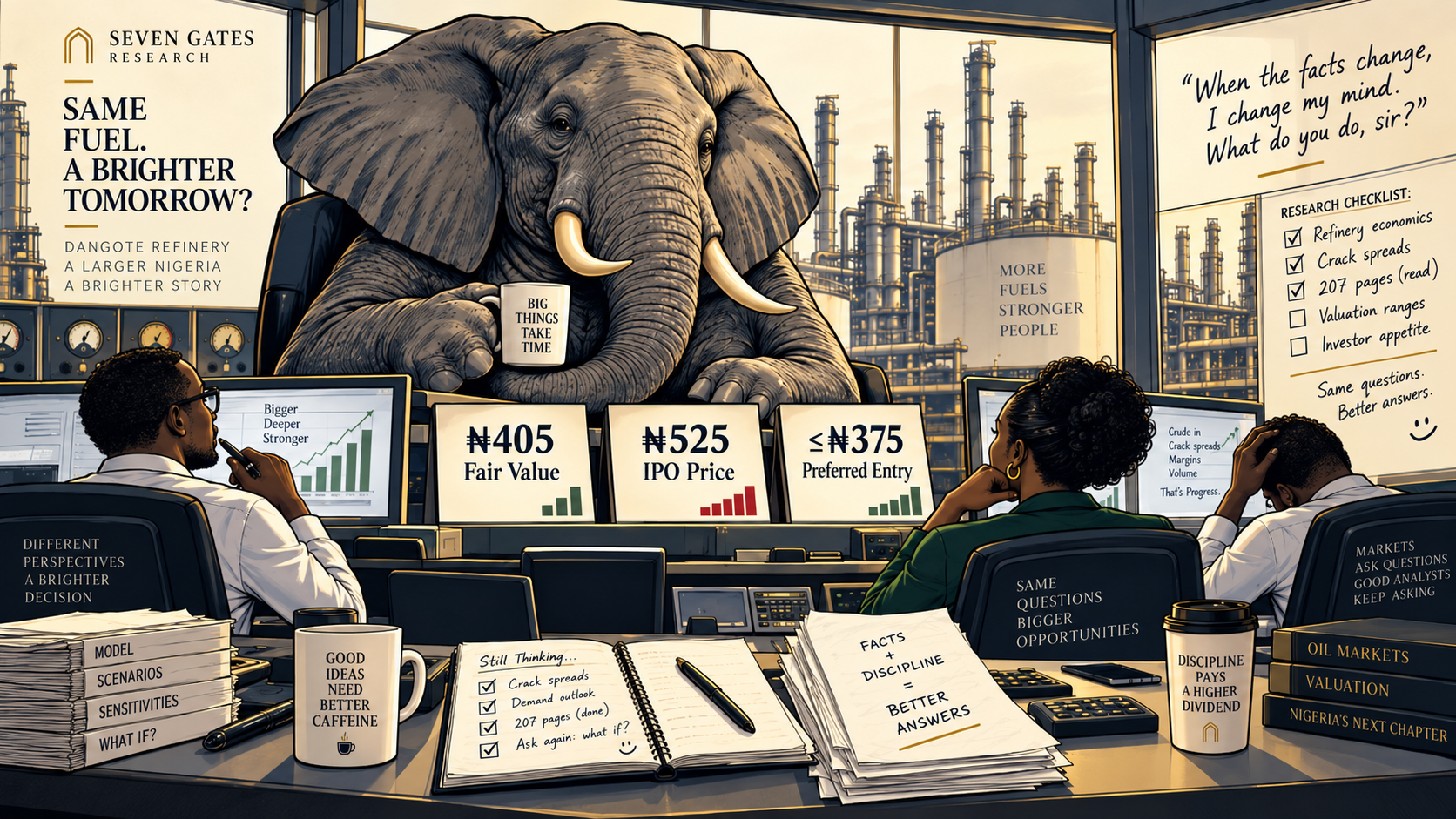
At a glance
| Seven Gates | |
|---|---|
| IPO price | ₦525 |
| Post-offer shares | 124.23bn |
| Implied market capitalisation | ₦65.22tn / ~$47.8bn |
| H1 2026 revenue | $13.91bn |
| H1 2026 PAT | $1.82bn |
| Reconstructed H1 EBITDA | ~$2.60bn |
| H1 operating cash flow | ~$1.27bn |
| Current capacity | 700kbd |
| Expansion target | 1.4m bpd |
| Expansion cost | $14.269bn |
| Management 2026 GRM estimate | ~$24.2/bbl |
| Seven Gates long-run GRM | $19.5/bbl |
| DCF | ₦374 |
| Normalised P/E | ₦413 |
| Peer-adjusted SOTP | ₦453 |
| Seven Gates fair value | ₦405 |
| Seven Gates implied market capitalisation | ~$36.9bn |
| Preferred entry | ≤₦375 |
| View at ₦525 | WAIT |
Seven Gates has had a mildly irresponsible night.
Caffeine supplied the chemistry. LLMs did some of the document archaeology. Sheer love of the game supplied the rest. We went through the 207-page Dangote Petroleum Refinery IPO prospectus, including the parts designed to test whether an equity analyst truly wants the job: tax notes, indebtedness, related parties, working capital, risk factors, definitions of EBITDA and footnotes with the emotional range of a gasket specification.
This is a labour of love. It is also the third time we have changed our mind on Dangote before a respectable control-room crew would have changed shift.
In August, our article Dangote Refinery IPO: The Elephant in the Control Room was written without audited standalone IPO accounts, an official offer price or the prospectus. We deliberately priced the unknowns harshly.
Then the facts changed.
There is a line usually attributed to John Maynard Keynes: “When the facts change, I change my mind. What do you do, sir?” The exact attribution is disputed, which is perfect. We have had to change our mind about the quotation while changing our mind about the refinery.
The audited numbers forced the valuation sharply upward. Then the refinery cycle forced us to ask whether those numbers belong in perpetuity.
Our answer is ₦405 a share, versus the ₦525 offer.
1. The refinery is excellent. The cycle is helping.
H1 2026 revenue was $13.91 billion, PAT $1.82 billion, and reconstructed EBITDA about $2.60 billion. The refinery reached stable full-capacity production across its processing units from March and demonstrated 700kbd during June performance testing. The prospectus also puts its Nelson Complexity Index at 11.5 and says 36 crude grades had been processed by June.
A brief bout of refinery mansplaining follows.
GRM, Gross Refining Margin, is roughly the value of the products you sell minus the crude and feedstock you bought. Imagine buying flour and selling bread, croissants and one suspiciously expensive pain au chocolat. GRM is the spread before the baker, electricity, maintenance, tax, interest and the compressor that chooses Tuesday afternoon to discover spirituality have been paid.
Effective utilisation is the percentage of theoretical capacity actually processed over time. A 700kbd refinery at 90% effective utilisation averages 630kbd. The missing 70kbd accommodates turnarounds, trips, maintenance and machinery's constitutional right to inconvenience management.
And NCI 11.5 is not a GCSE result. The Nelson Complexity Index measures how sophisticated the conversion kit is. Dangote is closer to a Swiss Army knife than a kettle. That flexibility is valuable, but complexity also supplies more equipment capable of requiring attention.
The last five years contain exceptionally rich refining conditions. Dangote's 2026 GRM estimate is around $24.2/bbl. We therefore fade long-run GRM to $19.5, above the 20-year external proxy but below today's excitement.
Taleb's turkey is useful here. Every breakfast strengthens the bird's confidence that the farmer is benevolent, right up to the observation that does not fit the model. Six good months prove that Dangote can make serious money. They do not prove that refining cycles have been repealed.
2. $100 oil does not automatically kill the thesis
Brent is now above $100/bbl. If crude rises and petrol, diesel and jet prices rise proportionately, the refining spread can survive. If crude outruns products, the crack compresses. If geopolitical disruption removes both crude and competing refining capacity, product scarcity can widen margins. The current market contains some of that last effect.
The less glamorous problem is working capital. Thirty days of crude at 700kbd is roughly 21 million barrels. Moving crude from $70 to $100 increases the value tied up in that illustrative inventory by about $630 million. At 1.4m bpd, double it.
H1 provides the warning: roughly $2.6bn of reconstructed EBITDA generated about $1.27bn of operating cash flow. EBITDA is an attractive house guest. Cash pays the mortgage.
3. We do not assume 95% utilisation forever
Performance-test capacity and sustainable annual throughput are different animals. The prospectus records planned CDU and RFCC shutdowns around year-end 2025 and early 2026 and explicitly warns about operational interruptions.
Our DCF starts the existing plant around 90% effective utilisation, declining towards 86% as the asset matures. Downtime is embedded in that assumption, so we do not deduct a second theatrical turnaround afterwards.
4. The moat is real. Government policy is not the moat.
Competitive imports are not theoretical. Nigeria abandoned a proposed 15% petrol and diesel import duty in 2025, and import competition remains part of the commercial landscape.
Dangote's moat is more durable than a tariff. It has enormous scale, NCI 11.5 complexity, crude flexibility, deep-water marine infrastructure, storage, integrated petrochemicals and proximity to a large fuel-deficit region. A trader can import a cargo. Replicating this complex requires somebody to volunteer for another multi-billion-dollar megaproject and several years of character development.
But this is a cost, logistics and configuration moat, not a statutory right to $24 refining margins. Imports can discipline domestic pricing. At 1.4m bpd, the marginal barrel increasingly competes internationally anyway.
5. The expansion deserves an elephant's memory
The prospectus budgets $14.269bn to expand capacity towards 1.4m bpd. Net IPO proceeds fund only about 11% of that amount; the balance is expected from operating cash generation and financing.
Here I struggle to forget the first refinery's long journey from announcement to commercial reality.
Any project engineer will tell you a Gantt chart is only as good as logistics, interfaces and the final system handover. The plant can look 97% complete, senior management can see steel everywhere, and then the readiness team discovers a Punch A item. Suddenly Operations wants another barrier, Engineering has found a drawing revision, HSE needs a risk assessment and twelve adults are discussing something that somebody confidently said yesterday would take one day.
I've been there too many times.
The joke that the final 10% takes 90% of the schedule is an exaggeration. I digress. On certain Tuesdays it can feel optimistic.
We therefore do not switch on 700kbd of new capacity overnight. Our DCF gives the second train a commissioning and ramp period, with no meaningful incremental throughput before 2031 in the base case.
6. Four models, because one spreadsheet can lie very confidently
Our base assumptions are explicit: ₦1,364/$ translation, 124.229bn post-offer shares, $23/bbl H2 2026 GRM, $21.5 in 2027, $20 in 2028, $19.5 long-run GRM, existing effective utilisation around 90% fading towards 86%, full $14.269bn expansion capex, second-train ramp of roughly 45%/80%/89%, mature combined sustaining capex around $1.2bn a year, cash tax moving towards 20%, 12% USD WACC and 2% terminal growth.
The DCF gives ₦374, normalised P/E ₦413, peer-adjusted SOTP ₦453, and an existing-business earning-power floor about ₦323. Weighting those lenses produces roughly ₦405.
As a market sanity check, current EV/EBITDA ranges from about 6x for HF Sinclair to roughly 12x for Phillips 66, with Valero and Marathon Petroleum in the high single digits. Dangote at ₦525 is around 9x annualised H1 EBITDA, but closer to 10.6x our normalised existing-business EBITDA.
The number
Dangote Refinery is a formidable asset. I would rather own this refinery than compete against it.
Those are asset judgements. ₦525 is a security price.
Our fair-value range is ₦320 to ₦510, central value ₦405, with ≤₦375 the level where the asymmetry starts becoming interesting.
The case that makes us wrong is plausible: GRM stays above $22, effective utilisation settles close to 90% through a full turnaround cycle, the expansion arrives near budget, financing remains sensible, imports do not materially erode netbacks and 1.4m bpd becomes an efficient Atlantic Basin export machine. In that world, ₦525 can work.
The opposite case is simpler: crude stays expensive while products normalise, cracks revert towards long-run means, uptime proves less heroic than a performance test, and $14.3bn of expansion capex arrives with the usual megaproject souvenirs.
The refinery can still be excellent in that world.
The share can still have been expensive.
When the facts change, change the model. Strong opinions, loosely held. Capital, rather more tightly.
And if the facts change again before the night shift goes home, we reserve the right to change our mind a fourth time.
Sources and methodology
Primary company figures are from the Dangote Petroleum Refinery and Petrochemicals FZE Initial Public Offering Prospectus dated 7 September 2026, cleared and registered with the Nigerian SEC. Market context includes Reuters reporting on Brent above $100/bbl and Nigerian import policy. External crack spreads are a Seven Gates reconstruction from Alon USA and Delek US annual filings and are used only as a cyclical benchmark. Peer multiples are September 2026 market ratios. DCF, EPV, normalised earnings, SOTP, utilisation and GRM assumptions are Seven Gates estimates, not company guidance.
Important: DPRP has not yet commenced public trading, so there is no genuine five-year stock-price history to plot. We will add the standard Seven Gates price chart once an actual trading history exists.
Disclaimer
This publication is for informational and educational purposes only and does not constitute financial, investment, tax or legal advice, or a recommendation, solicitation or invitation to buy or sell any security. Valuation estimates depend on assumptions that may prove wrong. Readers should independently verify the evidence, review the prospectus and obtain appropriate professional advice before making an investment decision.