SEVEN GATES DAILY BRIEF
Nigeria's expansion is broadening; price pressure is broader still
Nigeria's PMI shows a fifth month of expansion and renewed price pressure, South Africa enters coalition negotiations, a tanker attack kills a seafarer, and AI capital becomes more selective.
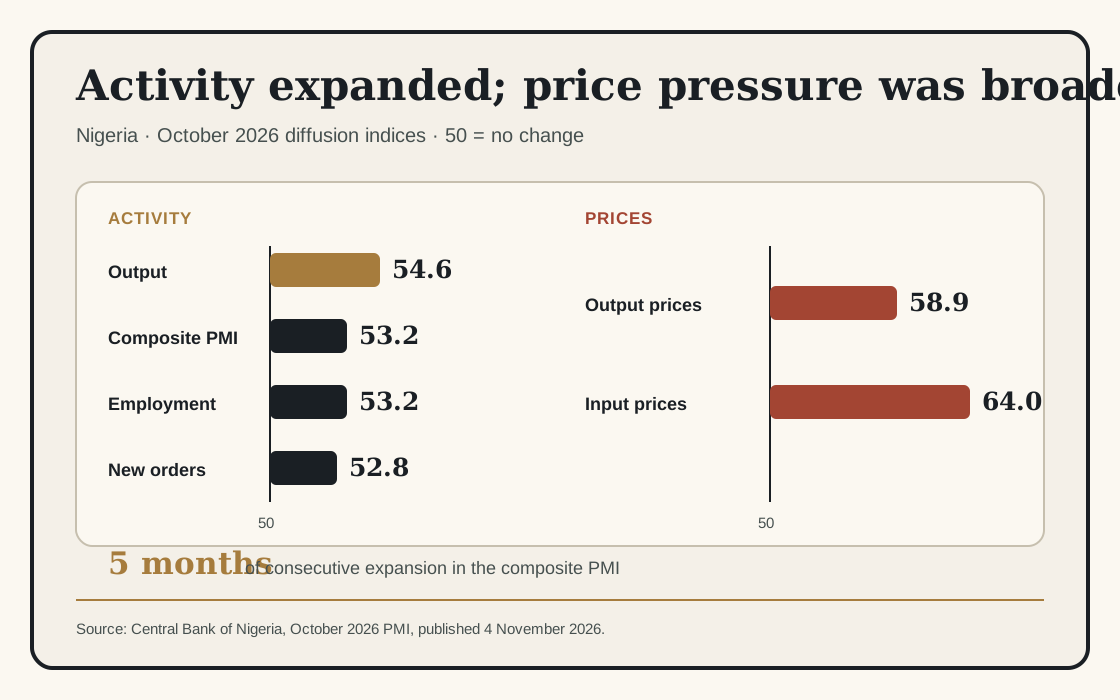
Nigeria's private economy expanded for a fifth consecutive month in October. The stronger message sits beneath the headline: output, new orders and employment all remained above the 50-point threshold, while the input-price index climbed to 64.0. Demand is improving, but price increases remain more widespread than activity growth.
1. Nigeria's recovery is gaining breadth and price pressure
The Central Bank of Nigeria's composite Purchasing Managers' Index rose from 53.0 in September to 53.2. Agriculture led at 54.7, industry increased to 52.6 and services eased to 52.7 while remaining in expansion. Twenty-four of 32 subsectors expanded.
The internal readings are encouraging. Output reached 54.6, new orders 52.8 and employment 53.2. Yet input prices rose to 64.0 and output prices to 58.9. Firms are selling more and hiring, but many are also paying more and passing part of that increase to customers. That combination supports near-term growth while limiting how quickly inflation and interest rates can fall.
For Nigerian businesses, the next test is margin quality. A durable expansion needs orders and output to keep rising without another widening between input costs and selling prices.
Source: Central Bank of Nigeria October PMI, published 4 November.
2. South Africa's local vote has broken the old municipal arithmetic
With 96.1% of voting districts counted late Friday, the ANC had 31.1% of national support, down from 45.6% in 2021. The DA stood at 24.5%, while the new MK party had 9.6%. Of 184 councils declared at that point, 118 were hung and only 66 had a party majority.
The result shifts political risk from polling day to coalition formation. Johannesburg, Tshwane and other large councils will depend on agreements among parties that competed against one another on service delivery and corruption. Stable coalitions could improve accountability. Repeated leadership changes would delay procurement, infrastructure maintenance and payments to suppliers.
Nigeria should watch the institutional lesson. Competitive politics can dislodge a dominant party, but fragmented councils need enforceable coalition agreements, public performance targets and clear rules for removing executives.
Sources: South African IEC results feed, updated 6 November; Reuters count report, 6 November.
3. The Gulf tanker attack has now killed a crew member
Velos Tankers confirmed that one seafarer died after an explosion struck the empty product tanker Velos Sapphire north of Qatar. The crew extinguished the fire, no other injuries or pollution were reported, and the ship reached Bahrain. The suspected missile's origin remains unidentified.
Yesterday, crew status was unconfirmed. The fatality changes the incident from a freight and insurance risk into a human loss. Continued attacks will raise crew danger, war-risk premiums and the cost of moving oil products even when crude prices fall. Nigeria can receive less revenue from cheaper oil while still paying higher shipping and fuel-import costs.
Sources: UKMTO incident 196, 5 November; Reuters fatality report, 6 November.
4. OpenAI raised capital, with a lower valuation than it first sought
OpenAI closed $11 billion of new funding at a reported $1.25 trillion valuation. The amount is part of a round originally targeting as much as $30 billion, while investors said the company had initially sought a $1.5 trillion valuation.
Private capital remains available after the public-market AI rout, but the terms show more selectivity. Funding at a lower valuation preserves expansion capacity while acknowledging regulatory, power and return risks. For African technology firms, the lesson is practical: capital will favour products with measurable revenue, reliable infrastructure and a credible path to cash generation.
Source: Reuters, 6 November.
5. Congo wants its minerals agreement measured in completed projects
After the second US-Congo strategic-minerals steering meeting, Congo asked for local processing, wider electricity access and completed investments. The joint statement cited a larger pipeline, the Lobito Corridor and discussions on Grand Inga, but announced no new financing commitments or named projects for funding.
That gap defines the industrial-policy test across Africa. Resource access creates negotiating power only when agreements produce plants, power, logistics and local capability. Nigeria faces the same test in lithium, gas and critical-mineral policy: signed frameworks need funded schedules and operating assets.
Source: Reuters, 6 November.
Three numbers worth remembering
- 64.0: Nigeria's October input-price diffusion index.
- 118: South African councils already declared hung late Friday.
- $1.25tn: OpenAI's reported valuation in its latest funding.
What could change everything?
Falling Nigerian price indices alongside stronger orders would improve the growth-inflation mix. Durable coalition agreements could turn South Africa's fragmented vote into functioning councils. Identification of the tanker attacker, or a verified navigation accord, would reset Gulf shipping risk. OpenAI closing the rest of its targeted round, and Congo naming financed projects with timetables, would convert reported pipelines into executable commitments.
Prepared for 7 November 2026 using information available by 6:00 a.m. London. Election totals remained provisional at the cut-off. Company funding terms, conflict reports and partnership claims are attributed. Calculations, Nigerian transmission and judgements are Seven Gates analysis.