SEVEN GATES DAILY BRIEF
Atiku's candidacy now depends on an appeal before January
A court removes a leading Nigerian challenger, AI fears drive a global equity rout, the Bank of England raises rates and tanker attacks continue in the Gulf.
A Federal High Court has voided Atiku Abubakar's nomination as the African Democratic Congress candidate for Nigeria's January presidential election. The ruling also set aside the process that produced the party leadership which nominated him. The ADC says it will appeal and seek a stay. With the vote about two months away, one of the principal opposition campaigns now has to run alongside a compressed appellate case.
1. Nigeria's opposition contest has moved into the courts
Justice Peter Lifu held that the David Mark-led ADC caretaker committee was improperly constituted and directed the electoral commission not to recognise decisions flowing from the disputed party process. Local reporting says the consequential orders affect other ADC candidates as well as Atiku; the party was still awaiting the certified judgment before defining the full scope.
The ADC points to a July ruling from another Federal High Court judge that affirmed its leadership and says the new decision conflicts with it. Those arguments now belong to the Court of Appeal and potentially the Supreme Court. Until appellate relief arrives, legal uncertainty will consume campaign time and complicate ballot planning.
The Nigerian transmission is political and economic. A competitive election needs settled rules early enough for parties, voters and the electoral commission to act on them. Investors can tolerate an adverse judgment more easily than a late, unresolved dispute over who may appear on the ballot.
Sources: Reuters, 5 November; Premium Times ruling report, 5 November; Voice of Nigeria appeal report, 5 November.
2. The AI trade suffered a global margin call
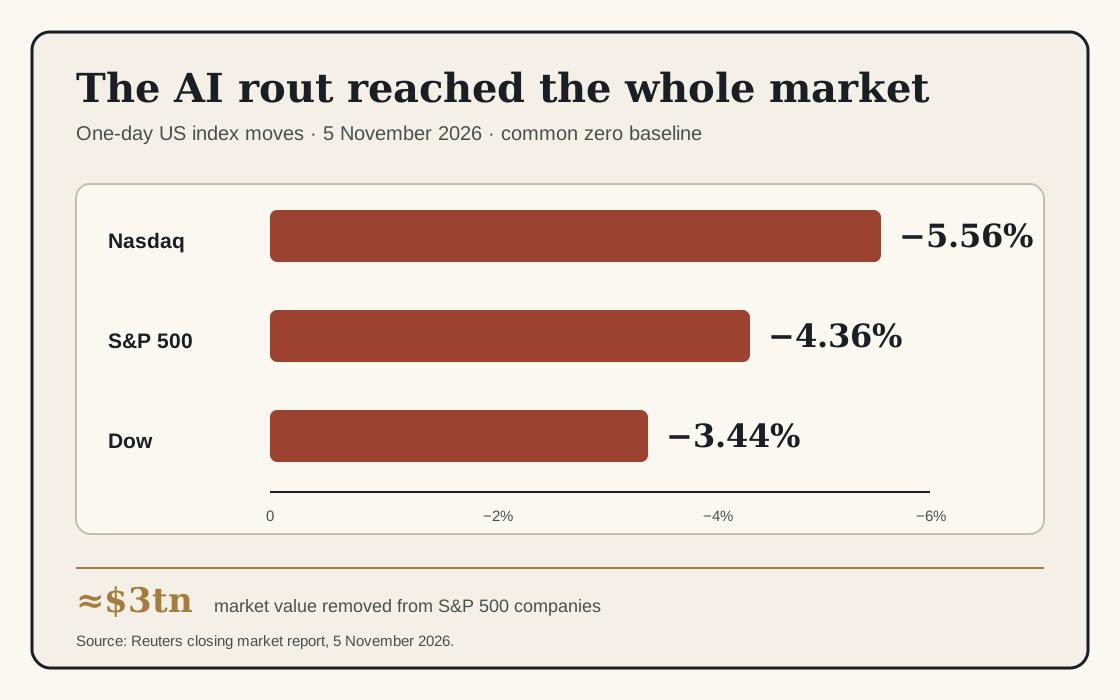
The Nasdaq Composite fell 5.56% on Thursday, its largest daily decline in 19 months. The S&P 500 lost 4.36% and the Dow 3.44%, removing roughly $3 trillion from S&P 500 companies. On Friday, South Korea's KOSPI fell more than 8% at the open and triggered a 20-minute circuit breaker; Taiwan and Japan also recorded steep technology-led falls.
The political trigger was concern that a Democratic Congress and newly elected state governments could slow data-centre permits, protect consumers from electricity costs and require independent AI testing. Existing doubts about returns on enormous infrastructure spending amplified the move. Forced selling across Asian chip markets shows how one concentrated investment thesis can transmit through collateral and margin rules.
Nigeria's direct equity exposure is limited, but global risk appetite affects Eurobond pricing, venture funding and technology valuations. The durable test is whether cloud demand, cash flow and contracted power capacity weaken. A one-day selloff measures positioning and fear before it measures operating demand.
Sources: Reuters US close, 5 November; Reuters Asia markets, 6 November.
3. The Bank of England raised Bank Rate to 4%
The Monetary Policy Committee voted 8–1 to raise Bank Rate by 25 basis points to 4%. Catherine Mann preferred 4.25%. UK inflation reached 3.5% in September, and the Bank now expects it to approach 5% by mid-2027 as Middle East energy disruption reaches fuel, utility bills and other prices.
The Bank has not committed to another increase. It will watch wages, business pricing and spare capacity for evidence that the energy shock is spreading. For Nigerians, tighter UK policy raises borrowing costs for households and businesses with sterling debt, while slower British demand can affect exports and remittances. It also adds to the global rate backdrop facing Nigeria's new external borrowing plan.
Sources: Bank of England decision and minutes, 5 November; Bank of England decision explainer, 5 November.
4. Tanker attacks continued while oil prices fell
UK maritime authorities reported that a tanker 50 nautical miles north of Qatar was struck by two unidentified projectiles on Wednesday night. Crew status, damage and environmental impact were unconfirmed at the initial report. It was at least the fifth vessel incident reported since Sunday. Iran separately attributed three Thursday tanker events to mines or fire, claims that were not independently verified.
Oil prices were still more than $20 below the previous week's level as traders priced a better chance of diplomacy after the US election. Physical danger and a falling futures price can coexist. Nigeria receives less crude revenue at lower prices while shipowners, fuel importers and consumers may continue to pay elevated insurance and freight costs.
Sources: UKMTO incident 196, 5 November; Reuters, 5 November.
Three numbers worth remembering
- 5.56%: the Nasdaq Composite's one-day fall.
- 4%: the new Bank of England policy rate.
- At least 5: reported Gulf vessel incidents since Sunday.
What could change everything?
An appellate stay and expedited judgment would clarify the ADC's ballot position. Enacted data-centre rules, cancelled projects or weaker cloud orders would show whether the AI selloff has an operating basis. Softer UK wages and pricing could halt further rate increases. A verified Gulf navigation agreement would reduce physical shipping risk; additional attacks would increase it.
Prepared for 6 November 2026 using information available by 6:00 a.m. London. Court orders, party claims, conflict reports and market estimates are attributed. Calculations, Nigerian transmission and judgements are Seven Gates analysis.