SEVEN GATES DAILY BRIEF
South Africa can absorb AGOA's loss; exposed sectors cannot
Washington removes South Africa and Rwanda from AGOA, a US strike complicates Iran talks, Australia raises rates and OpenAI proposes flexible data-centre demand.
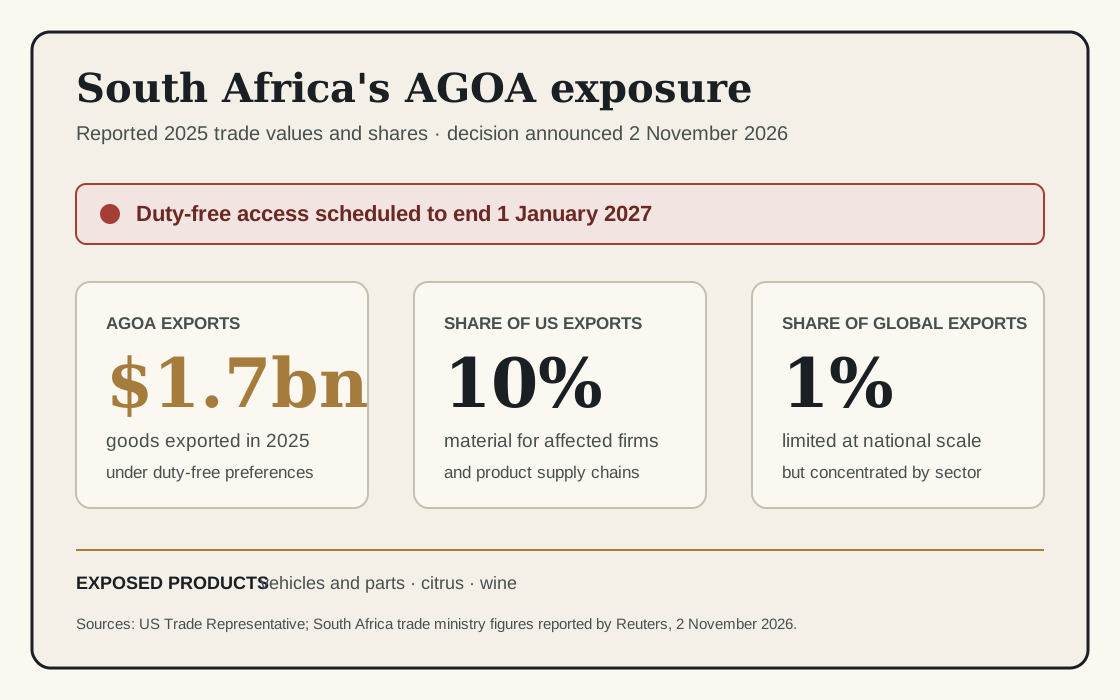
South Africa exported about $1.7 billion of goods to the United States under AGOA in 2025. That was only 1% of its global exports, according to its trade ministry. The small national share does not make the loss painless. Vehicle plants, citrus growers and wine producers experience the tariff change where it lands, not as an average across the economy.
1. South Africa and Rwanda will lose AGOA access on 1 January
The US Trade Representative said President Donald Trump had notified Congress that South Africa and Rwanda would leave the African Growth and Opportunity Act programme on 1 January 2027. Washington cited trade and investment barriers, national-security concerns and, for Rwanda, rule-of-law and human-rights issues. The notice gave no product-level tariff schedule or reinstatement test.
South Africa is AGOA's largest beneficiary. Its programme exports were about 10% of its sales to the US and 1% of total global exports. The government says it will support affected sectors and accelerate market diversification. Rwanda already lacked AGOA apparel benefits; coffee and minerals now face the wider change.
Nigeria's lesson is to measure policy dependence before an annual eligibility review becomes a commercial deadline. Government should publish product-level exposure, affected jobs and alternative-market capacity. Exporters need tariff scenarios by contract, not reassurance based on a small national percentage.
Sources: US Trade Representative, 2 November; Reuters, 2 November.
2. A US strike has complicated the route to an Iran agreement
Brent fell more than 7% on Monday as Iran-Qatar contacts raised hopes of a settlement, then edged back to $104.80 after US officials reported strikes on Iran's Qeshm Island. Some described the action as defensive protection for commercial shipping. Tehran says contacts with Washington continue, but revised proposals have not produced a breakthrough.
The price response is useful evidence. Traders still assign value to diplomacy, but military action can restore the risk premium before physical supply is damaged. The Strait of Hormuz carried about one-fifth of global crude and gas supplies before the war reduced traffic.
Nigeria's fiscal receipts may benefit from expensive oil, while transport, imported fuel and food absorb the shipping and inflation cost. Safe passage and a durable agreement remain more valuable than a brief price increase.
Source: Reuters, 3 November.
3. Australia delivered its fifth rate increase of 2026
The Reserve Bank of Australia raised its cash rate by 25 basis points to 4.85%, the highest since 2008. Six members voted to increase and three preferred 4.60%. Five increases this year have added 125 basis points.
The bank said fuel costs, domestic capacity pressure and AI-related technology demand had broadened inflation. It expects inflation to remain above 3% for the coming year, even as housing prices fall and unemployment rises. This is a difficult combination: weaker activity has not yet removed the price pressure.
For Nigeria, another advanced-economy increase reinforces the external test facing local easing. Global yields, oil inflation and dollar demand can keep frontier funding expensive even when domestic inflation improves.
Sources: Reserve Bank of Australia, 3 November; Reuters, 3 November.
4. OpenAI has proposed making data centres interruptible loads
OpenAI launched a programme under which future compute campuses would reduce electricity use when grids are strained. Its planned Georgia campus includes up to 1,000 megawatts of flexible demand response, which the company says is equivalent to average demand from roughly 700,000 households. It also promises to pay the infrastructure and service costs created by the project.
The proposal is material because it turns grid flexibility into a contract term. It is not yet a national operating record. Future agreements will vary by location, and the Georgia campus is still in development.
Nigeria should require the same discipline from large digital loads: dedicated capacity, curtailment rules, payment security and public evidence that households are not subsidising private compute. A data-centre announcement without a power contract remains an intention.
Source: OpenAI, 2 November.
Three numbers worth remembering
- $1.7 billion: South Africa's reported AGOA exports in 2025.
- 4.85%: Australia's new cash-rate target.
- 1,000 MW: flexible demand response proposed for OpenAI's Georgia campus.
What could change everything?
A product-level tariff schedule or a negotiated AGOA remedy would define the actual sector loss. A verified Hormuz navigation agreement would remove part of oil's risk premium; further strikes would do the reverse. Softer inflation could end Australia's tightening cycle. The first measured grid event at an OpenAI campus would test whether promised flexibility works under stress.
Prepared for 3 November 2026 using information available by 6:00 a.m. London. Government, company and conflict claims are attributed; calculations, Nigerian transmission and judgements are Seven Gates analysis.