SEVEN GATES DAILY BRIEF
Nigeria's $7.7 billion request leaves the borrowing price open
Nigeria revises its external borrowing request, South Africa begins coalition arithmetic, Arm reports stronger AI demand and oil gives back part of its war premium.
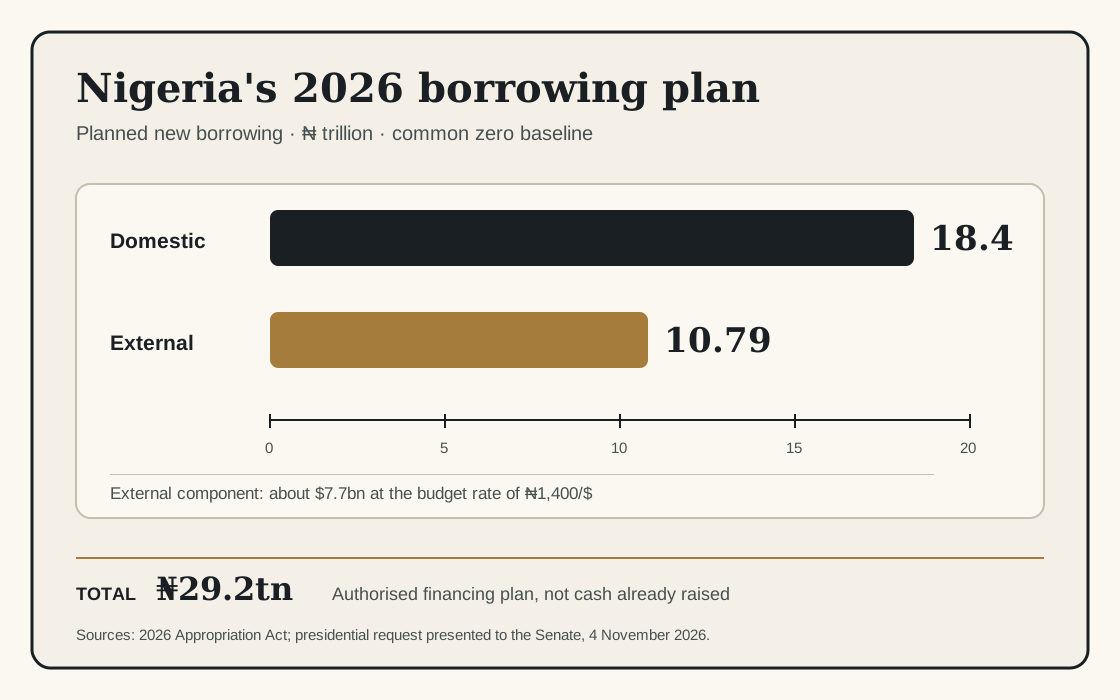
Nigeria's revised external borrowing request is smaller than the figure sent to lawmakers in October, but the apparent reduction needs careful treatment. President Bola Tinubu now seeks approval for $7.7 billion, equivalent to ₦10.79 trillion at the budget rate, specifically for the external component of the 2026 budget. The earlier request covered a broader 2026–2027 plan. Cost, maturity and lender mix will determine whether the new financing supports productive assets or increases foreign-currency pressure.
1. Nigeria has defined the amount before the terms
The 2026 budget provides for ₦29.2 trillion of new borrowing: ₦18.4 trillion domestic and ₦10.79 trillion external. The president's letter allows multilateral and bilateral loans, syndicated or bridge facilities and Eurobonds. It gives no interest rate, repayment period or final allocation among those channels. The Senate referred the request to its debt committee.
The government says the money will support transport, power, agriculture, security, education and healthcare. That project list is broad. Legislative approval should require a facility-level schedule covering disbursement, currency, maturity, expected economic return and debt-service source. Eurobonds can be raised quickly, but speed can be expensive when global yields or the naira move against the borrower.
The relevant Nigerian transmission is direct: dollar debt can finance infrastructure and add reserves at disbursement, then raise naira debt service if the currency weakens. The financing term sheet is the next evidence to watch; the two requests cover different time horizons.
Sources: Reuters, 4 November; Budget Office, 2026 Appropriation Act details, 10 August; State House, 2026 budget assent, 17 April.
2. South Africa's early count points to coalition bargaining
With roughly 12% of votes counted early Thursday, the African National Congress had about 32% and the Democratic Alliance about 31%. A Council for Scientific and Industrial Research projection put the parties near 32% and 26% respectively. The difference shows why a partial count cannot settle the national ranking: populous Gauteng and KwaZulu-Natal remained incomplete.
Municipal control will depend on council-by-council seats and coalition agreements, particularly in large cities. Water, roads, planning and waste services make those negotiations economically material. A national percentage cannot identify which councils will govern coherently.
For Nigeria, the useful comparison is administrative. Local accountability improves when results, coalition agreements, budgets and service outcomes can be traced at the same geographic level. National party totals are a poor substitute for that record.
Sources: South African Electoral Commission results portal, 5 November; Reuters early count, 5 November.
3. Arm's AI demand is reaching royalties and new products
Arm reported fiscal second-quarter revenue of $1.44 billion, 27% above the prior year and ahead of its guidance midpoint. Licence revenue rose 50%, while data-centre royalties doubled. The company expects its new AGI processor to generate $2 billion of revenue across fiscal 2027 and 2028.
This is stronger evidence than an AI partnership announcement because demand is appearing in reported licence and royalty lines. The remaining risk is execution: the AGI processor moves Arm from licensing designs toward selling silicon, with greater capital, supply-chain and customer-concentration exposure.
Nigeria will capture little semiconductor value without reliable power, technical training and data-centre demand. Universities and cloud buyers can still use Arm's expanding server position to negotiate skills, local capacity and energy commitments rather than celebrate a distant revenue number.
Sources: Arm shareholder letter, 4 November; Reuters, 4 November.
4. Oil has surrendered part of its war premium
Brent fell for a fourth session to $93.82 a barrel by 4:26 a.m. London, after dropping more than 8% on Wednesday. Traders reduced their estimate of immediate escalation risk after the US midterms, while JPMorgan estimated an oil surplus of 1.4 million barrels a day in October. Hormuz traffic has recovered close to pre-war volumes, although insurance and freight remain costly.
Nigeria now faces the reverse of October's price benefit. Lower crude can ease imported fuel and transport costs, yet it also reduces fiscal and export revenue unless production rises. Four falling sessions do not resolve the Iran war or remove shipping risk. Budget planning should use realised production and a conservative price, with any excess revenue treated as temporary.
Sources: Reuters oil update, 5 November; US Energy Information Administration weekly data.
Three numbers worth remembering
- ₦29.2 trillion: planned new borrowing in Nigeria's 2026 budget.
- About 12%: share of South African local-election votes counted in the early snapshot.
- $1.44 billion: Arm's fiscal second-quarter revenue.
What could change everything?
Nigeria's eventual interest rates, maturities and lender mix will determine the debt-service burden. Final South African council results and signed coalition agreements will determine governability. A durable Iran settlement could remove more of oil's risk premium; a new attack could restore it quickly. Arm's first AGI processor shipments will test whether its move into silicon earns acceptable returns.
Prepared for 5 November 2026 using information available by 6:00 a.m. London. Election results are preliminary; company forecasts, conflict reporting and market estimates are attributed. Calculations, Nigerian transmission and judgements are Seven Gates analysis.