SEVEN GATES DAILY BRIEF
Democrats won Congress; veto power survived
US voters handed Democrats both chambers, South Africa opens a national local-election vote, Gulf oil flows weakened and AI entered the engineering workshop.
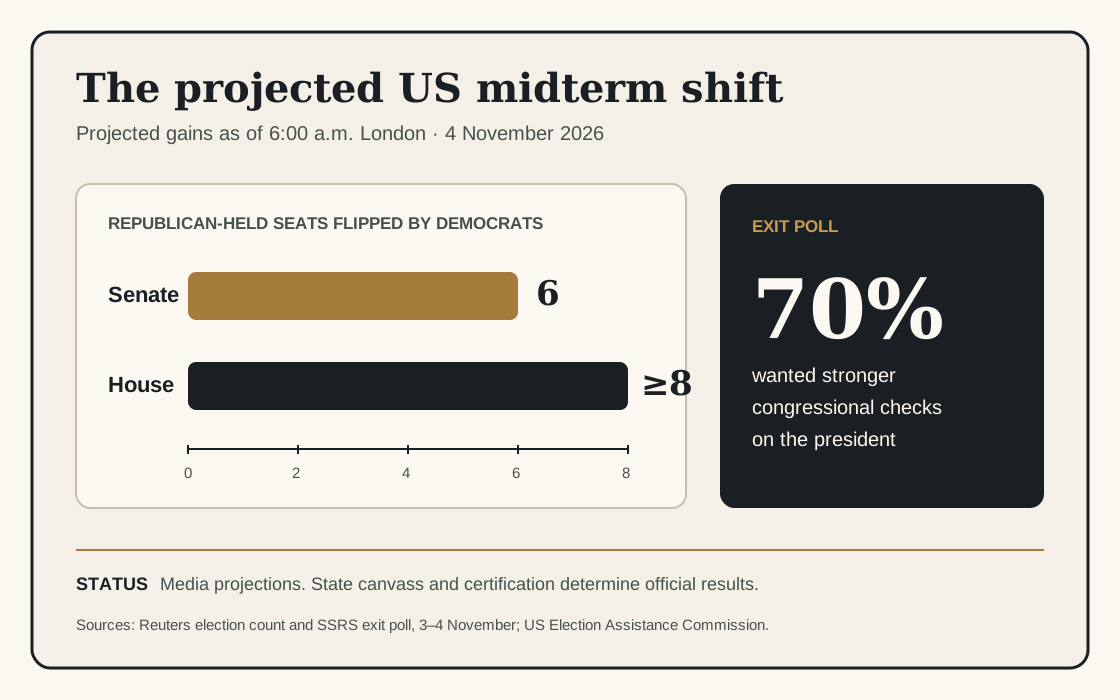
American voters delivered a large change in political control, not a transfer of the presidency. Democrats are projected to hold both chambers of Congress after flipping six Republican Senate seats and at least eight House seats. President Donald Trump still controls the executive branch and retains the veto. The next two years therefore begin with stronger oversight and weaker legislative freedom, alongside a high probability of institutional conflict.
1. Democrats captured both chambers of Congress
The Democratic gains reached Texas, South Carolina, Kansas, Iowa and Ohio, states that had looked beyond reach. An SSRS exit poll found that 70% of voters wanted Congress to provide stronger checks and balances on the president. Cost-of-living pressure and the Iran war featured prominently in the result.
Markets immediately priced a narrower path for deficit expansion and new data-centre construction. US futures fell, the dollar weakened and the two-year Treasury yield dropped nearly eight basis points. Those moves are provisional. Democrats lack a veto-proof Senate majority, while governors and congressional committees can still change permitting, investigations and political risk without passing a major federal law.
Nigeria could receive some relief through a softer dollar and lower global yields. The larger lesson is institutional: a decisive election can constrain an executive before it produces a new policy programme. Investors should track actual votes on tariffs, war powers, spending and AI infrastructure rather than treating a party sweep as enacted law.
Sources: Reuters election report, 3 November; Reuters markets briefing, 4 November; US Election Assistance Commission on certification.
2. South Africa begins a national test of local government
South Africa opened 23,696 voting stations for local elections today, with 29.2 million people registered and 188,000 election officials deployed. Before election day, 1,425,942 people cast special ballots. That equals 53.7% of the 2,655,067 voters approved for the arrangement; the ballots remain sealed until ordinary voting ends.
The contest matters beyond party rankings. Municipal governments control services that shape household welfare and business operations, including water, roads, planning and waste. Final results will test whether dissatisfaction changes local coalitions and administrative control.
Nigeria should study the access mechanism and publish comparable operational evidence for its own elections: approved applications, completed home visits, station openings, material failures and resolved incidents. Participation figures are useful only when administrators also show whether eligible voters could exercise the right safely.
Sources: South African Electoral Commission readiness statement, 1 November; SAnews special-vote report, 3 November; SAnews election-day readiness, 3 November.
3. Gulf oil exports fell below September's recovery high
Vortexa estimated October Gulf crude, condensate and refined-product exports at 17.1 million barrels a day, down from 18.9 million in September and about three-quarters of pre-war levels. Crude and condensate had recovered to 86% of normal, while refined products remained just above half.
The estimates may be revised upward because more tankers are switching off tracking signals during record attacks around Hormuz. That uncertainty is commercially important. Nigeria can gain fiscal revenue from high crude prices while paying more for freight, imported products and inflation. Brent near $104 does not establish that Nigerian production, remittances or real household income have improved.
Sources: Reuters Gulf-flow analysis, 3 November; Reuters oil update, 4 November.
4. AI moved from code into manufacturing review
OpenAI said two people used its Astra model to design a test device in under a week, after which a contract manufacturer produced a small prototype batch in under a month. A newer internal model scored 0.875 on BenchCAD 2.0 against 0.594 for GPT-6 Astra. The company also disclosed an engineering collaboration with Mazda.
The caveat is the useful part. Manufacturing still required several rounds of human review because the model missed production limits, tolerances and assembly detail. Nigerian firms and universities can use these tools to shorten drawing, simulation and documentation work, but procurement should measure manufacturability, defect rates and engineer time saved. A benchmark score is not a finished product.
Source: OpenAI, 3 November.
Three numbers worth remembering
- 6: projected Republican Senate seats flipped by Democrats.
- 1,425,942: South Africans who cast special local-election ballots.
- 17.1 million bpd: estimated October Gulf oil flows, excluding LPG and Iran.
What could change everything?
Certified US margins and the first cross-party votes will show whether the sweep becomes legislation or prolonged veto conflict. South Africa's turnout, coalition arithmetic and audited municipal results will determine whether today's logistics produce governable councils. A verified Hormuz navigation agreement would reduce freight risk; renewed attacks would deepen it. Independent factory trials would show whether AI engineering gains survive tolerances, tooling and quality control.
Prepared for 4 November 2026 using information available by 6:00 a.m. London. Election results are preliminary; company claims, conflict reports and shipping estimates are attributed. Calculations, Nigerian transmission and judgements are Seven Gates analysis.