SEVEN GATES DAILY BRIEF
Korea's export boom shows where the AI money is landing
South Korean exports expose the scale of AI hardware demand, Gulf diplomacy reaches Doha, Dangote gains a strategic Cameroon outlet and US ballot disputes intensify before the midterms.
South Korea has supplied the strongest answer yet to a difficult question about the artificial-intelligence boom: where is the spending visible outside company forecasts? It is moving through factories and across borders, at extraordinary scale.
1. Korea's trade data turns AI demand into physical evidence
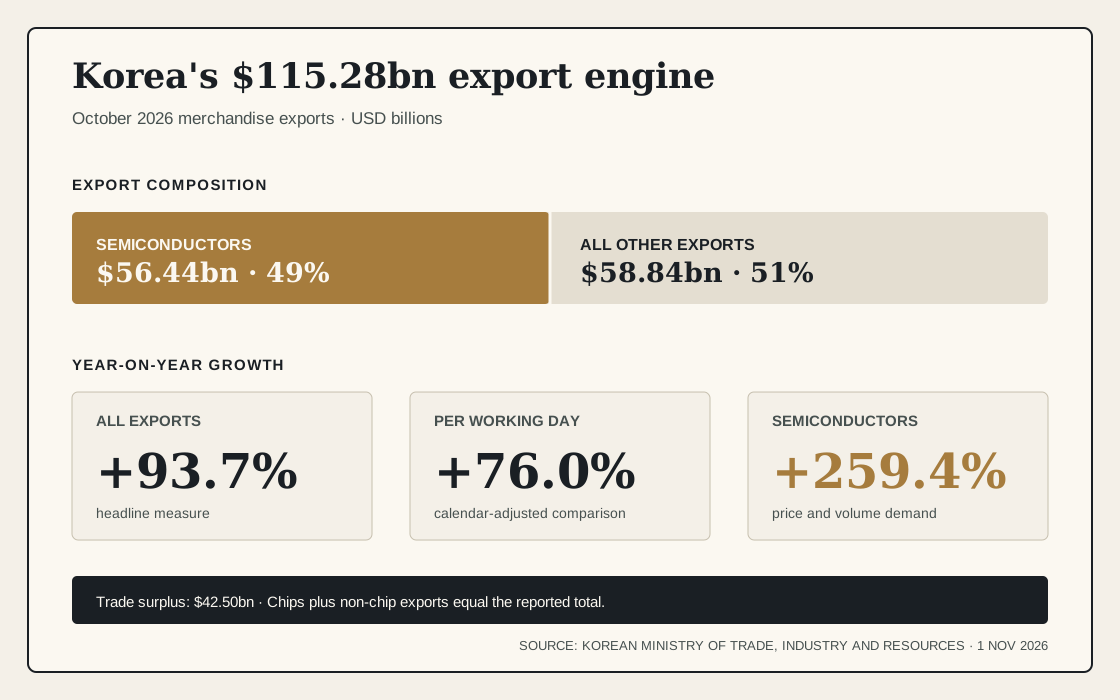
South Korean exports reached a record $115.28 billion in October, up 93.7% from a year earlier. Calendar effects helped because there were more working days, but average daily exports still rose 76%. Semiconductor shipments increased 259.4% to $56.44 billion, while computer exports rose 496.6%. Chips supplied 49% of the month's exports.
This does not settle whether every data-centre investment will earn an adequate return. It does show that the buildout is producing orders, volumes and trade surpluses now. Korea's $42.5 billion monthly surplus also illustrates the concentration of gains among countries that control scarce hardware.
The comparison needs discipline. Non-semiconductor exports also rose 34%, so this was broader than one product line, while the holiday effect makes the headline growth rate unsuitable as a clean forecast. The daily measure and the dollar value are the more durable signals.
Nigeria's direct exposure is mostly through cost and capital. More demand for chips and servers raises the dollar price of digital infrastructure, while foreign investors can choose profitable hardware exporters over frontier assets. The practical Nigerian response is disciplined procurement, shared infrastructure and products that earn revenue before imported equipment becomes obsolete.
Sources: Korean Ministry of Trade, Industry and Resources, 1 November; Reuters, 1 November.
2. Iran and Qatar have moved the Gulf decision into a negotiating room
Iranian negotiators met Qatari mediators in Doha on Saturday after more than 12 hours of talks in Tehran. The channel is active, but agreement is distant. Qatar's seven-day confidence-building proposal was judged insufficient by Iran, while Tehran's plan links reopening the Strait of Hormuz to a port-blockade end, unfrozen assets and an approved shipping route. US Secretary of State Marco Rubio said President Donald Trump had not decided on renewed strikes and preferred a diplomatic outcome.
For Nigeria, the transmission is immediate: Gulf escalation lifts crude receipts but also the landing cost of fuel, shipping and imported inputs. A durable navigation agreement matters more to household inflation than another temporary oil-price spike.
The immediate test is whether mediation produces reciprocal steps that ships, insurers and commodity traders can observe. Statements of preference do not lower freight costs; safe passage and enforceable commitments can.
Sources: Reuters, 31 October; Qatar Ministry of Foreign Affairs, 27 October.
3. Dangote has secured a regional outlet, with the economics still undisclosed
Cameroon's state refiner Sonara signed an agreement with Dangote Group and Lagos-based MRS Oil & Gas to supply refined fuel. Cameroon has depended entirely on imported products since a 2019 explosion disabled its only refinery. The announcement reported by Reuters did not specify volumes, prices, delivery dates or contract duration.
The strategic direction is clear. A Nigerian refinery is becoming part of Central Africa's supply security, and MRS adds finance and logistics. The commercial verdict requires cargo schedules, payment terms and evidence that shorter routes reduce delivered cost. Regional market share matters only if barrels generate cash and domestic Nigerian supply remains reliable.
Source: Reuters, 30 October.
4. US election disputes are testing rules before votes are counted
More than 51 million Americans had voted early by Saturday, ahead of Tuesday's midterms. At the same time, the US government has pursued emergency action over more than 20,000 California mail ballots and an investigation affecting Alaska's close Senate race. The Ninth Circuit rejected the requested California relief, finding that the government had not justified the extraordinary intervention on the record before it.
The market consequence depends on the result, but the institutional consequence begins earlier. Clear court orders, intact ballots and acceptance of verified counts reduce the risk that a fiscal or regulatory shift becomes a legitimacy crisis.
For global portfolios, the difference is material. A conventional change of congressional control can be priced through taxes, spending and regulation. A contested count adds uncertainty about the authority to make those policies at all.
Sources: Ninth Circuit order, 30 October; Reuters, 31 October.
Three numbers worth remembering
- $115.28 billion: South Korea's October exports.
- 49%: the semiconductor share of that export total.
- 51 million: Americans who had voted before the final campaign weekend.
What could change everything?
A reversal in Korean chip orders would challenge the strongest physical evidence for the AI cycle. A Gulf navigation agreement would lower the risk premium on fuel and freight. Published Cameroon cargo terms could turn a strategic announcement into measurable Nigerian export cash flow. In the United States, court compliance and an accepted count would contain the institutional risk; ballot seizures or disputed certification would enlarge it.
Prepared for 1 November 2026 using information available by 6:00 a.m. London. Official and company claims are attributed; calculations, Nigerian transmission and judgements are Seven Gates analysis.