SEVEN GATES DAILY BRIEF
Nigeria's Ebola testing has held the confirmed count at one
Repeat tests clear two suspected Nigerian Ebola cases, Hormuz shipping risk rises, Binance faces a live withdrawal test and a US court protects Alaska's secret ballot.
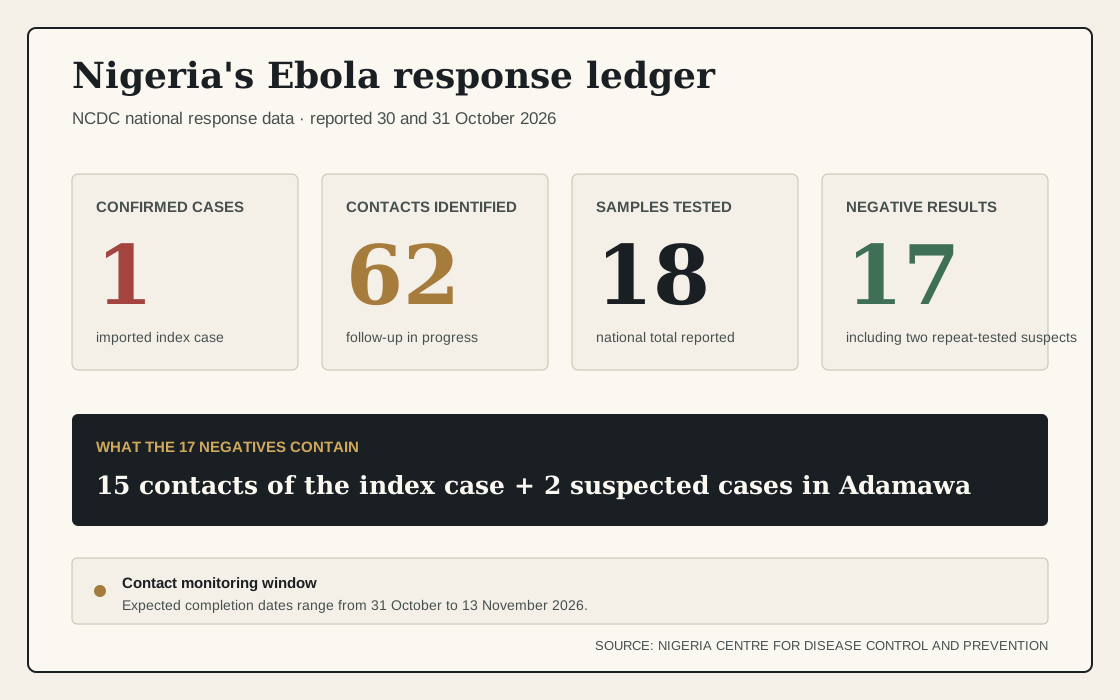
Two patients in Adamawa State who showed symptoms consistent with Ebola have tested negative twice. The result reduces the immediate risk of local transmission. It also shows why the remaining contact follow-up matters: early reassurance is useful only when surveillance continues.
1. Nigeria's repeat tests keep the confirmed count at one
The Nigeria Centre for Disease Control and Prevention said both suspected Adamawa cases were isolated and tested negative after two rounds. Its latest situation report records 18 samples tested, comprising the imported index case, 15 contacts and the two suspected cases. One result was positive and 17 were negative. Authorities identified 62 contacts, with monitoring scheduled to finish between 31 October and 13 November.
Nigeria's only confirmed case remains a Swiss traveller who arrived from Uganda and was later evacuated with her husband. The wider Bundibugyo Ebola outbreak has killed more than 5,000 people in the Democratic Republic of Congo, according to Reuters, and there is no approved vaccine or treatment for this species.
The operational test is now quiet persistence: complete every contact's monitoring period, investigate symptoms rapidly and publish changes without delay. The economic benefit of containment is avoided disruption to travel, schools, commerce and health services. A secondary case would change that assessment immediately.
Sources: NCDC Adamawa update, 31 October; NCDC situation report, 30 October; Reuters, 1 November.
2. Reported tanker explosions raise the cost of waiting for a Gulf agreement
Iran's Revolutionary Guard navy said two tankers exploded after striking mines while using what it called an unauthorised route through the Strait of Hormuz. Iranian state media carried the claim; independent confirmation, casualty information and environmental impact were not available in the initial report.
On the same day, seven OPEC+ countries kept December production targets unchanged and scheduled their next meeting for 29 November. Brent slipped to $111.72 early Monday as Iran-Qatar talks continued, after rising 13.6% in October. Production targets cannot remove the insurance, freight and delay costs created by unsafe passage.
Nigeria may receive more dollars per exported barrel, while households and businesses pay more for imported fuel, transport and goods. Safe, verifiable navigation would improve the balance more than a temporary price windfall.
Sources: Reuters on the tankers, 1 November; OPEC, 1 November; Reuters market report via CNA, 2 November.
3. Binance has reached the withdrawal stage of its credibility test
Binance restored withdrawals in phases on Sunday. It reported $3.64 billion of net withdrawals between 06:00 and 15:30 UTC, equal to 2.1% of its stated $171 billion of assets. The exchange said it had replaced 95% of the stolen assets and that flows were stabilising. DefiLlama produced a higher outflow estimate, which Binance disputed because it excluded transfers to new company wallets.
The reopening supplies evidence that users can move major assets again. It does not complete the security account. The FBI attributed the theft to North Korea's TraderTraitor unit, while Binance still owes users a technical post-incident report and full restoration across assets and networks.
For Nigerian users, the lesson is practical: test withdrawal access, diversify custody and limit the amount exposed to any single intermediary.
Sources: Binance recovery update, 1 November; FBI, 31 October; Reuters, 2 November.
4. An Alaska court rejected a pre-election certification block
US District Judge Sharon Gleason dismissed the Justice Department's attempt to block certification of Alaska's Senate result if votes for a similarly named candidate could have changed the outcome. She found no workable way to segregate and investigate secret ballots, and ruled that the government lacked standing. The department said it would appeal.
The ruling preserves the election process while leaving any provable misconduct open to ordinary investigation. That distinction matters in a close Senate contest: policy uncertainty can be priced, but uncertainty about whether verified results will be certified reaches the authority of government itself.
Sources: US District Court order, 1 November; Reuters, 1 November.
Three numbers worth remembering
- 62: contacts identified in Nigeria's Ebola response.
- $3.64 billion: net withdrawals Binance reported during the first reopening window.
- 13.6%: Brent crude's rise during October.
What could change everything?
A secondary Nigerian infection would turn surveillance into domestic outbreak control. Independently verified tanker damage or an enforceable Hormuz navigation agreement would reset oil and freight risk. Full withdrawals, a completed reserve proof and a technical post-mortem would strengthen Binance's account. A Ninth Circuit stay could reopen the Alaska certification question before voting ends.
Prepared for 2 November 2026 using information available by 6:00 a.m. London. Official and company claims are attributed; calculations, Nigerian transmission and judgements are Seven Gates analysis.