SEVEN GATES DAILY BRIEF
South Africa's larger GDP is a measurement gain, not a growth result
South Africa's rebasing changes its measured scale, while US growth stays firm, the ECB confronts energy inflation, Amazon raises the AI spending stakes and Israel enters coalition talks.
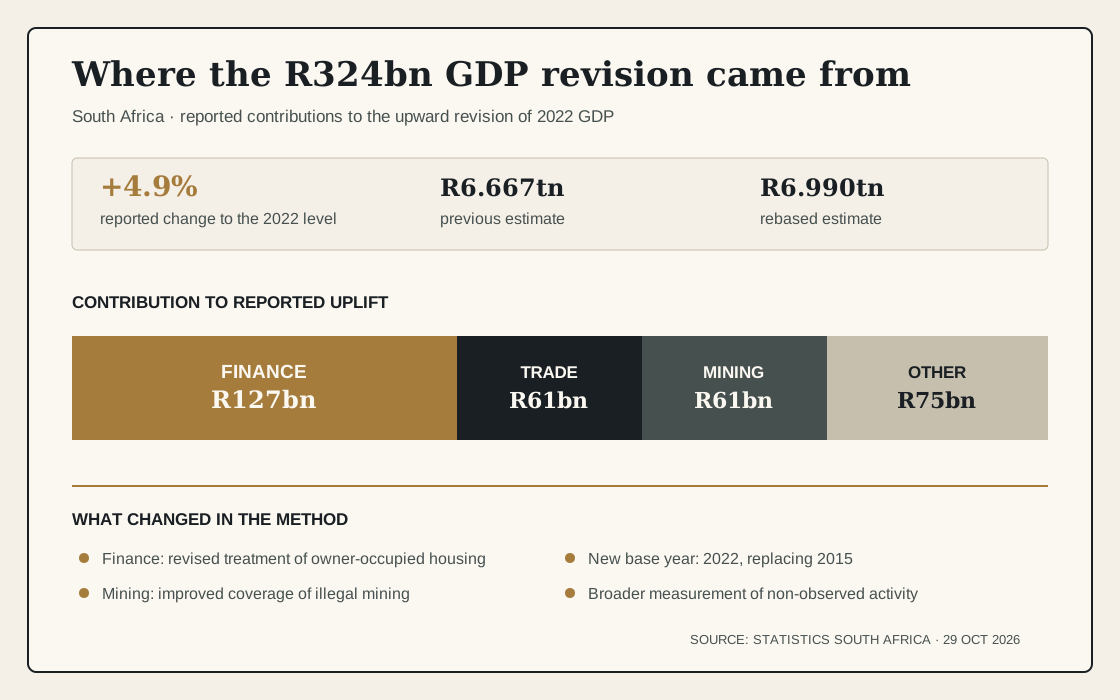
South Africa has not produced 4.9% more goods and services overnight. Its statistics agency has measured the 2022 economy again with better data, broader coverage and a newer base year. The revision matters, but it is a change in the estimate of past output, not a new burst of growth.
1. South Africa's larger GDP changes ratios before it changes lives
Statistics South Africa raised measured 2022 GDP from R6.667 trillion to R6.990 trillion, a reported increase of R324 billion or 4.9%. The 2025 estimate rose 5.3% to R8.044 trillion. Better measurement of owner-occupied housing added R127 billion through finance. Trade and mining added R61 billion each, with illegal mining now covered more fully.
The new denominator can lower debt-to-GDP and deficit-to-GDP ratios without reducing a rand of debt. It also puts South Africa's 2025 economy at about $483 billion against Nigeria's $328 billion at the exchange rates used by Reuters. That comparison is sensitive to currencies and says nothing by itself about income per person, productivity or household welfare.
Nigeria's lesson is methodological. Rebased numbers should arrive with a sector bridge, source notes and a clear separation between measured scale and economic performance. Better statistics can improve policy and investor confidence. They cannot substitute for growth.
Sources: Statistics South Africa, 29 October; Statistics South Africa key findings, 29 October; Reuters, 29 October.
2. US demand stayed strong while quarterly inflation slowed
US real GDP grew at a 3.4% annualised rate in the third quarter, up from 2.2%. Real final sales to private domestic purchasers rose 4.9%, while the quarterly PCE price index slowed to 2.1% from 5.0%.
The combination supports the soft-landing case, although an advance estimate can be revised. For Nigeria, stronger US demand can support commodity and risk appetite, but resilient growth also reduces pressure for rapid Federal Reserve cuts. Dollar funding therefore remains expensive even as quarterly US inflation improves.
Source: US Bureau of Economic Analysis, 29 October.
3. The ECB held rates as energy risk and succession converged
The European Central Bank kept its deposit rate at 2.50%, saying higher energy prices had increased inflation risks and weakened the growth outlook. On the same day, Christine Lagarde said she would leave on 7 February 2027, eight months before her term ends.
The decision preserves restrictive euro funding while the leadership process begins. Nigeria's transmission runs through eurobond demand, European trade and imported machinery. A December increase would add to global financing pressure; a credible succession process would reduce the risk that leadership uncertainty compounds it.
Sources: European Central Bank policy decision, 29 October; European Central Bank leadership statement, 29 October.
4. Amazon completed a difficult week for AI cash economics
AWS revenue rose 39% to $46.0 billion, its fastest growth in nearly five years. Amazon nevertheless reported trailing 12-month cash burn of $42.4 billion after $77.26 billion of quarterly capital expenditure, and expects 2026 spending of $220 billion with more next year.
Demand is not the unresolved question. The test is whether installed capacity produces enough cash before financing and depreciation become heavier constraints. Nigerian firms may gain from greater cloud capacity, but dollar pricing and foreign data-centre dependence keep the benefit conditional.
Sources: Amazon, 29 October; Reuters, 29 October.
5. Israel's completed count still produced no government
The completed count gives Benjamin Netanyahu's bloc 53 seats, Gadi Eisenkot's opposition 48 and Arab-led parties 19. Neither principal bloc reaches the 61-seat threshold. The official results are due to be submitted to the president on 4 November.
The next outcome depends on coalition choices, including whether parties that rejected Arab support change position. Until then, Israel retains a caretaker government while decisions on Iran, Gaza and regional security remain live risks for oil and shipping.
Sources: Israel Central Elections Committee, accessed 30 October; Reuters, 29 October; Times of Israel, 30 October.
Three numbers worth remembering
- 4.9%: South Africa's upward revision to measured 2022 GDP.
- 3.4%: annualised US real GDP growth in the third quarter.
- 53 seats: Netanyahu's bloc, eight short of an Israeli majority.
What could change everything?
For South Africa, the next test is whether revised ratios alter funding costs. A weaker second US GDP estimate would soften the growth signal. An ECB December increase would confirm the energy shock has changed policy. Amazon must convert capacity into cash, while Israel's president must identify a viable coalition path.
Prepared for 30 October 2026 using information available by 6:00 a.m. London. Official and company claims are attributed; calculations, Nigerian transmission and judgements are Seven Gates analysis.