SEVEN GATES DAILY BRIEF
Nigeria's transport allowance is relief without a wage settlement
Federal workers gain six months of transport support, while cloud growth separates from cash conversion, the Fed holds and Gulf oil risk remains elevated.
Nigeria's federal government has agreed to pay workers ₦70,000 a month for transport for six months. The immediate relief is real. The agreement does not resolve the larger question of what public-sector pay should become after inflation eroded the value of the current minimum wage.
1. The transport allowance buys time, not a wage settlement
The government and Nigeria Labour Congress signed the agreement on Wednesday. Payments are due from November across federal public-service levels, while a committee begins work on a new minimum wage. Six monthly payments amount to ₦420,000 per worker.
Important terms remain unpublished. The parties did not disclose the number of eligible workers, the total fiscal cost or the payment mechanism. They also failed to settle when a new wage would take effect, according to the signed memorandum reported by Punch. Those omissions determine whether the support reaches workers promptly and whether ministries can fund it without arrears.
For households, the allowance partly absorbs commuting costs. For fiscal analysis, a per-worker promise without a beneficiary count is not yet a costed programme. The government should publish the memorandum, payroll coverage and monthly payment record. Labour should treat the six-month limit as a deadline for the permanent wage negotiation, rather than evidence that the negotiation is complete.
Sources: Reuters, 28 October; Punch, 28 October; Channels Television, 27 October.
2. AI demand is accelerating faster than cash converges
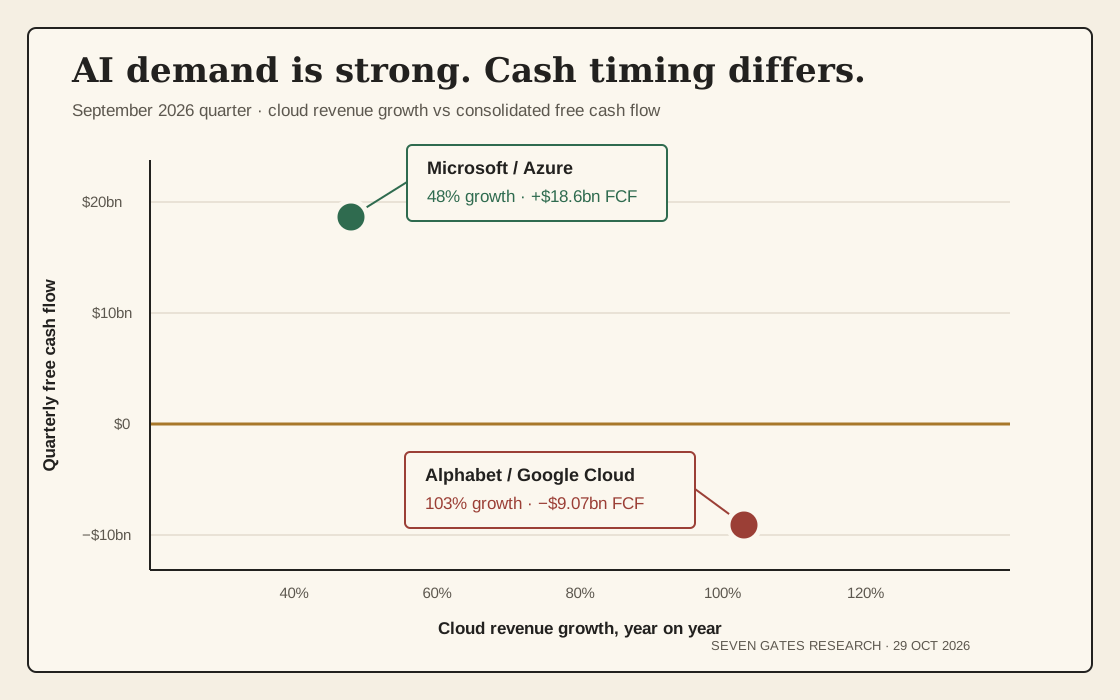
Microsoft reported 48% Azure growth and $18.6 billion of quarterly free cash flow. Alphabet's Google Cloud revenue grew 103%, yet the group recorded negative free cash flow of $9.07 billion. Alphabet now expects 2026 capital expenditure of $195 billion to $205 billion. Microsoft spent $45.2 billion in the quarter, below its own projection because some data-centre capacity arrived late.
Both companies show strong demand. The difference is timing: Alphabet's investment outpaced current group cash generation, while Microsoft's existing base still produced cash after investment. Their cloud definitions and business mixes differ, so the comparison cannot identify the better segment. It does show why revenue growth alone is an incomplete AI measure.
For Nigerian customers, more global capacity can improve model access and competition. The near-term constraint remains dollar pricing, data-centre location and reliable connectivity. For investors, the useful questions are how quickly deployed capacity earns revenue and whether free cash flow recovers before another spending cycle begins.
Sources: Microsoft, 28 October; Alphabet, 28 October; Reuters on Microsoft, 28 October; Reuters on Alphabet, 28 October.
3. The Federal Reserve held rates, with disagreement on both sides
The Federal Open Market Committee kept its target range at 3.75% to 4.00% in a 10-to-2 vote. Two members preferred a quarter-point increase. The committee described economic activity as strong and inflation as elevated.
This is a restrictive hold with visible concern about inflation, not the start of cheap money. Persistently high US yields raise the return global investors demand from Nigerian debt and can support the dollar against frontier currencies. Nigeria's improved reserves and positive real rates provide a buffer, but the next local easing decision still has to account for external funding conditions.
Sources: Federal Reserve, 28 October; Reuters, 28 October.
4. Oil above $114 carries two opposing signals
Brent traded near $114 a barrel early Thursday. Reports of renewed diplomatic contact with Iran pushed prices lower, but the decline was limited by Houthi attacks. Yemeni government forces said Aden airport was attacked. The Houthis also claimed a strike on a 550,000-barrel-a-day Saudi refinery, which Saudi authorities had not confirmed.
Nigeria can receive more oil revenue at this price only if production, sales and remittances hold. Households face the other side through imported fuel, freight and food costs. The latest US data added little relief: crude stocks fell 1.9 million barrels, while gasoline stocks rose 3.9 million.
Sources: Reuters, 29 October; US Energy Information Administration, 28 October.
Three numbers worth remembering
- ₦420,000: six months of the agreed transport allowance per worker.
- $18.6 billion: Microsoft's quarterly free cash flow, against Alphabet's negative $9.07 billion.
- 3.75%–4.00%: the Federal Reserve's unchanged target range.
What could change everything?
A published beneficiary count would turn Nigeria's allowance into a measurable fiscal commitment. Faster AI capacity deployment could narrow the cash gap in the chart. A clear Fed pivot would reset dollar funding conditions. In the Gulf, verified damage to Saudi refining or an accepted diplomatic framework would move oil risk in opposite directions.
Prepared for 29 October 2026 using information available by 6:00 a.m. London. Company and conflict claims are attributed; calculations, Nigerian transmission and judgements are Seven Gates analysis.