SEVEN GATES DAILY BRIEF
Thirty-three people died in custody; the report must become prosecutions
Nigeria's custody inquiry establishes a preventable cause of death and names an accountability path, while US investment accelerates, Israel counts votes and Russian refining recovers.
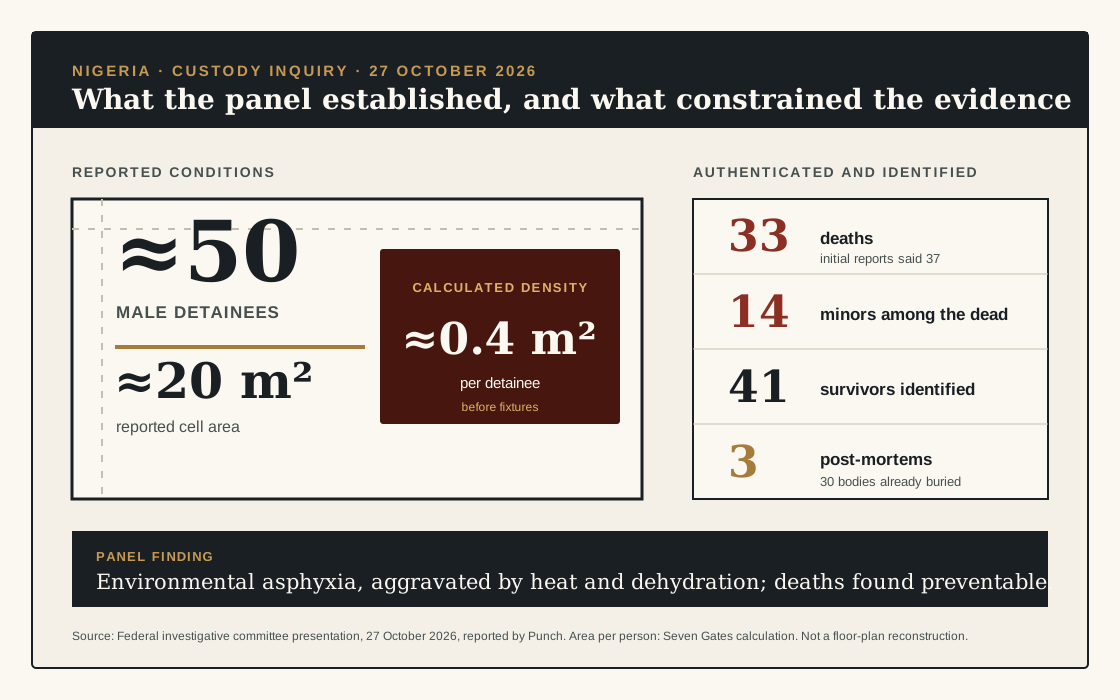
Nigeria's inquiry into deaths in Civil Defence custody has replaced an alarming first report with a more exact and more damning account. The panel authenticated 33 deaths, rather than the 37 initially reported. Fourteen of the dead were minors. Its central conclusion was that the deaths were preventable.
1. The custody report now requires criminal and institutional action
The federal panel found that about 50 male detainees were confined in roughly 20 square metres, without running water or a functioning toilet. It attributed the deaths to environmental asphyxia, aggravated by heat and dehydration, after repeated calls for help went unanswered. Disease was ruled out. The panel recommended prosecution and dismissal where responsibility is established, plus ₦1.4 billion of compensation for 33 families and 41 survivors.
The evidence also shows why accountability cannot end with compensation. Thirty bodies had been buried before the medical team arrived, leaving only three post-mortem examinations. Investigators found that the detention area had been cleaned and altered, while the relevant register was unavailable. The officers accused are entitled to due process. The state is obliged to preserve evidence, publish the report, identify the chain of command and test the panel's findings in court.
This is also a Nigerian investment issue. A government that cannot enforce custody standards raises the institutional risk borne by workers, communities and legitimate mining operators. Prosecutions, an independent detention inspectorate and published implementation deadlines would carry more weight than another promise of reform.
Sources: Federal Ministry of Information, 27 October; Punch, 28 October.
2. US business investment is running ahead of the rate-cut story
US durable-goods orders rose 1.8% in September to $345.4 billion, the Census Bureau said. Orders excluding transportation increased 0.5%, and the core business-equipment measure also rose 0.5%. Reuters calculates that core orders were 10.9% above a year earlier and estimates equipment spending grew at about a 20% annualised rate in the third quarter.
The data support near-term growth and the physical build-out behind artificial intelligence. They also reduce the case for hurried monetary easing when the Federal Reserve announces its decision later today. For Nigeria, stronger US demand can support export prices and global risk appetite, but higher-for-longer dollar yields would keep pressure on naira assets and sovereign funding costs. The transmission depends on the Fed's interpretation, not the factory number alone.
Sources: US Census Bureau, 27 October; Reuters, 27 October.
3. Israel has counted votes without producing a governing majority
With roughly 40% of ballots counted early Wednesday, Likud led with 21.7% and Gadi Eisenkot's Yashar had 15.7%. Exit polls put Benjamin Netanyahu's bloc on 51 to 52 seats and the opposition on 49 to 51, both short of the 61 required. Turnout reached 77.7%, the highest in more than two decades.
The result is therefore a negotiation, not a mandate. Arab parties may determine whether either camp can assemble a government, while Netanyahu remains caretaker. Final results can still move as larger and special ballots arrive. Nigeria's exposure runs through oil, shipping and diplomatic risk: coalition composition will influence Israel's posture toward Iran, Gaza and regional partners.
Sources: Israel Central Elections Committee, live count accessed 28 October; Reuters, 28 October; Associated Press, 28 October.
4. A pause in strikes is restoring Russian diesel supply
Russian refinery throughput reached about 5 million barrels a day in the second half of October, 25% above its early-month level, Reuters reported from three industry sources. Diesel output rose by roughly 50,000 tonnes a day to 225,000 after attacks stopped following an energy ceasefire on 16 October.
The extra product can ease global diesel tightness and Nigeria's import costs. The relief is conditional: the figures are industry estimates, roughly 80,000 tonnes a day may be available for export, and renewed attacks would reverse the recovery quickly.
Source: Reuters, 27 October.
Three numbers worth remembering
- 33: deaths authenticated by Nigeria's custody inquiry.
- 1.8%: September increase in US durable-goods orders.
- 77.7%: turnout in Israel's election.
What could change everything?
Publication of the full custody report and filed criminal charges would test whether the Nigerian findings have force. The Federal Reserve's language today could outweigh the durable-goods data for markets. Israel's later count could create a viable 61-seat path. In energy, the ceasefire either holds long enough to restore exports or the refinery rebound ends.
Prepared for 28 October 2026 using information available by 6:00 a.m. London. Official and company claims are attributed; calculations, Nigerian transmission and judgements are Seven Gates analysis.