SEVEN GATES DAILY BRIEF
Anthropic opened its books; the operating economics are improving fast
Anthropic's IPO filing reveals extraordinary growth and a narrowing operating loss, while Nigeria sets an inflation deadline, Israel votes and Microsoft offers 60,000 staff buyouts.
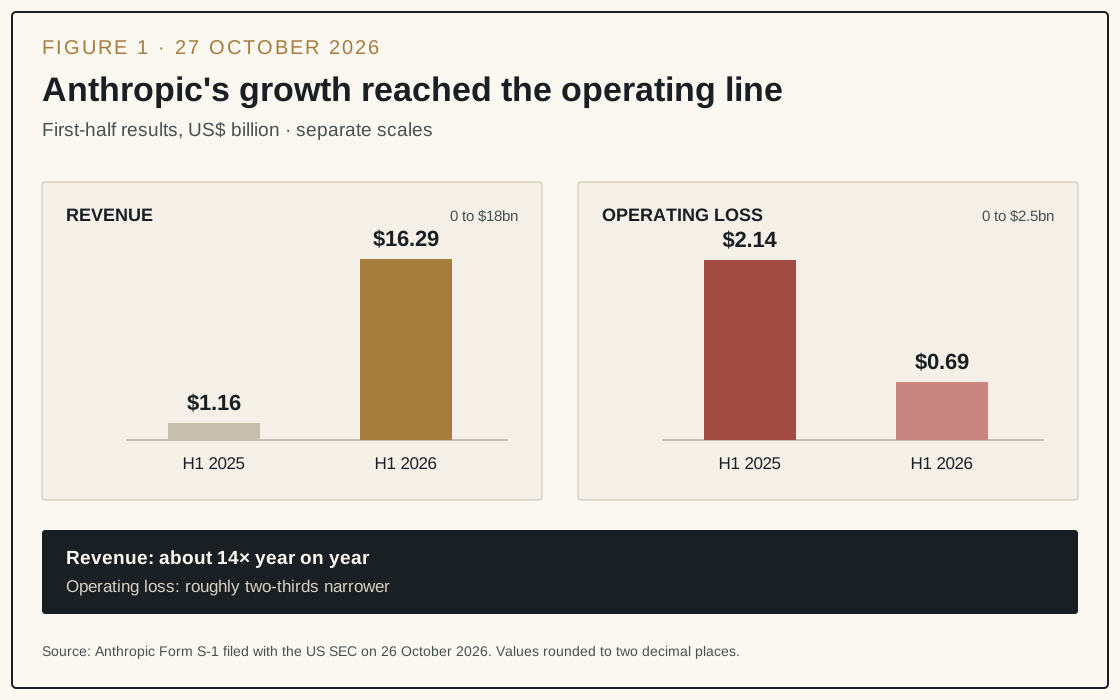
Anthropic filed publicly for a US initial public offering on Monday. The document matters because it replaces estimates with an income statement for one of the companies at the centre of the artificial-intelligence investment cycle. Demand is rising at exceptional speed. The remaining argument is whether that growth can keep outrunning the cost of compute.
1. Anthropic's operating economics improved faster than its headline loss suggests
First-half revenue rose to $16.29 billion from $1.16 billion a year earlier. Over the same period, the operating loss narrowed to $693 million from $2.14 billion. Anthropic also reported more than 11,900 business customers generating at least $100,000 of trailing annual revenue.
The filing's $80.7 billion net loss is alarming but needs classification. Reuters says it was driven largely by a non-cash revaluation of convertible bonds as Anthropic's private valuation increased. That charge says more about financing structure than current operations. The operating result is the cleaner measure of commercial progress.
The risk sits beyond the income statement. Anthropic depends on a small number of cloud and chip partners and has made vast compute commitments. Its IPO terms are still undisclosed. Investors therefore have evidence of operating leverage, but no offer price at which to judge it. For Nigeria, the immediate transmission is through global technology valuations and infrastructure allocation. Local firms buying model access should care about durable competition among providers, because concentrated supply can turn falling unit costs into pricing power for somebody else.
Sources: Anthropic, 26 October; US SEC filing, 26 October; Reuters, 26 October.
2. Nigeria has put an end-2027 date on cheaper money
Finance Minister Taiwo Oyedele said Nigeria aims to reduce inflation to low single digits before the end of 2027, allowing borrowing costs to fall sharply. The target is ambitious against the current baseline: the National Bureau of Statistics reports headline inflation at 14.63%, while the Central Bank reset its policy rate to 23% in September.
A deadline improves accountability, but it is not a policy mechanism. Food prices, electricity and fuel costs, the naira, fiscal spending and money growth will decide the path. Premature rate cuts could weaken the currency and restore imported inflation. If disinflation holds before easing begins, lower rates would relieve working-capital pressure, improve project economics and reduce the government's domestic interest bill. The sequence matters as much as the destination.
Sources: Reuters, 26 October; National Bureau of Statistics, accessed 27 October; Central Bank of Nigeria, September decision.
3. Israel votes today, but coalition formation will determine the result's reach
Voting for Israel's 120-seat Knesset runs from 7 a.m. to 10 p.m. local time. Parties must clear a 3.25% national threshold, and a governing coalition needs at least 61 seats. Reuters expects the final tally by 30 October and the official result by 4 November; formation can then take weeks.
The stakes extend beyond personalities. The coalition will shape war accountability, relations with the United States and Arab states, security policy and fiscal priorities. Exit polls can indicate direction tonight, but small parties near the threshold can change the viable coalition arithmetic. Nigeria's exposure is indirect through oil prices, shipping risk and diplomatic alignment across the Middle East.
Sources: Government of Israel, 26 October; Reuters election guide, 27 October.
4. Microsoft's AI budget is reaching the workforce
Microsoft is offering voluntary buyouts to about 60,000 employees, more than a quarter of its 223,000 global workforce. The programme covers eligible teams in four countries, including AI experiences, Copilot, Xbox and Windows, as the company forecasts $175 billion of 2026 capital expenditure.
Voluntary terms reduce the immediate coercion, but the scale still marks a large reallocation from labour toward infrastructure. Wednesday's earnings must show whether AI revenue is growing quickly enough to support that choice. For Nigerian technology workers and service exporters, the signal is mixed: AI investment expands demand for specialised skills while large employers are trying to produce more revenue with fewer people.
Sources: Reuters, 26 October; Microsoft 2026 Annual Report; Microsoft workforce facts, accessed 27 October.
Three numbers worth remembering
- $16.29 billion: Anthropic's first-half 2026 revenue.
- 14.63%: Nigeria's latest headline inflation rate.
- 60,000: Microsoft employees eligible for the new buyout programme.
What could change everything?
Anthropic's IPO price and disclosed compute obligations will decide whether better operations imply an attractive security. Nigeria's next inflation prints and any CBN easing will test the credibility of the 2027 target. In Israel, parties falling just above or below 3.25% could reorder coalition options. At Microsoft, acceptance of the buyout and Wednesday's cloud and AI results will show whether workforce reduction is optional adjustment or the start of a deeper restructuring.
Prepared for 27 October 2026 using information available by 6:00 a.m. London. Company and government claims are attributed; Nigerian transmission and judgements are Seven Gates analysis.