SEVEN GATES DAILY BRIEF
Lula won Brazil; Congress will decide how much changes
Brazil's presidential upset preserves a left-led government but not a free hand, while Algeria crosses a military threshold in Niger, the naira softens and AI infrastructure takes on more debt.
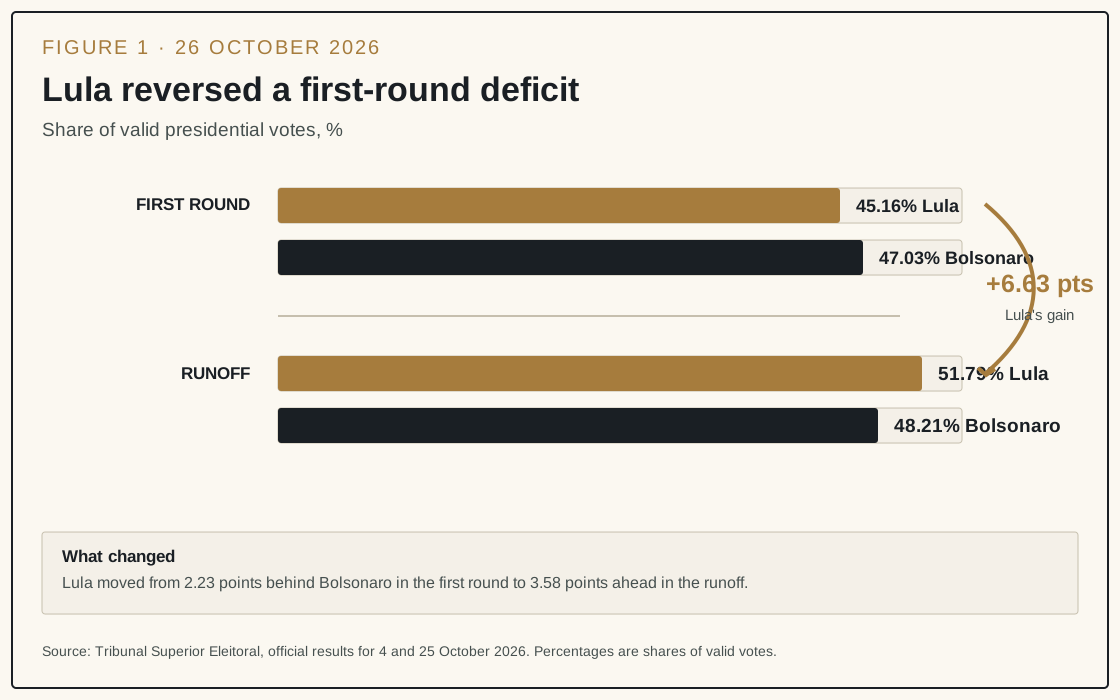
Brazilian voters returned Luiz Inácio Lula da Silva to office for a fourth term on Sunday. The surprise was not only the winner. Lula entered the runoff behind Flávio Bolsonaro, then finished with 51.79% of valid votes against 48.21%, according to Brazil's electoral court. Bolsonaro rejected the result and said he would seek annulment, although Reuters reported that analysts see little chance of reversal.
1. Lula won the presidency, not control of Brazil's fiscal choices
Lula's comeback interrupts Latin America's recent shift toward governments aligned with US President Donald Trump. It also changes the immediate market position: investors had expected Bolsonaro to win, and a Brazil-linked exchange-traded fund in Tokyo fell nearly 15% on Monday.
The governing constraint is Congress. Reuters describes it as Brazil's most conservative since democracy returned, while public debt exceeds 82% of GDP and growth is forecast at 2.3% next year. Welfare expansion and labour reform now meet high interest costs and an opposition able to obstruct legislation. The result preserves Lula's direction on social policy, climate and strategic autonomy, but the investable question is which promises survive the budget.
Nigeria's transmission is through emerging-market risk and South-South diplomacy rather than a direct trade shock. A disorderly challenge would raise political-risk sensitivity across emerging assets. An orderly certification followed by fiscal restraint would limit that spillover.
Sources: Brazilian Superior Electoral Court, 25 October; Reuters, 25 October; Reuters Morning Bid, 26 October.
2. Algeria is crossing a military threshold in Niger
Algeria's parliament approved the deployment of army units to Niger on Sunday, Reuters reported. It would be Algeria's first foreign troop deployment since its forces supported Egypt in the 1973 war. The decision moves a major North African military into a Sahel theatre already crowded by juntas, insurgents and competing foreign partners.
Mandate, size, duration and command arrangements remain undisclosed. Those details determine whether the force improves border security or adds another layer of strategic competition. Nigeria should watch coordination with Niger closely. Violence, displacement and illicit trade can move south toward Nigeria's northern border even when the deploying force is operating farther west or north.
Source: Reuters, 25 October.
3. The naira is testing the edge of last week's range
The official naira rate weakened to ₦1,339 per dollar on Thursday from ₦1,331 a week earlier, while street trading reached ₦1,370, according to traders cited by Reuters. Seasonal import demand and profit-taking were the stated pressures; traders identified ₦1,340 as the next level to watch.
One weekly move does not establish a new trend. It does show that improved reserves and reform credibility have not removed demand pressure. A sustained breach would raise imported input costs and the naira value of dollar debt. Dollar supply from oil receipts and portfolio flows will matter more than commentary.
Source: Reuters, 22 October.
4. SpaceX has put a $40 billion price on the AI capacity race
Elon Musk said SpaceX closed $40 billion of debt financing to buy Nvidia GPUs, with deliveries expected in the first half of 2027. He also forecast failures and consolidation among specialist AI cloud providers that lack substantial non-AI revenue. Reuters said pricing and completion details were unclear.
The financing matters beyond one company. It links AI infrastructure more tightly to credit markets and gives diversified cash flow a funding advantage. Nigerian technology investors should separate demand for computing from returns to its owners: capacity can grow while highly leveraged providers lose negotiating power.
Source: Reuters, 25 October.
5. Uganda's quarantine turns an Ebola dispute into policy
Uganda imposed a mandatory 21-day quarantine on citizens returning from the Democratic Republic of Congo. The step follows cases in Kenya and Nigeria involving people who travelled through Uganda, although the source of Nigeria's infection remains disputed. Kenya has discharged 60 monitored contacts, while Uganda is intensifying entry screening.
For Nigeria, the useful test remains completion of contact monitoring without secondary transmission. Travel history can direct surveillance; it cannot substitute for verified exposure chains.
Source: Reuters, 25 October.
Three numbers worth remembering
- 51.79%: Lula's official runoff share.
- ₦1,339/$: Thursday's official naira rate cited by Reuters.
- $40 billion: SpaceX debt financing Musk said would fund GPUs.
What could change everything?
A credible Brazilian legal challenge or prolonged unrest would change the political-risk assessment; certification and an early fiscal agreement would reduce it. Algeria's mandate and force size will show whether the Niger move is bounded cooperation or a larger strategic turn. For Nigeria, a sustained naira break beyond ₦1,340 or secondary Ebola transmission would matter more than one day's price or an unverified exposure theory. Disclosure of SpaceX's debt terms would show how much credit risk is being accepted to finance AI growth.
Prepared for 26 October 2026 using information available by 6:00 a.m. London. Claims by political figures and executives are attributed; Nigerian transmission and judgements are Seven Gates analysis.