SEVEN GATES DAILY BRIEF
At least 40 reported deaths demand answers in Taraba
A village attack makes civilian protection Nigeria's immediate test as the presidential campaign begins, while Gulf threats and a decisive AI earnings week widen the risks facing households and investors.
At least 40 people were killed in an attack on a village in Taraba State on Friday afternoon, Amnesty International told Reuters. The first obligations are to establish who died, identify the attackers and protect survivors. The report did not name the village, the assailants or a motive, and no government response was included. Those gaps require investigation rather than speculation.
1. Taraba requires verified facts and an accountable response
The reported toll makes civilian protection the most urgent issue in today's brief. It also gives practical meaning to the state-police amendment that cleared its state-assembly threshold last week. That reform is not yet operational and cannot answer Friday's attack. Existing federal and state authorities remain responsible for securing the area, preserving evidence, treating the wounded and reporting what they know.
The next useful facts are specific: a named location, a reconciled casualty list, the time security forces arrived, arrests and protection for nearby communities. Until officials provide them, the toll remains Amnesty's report rather than a confirmed government count.
Source: Reuters, 24 October.
2. Nigeria's campaign begins with a household-price test
President Bola Tinubu formally opened his re-election campaign in Kaduna on 24 October, ahead of the 16 January 2027 vote. His case is that subsidy removal, currency reform and other measures improved public finances, reserves and investor sentiment. Voters will judge those gains against daily purchasing power and security.
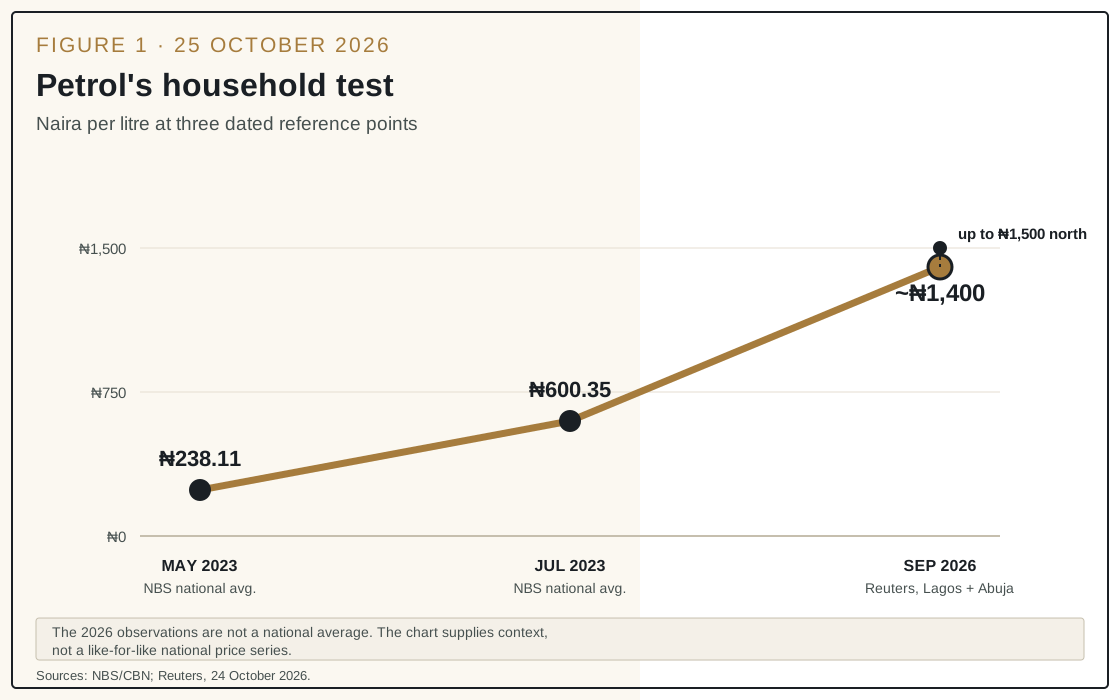
Petrol makes the trade-off visible. Reuters found prices around ₦1,400 per litre in Lagos and Abuja in September, and as high as ₦1,500 in parts of northern Nigeria. The NBS reported a ₦238.11 national average in May 2023. The measures are not directly comparable, but they show the scale of the household adjustment. Backing from 32 of 36 governors, as the campaign claims, supplies organisation; it does not settle how voters value incomes, prices and safety.
Sources: Reuters, 24 October; NBS, May 2023 price report; CBN July 2023 Economic Report.
3. Gulf security risk is moving closer to people and infrastructure
A 23 October US intelligence memo said Iranian plots against US citizens had reached advanced stages in the Middle East and elsewhere. Reuters reported that the State Department had reduced staffing in Saudi Arabia and updated travel advice for more than a dozen countries on 24 October. Separately, the Houthis renewed a warning against Riyadh's airport as some operations were due to resume after an attack earlier this month killed 13 people and wounded more than 300.
The intelligence claim is a US assessment, not an independently verified account of a specific plot. The observable response is wider: diplomatic drawdowns, travel disruption and threats to commercial shipping and energy infrastructure. Nigeria can receive more oil revenue when supply risk raises crude prices, while airlines, importers and consumers face higher fuel, freight and insurance costs. Production volumes and the domestic petrol price determine which effect dominates.
Sources: Reuters on the intelligence memo, 24 October; Reuters on Riyadh airport, 24 October.
4. AI investment faces a cash-return week
Alphabet and Microsoft report on Wednesday, Amazon on Thursday, and the Federal Reserve also decides rates on Wednesday. Reuters says the three companies are among the hyperscalers expected to spend about $800 billion this year, while third-quarter S&P 500 earnings are tracking more than 32% above a year earlier after over 100 reports.
Those results can separate useful demand from spending momentum. Investors need revenue growth, margins and capital-expenditure guidance strong enough to support the build-out as financing costs rise. The Fed is expected to hold after September's increase, but its December signal matters for long-duration technology valuations. Nigerian portfolios transmit both moves through global funds, dollar funding conditions and the naira value of foreign assets.
Source: Reuters, 23 October.
Three numbers worth remembering
- At least 40: people Amnesty reported killed in the Taraba village attack.
- ₦1,400: Reuters' approximate September petrol price per litre in Lagos and Abuja.
- $800 billion: expected 2026 hyperscaler capital spending cited by Reuters.
What could change everything?
A verified Taraba casualty account, arrests and prompt protection would change the security assessment. Real household-income gains and lower transport costs would strengthen the reform case beyond campaign organisation. Reduced Gulf threats would ease pressure on travel, freight and fuel; damage to energy infrastructure would do the opposite. For AI, cash-flow evidence from the three hyperscalers and the Fed's December signal will decide whether expectations still fit the cost of capital.
Prepared for 25 October 2026 using information available by 6:00 a.m. London. Casualty figures and intelligence assessments are attributed; mixed petrol measures are labelled. Nigerian transmission and judgements are Seven Gates analysis.