SEVEN GATES DAILY BRIEF
The oil corridor has acquired a defence pact
Saudi Arabia’s Red Sea outlet is becoming a multinational security project while Hormuz remains Tehran’s final bargaining chip; bonds price the risk, Washington and Beijing buy two months, AI finance meets the power grid, and Nepal refuses a debt-funded recovery.
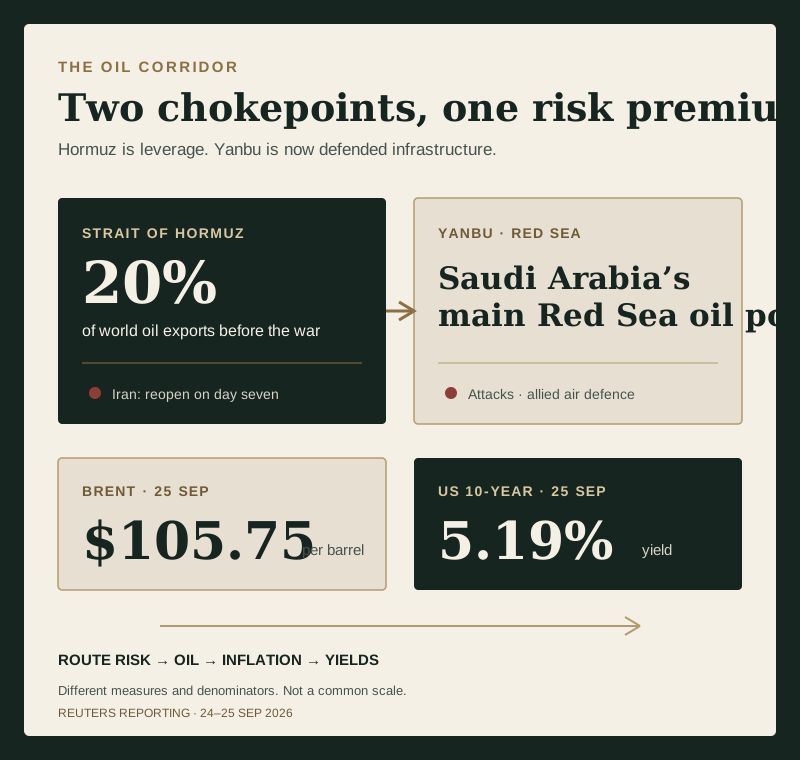
Oil markets wanted a ceasefire. They received a joint-defence clause, French radar and a seven-day sequencing argument. Diplomacy remains alive, but it has arrived wearing body armour.
1. The oil corridor has acquired a defence pact
Saudi Arabia, Turkey and Pakistan will convene their military chiefs under the Mecca Joint Defence Agreement after the Houthis fired dozens of missiles and drones at Saudi targets. Riyadh said it intercepted six ballistic missiles and issued emergency alerts for Mecca, Jeddah and Yanbu, its main Red Sea oil port. France is separately sending troops, radar and air-defence systems to protect Yanbu.
This is not merely another security meeting. Hormuz is constrained, the Bab el-Mandeb is contested, and Yanbu is the principal outlet around both. The alternative route is now becoming a multinational military asset. An attack on one member of the Mecca pact is treated as an attack on all three.
Iran’s proposal would end hostilities on all fronts within seven days in exchange for the lifting of the US port blockade, release of frozen funds and oil-sanctions waivers. Hormuz, which carried 20% of world oil exports before the war, would reopen only on the final day. The difficulty is no longer imagining a deal. It is deciding who relinquishes leverage first.
Sources: Reuters, Saudi allies and Houthi attacks, 25 September · Reuters, the phased US-Iran proposal, 24 September · Reuters, France’s Yanbu deployment, 24 September
2. The barrel has entered the bond market
Brent eased to $105.75 after a 3% overnight rise, but the US 10-year yield reached 5.1915% after touching a 19-year high. Futures now assign a 71% probability to another Federal Reserve increase in October, up from about 53% earlier this week. More than 90 basis points of tightening are priced for the cycle.
That is the transmission mechanism in one screen: oil raises inflation risk; bonds demand compensation; the dollar strengthens; emerging-market financing tightens. Nigeria receives more dollars for exported crude, then pays the other side through refinery feedstock, diesel, transport, inflation and local yields. Dangote removes a shipping problem. It cannot repeal the world price.
Source: Reuters, global markets, 25 September
3. Washington and Beijing bought two months, not a settlement
Donald Trump and Xi Jinping extended their trade truce by two months. They did not settle the larger disputes over tariffs, agricultural purchases, rare-earth supplies, technology controls or Taiwan. Xi called for AI to remain under human control; Trump said he wanted to leave it “exactly where it is” and rely on existing law.
The summit produced useful time and expensive ceremony. Companies still must invest against rules that may move again before their equipment arrives. Two months is a negotiating window, not an operating environment.
Source: Reuters, five summit takeaways, 24 September
4. AI finance has discovered the power grid
Oracle’s Project Jupiter data-centre debt has come under pressure as power, permitting and local opposition complicate construction. About $18 billion of loans were trading below par last week. A separate Reuters report says delays at an Oracle and Blue Owl project are now rippling through AI infrastructure finance.
The important constraint is physical. Models can scale in a release note; substations, pipelines and permits cannot. When revenue starts after the debt clock, a construction delay becomes a credit event. AI’s next benchmark may be contracted megawatts delivered on time.
Sources: Reuters, Project Jupiter debt pressure, 18 September · Reuters, AI-project delay and financing, 24 September
5. Nepal refuses to borrow for a disaster it did not price
Nepal says it needs recovery funding equal to about 10% of GDP after a glacier collapse killed at least 1,450 people and left more than 6,000 missing. Prime Minister Balendra Shah asked for grants, not another large loan, and proposed a Nepal-India-China system for satellite data, glacial-lake monitoring and early warning.
The request is morally plain and financially exact. Debt can rebuild a bridge while weakening the state that must maintain it. The World Bank has offered up to $170 million in emergency finance; the harder question is whether climate-vulnerable countries should compound disaster losses with debt service.
Source: Reuters, Nepal’s recovery appeal, 25 September
Three numbers worth remembering
- 20%: the share of world oil exports that passed through Hormuz before the war.
- 5.19%: the US 10-year Treasury yield on 25 September.
- $18 billion: Project Jupiter loans facing market pressure.
Sources are linked in items 1, 2 and 4.
What could change everything?
A verified, simultaneous exchange would: partially reopen Hormuz as Washington eases the port blockade and oil sanctions, with Qatar policing the sequence. That could remove part of the oil premium, cool Fed-hike bets and ease Nigeria’s fuel transmission. A successful strike on Yanbu would reverse every arrow.
Prepared for 25 September 2026 from sources checked through 03:55 UTC. Market prices, conflict diplomacy and casualty figures may change; transmission mechanisms are Seven Gates analysis.