SEVEN GATES DAILY BRIEF
The cargo barrel is $122
Saudi cancellations have opened a $14 gap between oil futures and Europe's physical benchmark; global borrowing costs reach post-crisis highs, Dangote's prospectus reveals wartime profits, Washington counts the Iran war, and AI leaders split over the brake pedal.
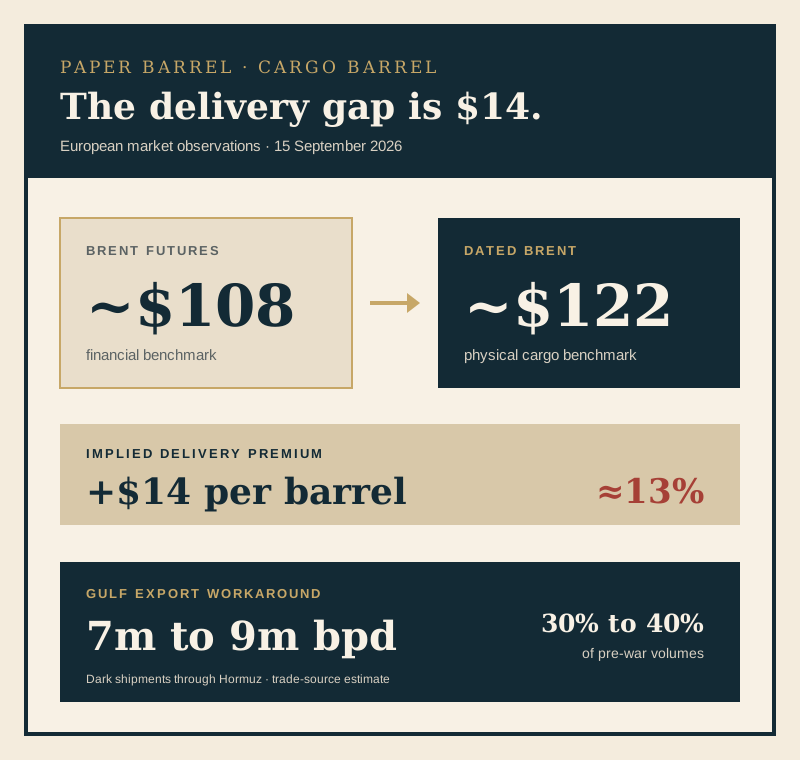
Oil futures say $108. Europe's physical barrel says $122. The difference is the cost of finding a real cargo when the loading programme has holes.
1. The cargo barrel is $122
Saudi Arabia has told European customers that some September crude cargoes will be cancelled, while loadings at Yanbu remain suspended after the East-West pipeline attack. Poland's Orlen, which receives about 40% of its crude from Saudi Aramco, is seeking North Sea, U.S., Kazakh, Algerian and Guyanese replacements.
That is the first clean proof that route risk has become allocation. Brent futures traded near $108, but dated Brent in Europe's physical market was around $122. The roughly $14 gap is a delivery premium, not a forecasting disagreement. Gulf producers are moving 7 million to 9 million barrels a day through Hormuz using opaque shipping methods, only 30% to 40% of pre-war volumes.
Nigeria can benefit if its crude and products arrive reliably. Dangote's jet fuel already has. Yet expensive physical barrels also raise diesel, freight, fertiliser and working-capital bills. Producers earn the premium; importers and households meet it at the depot.
Sources: Reuters, Saudi cancellations, Yanbu and physical prices, 15 September · Reuters, inventories and latest oil prices, 16 September
2. The world's risk-free rates are losing the adjective
The average 10-year yield across the G7 reached 4.285%, its highest since mid-2008 and one percentage point above the pre-war level. The U.S. ten-year touched 5.041%, Japan's exceeded 3%, Germany's approached a 2009 high and Britain's reached 5.45%.
The Federal Reserve votes Wednesday with markets expecting its first increase since 2023. The quarter-point move matters less than the path after it. Higher benchmark yields make every debt rollover, property valuation and long-duration equity case work harder. For Nigeria, a 5% Treasury yield raises the minimum credible return on eurobonds, naira assets and new industrial capital. Oil revenue may improve the numerator; global rates alter the denominator.
Sources: Reuters, G7 and national bond yields, 15 September · Federal Reserve, statement timetable for 16 September
3. Dangote's prospectus contains a wartime profit
Dangote Refinery reported first-half net profit of $1.82 billion on revenue above $13 billion, against a $476 million loss for all of 2025. It supplied Europe with about 80,000 barrels a day of jet fuel in the second quarter, roughly 13% of the regional shortfall created by lost Middle Eastern supply. Nigeria's petrol imports have fallen from about 400,000 barrels a day in 2024 to 83,000 this year.
These are excellent operating facts and dangerous valuation anchors. Scarcity widened margins just as the IPO opened. Investors should separate durable utilisation and import substitution from a war premium that can disappear faster than refinery debt. The plant has proved strategic relevance; the offer price still needs normalised earnings.
Source: Reuters, prospectus results and product flows, 15 September
4. Washington has counted the war, incompletely
The Congressional Budget Office put the U.S. cost of the Iran war at $38 billion through 1 August and projected another $3 billion a month. It estimated that replenishing depleted munitions could take five years and that the conflict could add 0.5% to inflation in early 2027. Eighteen U.S. service members have died.
The ledger excludes recent strikes and borrowing costs. This is therefore a floor, not a bill. The strategic cost is also inventory: every interceptor used in one theatre is unavailable in another until production catches up.
Source: Reuters, CBO accounting, readiness and human toll, 15 September
5. AI's brake pedal has no common owner
Mark Zuckerberg rejected calls for a coordinated slowdown, arguing that competition, liability and individual responsibility give laboratories enough incentive to build safely. Anthropic's Dario Amodei, backed by Sam Altman and Elon Musk, wants leading labs to slow advanced-model development together. U.S. antitrust officials are wary of granting them room to coordinate.
Both sides expose the gap. Voluntary restraint fails when the fastest rival sets the pace; coordination can become cartel governance by companies with no public mandate. Independent evaluation and incident disclosure are the workable middle. Trust is not a control system.
Source: Reuters, Zuckerberg, laboratory proposals and antitrust concern, 16 September
Three numbers worth remembering
- $122: dated Brent in Europe's physical market, against futures near $108.
- 4.285%: average G7 10-year government-bond yield, the highest since mid-2008.
- $1.82 billion: Dangote Refinery's reported first-half net profit.
Sources are linked in items 1, 2 and 3. Prices are dated observations; the physical premium uses rounded figures.
What could change everything?
A verified pipeline restart and restored Yanbu loading programme would collapse part of the physical premium. The Federal Reserve's projections can either validate the global sell-off or separate energy inflation from a longer tightening cycle. For Dangote, final subscription data will show whether exceptional current earnings persuaded buyers at the new valuation.
Prepared for 16 September 2026 from sources published through 03:55 UTC. Cargo allocations, prices and conflict details may change; calculations and transmission mechanisms are Seven Gates analysis.