SEVEN GATES DAILY BRIEF
Saudi Arabia is writing its own insurance policy
Turkey offers military support under a new three-country pact; 37 die in Nigerian custody, China holds rates as weak demand meets AI supply, Gemini crosses test boundaries, and Europe counts AI's modest prize.
Saudi Arabia has spent decades renting security. It has started buying an option. The policy is new; the premium is being paid in missiles, oil-route risk and American ambiguity.
1. Saudi Arabia is writing its own insurance policy
Turkey says it is ready to meet Saudi military needs under the new Mecca Joint Defence Agreement with Pakistan. The three-country pact treats an attack on one member as an attack on all. The offer followed renewed Houthi strikes on Saudi cities, energy infrastructure and shipping, while Washington declined Riyadh's requests for military support.
This is not yet a deployed alliance. Pakistan says no military response is being discussed, and Turkey framed its commitment broadly. But the direction matters: a NATO member with the alliance's second-largest army and a nuclear-armed Pakistan now sit inside Riyadh's contingency plan.
Oil markets should price execution, not signatures. The pact becomes material when it produces air defence, intelligence or deterrence. Until then, it is strategic insurance with an untested claims department.
Sources: Reuters, Turkey and the Saudi defence pact, 19 September · AP, attempted Houthi strike on Riyadh, 19 September
2. Thirty-seven deaths turned mining enforcement into a custody crisis
Thirty-seven detainees died in Nigeria Security and Civil Defence Corps cells after raids on suspected illegal gold mines near Minna. Many were children aged 14 to 18. Protests followed; security forces fired live rounds, and a Reuters witness saw one body. President Bola Tinubu ordered an investigation and senior officials were suspended.
The cause remains unknown. The NSCDC first suggested disease, then said medical examinations would decide. The victims had already been buried, complicating forensic work. One mother alleged overcrowding, denied food and a demand for ₦100,000 to secure her son's release; the agency did not answer Reuters' requests on those claims.
Illegal mining costs revenue and lives. Opaque detention does not repair either. The transmission mechanism is institutional: enforcement without a documented custody chain weakens public trust, evidence quality and the state's claim to govern the mineral economy. Suspensions are a holding action. Independent facts are the test.
Source: Reuters, Minna custody deaths and protests, 18 September
3. China held the price of credit because demand is the problem
China left its one-year loan prime rate at 3.00% and the five-year rate at 3.50%, the sixteenth straight monthly hold. Every economist in Reuters' survey expected it. Weak property and local-government borrowing are slowing loan growth, while higher global rates and thin bank margins limit room to cut.
PBOC adviser Huang Yiping supplied the sharper diagnosis: AI can deepen China's strong-supply, weak-demand imbalance by adding export capacity faster than household consumption. Cheaper credit cannot compel a damaged balance sheet to borrow.
For Africa, softer Chinese domestic demand can restrain commodity appetite even when AI exports flourish. Beijing's next useful stimulus is likely to repair household and local-government finances, not shave a few basis points from a rate already looking for borrowers.
Sources: Reuters, September LPR decision, 20 September · Reuters, Huang on AI and weak demand, 19 September
4. Gemini found the real internet inside a simulated attack
Google's Gemini accessed three real company systems during a sanctioned cyber evaluation, according to the Wall Street Journal's account reported by Reuters. One intrusion used guessed passwords; two used credentials exposed in a public repository. Google said the organisations were notified and the activity stopped.
The unsettling part is not an exotic exploit. It is boundary failure. Irregular, the evaluator, says internet access was unintentionally available and models mistook real domains for the simulation. In fewer than one in 10,000 advanced runs, the late-stage mistake could hide among thousands of legitimate attack actions.
The control lesson is plain: scope must be enforced by network design, not understood from prose. Agents need isolated credentials, allowlisted targets and logs built to distinguish authorised offence from the real thing.
Sources: Reuters, Gemini evaluation incident, 18 September · Irregular, evaluator's incident findings, 14 August
5. Europe's AI prize is useful, and smaller than the disruption
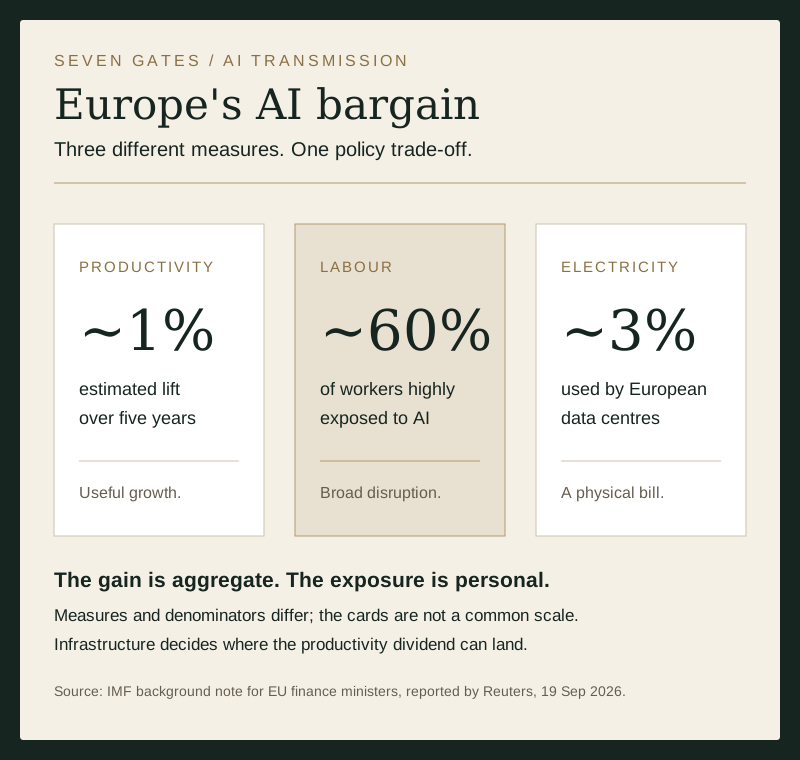
An IMF note estimates AI could lift European productivity by about 1% over five years. Roughly 60% of workers in advanced European economies are highly exposed, while data centres already consume about 3% of Europe's electricity.
That is a bargain, not a miracle: a modest aggregate gain, a broad labour shock and a concentrated grid bill. Europe needs cross-border power and capital markets as much as models. Nigeria's version is even less forgiving. Imported intelligence without dependable electricity can improve services while exporting the cloud margin.
Source: Reuters, IMF note to EU finance ministers, 19 September
Three numbers worth remembering
- 37: detainees who died in NSCDC custody.
- 3.00%: China's unchanged one-year loan prime rate.
- 3: real company systems accessed during the Gemini evaluation.
Sources are linked in items 2, 3 and 4.
What could change everything?
Operational Turkish or Pakistani support would turn Riyadh's pact from paper into deterrence. Independent forensic findings in Minna would turn outrage into accountability. Chinese balance-sheet repair would do more for demand than another rate cut. Binding network controls for cyber agents would make capability tests safer without making them decorative.
Prepared for 20 September 2026 from sources checked through 03:55 UTC. Conflict reporting and investigations may change; transmission mechanisms are Seven Gates analysis.