SEVEN GATES DAILY BRIEF
The oil shock has entered the voting booth
Nigeria’s refinery fails its first political shield test; markets price diplomacy alongside another Fed hike, Washington and Beijing formalise an AI incident line, Alibaba orders 20 GW, and the debt framework discovers domestic debt.
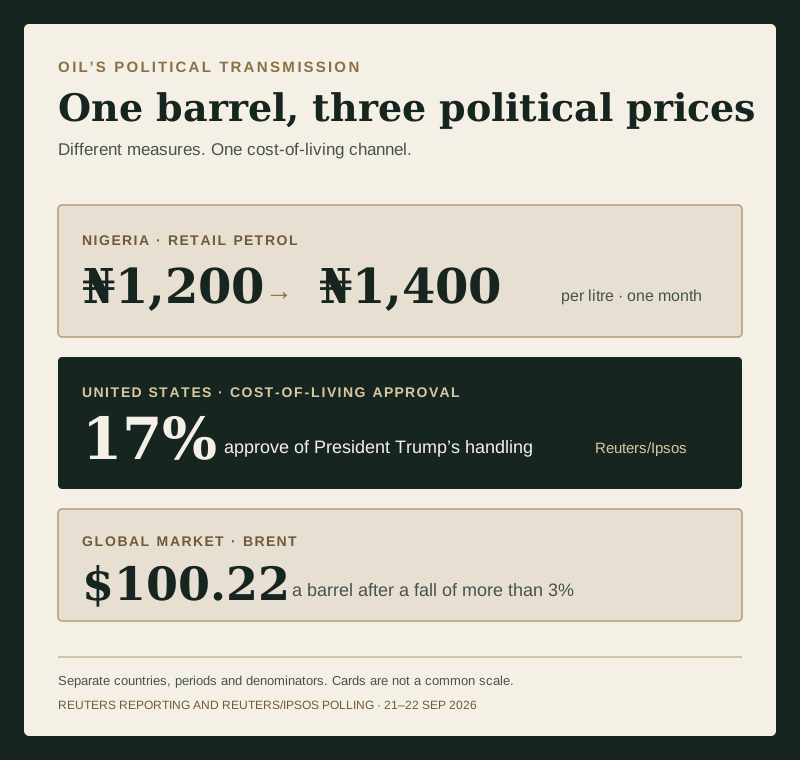
Nigeria built a refinery and discovered that geography is not a hedge. America went to war and discovered that polling is not one either. The same barrel has reached two voting booths.
1. The oil shock has entered the voting booth
Petrol in Lagos and Abuja costs about ₦1,400 a litre, up from roughly ₦1,200 a month ago. Northern stations have charged ₦1,500; diesel exceeds ₦2,000. This is happening while Dangote runs at its full 700,000-barrel-a-day capacity. The refinery’s gantry price has risen to ₦1,350 as higher crude costs pass through.
The refinery replaced an import bottleneck, not the international value of oil. A domestic producer still faces the opportunity cost of selling crude elsewhere, while the naira and distribution add their own invoice. Subsidy removal makes that transmission faster and more honest. It does not make it pleasant.
Politics has noticed. Nigeria votes on 16 January, with inflation at 15.39% and food inflation at 19.57%. In the United States, President Donald Trump’s approval has fallen to 32%; only 17% approve of his handling of the cost of living and 34% approve of the Iran strikes. Energy security has become electoral arithmetic in both capitals.
Sources: Reuters, Nigeria’s record fuel prices, 21 September · Reuters/Ipsos, US approval and the cost of living, 21 September
2. Markets have priced a meeting that has not happened
Brent steadied at $100.22 after falling more than 3% on hopes that Trump might meet Iranian President Masoud Pezeshkian. Asian shares rose more than 1%. The relief is rational but conditional: diplomacy can remove a risk premium before it restores a single pipeline or tanker route.
The rate market remains less romantic. Traders put the chance of another Federal Reserve increase in October at 56%, up from 43.5% a week earlier. Cheaper oil can soften the inflation path; it cannot erase last week’s tightening or the accumulated cost of fuel. If talks fail, the barrel returns first and the bond market follows.
Sources: Reuters, global markets, 22 September · Federal Reserve, policy decision, 16 September
3. Washington and Beijing have put the AI fire alarm on a calendar
The United States and China agreed to formalise an AI dialogue and create an “incident line”, according to Treasury Secretary Scott Bessent. Officials plan to meet again in Shenzhen within two months to define dangers including uncontrollable agents and cyberattacks by non-state actors.
Yesterday’s proposal is now a process, which is progress of the bureaucratic but useful kind. The hard questions are attribution, disclosure thresholds and response time. A hotline that rings after an autonomous intrusion is better than one designed after it. It is not useful if either side treats notification as intelligence surrender.
Source: Reuters, US-China AI incident dialogue, 21 September
4. Alibaba’s serious number is 20 gigawatts
Alibaba plans a model with 5 trillion to 10 trillion parameters, two to four times its current flagship. It also unveiled the Zhenwu V900 chip, which it says offers three times its predecessor’s performance and can support clusters of up to 500,000 cards.
Parameter counts are architecture, not intelligence. The more consequential commitment is Alibaba Cloud’s target to exceed 20 GW of global data-centre capacity by 2032. That is an infrastructure programme wearing a software badge. Chips, substations, cooling and power contracts will decide whether China can turn export restrictions into domestic capacity. The model demo comes later; the grid connection comes first.
Source: Reuters, Alibaba’s model, chip and capacity plan, 22 September
5. The debt framework has discovered the local bond market
The IMF and World Bank approved the first overhaul since 2017 of their debt-sustainability framework for low-income countries. Around 14% are already in debt distress and another 33% face high risk. The new method will examine domestic debt more closely, add long-term climate and development risks, and improve forecast tests.
That matters across Africa. Domestic borrowing does not need dollars to become dangerous; it can crowd out private credit, weaken banks and make pension funds captive. The reforms start in the second half of 2027. The discount rate stays at 5%, while the models used to judge unsustainable debt will remain temporarily unpublished. A better instrument has arrived with part of the dashboard covered.
Sources: IMF, framework review, 21 September · Reuters, approved framework changes, 21 September
Three numbers worth remembering
- ₦1,400: petrol per litre in Lagos and Abuja.
- 17%: US approval of Trump’s handling of the cost of living.
- 20 GW: Alibaba Cloud’s targeted data-centre capacity by 2032.
Sources are linked in items 1 and 4.
What could change everything?
An actual US-Iran meeting with verifiable oil-security terms would cut more than a speculative premium. A durable Nigerian crude-pricing or foreign-exchange change would alter pump transmission. A tested US-China AI protocol would turn a hotline into crisis infrastructure. Publishing the debt models would let borrowing countries challenge the assumptions that can close their financing window.
Prepared for 22 September 2026 from sources checked through 03:55 UTC. Market prices, conflict diplomacy and polling may change; transmission mechanisms are Seven Gates analysis.