SEVEN GATES DAILY BRIEF
China has found the price of distance
Beijing presses Iran as Red Sea risk reaches China's energy bill; physical oil splits from the benchmark, investors pull money, Airtel Money reportedly resets its IPO, Volkswagen takes a €10 billion hit, and a court puts a human signature back on AI.
China has spent years selling non-interference. Bab el-Mandeb has sent the invoice. Once two chokepoints threaten the same cargo, diplomatic distance becomes a shipping cost.
1. China has found the price of distance
Saudi Arabia asked Beijing for help after Houthi advances along Yemen's Red Sea coast exposed oil exports and shipping near Bab el-Mandeb. China then privately urged Iran to use its influence to restrain the group, according to three Iranian sources. Beijing publicly called for restraint and safe navigation, but issued no explicit economic threat.
That gap is the test. China bought more than 80% of Iran's seaborne oil exports in 2025 and has leverage that communiqués do not. Yet leverage only becomes policy when refusing a request carries a cost.
The people paying first are not diplomats. At least 112,000 people have been displaced inside Yemen and nearly 3,000 have fled to Djibouti by sea. Any account of the shipping lane that omits them is an incomplete ledger.
Sources: Reuters, China, Iran and the Saudi appeal, 17 September · Reuters, displacement from the Houthi advance, 18 September
2. The barrel now has a postcode
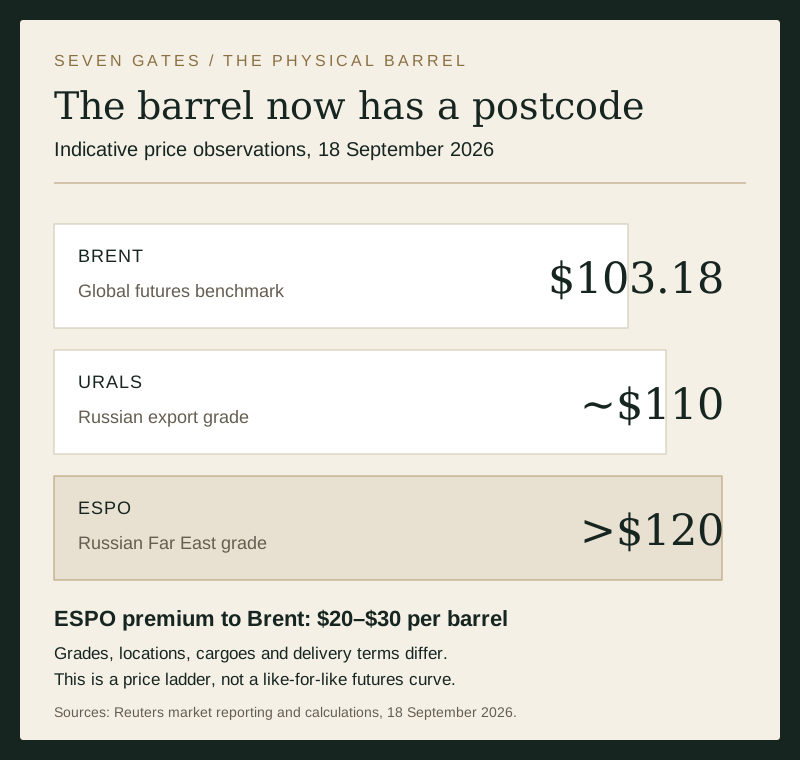
Brent was $103.18 on Friday. Russia's Urals reached about $110, while ESPO rose above $120 for the first time since April. Reuters calculated a record $20 to $30 ESPO premium to Brent as Chinese refiners secured November and December cargoes early.
These are not interchangeable barrels or identical delivery terms. That is precisely the point. A benchmark can fall while a refinery's available feedstock becomes dearer. Saudi Aramco also halted October deliveries to at least two European refiners after damage to East-West pipeline pumping stations.
For Nigeria, Brent alone is now a lazy dashboard. Federal receipts depend on volumes and realised differentials; refiners face grade, freight and timing costs. Reliable light-sweet cargoes may command value, while delayed loadings still leave the budget with an attractive quotation and less cash.
Sources: Reuters, ESPO and Urals physical prices, 18 September · Reuters, Brent close, 18 September · Reuters, halted Aramco deliveries, 18 September
3. Capital is retreating, including from African ambition
Investors withdrew $23.21 billion from global equity funds in the week through 16 September, the largest outflow in nine months. Emerging-market equity funds lost $1.61 billion and bond funds lost $167 million.
Airtel Money supplied the corporate footnote. It is reportedly seeking at least £600 million in London, down from an earlier £1.1 billion to £1.5 billion target after investor feedback. Airtel Africa fell 11.3% on Friday.
The business has scale; the market is pricing terms. For Nigeria, where Airtel operates mobile money and telecoms networks, a smaller float would not weaken the utility of digital payments. It would show that user growth and African reach do not cancel the global discount rate.
Sources: Reuters, global fund flows, 18 September · The Times, reported Airtel Money terms, 18 September · Reuters, Airtel Africa market reaction, 18 September
4. Volkswagen's China problem has become a €10 billion bill
Volkswagen warned of €10 billion in one-off costs, including a €6 billion Porsche writedown, as Chinese demand, U.S. tariffs and restructuring converged. Its 2026 operating-margin forecast fell from 4.0% to 5.5% to no more than 1%.
The adjustment includes planned job cuts. It is an industrial-policy warning: the transition to electric vehicles does not protect legacy manufacturers from price competition, trade barriers or a weaker luxury franchise. Technology changes the product; it does not repeal the income statement.
Source: Reuters, Volkswagen and Porsche outlook, 18 September
5. The court is putting a human signature back on AI
The Tenth U.S. Circuit Court of Appeals proposed requiring lawyers and self-represented litigants to certify that a human reviewed AI-assisted filings and independently verified authorities, quotations and analysis. If adopted, it would be the first such rule among the 13 federal appeals courts and would take effect on 1 January 2027.
This is not an AI ban. It is a liability boundary. The machine may draft; the person still owns the citation and the consequence. That principle will travel well beyond law.
Source: Reuters, proposed AI filing rule, 18 September
Three numbers worth remembering
- 112,000: people displaced inside Yemen during the renewed advance.
- Above $120: the reported ESPO physical oil price.
- $23.21 billion: withdrawn from global equity funds in one week.
Sources are linked in items 1, 2 and 3. Prices and fund flows are dated observations.
What could change everything?
Chinese economic pressure on Tehran would turn private diplomacy into leverage. Verified Saudi pipeline throughput would narrow the gap between futures and cargo reality. A successful, fully subscribed Airtel Money float at the revised terms would show that public markets still reward African scale. Until then, watch executed cargoes, settled capital and enforceable signatures.
Prepared for 19 September 2026 from sources checked through 03:50 UTC. Conflict reports, cargo prices and proposed transactions may change; transmission mechanisms are Seven Gates analysis.