SEVEN GATES DAILY BRIEF
The Fed raised the price of time
The first U.S. rate increase since 2023 lifts the global cost of capital; Saudi Arabia finds an Oman detour, Washington targets Russian energy, West Africa rations fuel, and Congress starts pricing AI's electricity appetite.
The Federal Reserve raised rates. Oil fell anyway. One is a durable change in the price of money; the other is a clever shipping workaround. Markets should not confuse the invoice with the discount coupon.
1. The Fed raised the price of time
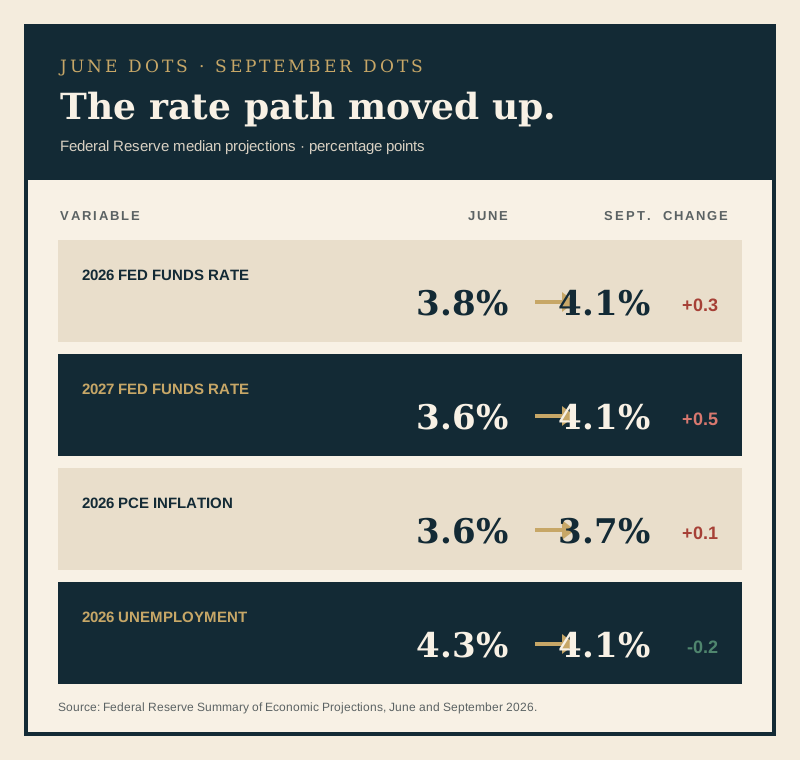
The Federal Reserve lifted its target range by 25 basis points to 3.75% to 4.00%, the first increase since 2023. The vote was unanimous. More important, the median policy-rate projection moved to 4.1% at the end of both 2026 and 2027, up from June forecasts of 3.8% and 3.6%.
This was not a recessionary panic. The Fed raised its 2026 growth forecast to 2.3%, cut unemployment to 4.1% and lifted PCE inflation to 3.7%. Markets heard the arithmetic: the dollar reached a seven-week high, the two-year Treasury yield rose to 4.7145% and the ten-year hovered just below 5%.
For Nigeria, the transmission is immediate. A stronger dollar pressures the naira and imported inputs. A near-5% Treasury yield raises the return demanded from eurobonds, equities and factories. Oil can enlarge the numerator, but Washington has just made the denominator less friendly.
Sources: Federal Reserve, FOMC statement, 16 September · Federal Reserve, September projections · Reuters, global market reaction, 17 September
2. Saudi Arabia found an Oman-shaped exit
Brent fell $1.24 to $104.59 after losing about $3 on Wednesday. Saudi Arabia is offering Asian refiners extra cargoes through ship-to-ship transfers off Sohar, Oman, partly replacing flows lost after attacks stopped the East-West pipeline and suspended Yanbu loading.
This is relief, not repair. The workaround can move marginal barrels, but Yanbu remains closed and two pumping stations are damaged. Route risk has been reduced by logistics rather than removed by peace.
Nigeria loses some scarcity premium as futures fall, yet cheaper crude also lowers diesel, freight and working-capital pressure. Reliable Nigerian barrels and Dangote products retain value when buyers are buying delivery rather than geology.
Source: Reuters, Saudi cargoes through Oman and oil prices, 17 September
3. Washington put a tariff weapon beside the oil market
The U.S. House passed the Russia and Iran sanctions bill by 262 votes to 159, sending it to President Trump. It targets Russia's energy and defence sectors, its shadow tanker fleet and Iran. It also authorises tariffs of up to 100% on countries, including China and India, that keep buying Russian energy.
The sanction is therefore both a barrel policy and a trade policy. If used aggressively, it could redirect crude, widen freight differentials and tax two of the world's largest importers. The presidential discretion is almost as important as the headline ceiling. A weapon does not need to be fired to alter the room.
Source: Reuters, House passage and tariff authority, 16 September
4. West Africa's fuel rationing has reached the truck queue
Ghana's state distributor BOST has cut diesel and petrol exports to Burkina Faso and Mali to protect domestic supply. Burkina Faso requested 80,000 tonnes for July and August and received 40,000. Mali received 10,000 tonnes while seeking another 40,000. Ghanaian diesel demand is also rising.
This is how a global shock becomes regional power. Landlocked Sahel economies depend on coastal storage, roads and political goodwill. Dangote gives Nigeria a chance to become a steadier regional supplier, but only if dollar funding, trucks and domestic affordability survive the same shock. A refinery gate is not a delivery network.
Source: Reuters, Ghana fuel-export cuts, 16 September
5. AI's electricity bill has entered politics
The U.S. House passed the Ratepayer Protection Act by 417 votes to three. It would require state utility regulators to consider whether data centres should bear the incremental grid costs built to serve them. The verb is only “consider”, but the direction is plain: households are resisting the socialisation of AI infrastructure costs.
That changes the industry argument from chips to kilowatt-hours and who pays for them. For African markets, cheap power is not enough. Reliable generation, transmission and a contract that allocates new capacity costs will decide whether data-centre investment creates an export industry or merely a very large private generator.
Source: Reuters, House data-centre power-cost bill, 16 September
Three numbers worth remembering
- 4.1%: the Fed's median end-2026 and end-2027 policy-rate projection.
- $104.59: Brent after Saudi Arabia offered extra cargoes through Oman.
- 417-3: the House vote on making regulators examine who pays for data-centre grid expansion.
Sources are linked in items 1, 2 and 5. Market prices are dated observations.
What could change everything?
A fast Yanbu restart would remove more of oil's delivery premium. Another hot U.S. inflation print would turn the Fed's projected hike into a timetable. President Trump's use, or restraint, of the new Russia tariff authority could matter more than the statute. In West Africa, replacement cargoes would separate a short allocation squeeze from a structural fuel corridor problem.
Prepared for 17 September 2026 from sources published through 03:50 UTC. Prices, cargo allocations and conflict details may change; transmission mechanisms are Seven Gates analysis.