SEVEN GATES DAILY BRIEF
Hormuz is dark, not empty
Visible Hormuz traffic collapses while physical oil flows persist; Europe’s jet-fuel deficit recruits Nigeria, Washington and Beijing design an AI alarm, China questions robot revenue, and Vietnam’s index upgrade rewards market plumbing.
A shipping screen can go blank before an oil market does. Twelve visible commodity vessels crossed Hormuz at the weekend. The barrels were less obedient.
1. Hormuz is dark, not empty
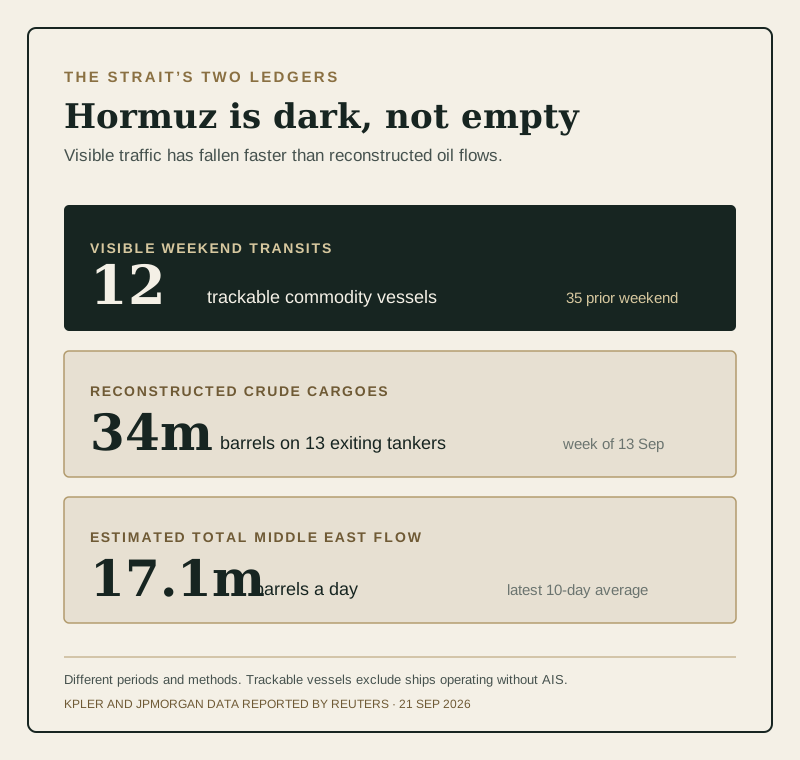
Trackable weekend transits through the Strait totalled 12 vessels, down from 35 a week earlier. Before the war began on 28 February, about 125 large commercial vessels used the route each day. That visible collapse is real, but it is not a barrel count: ships are switching off transponders while satellite imagery, cargo data and discharge records reconstruct the traffic after the fact.
Thirteen crude tankers carrying 34 million barrels exited in the week of 13 September. JPMorgan estimates total Middle East oil flows averaged 17.1 million barrels a day over the latest 10 days, still 6.1 million below the 2025 average. Saudi exports recovered above 4 million bpd in September from 2.4 million in August, despite attacks on the East-West pipeline.
The market has two ledgers: ships it can see and cargoes it must infer. Better reconstruction limits the catastrophe premium. Opacity still raises insurance, verification and security costs. Brent fell 2.1% to $101.63, but two-year Treasury yields remain 36 basis points higher over two weeks after the Federal Reserve’s 16 September rate increase. More barrels can remove an oil premium. They cannot instantly reverse the rate transmission.
Sources: Reuters, Hormuz vessel and cargo data, 21 September · Reuters, global markets, 21 September · Federal Reserve, policy decision, 16 September
2. Europe’s jet-fuel deficit has recruited Nigeria
Europe faces a fourth-quarter jet-fuel deficit of 510,000 bpd after losing roughly half its imports during the Iran war. Stocks in the Amsterdam-Rotterdam-Antwerp hub are at a seven-year low. Cargoes are now arriving from Nigeria, the United States, Canada and, at a five-year high, South Korea.
This is the useful side of dislocation: product arbitrage routes around the crude chokepoint. Asia has a forecast surplus of 419,000 bpd, while European scarcity can pull refinery output across longer routes.
For Nigeria, the prize is foreign exchange from finished products rather than another celebration of high Brent. The mechanism is unforgiving. Refinery uptime, fuel certification, terminal capacity, freight and settlement determine whether shortage becomes a booked cargo. A deficit in Europe is only an opportunity in Lagos when the molecule arrives on specification and on time.
Source: Reuters, Europe’s fourth-quarter jet-fuel deficit, 21 September
3. Washington and Beijing are designing an AI fire alarm
US Treasury Secretary Scott Bessent proposed an incident-notification mechanism for AI events that rise to national-security concern during talks with Chinese Vice Premier He Lifeng. The idea may reach the Trump-Xi summit later this week. China has acknowledged the AI discussion but has not publicly accepted the mechanism; chip controls remain outside this channel.
This is not an AI arms-control treaty. It is a fire alarm. Its value will depend on shared definitions, a secure contact point, response times and reciprocal disclosure. Without those, notification becomes summit furniture. With them, two rivals gain a modest way to distinguish an accident from an attack before markets or militaries write their own explanation.
Sources: Reuters, US-China AI and trade talks, 20 September · AP, proposed AI notification mechanism, 20 September
4. Beijing is auditing the customers behind robot revenue
Chinese regulators are informally slowing or pausing humanoid-robot listings after Unitree’s shares rose more than fivefold on debut, then fell 55% from their peak. At least six companies are seeking listings. In some local-government ventures, public projects supplied 80% to 90% of initial investment.
The question is revenue quality. One investor estimates valuations could fall 60% to 70% if data-centre and state-linked sales were stripped out. A robot can execute a backflip. Revenue still needs an unaffiliated customer. China’s IPO gate is becoming a test of commercial deployment rather than engineering theatre.
Source: Reuters, China slows the humanoid-robot IPO rush, 21 September
5. Vietnam’s index upgrade is a plumbing exam
Vietnam joined FTSE Russell’s emerging-market benchmark after eight years on the watchlist. FTSE estimates the upgrade could attract up to $6 billion, phased through four additions ending in September 2027. Foreign investors remain net sellers this year, so inclusion is an invitation, not a command.
The wider lesson is mechanical. Foreign-ownership limits, free float, custody and settlement still constrain flows; a central clearing counterparty expected in 2027 matters for any later MSCI upgrade. Nigeria’s route back to broader index relevance runs through the same unglamorous machinery: dependable foreign-exchange conversion, tradable float and settlement that works on an ordinary Tuesday.
Source: Reuters, Vietnam joins FTSE’s emerging-market benchmark, 21 September
Three numbers worth remembering
- 12: trackable commodity vessels that crossed Hormuz over the weekend.
- 510,000 bpd: Europe’s forecast fourth-quarter jet-fuel deficit.
- Up to $6 billion: estimated flows from Vietnam’s FTSE upgrade.
Sources are linked in items 1, 2 and 5.
What could change everything?
Restored Saudi pipeline capacity or a durable Iran agreement would narrow the gap between visible and inferred oil flows. A binding US-China AI protocol would turn a summit proposal into crisis infrastructure. Sustained Nigerian jet-fuel exports would convert European scarcity into foreign exchange. Formal robot-listing rules would show whether Beijing is cooling speculation or rewriting the test for technology revenue.
Prepared for 21 September 2026 from sources checked through 03:55 UTC. Conflict reporting and flow estimates may change; transmission mechanisms are Seven Gates analysis.