SEVEN GATES DAILY BRIEF
The oil shock has crossed 5%
Brent near $107 has pushed the U.S. ten-year yield above 5% and a Federal Reserve increase into the base case; Dangote opens Africa's largest IPO, China's factories outrun its consumers, Waymo sets a Tokyo date, and Thailand and Cambodia choose conciliation.
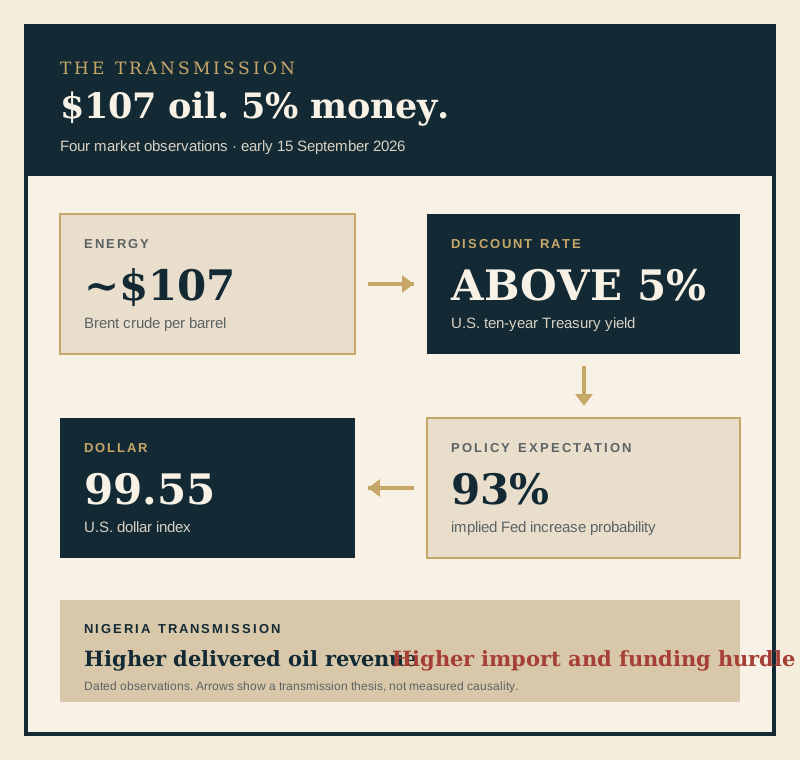
At $107, oil is expensive. Above 5% on the U.S. ten-year, it becomes the price of nearly everything. The energy shock has crossed into the global discount rate.
1. The oil shock has crossed 5%
Brent traded near $107 early Tuesday, the U.S. ten-year Treasury yield moved above 5% for the first time since October 2023, and futures assigned a 93% probability to a quarter-point Federal Reserve increase on Wednesday. That would be the first U.S. rate rise in more than three years.
The physical and financial stories now reinforce each other. Houthi missile and drone attacks wounded 13 civilians in southern Saudi Arabia, the East-West oil pipeline remains offline, and Gulf talks with Iran on reopening Hormuz were postponed. Supply anxiety raises energy prices; inflation risk raises yields; higher yields strengthen the dollar and reset asset values.
Nigeria's ledger remains two-sided. Scarce, deliverable crude earns more dollars, but diesel, freight, fertiliser and imported machinery become dearer. A firmer dollar and 5% Treasury benchmark also demand a larger premium from naira assets and sovereign borrowers. Abuja receives the oil benefit only when barrels are lifted; households receive the cost through the nearest bus fare.
Sources: Reuters, oil, dollar, yields and Fed probability, 15 September · Reuters, Houthi attacks and stalled talks, 15 September · Federal Reserve, official meeting calendar
2. Dangote's people's IPO comes with institutional arithmetic
Books are open for Africa's largest share sale. Dangote Refinery is offering roughly 3% to the public, seeking ₦2.15 trillion before any greenshoe and allowing entry from 10 shares, about $4. The accessibility is real. So is the valuation step: the IPO values the company near $49 billion, against $40 billion in July's private placement.
Retail buyers are paying more than institutions that accepted lock-ups and other conditions. That may be justified, but the prospectus must do the work. The investment case turns on refinery uptime, crude access, margins after war premiums fade, expansion funding and minority protections. “People's” describes the invitation; price decides whether the welcome is generous.
Source: Reuters, offer terms, valuation and refinery capacity, 14 September
3. China's factories are outrunning its customers
Chinese industrial output rose 5.2% from a year earlier in August, beating expectations, while retail sales grew only 0.4%. Fixed-asset investment fell 7.2% across the first eight months; property investment dropped 19.9%. High-tech manufacturing, by contrast, grew 16.7%.
This is productive capacity without matching domestic appetite. More output must find an overseas buyer, increasing price pressure abroad and trade friction around it. Beijing can subsidise demand, but another factory is not a household balance sheet.
Sources: China National Bureau of Statistics, August activity, 15 September · Reuters, production, consumption and investment, 15 September
4. Waymo has put a date on its first foreign robotaxi market
Waymo, GO and Nihon Kotsu intend to offer fully driverless rides to Tokyo passengers in 2027, starting small and expanding towards about 100 vehicles. Regulatory approval and local validation remain conditions, not footnotes.
Tokyo is a serious export test for embodied AI: left-hand traffic, narrow streets, exacting regulators and a shrinking workforce. Success would show that autonomy can travel beyond familiar American road rules. Failure would remind investors that software crosses borders more easily than liability does.
Sources: Waymo, official Tokyo plan, 15 September · Reuters, partnership and proposed fleet, 15 September
5. Thailand and Cambodia have chosen a table over a patrol boat
The neighbours opened a UN Convention on the Law of the Sea conciliation in Singapore over their maritime boundary. The process is expected to take about 12 months and its recommendations will not bind either government.
That limitation is also the point. Conciliation creates a face-saving route towards delimitation or shared resource development before exploration turns an old map dispute into a new security one. In a week of blocked straits, two states discussing rules of procedure counts as progress.
Sources: Thailand Ministry of Foreign Affairs, official process note · Reuters, opening statements, 15 September
Three numbers worth remembering
- 5%: the U.S. ten-year yield threshold crossed for the first time since October 2023.
- $49 billion: the Dangote Refinery valuation implied by the public offer.
- 0.4%: China's August retail-sales growth, beside 5.2% industrial-output growth.
Sources are linked in items 1, 2 and 3. Prices and probabilities are dated observations, not forecasts.
What could change everything?
The Federal Reserve can validate the bond sell-off or reject it on Wednesday. A Saudi pipeline restart or credible Hormuz timetable would remove part of the energy premium. Dangote's order book will show whether low entry tickets can overcome a higher valuation. In Asia, conciliation matters only if both governments keep resource vessels and naval assets behind their lawyers.
Prepared for 15 September 2026 from sources published through 03:55 UTC. Market prices, probabilities and incident details may change; transmission mechanisms and judgements are Seven Gates analysis.