SEVEN GATES DAILY BRIEF
The bypass has become the target
Saudi Arabia's oil escape route closes after attack as Houthis seize Perim; BRICS opens a narrow diplomatic channel, Nigeria sanctions South African visits, AI chiefs ask for a brake, and Congo's Ebola outbreak crosses 7,000 cases.
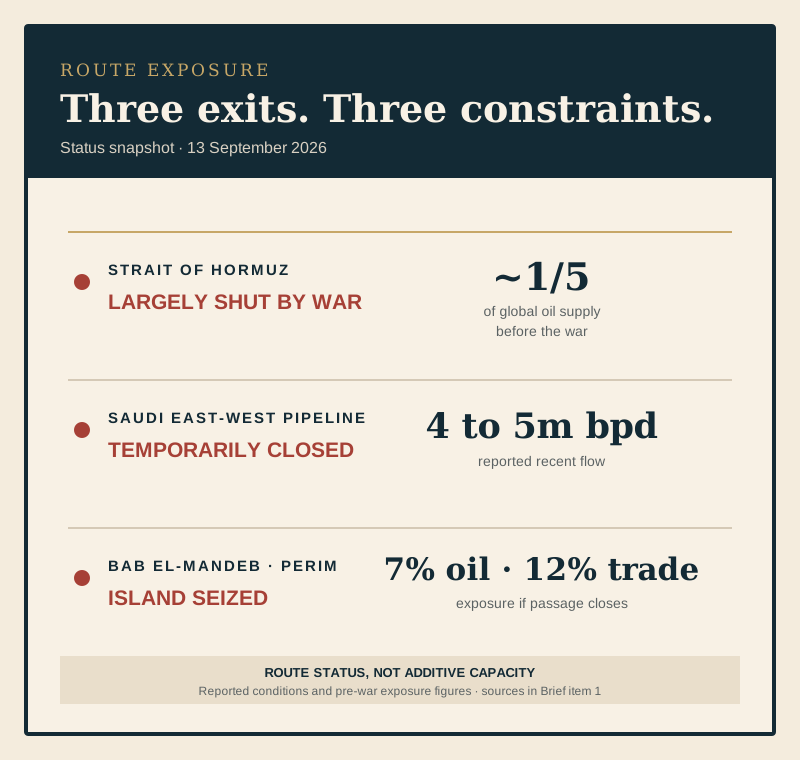
The bypass was supposed to be the defence. Saudi Arabia's east-west oil pipeline is now shut after an aerial attack, while Houthi forces hold Perim at the Red Sea exit. The redundancy has become the front line.
1. The oil shock is attacking the escape routes
Saudi Arabia temporarily closed its 1,200-kilometre East-West pipeline after a drone attack launched from Iraq. No group has claimed responsibility, and the damage and export impact remain under assessment. The route had been moving 4 million to 5 million barrels a day, about 4% to 5% of global supply, while war largely shut the Strait of Hormuz.
The second warning sits farther south. Houthi forces seized Yemen's Perim island on Friday, placing them beside the Bab el-Mandeb passage. A closure there would constrain about 7% of global petroleum supply and 12% of global trade. Early Sunday, the UK Maritime Trade Operations service also received a report that a projectile struck a vessel in Hormuz; damage and crew status were not yet known.
For Nigeria, a higher benchmark is not automatically a windfall. The premium belongs to barrels that can be produced, loaded, insured and delivered. Reliable Nigerian liftings could gain share, but freight, fertiliser and imported fuel costs travel home faster than fiscal relief. A valuable cargo at sea is still a logistical problem wearing a better price.
Sources: Reuters, pipeline closure, Perim seizure and Hormuz incident, 13 September · UKMTO, official maritime incident service
2. BRICS has found a diplomatic sentence, not yet an outcome
Iran and the United Arab Emirates endorsed a BRICS declaration urging restraint, civilian protection, sovereignty and maritime stability. Iran's president also met Abu Dhabi's crown prince in New Delhi, their highest-level engagement since the war began.
Consensus between two states on opposite sides of the conflict is useful, but declaratory verbs do not reopen pipelines. The operational test comes at Monday's Gulf meeting in Oman. Any agreement needs observable steps on shipping access and attacks, not merely language everyone can sign because nobody must enforce it.
Source: Reuters, BRICS declaration and Iran-UAE meeting, 12 September
3. Nigeria has escalated with South Africa without closing the door
Nigeria's parliament suspended official visits and ordered lawmakers to boycott South African-hosted legislative events over attacks on Nigerian migrants. Government travel remains outside the measure, making this a calibrated sanction rather than a diplomatic break.
Nigerian officials say 98 citizens have died in mob or hate incidents since 2022, while 1,695 Nigerians voluntarily left South Africa this year. The human grievance is real. The economic risk is escalation between Africa's two largest economies, with banking, telecoms, trade and the credibility of continental integration in the room. Pretoria's condemnation of xenophobia now needs visible prosecution and protection.
Source: Reuters, parliamentary action and official figures, 11 September
4. AI leaders are asking for a brake they do not control
OpenAI chief Sam Altman said the company will not pursue an IPO in 2026 and that leading laboratories may be close to an agreement to slow advanced-model development. Anthropic chief Dario Amodei proposed embedded independent evaluators, coordination among frontier labs and international cooperation. Altman supported giving evaluators employee-like access.
The IPO delay is less important than the governance admission. If executives believe competitive incentives cannot safely govern the next models, voluntary restraint is an interim measure, not a system. Independent access, disclosed scope and published findings would be evidence. A promise to slow down is not a throttle.
Sources: Reuters, Altman on IPO timing and evaluator access, 12 September · Reuters, Amodei's three-step proposal, 12 September
5. Congo's Ebola emergency has entered a harder geography
Confirmed infections in the Democratic Republic of the Congo reached 7,022, with 3,398 deaths, and the virus spread to South Ubangi, a seventh province far from the eastern epicentre. The distance matters more than the round number: it expands the surveillance map while staff, partner capacity and funding are already stretched.
WHO's 10 September assessment, based on data through 7 September, classified national risk as very high and risk to neighbouring countries as high. It reported a 48.3% crude case-fatality ratio and said vaccine efficacy against this Bundibugyo strain remains unknown. The response needs faster detection, care and contact tracing, not false reassurance from an experimental shield.
Sources: WHO, official outbreak assessment, 10 September · Reuters, latest case count and provincial spread, 11 September
Three numbers worth remembering
- 4 million to 5 million barrels a day: reported recent flow through Saudi Arabia's East-West pipeline.
- 1,695: Nigerians who voluntarily left South Africa in 2026.
- 7,022: confirmed Ebola infections in the DRC by 11 September.
Sources are linked in items 1, 3 and 5. The route figures describe separate exposures and are not additive.
What could change everything?
A verified Saudi pipeline reopening would restore the main physical bypass. A monitorable Oman agreement on shipping access could remove part of the oil premium. In Congo, funded deployment of surveillance teams into the newly affected province would determine whether distance becomes sustained transmission.
Prepared for 13 September 2026 from sources published through 03:45 UTC. Incident details remain provisional; transmission mechanisms and judgements are Seven Gates analysis.