SEVEN GATES DAILY BRIEF
The $101 barrel now carries a shipping premium
Gulf tanker attacks turn oil risk into a logistics bill; Europe enters the test with thinner buffers, Dangote's Kenya plan exposes a funding gap, and AI's next utilities are power and permission.
A $100 oil price can be a market opinion. A tanker under attack is a physical constraint. The Gulf crisis has crossed that line, leaving governments to discover that emergency barrels, alternative routes and optimistic communiqués are not interchangeable.
1. The Gulf risk premium has become a logistics bill
Brent settled at $101.21 a barrel on 9 September, up 3.4%. Reuters reported the largest wave of tanker attacks since the conflict began: Iran said it attacked ten ships after the United States sank five Iranian tankers. One seafarer was killed aboard the Hercules Star. Oil flow through Hormuz, estimated at 8 to 9 million barrels a day in the week before 30 August, has recently fallen below 2 million, according to Rystad Energy.
The mechanism has changed. Traders are pricing not only lost production but scarce safe passage, insurance and usable alternatives. Houthi attacks on Saudi facilities threaten the Red Sea route too. The US Energy Information Administration estimates global oil inventories have fallen by about 400 million barrels this year, which makes disruption harder to absorb.
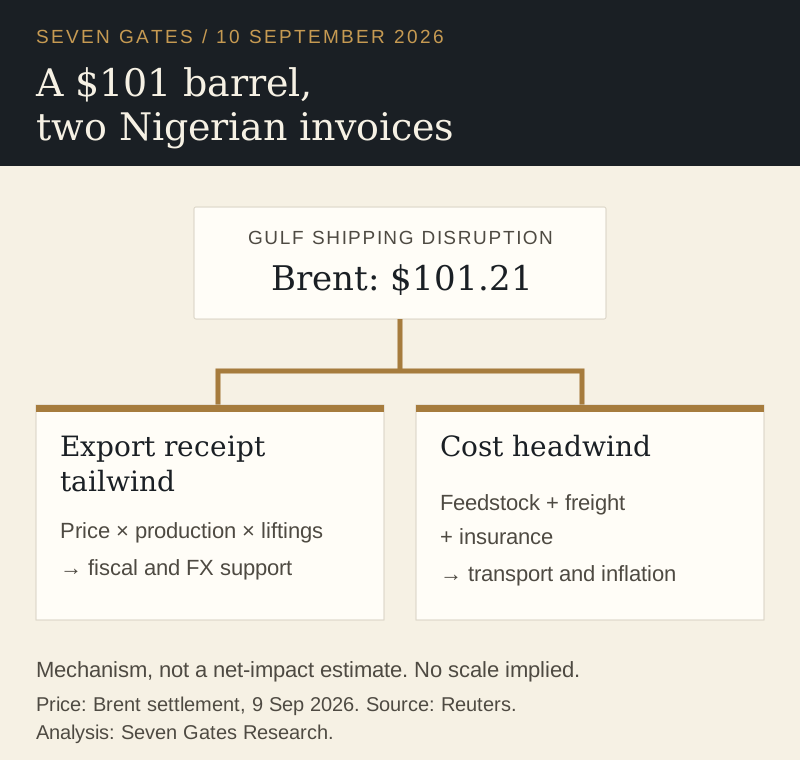
Nigeria gets two invoices. Higher export prices may support receipts and foreign exchange if production and liftings hold. Yet the same benchmark raises internationally priced feedstock, freight and insurance, passing into diesel, transport and food. A fiscal tailwind can arrive beside a household headwind. Oil economies do enjoy irony, but rarely a discount.
Sources: Reuters, market close and shipping disruption · EIA, Short-Term Energy Outlook
2. Europe's energy exit has met its first hard audit
The European Court of Auditors says the EU's plan to leave Russian fossil fuels is faltering. Russian gas has fallen from 45% of imports before the 2022 invasion of Ukraine to 12%, but gas storage is about 67% full, against 80% a year earlier. Only €54.3 billion has been committed against an initial €300 billion investment estimate.
That gap matters as Russian LNG is due to be banned from January 2027 and Gulf supply is strained. Mild weather and demand destruction helped Europe reduce dependence; neither is infrastructure. Resilience built on pipelines, grids and storage survives bad luck. Resilience built on another gentle winter is a wager wearing a policy badge.
Sources: Reuters, auditors' findings · European Court of Auditors
3. Dangote's Kenya refinery has a launch date, not yet a supply chain
Dangote plans to break ground this month on a 700,000-barrel-a-day refinery in Lamu, aiming for completion in 2030 at a cost of $15 billion to $16 billion. Kenya has no commercial crude output. Candidate supplies from Uganda and South Sudan face incomplete infrastructure or political risk, while Lamu's planned storage and large-tanker facilities are mostly unbuilt.
The Nigerian transmission is capital allocation. Dangote is seeking roughly $40 billion for energy projects through 2030 while also planning a Lagos refinery expansion and public offering. Kenya could create a formidable East African platform. It could also compete for group cash, debt capacity and management attention. Investors need disclosure on feedstock contracts, country equity, related-party funding and sequencing. A groundbreaking is evidence of intent, not bankability.
Source: Reuters, project, funding and supply constraints
4. AI's next infrastructure problem is electricity
Google will invest at least €13 billion in Finnish AI and data-centre infrastructure during 2027 and 2028, its largest European investment. The package includes three northern data centres and a 22-year power-purchase agreement with Fortum covering up to half the output of the Loviisa nuclear plant.
The strategic point is not another large cheque. AI capacity is becoming a contest for long-duration power, grid access, cooling and permitted sites. Models travel easily; substations do not. Countries seeking AI investment will increasingly compete on reliable electrons and planning competence rather than slogans about innovation.
Sources: Google, investment announcement · Reuters, power and investment details
5. Payments are building a passport for shopping agents
Ant International, Mastercard and Visa launched work on a common Know-Your-Agent framework. It would let networks, wallets, marketplaces and agent platforms recognise trusted purchasing agents while retaining their own approval and risk controls.
The valuable layer may be permission, not the shopping assistant. Identity, delegated intent, revocation and disputes decide whether an agent can safely spend. Nigerian banks and payment firms should watch the interoperability rules: standards written elsewhere can become the admission ticket to cross-border commerce. The demo sells convenience; liability writes the contract.
Source: Reuters, framework and participating protocols
Three numbers worth remembering
- $101.21: Brent's 9 September settlement.
- Below 2 million barrels a day: recent Hormuz oil flow estimated by Rystad, versus 8 to 9 million before 30 August.
- €13 billion: Google's planned two-year Finnish infrastructure investment.
Sources are linked in items 1 and 4. The flow estimate is not a customs tally.
What could change everything?
A verified ceasefire plus sustained safe Hormuz passage would remove part of the logistics premium. Confirmed damage to major export infrastructure would deepen it. For Dangote, binding crude-supply and financing agreements would turn an ambitious site plan into an investable sequence.
Prepared for 10 September 2026 from sources published through 03:40 UTC. Prices and flows are dated observations; transmission mechanisms are Seven Gates analysis.