SEVEN GATES DAILY BRIEF
The Iran War Has Reached the Tankers
US strikes on three Iranian oil tankers turn a shipping-risk story into a supply-destruction story, while a two-year AGOA reprieve and a 58 per cent NGX rally show how much of Nigeria's good news depends on the oil price holding.
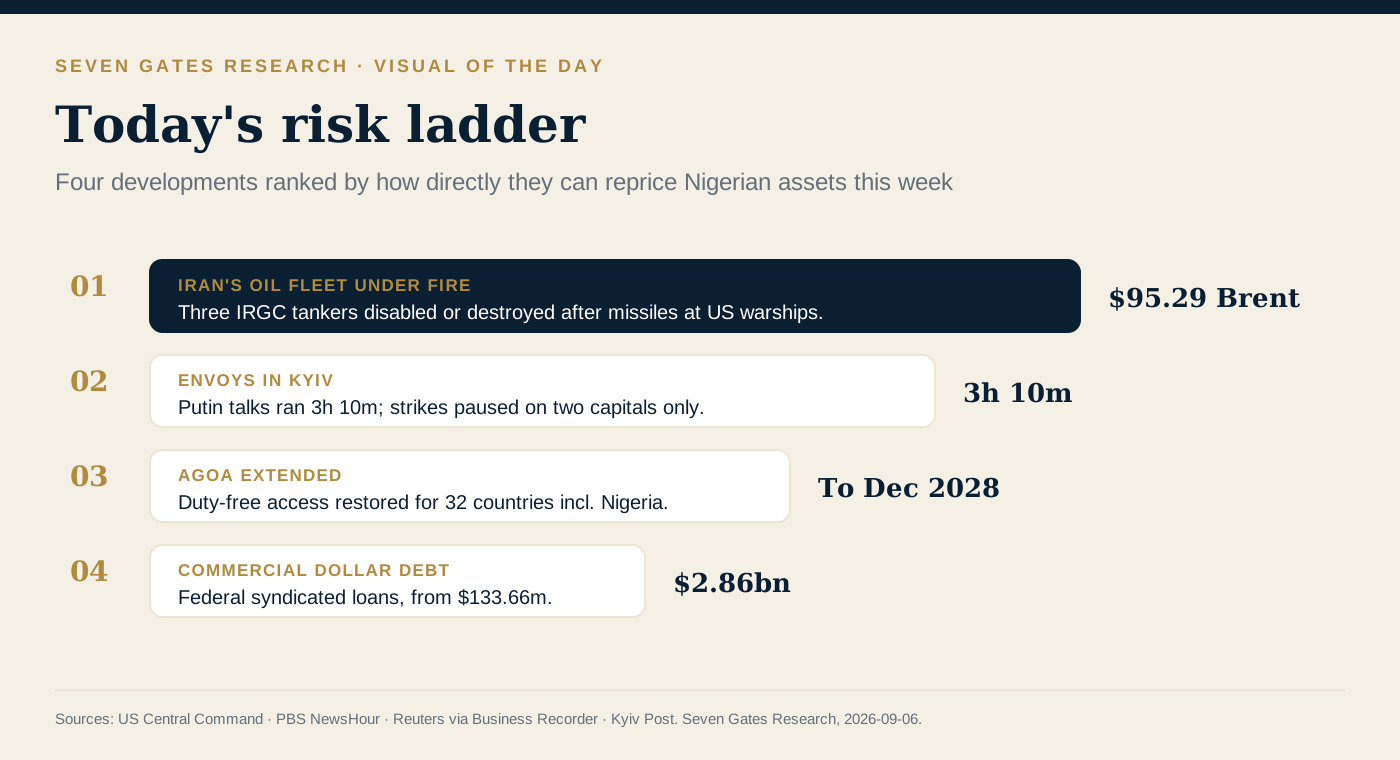
For six months the Iran war has been priced as a risk to shipping. On Saturday it became a war on the ships themselves, with US forces disabling or destroying three Iranian crude carriers after missile fire at an American carrier group. The same weekend brings Washington's envoys to Kyiv, a two-year extension of America's trade preferences for Africa, and Nigerian data that look cheerful until the borrowing terms are read closely.
1. Three tankers for two warships: Washington is now targeting Iran's oil fleet
US Central Command says the Revolutionary Guard fired ballistic missiles at an American aircraft carrier and a guided-missile destroyer on Saturday. Both evaded the attack. In response, US forces permanently disabled the tanker Downy off Kharg Island and the Stark 1 near Jask, and destroyed the unladen Kylo in the Gulf of Oman. Admiral Brad Cooper promised to destroy Iran's limited and exposed oil fleet if necessary. That is a change of target. Kharg handles the bulk of Iranian crude exports, and strikes six miles from the terminal put supply itself, not merely transit, in play. Brent closed the week at $95.29, up 6.1 per cent, with only four vessels transiting Hormuz on Thursday against a normal fifteen. Nigeria's export receipts improve; its petrol and diesel bills do not.
Sources: US Central Command · PBS NewsHour · Reuters via Business Recorder
2. Kyiv gets its turn, with a truce that covers two capitals and nothing else
Steve Witkoff and Jared Kushner spent three hours and ten minutes with Vladimir Putin on Saturday and travel to Kyiv today to meet Volodymyr Zelenskyy. The Kremlin's Yuri Ushakov called the Americans seriously prepared and said the discussion covered settlement proposals alongside large US-Russian commercial projects, which tells you what Moscow considers the prize. Putin confirmed Russia halted strikes on Kyiv from midnight on 5 September but rejected Ukraine's request for a three-day frontline ceasefire; Ukraine has paused attacks on Moscow until Monday. Beyond the two capitals the war continued. Ukraine reported one person killed and at least ten injured overnight, intercepting 82 of 108 Russian drones, while a Ukrainian drone killed one person in Belgorod. A ceasefire that protects the negotiators' hotels and nobody else is a narrow foundation.
Sources: Kyiv Post · Associated Press via KSAT
3. AGOA survives to 2028, which is long enough to ship and too short to build
President Trump has signed the Continuing Appropriations and Extensions Act, 2027, carrying the African Growth and Opportunity Act through to 31 December 2028 after a 370 to 48 House vote. Duty-free access is restored retroactively for the months the programme lapsed, and 32 countries including Nigeria remain eligible. Ngozi Okonjo-Iweala welcomed the decision. The arithmetic is less warm. Goods exported under AGOA were worth about $8.23 billion in 2024, roughly half of it South African, and Nigeria's own use has long been dominated by crude that would sell regardless. Two years is enough to fill existing order books for cocoa, cashew and garments. It is not enough to justify a factory, which is what South Africa's request for a fifteen-year term was really about.
Sources: ThisDay · Business Day South Africa · Ecofin Agency
4. Lagos is rallying on oil and IPO hope, and businesses are starting to believe it
The NGX All-Share Index rose 2.36 per cent in the first week of September to 246,992.44, taking the year-to-date return to 58.72 per cent and market capitalisation to ₦159.56 trillion. Turnover jumped 70.7 per cent to ₦210.3 billion and 56 stocks advanced against 35 decliners, a healthier spread than the previous week's 24 to 55. The oil and gas index led with 9.10 per cent as investors positioned ahead of the Dangote Refinery order book. The real economy is following at a distance: NESG's business performance index rose to 112.7 in August from 108.6, the highest since February, with manufacturing at 120.4. The cost-of-doing-business reading of 56.7 stays deep below neutral, so the confidence is real but paid for in power, rent and credit.
Sources: BusinessDay Nigeria · Nairametrics
5. Nigeria's syndicated loans have grown twenty-one-fold, and the lender list matters more than the headline
Debt Management Office figures analysed by The Punch show federal syndicated loans rising from $133.66 million in March 2025 to $2.86 billion in March 2026. First Abu Dhabi Bank holds $1.87 billion, Afreximbank $637.82 million and UniCredit $319.27 million, largely against the first two sections of the Lagos-Calabar Coastal Highway, financed at $747 million and $1.126 billion. Syndicated debt is now 5.51 per cent of external obligations, up from 0.29 per cent, within total external debt that grew 12.9 per cent to $51.90 billion. Wale Edun called it the return of international capital. It is also the return of commercial pricing: bank syndications carry floating dollar rates and shorter tenors than the concessional money they displace, which is why Friday's US jobs report reaches the Abuja budget faster than it used to.
Sources: The Punch via Parrot Nigeria
Three numbers worth remembering
| Number | Why it matters | Source |
|---|---|---|
| $95.29 | Brent's Friday close, up 6.1 per cent on the week, before the tanker strikes had been priced. | Reuters via Business Recorder |
| 58.72% | NGX All-Share Index return so far in 2026 after last week's 2.36 per cent gain. | BusinessDay Nigeria |
| $2.86bn | Federal syndicated bank loans at March 2026, against $133.66 million a year earlier. | The Punch via Parrot Nigeria |
What could change everything?
- Whether Iran answers the tanker strikes with attacks on Gulf export infrastructure rather than warships, which would move the oil story from fear to physical loss.
- What Witkoff and Kushner carry out of Kyiv today, and whether the two-capital pause survives the return flight.
- Governorship campaigns open on Wednesday, 9 September, adding state-level money and noise to a presidential race already under way for the 16 January vote.
- The Dangote Refinery order book on 14 September, which will show whether the oil and gas rally was positioning or belief.