SEVEN GATES DAILY BRIEF
The oil war is widening. The buffers are shrinking.
Attacks reach Saudi energy infrastructure as US emergency stocks fall; Nigeria's IPO preparations test market liquidity, Sudan's mediators seek practical progress and Meta moves from answers to actions.
Emergency reserves can release barrels. They cannot repair a refinery or secure a shipping route. That distinction matters as attacks reach Saudi energy infrastructure and America's oil cushion contracts. Nigeria faces a different capacity test: whether a landmark share sale brings new money into its market or rearranges money already there.
1. The Gulf shock is spreading beyond the chokepoint
The UN condemned Houthi attacks on southern Saudi Arabia on 8 September, saying civilian and energy infrastructure had been affected. Reuters reported fires at the Jazan refinery and an Abha oil distribution centre; Saudi authorities said 73 people were injured, including women and children. US Central Command said it destroyed five Iranian crude carriers; Iran said it struck a US base in Jordan.
The economic change is geographical. A threat concentrated on Hormuz encourages rerouting; attacks elsewhere threaten the alternatives as well. Damage, repair time and usable export capacity now matter more than another declaration of resolve. An attack does not establish the size of a sustained supply loss.
For Nigeria, higher crude prices can improve export receipts while raising feedstock, freight and insurance costs. Refining at home changes dependence, not the international pricing of oil. Government revenue and household purchasing power can move in opposite directions.
Sources: UN, 8 September · Reuters, Saudi attacks
2. America's emergency cushion is smaller, not exhausted
US Strategic Petroleum Reserve stocks fell by about 1.2 million barrels to 285.4 million last week, Reuters reported on 8 September, citing Energy Department data. That is the lowest level since November 1982.
The policy buys time by exchanging stored supply for current relief. It cannot indefinitely offset disrupted production. DOE's published maximum nominal drawdown capability is 4.4 million barrels a day, a different measure from the stock available. Neither number establishes how long a particular global shortage could be covered. Storage capacity is not oil, and oil underground is not an unlimited daily delivery service.
Sources: Reuters, inventory update · DOE, reserve mechanics
3. Dangote's IPO is testing the market before opening
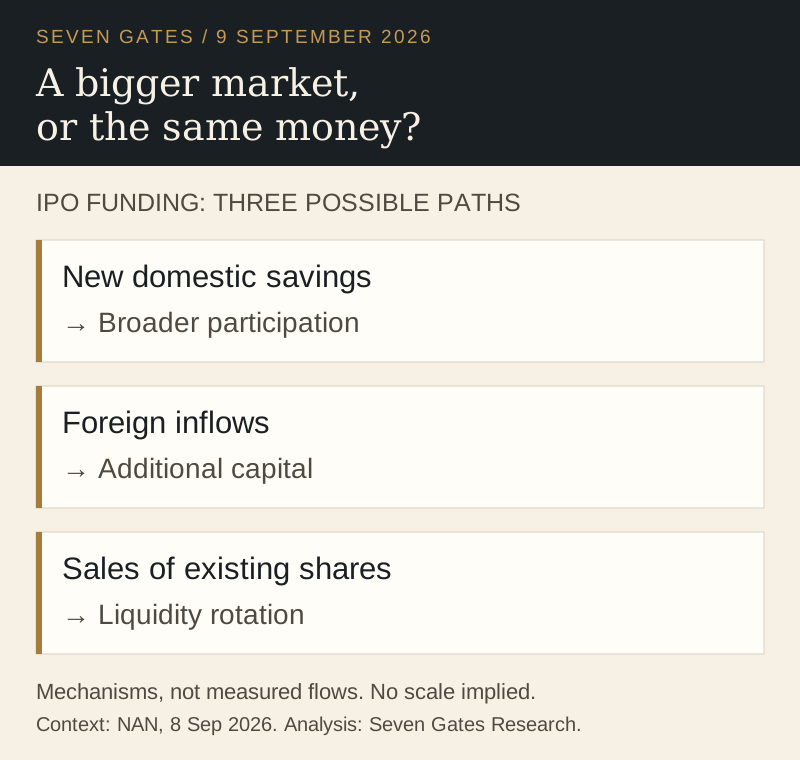
Nigeria's All-Share Index fell 1.17% on 8 September, while equity market capitalisation declined by ₦1.879 trillion, according to the News Agency of Nigeria. Broker Aruna Kebira attributed selling to investors raising cash ahead of the refinery offer, expected to open on 14 September. That explanation is market testimony, not proof that every sale funded an IPO subscription.
The distinction matters internationally: a large flotation can deepen a market without immediately increasing its pool of investable cash. Existing shareholders selling to subscribe may depress other prices even when confidence in the new issuer is strong. Fresh savings and foreign inflows would change that arithmetic. Market value lost is not cash withdrawn, and neither a famous sponsor nor a busy signing ceremony settles valuation.
Source: NAN, market close and broker interview
4. Sudan's diplomacy needs something civilians can measure
The UN's Sudan envoy joined African Union, IGAD, Arab League and EU counterparts in Khartoum on 8 September. Their mission seeks an inclusive political track; discussions have included civilian protection, detainee exchanges and a single national examination process for schoolchildren.
These practical issues are not decorative additions to a peace process. A released detainee, safer journey or recognised examination changes a family's options before a comprehensive settlement arrives. But meetings are not a ceasefire. Judge this effort by implementable commitments and participation beyond armed power, not the length of its closing statement.
Source: UN, Sudan mission update
5. Meta's next interface asks for permission to act
Meta launched Muse on 8 September, initially rolling out in the US. The company says its personal agent can work across connected services, with approvals before sensitive actions and a visible audit trail. WhatsApp access does not mean a Nigerian rollout has been announced.
The commercial shift is from answering questions to executing decisions. Merchants may increasingly compete for an agent's selection, while users must understand what authority they delegate. Meta's security descriptions are vendor claims, not independent assurance. Approval quality, revocation and recoverability will matter as much as a polished demonstration.
Source: Meta's launch and stated safeguards
Three numbers worth remembering
- 285.4 million barrels: US emergency crude stocks, reported 8 September.
- 1.17%: Nigeria's benchmark equity-index decline on 8 September.
- ₦1.879 trillion: the day's reported market-capitalisation decline, not cash leaving the exchange.
Sources: the Reuters inventory update and NAN market report linked above.
What could change everything?
Verified, sustained losses of Saudi output or export capacity would harden the supply shock. Fresh capital entering Nigeria's IPO would distinguish market expansion from rotation. In Sudan, civilian access and implemented agreements would turn diplomacy into evidence.
Prepared for 9 September 2026 from sources published through 8 September. Figures are dated observations; transmission mechanisms are Seven Gates analysis. No live-price claim is made.