SEVEN GATES DAILY BRIEF
Hormuz has turned a shipping crisis into an inflation test
Renewed US-Iran hostilities pushed oil towards its sharpest weekly rise since July, raising Nigerian fuel costs and complicating the global rate outlook as China and the AI giants tighten control over strategic infrastructure.
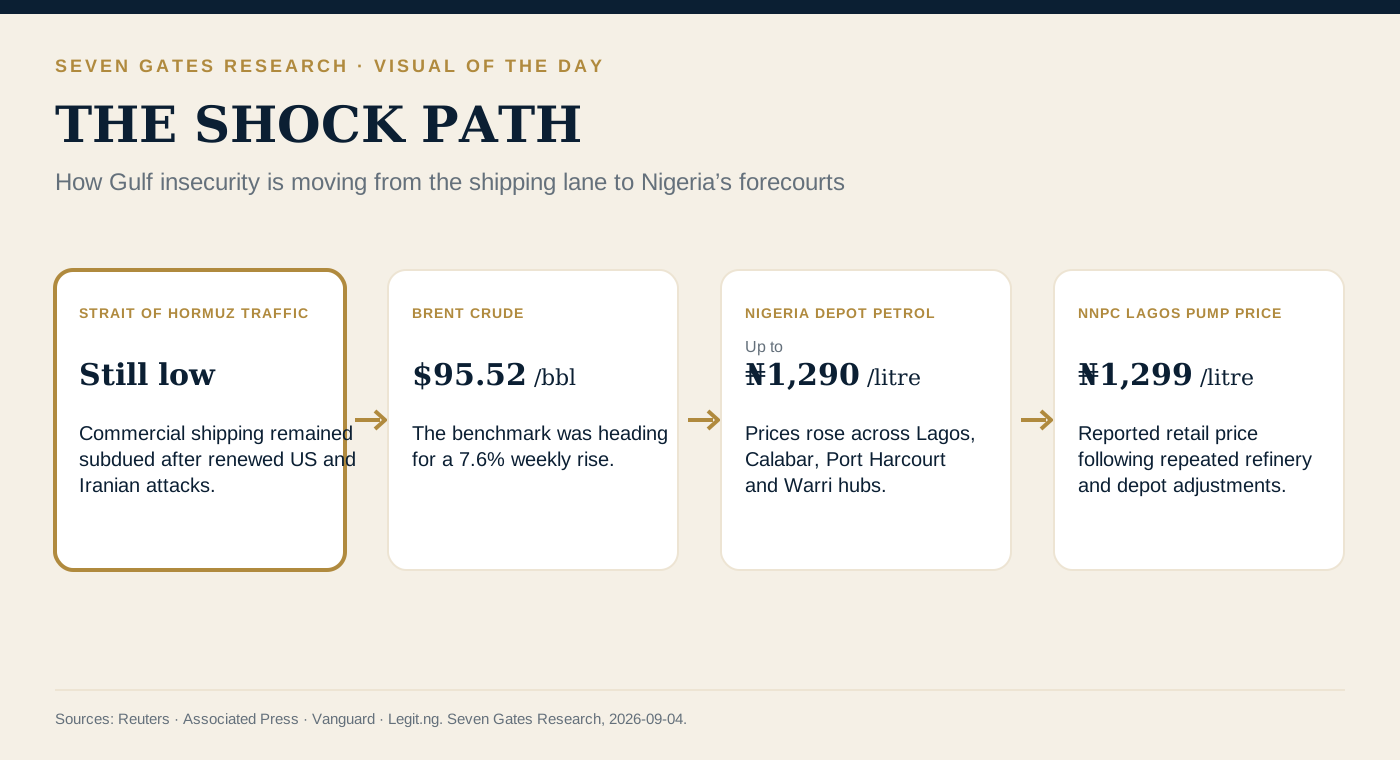
The Strait of Hormuz is again transmitting military risk into household prices. Renewed US-Iran strikes have lifted oil sharply, while the volume of shipping through the waterway remains contested. Nigeria is receiving both sides of the shock: stronger crude revenues and dearer petrol. Elsewhere, bond markets are reconsidering a US rate increase, Chinese rare-earth suppliers are withholding shipments, and two large AI announcements have made control of infrastructure more important than another round of benchmark applause.
1. 01 · Hormuz is open to claims, but not yet to normal commerce
Renewed US attacks on Iran this week killed and wounded dozens, including civilians, and brought Iranian retaliation elsewhere in the Gulf. Washington says negotiations will not resume unless Tehran stops attacking commercial shipping. Traffic through the Strait of Hormuz remained low on Friday, despite US claims that daily oil flows have recovered sharply. Brent held near $95.52 a barrel and was heading for a 7.6% weekly gain, its steepest since July. The distinction between a few permitted cargoes and dependable passage matters. Shipowners require naval security, insurance and several uneventful days before political declarations become physical supply. Until then, the strait remains an inflationary toll booth operated by war.
Sources: Reuters: Oil set for steepest weekly gain since mid-July · Associated Press: Ship traffic remains low after renewed attacks
2. 02 · Nigeria’s oil windfall has arrived first as a petrol bill
Nigeria’s deregulated fuel market is passing the Gulf shock rapidly to consumers. Dangote Refinery raised its petrol gantry price by ₦66 to ₦1,266 per litre, while depot prices reached ₦1,290. NNPC outlets were reported at ₦1,299 in Lagos and as high as ₦1,345 in Abuja. Domestic refining reduces freight and supply risks, but it does not abolish the international value of crude, foreign-exchange costs or marketers’ margins. Higher oil may improve export receipts and government revenue, yet households experience the adjustment through transport and food before Abuja books the gain. Labour’s demand for more domestic crude supply may help availability. It cannot fully insulate prices while crude remains commercially linked to the world market.
Sources: Vanguard: Depot petrol prices reach ₦1,290 · Legit.ng: NNPC adjusts retail petrol prices · Central Bank of Nigeria: Monetary policy decisions
3. 03 · The Fed’s pause case has improved, not prevailed
Federal Reserve Governor Christopher Waller urged markets to give disinflation more time, cutting the implied probability of a September rate increase to roughly 50% from 63%. The intervention steadied bonds after a sell-off driven by persistent inflation, heavy sovereign borrowing and geopolitical risk. August payrolls are expected to show a rebound and unemployment of about 4.1%, although next week’s consumer-price report may carry greater weight before the 15-16 September meeting. A pause would relieve the dollar and emerging-market financing conditions. The counterargument sits near $95 oil: another energy-driven inflation impulse could make restraint harder to defend. Central banking has rediscovered an old inconvenience. The data arrive individually, while the shocks prefer travelling together.
Sources: Reuters: US equity futures and September rate expectations · Reuters: US August employment report preview
4. 04 · China’s rare-earth leverage is moving outside formal policy
Some Chinese rare-earth suppliers are declining US orders because they fear repercussions from Beijing, according to Reuters. The refusals follow Chinese sanctions on the Responsible Business Alliance, a US supply-chain monitor, and persist despite earlier commitments to facilitate export licences. The issue has entered preparations for President Xi Jinping’s planned Washington visit on 24 September. This is not yet a comprehensive embargo, and other suppliers continue to ship. It is still strategically important. Informal caution can disrupt trade without a new regulation for companies to challenge, leaving American automotive, electronics and defence manufacturers with uncertain delivery schedules. China’s advantage is not merely mineral concentration. It is the ability to make commercial compliance depend on interpreting political weather.
Sources: Reuters: Chinese rare-earth suppliers halt some US shipments
5. 05 · AI competition has become a contest over access and control
Nvidia agreed to acquire Hugging Face for $12.9303 billion, placing a platform used by more than 18 million developers and 200,000 companies inside the dominant AI-chip supplier. Nvidia says Hugging Face will remain open across models, clouds and hardware, with no requirement to use Nvidia compute. That promise will become the transaction’s central regulatory and developer test. OpenAI, meanwhile, released GPT-6 Astra, its first model classified at the company’s Critical cybersecurity threshold, and committed $1 billion in subsidised access and support for infrastructure defenders. Together, the announcements mark a shift. Competitive power now lies not only in creating capable models, but in owning distribution while deciding who receives their most consequential capabilities.
Sources: Nvidia: Agreement to acquire Hugging Face · OpenAI: GPT-6 Astra safety overview · OpenAI: Daybreak for Frontline Defenders
Three numbers worth remembering
| Number | Why it matters | Source |
|---|---|---|
| 7.6% | Brent crude’s weekly gain as renewed US-Iran hostilities revived supply fears. | Reuters |
| ≈50% | Market-implied probability of a September Federal Reserve rate increase after Christopher Waller’s comments, down from 63%. | Reuters |
| $12.9303bn | Nvidia’s agreed purchase price for Hugging Face, extending its reach from AI chips into model distribution. | Nvidia |
What could change everything?
- Hormuz traffic: several days of rising, insurable tanker passage would matter more than any single-day US flow estimate.
- US inflation: payrolls can move Friday’s markets, but next week’s consumer-price report may decide whether the Fed pauses or raises rates on 15-16 September.
- Nigeria’s pass-through: further increases in depot and pump prices would feed transport and food costs, testing the recent disinflation narrative.
- Rare earths: supplier behaviour before Xi Jinping’s planned 24 September Washington visit will show whether earlier export commitments have practical force or merely diplomatic wording remains intact on paper and not in warehouses or factory schedules abroad today for buyers seeking certainty now worldwide too soon to know fully yet clearly enough to matter commercially right now as firms set production plans and inventories, with licences, sanctions risk and political interpretation all interacting beyond formal customs rules and official statements from either capital, creating a shadow compliance regime where uncertainty itself functions as a restriction even if volumes later recover partially before the summit itself takes place in Washington, leaving manufacturers to distinguish a temporary supplier hesitation from a durable strategic bottleneck that could reshape procurement, stockpiling and allied industrial policy over the coming quarters, especially for automotive, electronics and defence supply chains that cannot substitute specialised materials quickly or cheaply without sacrificing performance, output or strategic readiness in an increasingly fragmented trading system where mineral security has become inseparable from diplomacy and military planning; what matters next is whether Beijing clarifies that compliant US orders may proceed, whether exporters trust that guidance enough to act, and whether Washington arrives at the summit with concessions, retaliation or a credible alternative supply plan, because the present ambiguity lets China preserve leverage without announcing an embargo and lets both governments deny that a formal rupture has occurred even while individual companies absorb delays, higher inventory costs and production risk, a useful arrangement for diplomacy but an uncomfortable one for anyone running a factory, negotiating a supply contract or trying to price the next quarter’s industrial output with confidence amid a strategic contest whose rules remain deliberately unwritten and therefore unusually difficult for corporate compliance teams to interpret consistently across suppliers, provinces and product categories, especially when sanctions against a monitoring body can influence commercial conduct more broadly than the legal text might suggest, encouraging caution well beyond the entities or transactions directly named and turning political signalling into a material constraint on trade flows before customs data can reveal the full scale of the disruption or officials admit that previous undertakings are not being implemented uniformly in practice despite repeated requests and summit preparations now underway in both capitals ahead of a meeting whose success may depend on whether physical shipments improve before the leaders sit down rather than on promises delivered afterwards when factories may already have altered schedules, inventories and sourcing plans in response to a risk that remains difficult to quantify but impossible to ignore, which is precisely why this apparently limited supplier action belongs on today’s decision board rather than being dismissed as another pre-summit negotiating tactic with no immediate industrial consequences for companies that need material, not reassurance, delivered on time under contracts whose commercial value depends on predictable licensing, logistics and political permission across a supply chain still heavily concentrated inside China and therefore acutely exposed to informal administrative pressure, supplier self-censorship and sudden shifts in bilateral relations that can occur faster than alternative mines, processing plants or magnet capacity can be financed, permitted and built elsewhere, ensuring that even a short disruption can have effects well beyond its duration through precautionary stockpiling, price volatility and duplicated supply chains that raise costs for producers and ultimately consumers across major industrial economies while strengthening the case for state-backed diversification that may itself deepen the strategic separation both governments publicly say they wish to manage responsibly ahead of September’s meeting in Washington between Xi and Trump, where rare-earth access will be one of several tests of whether negotiated understandings can survive contact with domestic politics, sanctions enforcement and the incentives of firms that fear becoming the next example used to discipline cross-border commercial behaviour during a period of heightened geopolitical competition and fragile trust between the world’s two largest economies, making actual cargo departures, licence approvals and supplier acceptance of US orders the evidence to watch rather than communiqués alone, since the present dispute demonstrates that trade restrictions need not be formally announced to have real economic force and that private actors can become the transmission mechanism for state power simply by deciding that the safest commercial choice is not to transact at all until the political risk becomes clearer, a delay that may look prudent from one company’s perspective while producing systemic shortages when repeated across a concentrated industry whose outputs are small in volume but indispensable in value chains from electric motors to missile guidance and advanced electronics, so the question before 24 September is not merely whether China is technically complying with past commitments but whether US customers can reliably obtain the specific materials they require at commercially useful speed, quantity and documentation without suppliers fearing punishment for doing business that officials have ostensibly authorised, which is a higher standard than diplomatic progress but the only one that production managers can use, and it will determine whether this episode fades as temporary caution or hardens into another layer of strategic decoupling whose costs continue long after the summit photographs are filed away and the official statements declare constructive discussion while procurement departments quietly order larger inventories, qualify costlier suppliers and redesign products around materials that may be less efficient but politically safer, thereby converting uncertainty into permanent capital expenditure and reducing the economic gains from the integrated supply chains both countries spent decades constructing before mineral security became a central instrument of national power and commercial dependence became a recognised vulnerability rather than an uncomplicated source of efficiency for shareholders, workers and consumers globally across allied and non-aligned markets alike where access to Chinese processing remains essential today and diversification remains measured in years, not diplomatic news cycles or quarterly earnings calls, making the next few weeks a practical test of whether geopolitical stabilisation can be observed in invoices and shipping documents rather than speeches alone, and whether the planned summit produces enforceable mechanisms for licensing and delivery or another broad commitment vulnerable to the same informal pressures now causing suppliers to withhold shipments despite official understandings that were supposed to keep them flowing smoothly across borders during an already difficult period for manufacturers managing high energy costs, tighter financial conditions and uncertain final demand, all of which magnify the impact of even modest disruptions in critical inputs and leave policymakers balancing immediate industrial needs against the longer project of reducing a dependence that cannot be unwound quickly without substantial public subsidy, environmental trade-offs and cooperation among allies that also compete for the same scarce non-Chinese production, processing and technical expertise needed to build a resilient alternative value chain at scale over time while keeping current factories supplied in the interim, a challenge made harder whenever diplomatic commitments fail to produce predictable commercial conduct and each disruption encourages further stockpiling that tightens the market for everyone else, potentially turning a limited bilateral dispute into broader price and availability pressures that reach manufacturers far beyond the United States or China and reinforce the strategic importance of what appears, in tonnage terms, to be a relatively small category of international trade but in technological and military terms sits near the centre of modern industrial power, which is why the supplier refusals deserve scrutiny before they appear clearly in aggregate trade statistics that may arrive too late for firms making production decisions now and too broadly categorised to identify which specialised rare-earth products, magnets or compounds are encountering the greatest friction, leaving company reports and individual licensing outcomes as the more immediate evidence of whether the problem is narrowing or spreading in advance of the summit, alongside any official Chinese clarification regarding the implications of sanctions on the Responsible Business Alliance for exporters dealing with American customers and any US response that might further deter trade through secondary restrictions, procurement bans or retaliation against Chinese entities, each of which could widen the gap between the governments’ stated desire for managed competition and the increasingly defensive behaviour of businesses caught between them, with the most cautious firms likely to move first and thereby set a precedent others follow even without direct instruction, creating a commercially rational but collectively disruptive pattern that formal diplomacy may struggle to reverse quickly once trust in predictable access has been weakened by repeated episodes of licensing delays, sanctions and political signalling around materials for which short-term substitution remains extremely limited; therefore, the hinge is evidence of restored supplier confidence and regular shipments, not merely another assurance that export channels remain technically available under existing rules, because technical availability without willing counterparties is supply in theory rather than in practice, and strategic industries operate on the latter only, particularly when production lines, defence readiness and investment schedules depend on inputs whose absence can halt output worth many times the cost of the minerals themselves and whose delivery requires coordination across mining, separation, refining, alloying, magnet production and specialised logistics, stages where China retains powerful advantages and where a disruption at any one point can undermine the entire downstream chain, making resilience a systems problem rather than a simple question of finding another mine in another country and explaining why diversification efforts, while necessary, offer little immediate protection from decisions being taken by suppliers today under pressure they may not be willing to describe publicly or formally document for fear of attracting additional scrutiny from either government, leaving markets to infer policy from behaviour and manufacturers to pay for that uncertainty through larger buffers and less efficient procurement arrangements whose costs will persist even if September’s meeting produces a temporary thaw, because companies remember interruptions longer than politicians remember communiqués and will continue building redundancy once the reliability of concentrated supply has been questioned repeatedly, potentially accelerating an industrial reorganisation that both raises costs and reduces mutual dependence, thereby weakening one of the stabilising forces in the bilateral relationship while increasing the temptation to use remaining chokepoints more aggressively during future disputes, a cycle that can become self-reinforcing unless the summit delivers not only broad commitments but transparent, monitorable procedures for licences, supplier protection and dispute resolution that companies believe will survive the next sanctions announcement or political controversy, which is a demanding outcome but the clearest route from current ambiguity towards commercially meaningful stability in a market where confidence is itself an essential input and where official silence can be as consequential as a published restriction when suppliers conclude that discretion is safer than fulfilling an order to an American customer under circumstances that may later be judged politically unacceptable in Beijing despite appearing legally permissible today, an asymmetry that gives informal power considerable reach and makes conventional trade analysis, focused on tariffs and formal export controls, insufficient for understanding how strategic commerce now operates between rival great powers whose firms remain economically intertwined even as their governments prepare for prolonged competition across technology, defence, energy and industrial capacity, all domains dependent to varying degrees on materials China can influence at relatively low direct economic cost compared with the disruption imposed on downstream users elsewhere, although overuse of that leverage would accelerate diversification and damage Chinese suppliers over time, providing a counterargument and a constraint that may encourage compromise before or during the summit if both sides judge that predictable trade serves their wider interests better than another escalation whose immediate political benefits are outweighed by long-term industrial separation, but that calculation has yet to produce consistent shipments, which is why the evidence remains mixed and the risk material today for markets and companies with direct exposure to rare-earth-dependent production; this is the practical meaning of the hinge and the reason it should be monitored through cargoes, licences and supplier acceptance rather than rhetoric, with particular attention to whether refusals remain confined to a handful of firms or spread across the sector as September 24 approaches and political scrutiny intensifies on both sides, potentially making compromise harder in public even if officials seek a private arrangement that restores flows without requiring either leader to appear to concede under pressure, a familiar diplomatic solution whose success would still need to be measured at factory gates and ports before the supply-chain risk premium can genuinely fall.
Sources
- Reuters: Oil set for steepest weekly gain since mid-July
- Associated Press: Ship traffic remains low after renewed attacks
- Vanguard: Depot petrol prices reach ₦1,290
- Legit.ng: NNPC adjusts retail petrol prices
- Central Bank of Nigeria: Monetary policy decisions
- Reuters: US equity futures and September rate expectations
- Reuters: US August employment report preview
- Reuters: Chinese rare-earth suppliers halt some US shipments
- Nvidia: Agreement to acquire Hugging Face
- OpenAI: GPT-6 Astra safety overview
- OpenAI: Daybreak for Frontline Defenders