SEVEN GATES DAILY BRIEF
Oil is approaching $100. The second invoice is interest.
Brent's climb is tightening financial conditions beyond the Gulf, while Germany's political centre contracts, Congo's Ebola emergency deepens, Japan's wages recover and the UN demands enforceable limits for AI.
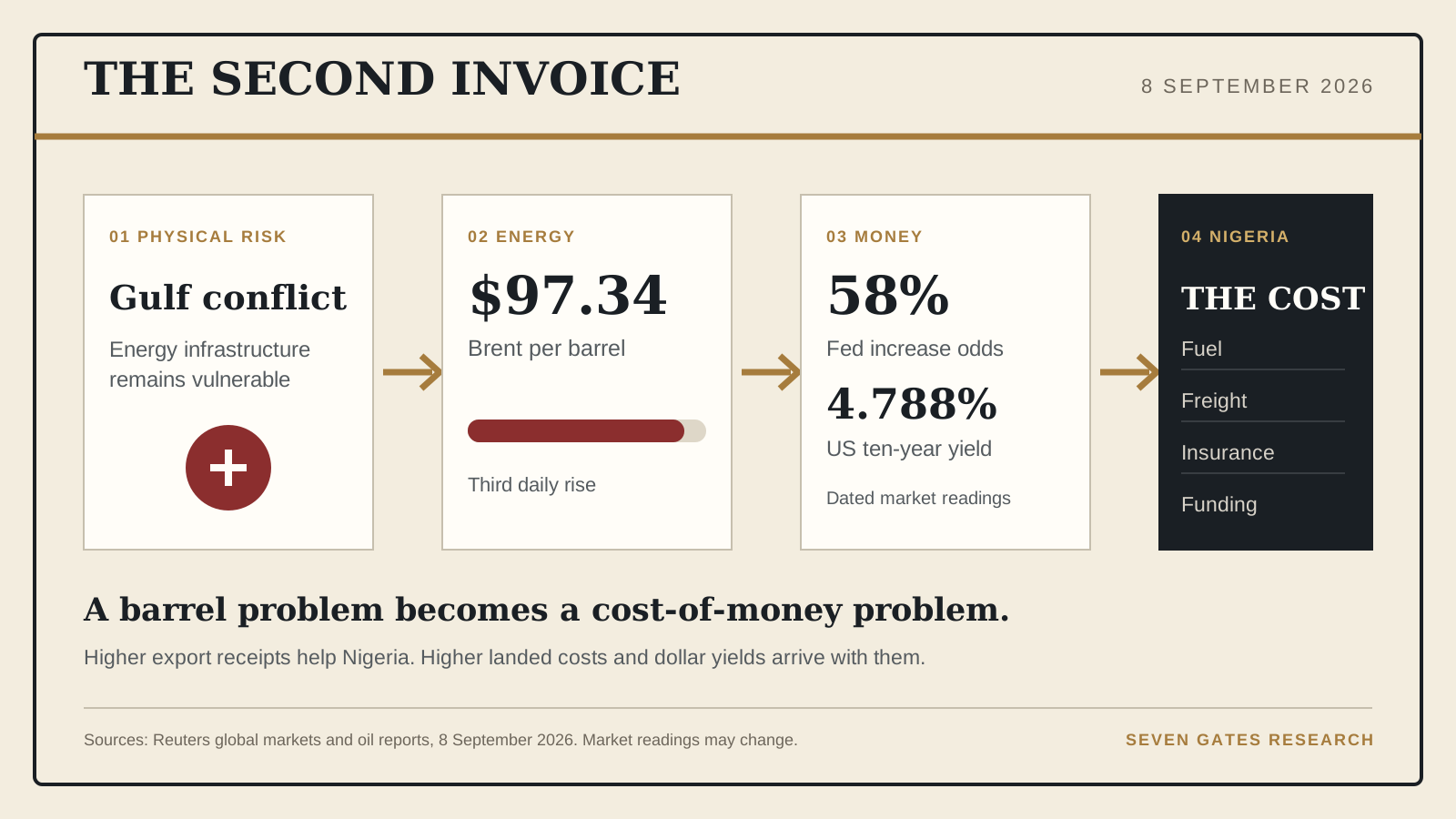
The Gulf conflict is travelling through inflation expectations, sovereign yields and currencies, turning a barrel problem into a cost-of-money problem. Elsewhere, voters are testing Germany's postwar political firewall, health workers are carrying Congo's Ebola response, and Japan is finally producing wage growth that survives contact with inflation.
1. Oil is nearing $100, and the rate market has noticed
Brent rose for a third session to $97.34 a barrel early Tuesday as Iran warned that Gulf energy infrastructure remained vulnerable. The US ten-year Treasury yield reached 4.788%, while markets assigned a 58% probability to a Federal Reserve increase next week. These are not separate trades. Costlier energy raises the chance that central banks tighten into slower growth.
Nigeria receives the familiar two-sided invoice. Higher crude prices can strengthen export receipts, but freight, insurance, imported equipment and dollar funding reprice quickly. Domestic refining reduces product-import dependence; it does not repeal the global cost of ships or capital. This windfall arrives with deductions.
Sources: Reuters, 8 September market wrap · Reuters, oil market update · International Energy Agency
2. Germany's political firewall is now load-bearing
The far-right AfD won 43.8% in Saxony-Anhalt, taking 39 of 83 seats and more than doubling its 2021 vote share. Chancellor Friedrich Merz's CDU fell to 17.2%. The AfD lacks the 42 seats required for a majority, and Merz has ruled out cooperation. Five BSW legislators now sit between an electoral landslide and executive power.
One state does not elect Berlin. It does reveal the pressure on Europe's centre over migration, energy, Ukraine and living standards. German support for Ukraine, EU bargains and mainstream credibility now face a voter test that cannot be dismissed as marginal protest.
Sources: Official Saxony-Anhalt results · Official seat allocation · Reuters
3. Congo's Ebola response is exhausting the people asked to contain it
The Democratic Republic of the Congo's Bundibugyo Ebola outbreak has spread across 60 health zones in six provinces. Associated Press reports more than 3,200 deaths among over 6,600 confirmed cases since May. Burial teams face fatigue, unpaid wages, infection risk and hostility from grieving communities.
Safe-burial rules interrupt rituals when families are least able to accept instruction. Violence and displacement weaken surveillance, trust and access to care. Outbreak control is therefore a labour, security and legitimacy problem as well as a medical one. The human cost remains the story; border disruption is merely a consequence.
Sources: World Health Organization outbreak update · WHO Africa · Associated Press
4. Japan has found real wage growth. The Bank of Japan has found a decision.
Japan's real wages rose 2.4% year on year in July, the seventh consecutive increase and the strongest since May 2021. Revised data showed second-quarter growth at a 1.4% annualised pace, up from 1.1%. The yen reached its strongest level since February as investors anticipated another Bank of Japan increase.
Private consumption was flat and capital spending declined. Japan is nearing the wage-price cycle policymakers wanted, but oil near $100 can turn imported inflation into a saboteur. A stronger yen would soften that shock while unwinding cheap-yen trades across global portfolios.
Sources: Japan Cabinet Office release schedule · Reuters, revised GDP · Reuters, real wages
5. The UN wants AI safety promises converted into enforceable boundaries
UN human-rights chief Volker Türk called for "cast iron guarantees" around AI safety, arguing that corporate concentration, cyber breaches and autonomous weapons outrun voluntary assurances. The useful point is institutional, not apocalyptic: capability is advancing faster than public mechanisms for assigning liability.
Enforceable red lines would turn governance from a manifesto into a cost centre. That may be the price of durable adoption in finance, medicine, government and defence, where "the model behaved unexpectedly" is not a control framework.
Source: Office of the UN High Commissioner for Human Rights
Three numbers worth remembering
| Number | Why it matters | Source |
|---|---|---|
| $97.34 | Brent crude early on 8 September, the clearest price signal from renewed Gulf risk. | Reuters |
| 4.788% | US ten-year Treasury yield as energy risk and strong employment revive tightening expectations. | Reuters |
| 43.8% | AfD's vote share in Saxony-Anhalt, its strongest state-election result. | Official results |
What could change everything?
- A verified hit to Gulf production or export infrastructure would move oil from risk premium to physical shortage.
- US producer-price data on 10 September and consumer-price data on 11 September will determine whether the Fed can look through energy or must answer it.
- Coalition arithmetic in Saxony-Anhalt will show whether Germany's firewall still governs power, not merely speeches.
- Faster funding, protected access and reliable pay for Congo's frontline teams would matter more than another emergency declaration.
Sources
- Reuters, global markets
- Reuters, oil
- International Energy Agency
- Saxony-Anhalt election authority
- World Health Organization
- WHO Africa
- Associated Press, Congo Ebola
- Japan Cabinet Office
- Office of the UN High Commissioner for Human Rights
Sources and market readings checked at 04:45 BST on 8 September 2026. Prices, yields, probabilities and outbreak counts may change after publication.