SEVEN GATES RESEARCH · LOKOJA CONTRARIAN
Uber Nigeria: The Cheapest Drivers Were Still Too Expensive
Uber left Lagos on the same day it cut 3,300 employees. Months earlier it had committed more than $10 billion to autonomous vehicles. Not the same event. The same capital-allocation problem.
At a glance
| Uber Nigeria launch | 2014 |
| Exit | 2 September 2026 |
| Early milestone | Over 1m Lagos trips; approximately 9m km by July 2016 |
| Reported 2018 scale | 267k monthly riders; 9,000 active drivers |
| 2025 Seven Gates reconstruction | approximately ₦60bn gross bookings; approximately ₦12.6bn platform revenue |
| Driver overlap | 32% of surveyed Nigerian Bolt drivers used multiple apps |
| Global restructuring | 3,300 jobs cut on 2 September 2026 |
| Autonomy commitment | Over $10bn committed to autonomous mobility |
| Seven Gates view | WATCH on NYSE: UBER (unchanged) |
Method. Uber does not disclose a Nigeria segment P&L. Nigeria-specific revenue, trip and active-driver series after the early disclosure years are reconstructed estimates. Where the company or a credible source directly disclosed a metric, it is treated as reported. Where it did not, the estimate is labelled and used only for order-of-magnitude reasoning.
1. Two emails
On 2 September 2026, phones lit up across Lagos with an unusually final sort of notification.
Uber was leaving Nigeria.
After twelve years, the company said it had conducted a thorough review and decided to wind down operations immediately. Riders and drivers would still be able to reach the Help Centre until 23 September. After that, Lagos would remain on the map, but not on Uber's.
Roughly eight thousand miles west, another Uber message was landing.
Dara Khosrowshahi told employees that the company had acquired too many layers, too much coordination and too many fragmented teams. About 3,300 corporate employees, 10 per cent of Uber's global workforce, were going. It was the company's largest reduction since the pandemic. The savings would be redirected toward growth and innovation, including autonomous vehicles.
The robotaxi decision itself was not made that morning. It was already much further along.
Uber has committed more than $10 billion to autonomous mobility, including more than $2.5 billion of equity investments and over $7.5 billion of commitments toward robotaxi fleets. It wants autonomous rides in at least 28 cities by 2028 and describes its ambition, with commendable modesty, as becoming the world's leading commercialisation platform for autonomous mobility.
Nobody at Uber has said the Nigeria exit and the robotaxi strategy are causally connected. There is no evidence that somebody in San Francisco opened a spreadsheet labelled Lagos versus Robots and chose the robots.
The relationship is more interesting than that.
Old Uber loved places like Nigeria because the most expensive component of a taxi business arrived free with every vehicle: a human being willing to own, finance, fuel, repair and drive the car.
New Uber is preparing for a world in which that human becomes optional.
For twelve years, Nigeria supplied exactly what the original model wanted in abundance: drivers, privately financed vehicles and a gigantic city that could consume transportation faster than anyone could organise it.
Then the optimisation target changed.
2. The yard
There are yards around Lagos where cars wait for men who do not yet own them.
The arrangement has several names. Lease-to-own. Drive-to-own. Hire purchase. Partnership. Each eventually reaches the same sentence: keep driving and, one day, the car is yours.
The driver pays for fuel. The driver absorbs traffic. The driver watches tyres, brakes and suspension disappear into Lagos roads. The finance company owns the car until the last instalment lands.
Uber itself partnered with Moove to expand this model. By 2024, one reported Moove arrangement had drivers paying about ₦9,400 a day for 48 months, while also paying Uber's commission. Drivers were expected to work long days and make enough trips to keep the machine fed. LagRide drivers faced a similar structure.
Do the arithmetic on ₦9,400 for six days a week and the word flexibility begins to acquire a certain Nigerian elasticity.
The genius of Uber's original model was that almost none of this debt belonged to Uber.
A bank financed the car. A lender financed the driver. Somebody else supplied the petrol. Somebody else paid when a control arm met a pothole near Ojota.
Uber supplied matching software and took a percentage.
It was one of the great balance-sheet tricks of modern capitalism, perfectly legal and so elegant that an entire generation of founders spent ten years announcing themselves as 'the Uber of' industries that had previously shown no desire to be Ubered.
Then Uber left.
The instalment did not.
Debt, being a less sentimental technology than software, continued operating normally.
3. Kayode, 2014
Kayode Olaniyan remembers the early days.
When Uber came to Lagos in 2014, he told Nigerian reporters, drivers could make as much as ₦300,000 in a week. The money was sufficiently strange that the sensible response was to assume it could not last.
It did not. By 2025, reporters found drivers juggling Uber, Bolt, inDrive and Rida, watching several apps and hunting for whichever machine happened to offer the least insulting fare at that moment.
The sequence was not uniquely Nigerian. Subsidise the driver until cars appear. Subsidise the passenger until demand appears. Let each side attract the other. Then reduce the subsidy and allow network effects to take over.
Uber eventually charged Nigerian drivers a service fee commonly around 20 to 25 per cent. During earlier fare wars it sometimes cut passenger prices aggressively and topped up driver earnings while demand adjusted.
And demand did grow.
By July 2016 Uber had completed more than one million Lagos trips, covering approximately nine million kilometres. The millionth ride ran from Yaba to Lekki. In 2017 the company reported 267,000 active Nigerian riders and 7,000 drivers. By August 2018 it reported 267,000 monthly riders and 9,000 active drivers.
Then the Nigerian disclosure became oddly bashful.
Uber still knew everything. Its later economic-impact work used internal data on trip numbers, trip times, active drivers and driver earnings. It simply stopped publishing most of the useful denominators.
So we reconstructed them.
The Seven Gates shadow model uses Uber's early trip and distance disclosures, reported rider and driver milestones, historical fares, service fees, later driver economics and market-growth evidence. It is not Uber's reported Nigerian P&L.
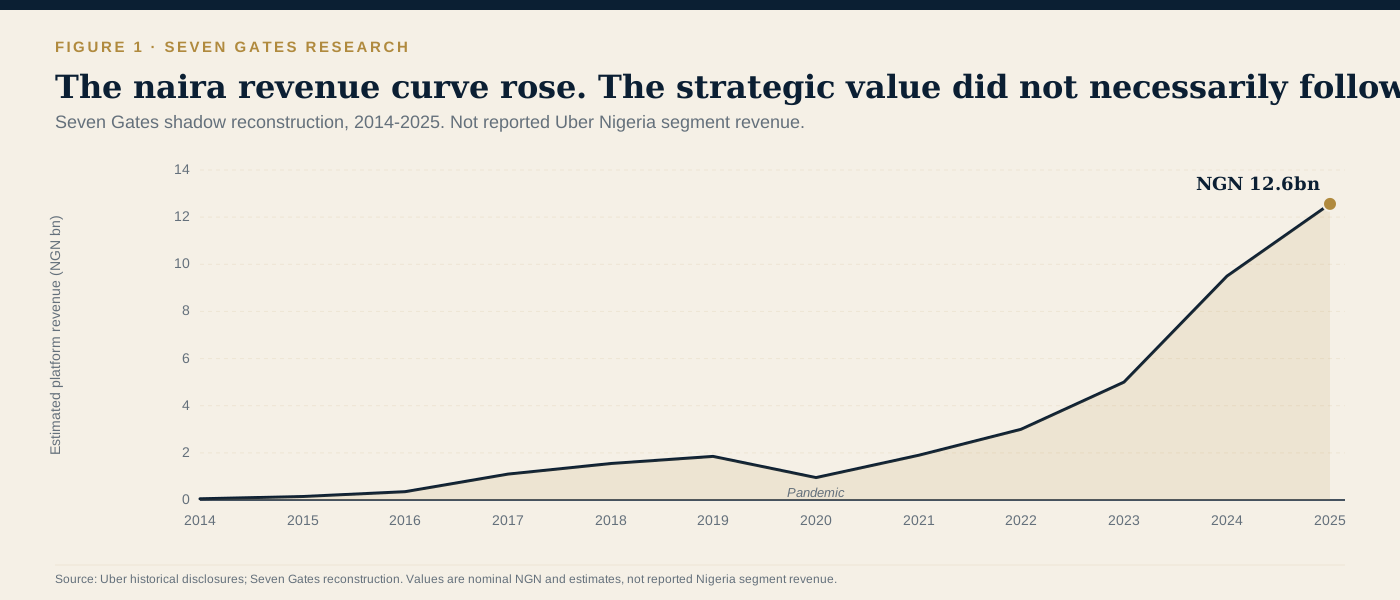
On that reconstruction, Uber Nigeria may have reached roughly ₦60 billion of gross bookings and ₦12.5 billion of platform revenue in 2025, with a pre-exit 2026 annualised trajectory closer to ₦75 billion and ₦16 billion respectively.
The exact figures will be wrong. The order of magnitude is what matters.
This was probably not a business in terminal demand decline. It was a business where trips, fares and nominal naira turnover could rise at the same time that the economic attractiveness to the parent company deteriorated.
That distinction is the whole story.
4. What Uber was actually selling
Ask a Lagos rider why she used Uber and she may tell you price, comfort or convenience.
The better answer was the link.
Before the car arrived, she could send the journey to somebody on WhatsApp. Plate number. Driver. Route. A moving dot.
Nobody had to watch the dot continuously. Its usefulness came from the possibility that somebody could.
Uber's commissioned 2023 Nigerian survey found convenience important to 98 per cent of users, safety to 97 per cent and comfort to 96 per cent.
The product was transportation, certainly.
But buried inside the transportation was something Lagos had historically struggled to provide cheaply: a witness.
A plate existed in a database. The driver had submitted documents. The trip had a timestamp. There was a receipt. There was a route.
Consider Safiya Usman in Abuja. In 2023 she took a Bolt ride offline after the driver asked her to cancel the app trip. The following morning she realised she had left her purse in the car.
Now the clever saving on commission acquired its true price.
Because the trip had been cancelled, she could not simply retrieve the driver's details through the completed ride.
She was lucky. The driver was honest and returned the purse the following day.
That small story contains almost the entire economics of going offline.
The driver and passenger can remove the middleman. They also remove the witness.
Uber did not invent safety. It made accountability searchable.
When Uber disappeared, Lagos did not lose cars. Bolt, inDrive, Rida, LagRide and others still exist. Danfos remain admirably untroubled by Silicon Valley strategy meetings.
What disappeared was one more competing institution trying to turn an informal journey into a documented transaction.
That is a subtler loss.
5. Going offline
Here is where the story becomes fun.
The platforms built algorithms to manage drivers. The drivers began managing the algorithms.
In Lagos, some Uber drivers discovered that GPS itself was negotiable. Uber acknowledged in 2018 that drivers were using software that simulated fake locations, causing riders to be charged for distances the cars had never travelled. The app saw kilometres. The road did not.
Later came bonus engineering. When platforms began offering bonuses for completing a certain number of weekly trips, Nigerian drivers discovered the ancient economic principle that any target can eventually become a business opportunity.
One driver described having a friend book a short dummy trip. The driver might travel only one kilometre of a nominal three-kilometre ride, end it and move one trip closer to the bonus. Another driver said Uber eventually blocked his account after detecting the trick and demanded about ₦80,000 before restoration.
Then there is the cleanest manoeuvre of all. Accept the rider. Arrive. Ask the rider to cancel. Negotiate directly. The app says ₦4,000. The driver says ₦5,000. The rider has already waited fifteen minutes and has a wedding to attend. The company receives zero.
Bolt said that after tightening real-time monitoring and penalties from November 2024, offline trips in Nigeria fell 42 per cent. The crackdown formed part of a wider $107 million safety programme.
None of this is especially Nigerian.
At Reagan National Airport in Washington in 2019, Uber and Lyft drivers learned the airline timetable. Before aircraft landed, groups of drivers simultaneously switched their apps off. Artificial scarcity appeared. Surge pricing rose. Then the drivers switched themselves back on.
For a few minutes, roughly a hundred human beings became a cartel implemented through an off button.
In Hyderabad, India, thousands of drivers gathered in a Telegram group to exchange jugaad, practical hacks for dealing with the black box that assigned their livelihoods.
Once software begins managing labour, labour eventually starts reverse-engineering software.
And the Nigeria numbers contain another trick.
The same man can be three drivers.
A driver can be active on Uber, Bolt and inDrive. Each platform counts a driver. Nigeria still contains only one man, one Toyota and one school-fee problem.
A 2023 Oliver Wyman / Bolt survey found 32 per cent of Nigerian Bolt drivers used multiple ride-hailing apps. An earlier Nigerian study found enough overlap and secondary employment that about 21,000 claimed digital-taxi jobs across major platforms translated into an estimated 7,388 net new jobs after adjusting for pluriactivity and duplication.
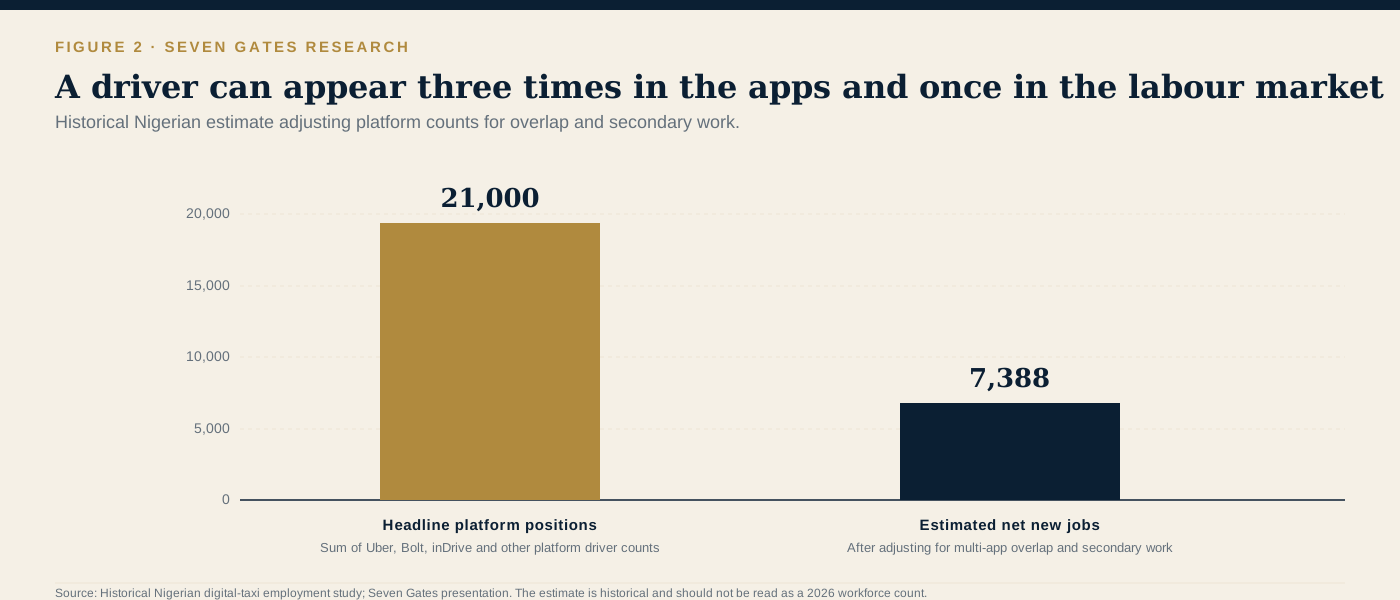
If Uber had 12,000 active drivers, 12,000 people did not become unemployed on 2 September. Many were already on Bolt, inDrive or Rida.
What they lost was something harder to count: an outside option.
One fewer app means one fewer bidder for the driver's next hour.
And in labour markets, the bidder who loses every auction still affects the price.
6. The naira problem
Now the dull part, which is why it matters.
Uber Nigeria collected naira. Many local costs were also naira: employees, offices, local marketing, payments and regulatory expenses.
But the platform itself sits inside a global corporation whose engineering, cloud infrastructure, insurance architecture, corporate staff and required shareholder returns are substantially measured in hard currency.
That creates an unpleasant asymmetry.
A Nigerian operation can report more trips, more riders, higher naira fares and higher nominal revenue, and still become less important to the parent company after translation into dollars.
A growing country can become a shrinking line item.
Our shadow model has Uber Nigeria's estimated nominal platform revenue rising dramatically after 2022. That does not prove profitability. Uber does not disclose a Nigerian income statement, and we should resist the financial-journalistic tradition of manufacturing one merely because Excel has opened successfully.
Nor should currency weakness be presented as the single explanation for Uber's exit. It is better understood as a tax on strategic patience.
If trip volumes grow 15 per cent while the currency weakens 25 per cent, headquarters receives a very different story from the one visible through the windscreen in Lekki.
And Uber now has much more attractive places to put a marginal dollar.
This is not a company running out of petrol.
Uber generated about $52.0 billion of revenue, $193.5 billion of gross bookings and $9.76 billion of free cash flow in 2025. In the second quarter of 2026 it completed 3.9 billion trips, generated $14.2 billion of revenue and pushed trailing twelve-month free cash flow above $10 billion.
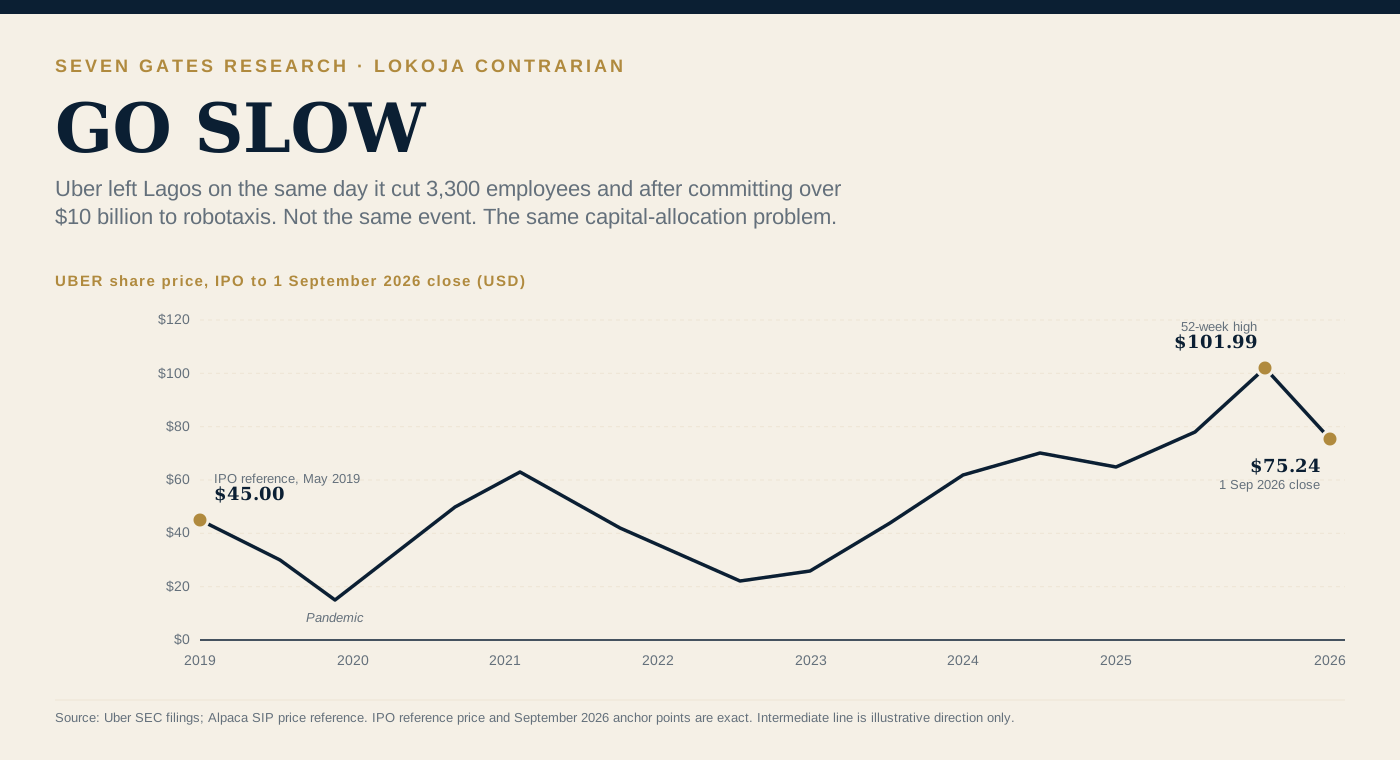
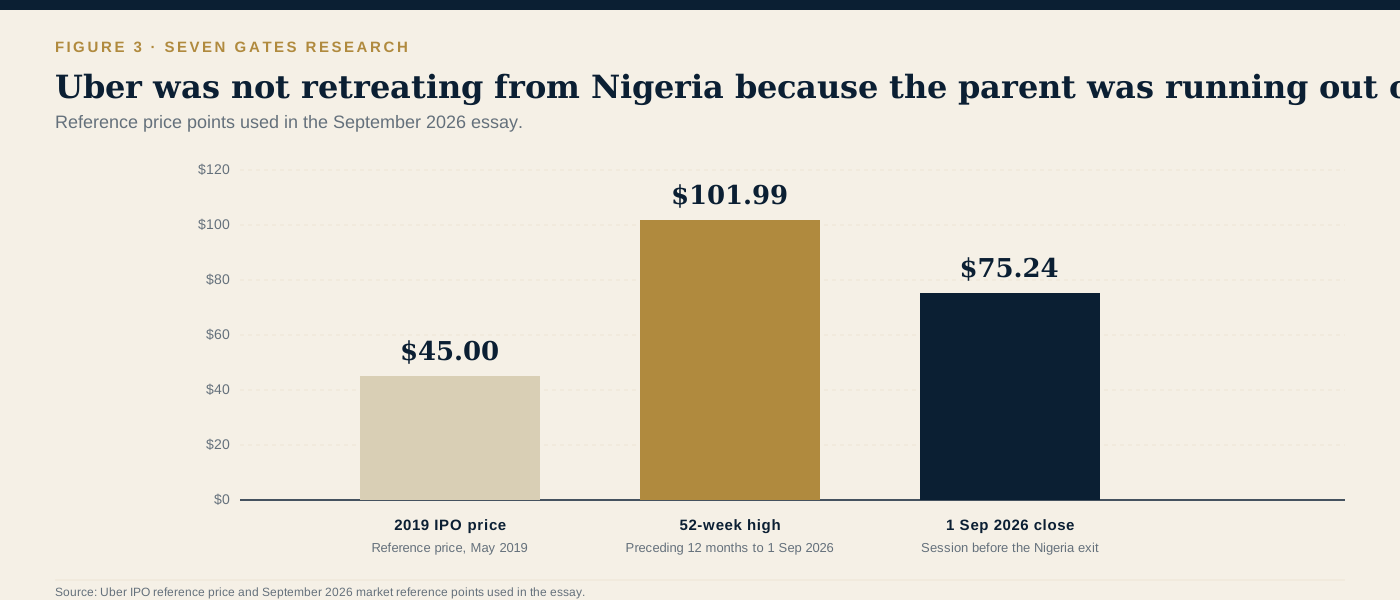
The stock tells a similarly complicated story. Uber went public at $45 in 2019. It closed on 1 September 2026 at $75.24, below its $101.99 52-week high. This was not a distressed company retreating to California with creditors behind it.
And here comes the exquisite reversal.
Uber became famous for being asset-light. Drivers bought the cars. Drivers financed the cars. Drivers replaced the tyres. Uber owned the marketplace.
Now Uber expects to commit more than $7.5 billion toward acquiring robotaxi fleets, in addition to billions invested in the companies building them.
The company that persuaded human beings to put cars on their own balance sheets is preparing to put cars back onto somebody much closer to Uber's balance sheet because the cars no longer require human beings.
The asset-light model is becoming heavier precisely because the labour is becoming lighter.
That is the transaction hiding underneath Nigeria.
7. The man who kept removing people
You cannot write about Uber's future without writing about the man it threw out of its past.
Travis Kalanick's career has always had the same basic geometry.
First came Scour, file sharing without the record store or studio distribution chain. Then Red Swoosh. Then Uber, which inserted software between passenger and driver while making the taxi dispatcher increasingly ornamental.
He built Uber into one of the most aggressive companies Silicon Valley had produced, then accumulated enough scandals that investors forced him out as CEO in 2017. He left the board in 2019.
Most founders disappear after that. Kalanick changed nouns.
CloudKitchens stripped the restaurant down. No dining room. No waiter. No polished frontage. Food, real estate, software and delivery.
Then in March 2026 he unveiled Atoms, bringing CloudKitchens into a broader industrial-robotics company spanning food, mining and transport. It acquired Pronto, the autonomy business run by Anthony Levandowski, whose previous history with Uber and Waymo requires a family tree and several lawyers to explain properly.
In July, Atoms raised $1.7 billion led by Andreessen Horowitz. Uber participated. Tech reporting subsequently put Uber's investment at about $100 million.
Nine years after Uber's board pushed Kalanick out, Uber wrote a cheque to his robot company.
American capitalism is very forgiving once the cap table improves.
The original draft of this story would say Kalanick spent his career removing people. That is too simple.
He removes layers.
Scour attacked distribution. Uber attacked dispatch and ownership. CloudKitchens attacked the dining room. Atoms is attacking physical labour itself.
The scandals altered who ran Uber. They did not kill the underlying instinct.
Kalanick called the Atoms financing 'unfinished business', part of a journey from bits to atoms that began at Uber.
For once, founder mythology may have accidentally described the thing accurately.
8. Aristotle, on robotaxis
Aristotle got there first.
In Book I of Politics, while discussing slavery and household production, he pauses to imagine tools capable of acting on their own, like the mythical moving statues of Daedalus.
if every tool could perform its own work… master-craftsmen would have no need of assistants.
He was not predicting Waymo. But twenty-three centuries before lidar, he had isolated the economic question.
What happens to the human instrument when the instrument becomes capable of acting by itself?
For seventeen years Uber built one of history's largest systems for coordinating human drivers. In 2025, its platform handled more than 13.5 billion trips worldwide.
Now the company is spending billions to build the commercial machinery required when some portion of those trips no longer needs a driver.
A robotaxi does not ask for a fuel bonus. It does not run Bolt simultaneously. It does not join a union. It does not ask the passenger to cancel and transfer the money. It does not protest when the airport fare makes no sense after another fuel-price increase.
It also does not finance itself, buy its own tyres or take depreciation home at night.
That last point is why autonomy is not the free lunch sometimes presented in investor decks.
The human driver absorbed a remarkable amount of capital risk on Uber's behalf.
Replacing the human means replacing the human's balance sheet too.
Aristotle saw the labour substitution. He did not have to model the fleet-finance facility.
9. The un-invention
Here is the part that should bother anyone who believes technology moves neatly forward.
Uber's great Nigerian contribution was not simply calling a car with a phone. It was price certainty.
Traditional taxis could require an argument through a half-open window. Destination. Traffic. Rain. Your clothes. Your accent. Your apparent urgency. A short seminar in behavioural economics before anyone turned the ignition.
Uber put a number on the screen first.
In 2016, that idea had entered global culture so completely that MadeinTYO could rap, 'Uber every ... where', and nobody needed the noun explained. The song became a hit and later went double platinum.
In Lagos, the deeper achievement was mundane. The machine had already haggled.
Now watch what happened next.
inDrive made bargaining a feature. Riders proposed prices and drivers countered. Other platforms experimented with lower commissions and different pricing models. Drivers on Uber and Bolt increasingly demanded extra cash when the algorithm's fare failed to reflect petrol and maintenance.
In Abuja in 2024, drivers were routinely asking passengers for another ₦1,000 to ₦2,000 above the app fare. One told reporters that rides quoted below ₦3,000 could become ₦5,000 or be cancelled.
The haggle came back. Only now it had GPS.
Technology had spent billions recreating the half-open window.
Taleb popularised the Lindy effect for things that do not perish biologically: the longer a technology lives, the longer it can be expected to live.
The danfo has survived apps, venture capital, bans, fuel crises, governors and several generations of people confidently predicting its death.
Negotiation has lasted longer still.
Uber spent twelve years in Lagos. The bargain through the window was waiting when it left.
10. What breaks next
The obvious conclusion is that Bolt and inDrive win. They do.
But the interesting consequences begin one layer underneath.
The debt outlives the platform. Drivers on finance arrangements still owe the remittance. Some will migrate almost seamlessly onto Bolt or inDrive. Others will discover that losing one source of trip flow changes the mathematics of a fixed daily obligation. Defaults can become repossessions; repossessions become used vehicles; enough distressed vehicles eventually affect prices outside ride-hailing itself.
Twelve thousand Uber drivers do not mean twelve thousand lost jobs. Multi-apping means the actual employment shock will be much smaller than the headline platform count. But that misses the economic loss. Each driver has lost one auctioneer for his time. Bolt and inDrive can absorb riders while drivers simultaneously become worse off because their outside option has weakened. Competition protects suppliers as well as customers.
Bolt may gain riders and still have less reason to improve. Nigeria is not left without competition. Bolt, inDrive, Rida, LagRide and others remain. The problem is that a large global competitor has disappeared. Price wars are painful for companies but rather agreeable for consumers. Safety-feature races cost money. Driver bonuses cost money. Once the field thins, capitalism occasionally remembers it came to make a profit.
The safety loss may appear somewhere nobody is measuring. If more drivers move rides offline to escape commissions, more trips lose their digital audit trail. Safiya's purse is the benign version. The dangerous version does not end with the purse coming back.
The credit graph loses information. Vehicle financiers such as Moove grew partly because trip and earnings data made a previously opaque worker measurable. The app turned future driving into something closer to an underwritable cash flow. Uber's departure does not destroy this model, because other platforms remain, but it removes one stream of behavioural data and one source of demand.
The regulator loses a sensor. Lagos and Uber had spent 2024 arguing over real-time trip-data sharing before reaching an agreement. Aggregated platform data has become part of how a modern city tries to understand mobility. When a platform leaves, the state loses not just cars but observations.
Corporate Nigeria will substitute, but substitution has friction. Uber for Business disappears with Uber's consumer service. Expense departments will find Bolt or other systems. Nobody will perish. But the small administrative conveniences that accumulate around a twelve-year incumbent have to be rebuilt somewhere else.
And then there is the founder problem.
For a decade, African pitch decks contained three immortal constructions: Uber for X. Airbnb for Y. Amazon for Z.
Uber for X did enormous intellectual work because it implied that a model proved elsewhere could simply be localised, given enough capital and sufficiently attractive typography.
Nigeria now gets to supply the footnote.
Uber for X. Except sometimes Uber.
11. Last ride
Fela's Go Slow, associated with Roforofo Fight in 1972, is about the specific absurdity of Lagos traffic: the lorry in front, the taxi beside you, the bus behind, the human being theoretically travelling while achieving almost no movement at all.
Every transport innovation since has eventually met the same traffic.
Uber's contribution was to put an algorithm inside it.
There is a symmetry to the ending.
The early Uber became famous for learning how to route around systems. Greyball could show regulators phantom cars. God View could track riders. Ripley could remotely lock staff computers during raids. Uber says those tools belong to an earlier period and that it stopped the controversial practices under Khosrowshahi.
Then Lagos drivers learned to route around Uber.
Fake the GPS. Manufacture the bonus trip. Run three apps. Ask for another ₦2,000. Cancel the ride. Take the transfer.
The comparison is not moral. A driver trying to preserve his margin is not the same thing as a multibillion-dollar company evading a regulator.
But the mechanism rhymes.
The system sets a rule. The humans discover the edges. The system measures behaviour. The humans learn what it measures. The system changes. The humans change faster.
Uber eventually reached the logical solution to the human problem: build a car that cannot negotiate.
Somewhere in Lagos, Kayode and thousands like him will open Bolt, inDrive, Rida, perhaps two at once. They will take whichever fare works. The people who financed their cars will still expect payment. Riders will still need to cross town. Third Mainland Bridge will remain serenely indifferent to corporate strategy.
The dot on one map stopped moving on a Wednesday.
Lagos did not.
Go slow.
Research notes and data limitations
Nigeria-specific annual revenue, trip volumes and active-driver numbers after the early disclosure years are not separately reported by Uber. Figures identified as Seven Gates reconstructions are estimates, not company financial disclosures.
Uber's commissioned 2023 economic-impact study reported an estimated ₦34 billion economic contribution and ₦6.1 billion in additional driver income relative to drivers' estimated next-best alternative. The ₦6.1 billion figure is not total driver payouts.
Driver counts across ride-hailing platforms should not be summed as unique people. Multi-apping creates duplicate platform-driver relationships. The essay therefore treats platform driver counts, unique workers and net new employment as different concepts.
The argument linking the Nigeria exit, global layoffs and the autonomous-vehicle strategy is an inference about capital allocation, not a claim that Uber publicly said robotaxis caused the Nigeria exit.
This essay does not change the standing Seven Gates rating on NYSE: UBER. It is a red-team essay, not a rated research note. The rating remains WATCH, pending, among other items, a full free-cash-flow reconstruction and first-hand driver interviews.
Selected sources
- Uber Nigeria: "2 Years Moving Lagos" historical milestone release (2016)
- Uber / Public First: Nigeria economic impact study (2023 data)
- TechCabal reporting on Nigerian ride-hailing drivers, offline trips, fares, gaming and vehicle finance
- Oliver Wyman shared-mobility survey
- Uber Technologies SEC filings and 2026 corporate results
- Reuters reporting on 2 September 2026 restructuring and Uber autonomous-vehicle capital commitments
- Reuters / technology press coverage of Travis Kalanick, Atoms and Pronto
- Aristotle, Politics, Book I, on self-acting tools.
- Fela Kuti, Go Slow, historical and cultural reference.