SEVEN GATES RESEARCH · COMPANY RESEARCH
FCMB: The ₦14 Share
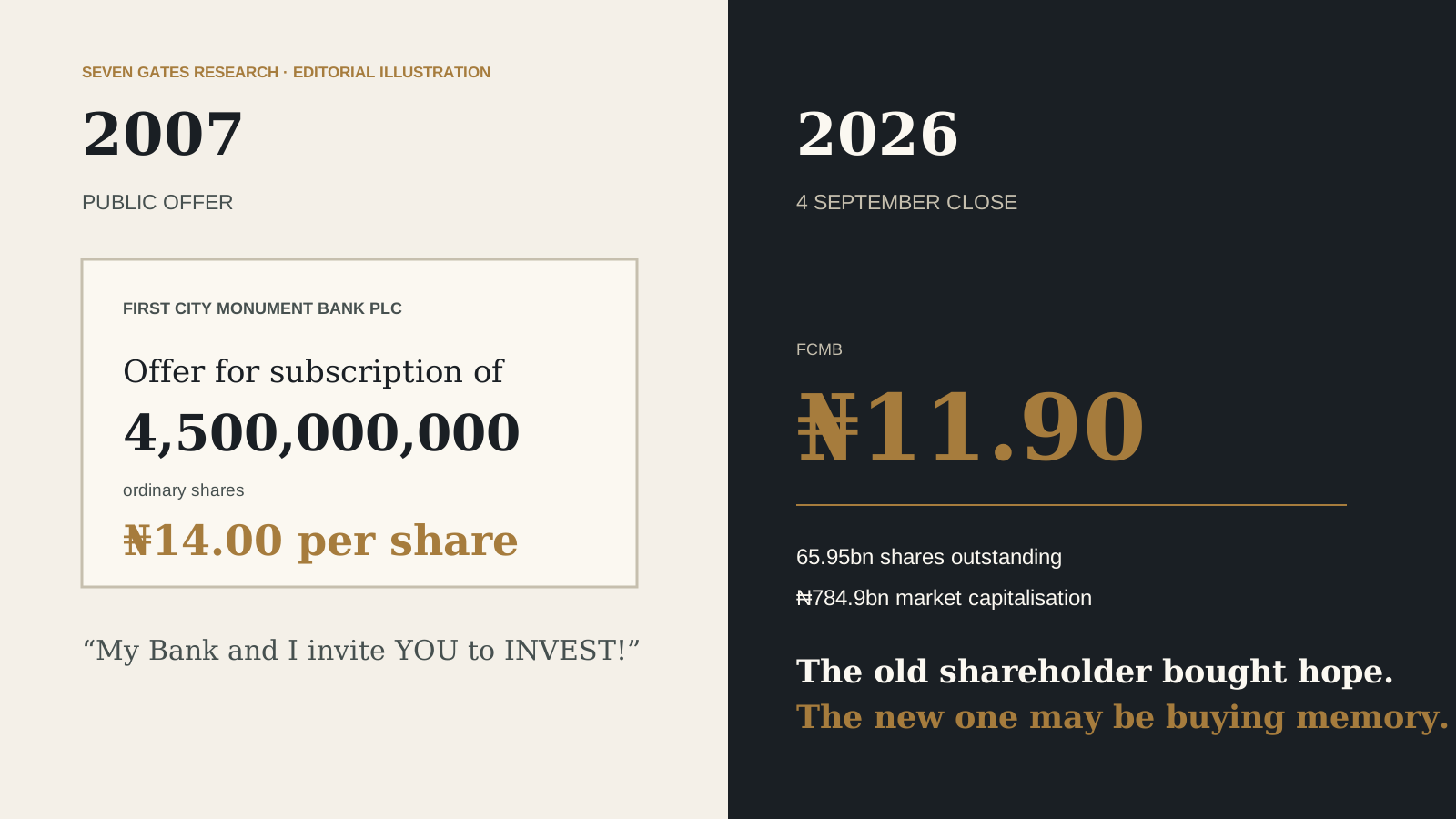
In 2007 Nigerians paid ₦14 for FCMB. Nineteen years, two bonus issues, a banking crisis and billions of new shares later, it trades at ₦11.90. The old shareholder bought the dream expensively. The new shareholder may be buying the disappointment cheaply.
At a glance
| FCMB Group Plc | |
|---|---|
| Reference price | ₦11.90 |
| Price date | 4 September 2026 close |
| Shares outstanding | 65.95bn |
| Market capitalisation | ₦784.9bn |
| H1 2026 PBT | ₦157.3bn |
| H1 2026 PAT | ₦139.9bn |
| Annualised H1 ROAE | 27.9% |
| Equity attributable to owners | ~₦1.172tn |
| Book value/share | ~₦17.77 |
| Price/book | ~0.67× |
| Annualised H1 EPS | ₦4.23 |
| Price/annualised EPS | ~2.8× |
| Capital adequacy ratio | 23.5% |
| Seven Gates view | ACCUMULATE |
| Preferred entry | ≤₦11.50 |
| Base fair value | ₦15.50–₦18.00 |
| Bear | ₦8.50–₦10.00 |
| Bull | ₦22–₦24 |
The answer before the sermon: FCMB is cheap enough to own, but not clean enough for a table-thumping Buy. The asymmetry improves materially below ₦11.50. The decisive question is whether the recapitalised bank can sustain ROE above 20% without another credit accident.
1. Everybody was an investment banker
In October 2007, FCMB placed an advertisement in Nigerian newspapers that now looks like an archaeological object from a vanished civilisation. A woman looks straight at the reader. Beside her sits the invitation: 4.5 billion ordinary shares, fifty kobo each, offered at ₦14 a share. “My Bank and I invite YOU to INVEST!” The typography is cheerful. The timing was magnificent. Nigerian banking shares were flying, public offers arrived with the regularity of church programmes, and a generation of new investors had learned that a share certificate was apparently a machine for converting optimism into money.
Nineteen years later FCMB trades at ₦11.90.
Source: Investing.com, 4 September 2026 close; StockAnalysis company page.
That sentence is irresistible, but incomplete. A share price is not a corporate biography. FCMB paid dividends, issued bonus shares, bought FinBank, reorganised into a holding company, survived the banking crisis, endured two large currency devaluations and, recently, issued an industrial quantity of new equity. The proper question is not whether ₦11.90 is smaller than ₦14. It plainly is. The useful question is what happened to the economic claim purchased for ₦14, and whether today’s claim is finally cheap enough to compensate for FCMB’s history.
2. The 1,000-share test
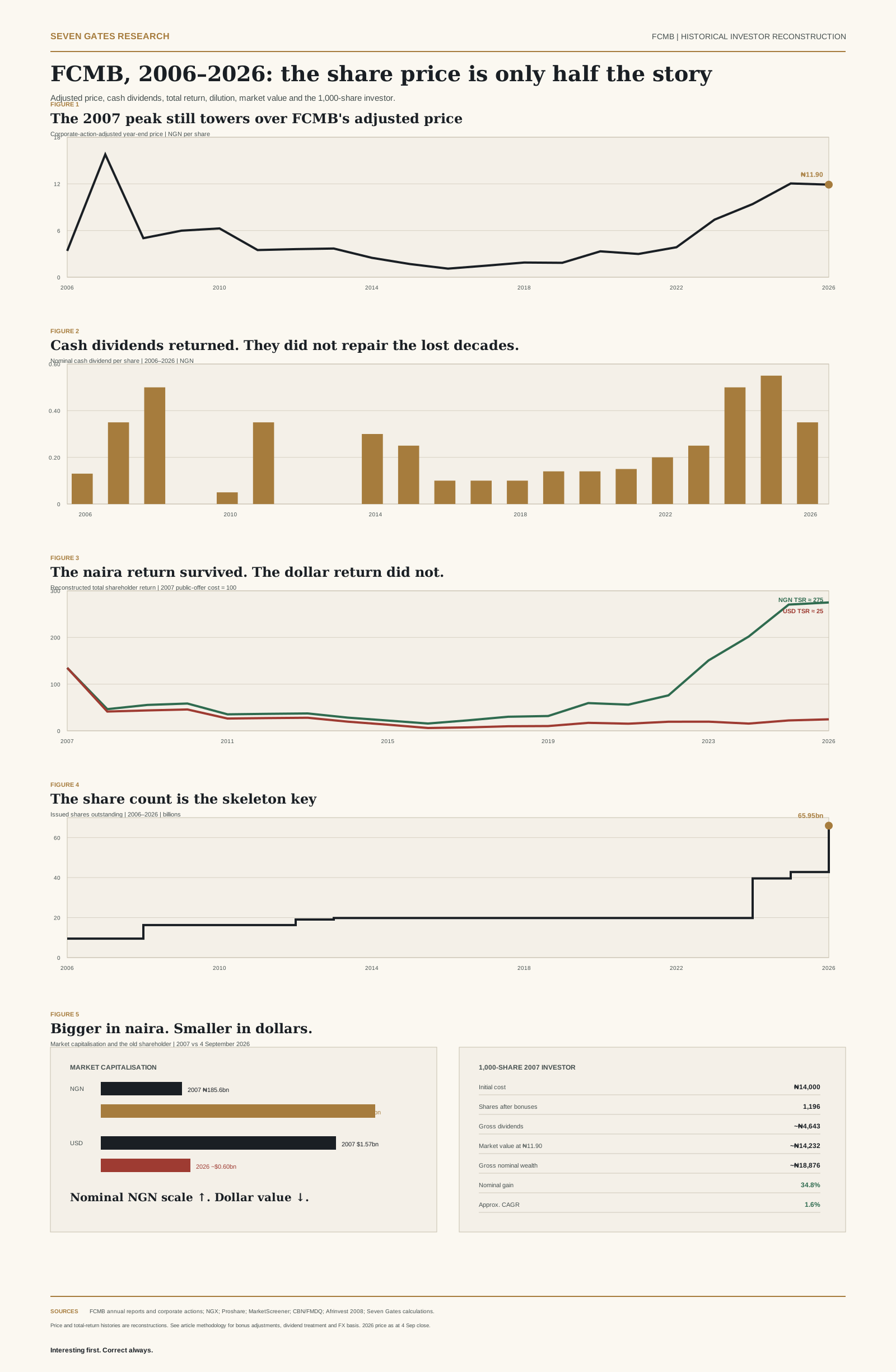
Start with the old shareholder. Someone who bought 1,000 shares in the 2007 offer spent ₦14,000. The 2012 three-for-twenty bonus raised the holding to 1,150 shares. The 2013 one-for-twenty-five bonus lifted it to 1,196. Assuming that investor did not put fresh money into later capital raises, those 1,196 shares are worth ₦14,232 at today’s price. Gross cash dividends received since the offer amount to roughly ₦4,643. Total nominal wealth is therefore about ₦18,876.
Bonus issues: Proshare corporate-action history.
That is a gain of 34.8 percent in almost nineteen years, before withholding tax and without adjusting for inflation. The approximate compound rate is 1.6 percent a year. Nigeria did not spend those nineteen years enjoying Swiss inflation.
| 2007 public-offer investor | Position |
|---|---|
| Initial purchase | 1,000 shares |
| Cost | ₦14,000 |
| 2012 bonus | 3-for-20 → 1,150 shares |
| 2013 bonus | 1-for-25 → 1,196 shares |
| Gross dividends, 2008–2026 | ~₦4,643 |
| Market value at ₦11.90 | ~₦14,232 |
| Gross nominal wealth | ~₦18,876 |
| Nominal gain | 34.8% |
| Approx. nominal CAGR | 1.6% |
Seven Gates reconstruction. Assumes no participation in later capital raises, no dividend reinvestment and gross dividends before withholding tax.
Reinvest the dividends and the naira picture becomes less embarrassing. Our reconstructed total-return index turns 100 at the 2007 offer into about 275 today, roughly 5.5 percent annualised. Then translate the wealth into dollars. Using the official or investable market exchange rate appropriate to each period, the same index falls to about 25. In external purchasing power, roughly three quarters of the original dollar value disappeared. Dividends helped. The currency collected the rest.
3. Market capitalisation is not shareholder return
This is why the viral defence that FCMB’s market capitalisation rose from about ₦165 billion in 2007 to ₦785 billion today needs surgery. Contemporary Afrinvest data actually put December 2007 market capitalisation near ₦185.6 billion, or $1.57 billion. Today NGX puts it at ₦784.9 billion, about $596 million at the current official exchange rate. FCMB became more than four times larger in nominal naira market value while becoming roughly 62 percent smaller in dollars.
The share count explains much of the magic trick. FCMB had about 9.5 billion shares in 2007 and 16.3 billion by 2008. It had 19.8 billion for most of the decade after 2013. Then recapitalisation arrived with a forklift. The 2024 public offer issued another 19.8 billion shares at ₦7.30. A further 3.17 billion shares came from a convertible loan in 2025. The latest offer allotted 23.18 billion shares at ₦10. FCMB now has 65.95 billion shares outstanding.
Market capitalisation can rise because existing shares become more valuable. It can also rise because the company prints many more claims and new owners arrive carrying cash. FCMB has experienced plenty of the second mechanism. This does not make the capital raises bad. The Central Bank required stronger paid-in capital, and FCMB now has a genuinely healthier capital position. It does mean that market-cap growth cannot be presented as the return earned by the person who bought the 2007 newspaper offer.
4. The inconvenient part: FCMB is cheap
Now comes the inconvenient part for anyone hoping this is merely a morality play about old Nigerian bank stocks. FCMB today looks cheap.
There is another reason to avoid treating FCMB as a smaller conventional bank. The holding company owns the bank, Credit Direct, investment banking, pensions, asset management, trustees and stockbroking operations. Banking still supplied 74 percent of H1 group profit before tax, but the other businesses create fee income and capital-light earnings that deserve value when recurring. Assets under management reached ₦1.95 trillion. Credit Direct alone produced ₦17.7 billion of H1 PBT. This diversification matters because Nigerian banking profits can be violently rate-sensitive.
Governance is less obviously problematic than the share-price history might imply. Ladi Balogun owns a stake, while the register is dispersed. That alignment is welcome, not conclusive. The capital-allocation test now changes. Management has raised the equity. The next examination is whether it can convert that capital into per-share earnings growth rather than a larger balance sheet. A recapitalised bank that cannot earn above its cost of equity has only become safer, not necessarily more valuable.
5. What the accounts say now
At June 2026, group common equity attributable to shareholders was about ₦1.17 trillion. Against 65.95 billion shares, book value is roughly ₦17.8 per share. At ₦11.90, the stock trades near 0.67 times book. H1 profit before tax rose 99 percent to ₦157.3 billion; profit after tax reached ₦139.9 billion. Annualised return on average equity was 27.9 percent and annualised EPS was ₦4.23. The headline multiple is therefore about 2.8 times earnings.
Primary source: FCMB H1 2026 results.
A bank producing a durable 25 percent return on equity should not ordinarily trade at two thirds of book unless investors believe the return will fall, the book is unreliable, or the risk deserves a very large discount. With FCMB, all three suspicions deserve examination.
6. The bull case is in the plumbing
The strongest evidence for the bull is not the profit growth itself. It is the plumbing. Net interest income rose 71.8 percent to ₦356.3 billion while the low-cost deposit mix improved from 65.4 percent at December to 74.9 percent in June. Cost-to-income fell from 57.0 percent to 41.4 percent. Capital adequacy reached 23.5 percent after roughly ₦227 billion of fresh capital entered during the second quarter. Non-bank businesses supplied 26 percent of group profit before tax. FCMB is better funded, better capitalised and operationally more efficient than the institution implied by its historical scar tissue.
But the earnings engine deserves a screwdriver, not applause. Interest income from loans was slightly lower year on year, while income from cash and investment securities surged. That tells us a meaningful portion of the margin expansion came from high yields on liquid and sovereign assets rather than explosive growth in customer lending. Loans were ₦2.49 trillion against ₦4.92 trillion of deposits. This is comfortable liquidity, but it also means FCMB must eventually deploy its enlarged equity base without discovering that high nominal yields made everyone look clever.
7. The bear case is in the loan book
Credit is the second warning. H1 impairment losses jumped to ₦85.9 billion from ₦36.2 billion, including about ₦63.4 billion of write-offs as management accelerated the clean-up of Stage 2 loans. The Nigerian bank’s prudential NPL ratio ended June at 5.2 percent. Management calls the action decisive. Fitch still describes FCMB as a second-tier franchise with high credit concentrations, substantial sovereign exposure and weaker pricing power than the largest Nigerian banks. Both descriptions can be true.
Credit context: Fitch May 2026 rating commentary.
There is also a small optical sweetener. H1 other income included roughly ₦9.3 billion from the disposal of a minority interest in FCMB Pensions. It is real money, but it should not receive a recurring multiple.
The H1 accounts record a ₦9.303bn gain on disposal of a minority interest in FCMB Pensions: FCMB Q2 2026 financial statements.
8. Valuation
So what is FCMB worth? My base case assumes sustainable return on equity settles around 21 to 22 percent as rates normalise, credit costs retreat but remain meaningful, and the enlarged capital base begins earning properly. I use a demanding Nigerian cost of equity and refuse to capitalise the current 27.9 percent ROE as eternity. That produces a fair-value range around ₦15.50 to ₦18.00 over twelve to eighteen months. The midpoint implies material upside from ₦11.90, before a modest dividend.
The bear case is about ₦9. If impairments remain elevated, NPLs rebuild, falling rates compress asset yields faster than deposit costs, or another capital raise arrives before the present capital earns its keep, the discount to book is justified. The bull case reaches roughly ₦22 to ₦24 if FCMB can sustain mid-twenties ROE on the new equity base, hold the low-cost deposit franchise, normalise credit charges and grow non-bank earnings without one-offs.
My rating is Accumulate, not table-thumping Buy. Below ₦11.50 I would be increasingly interested. Above ₦16 without a corresponding upgrade in sustainable earnings, much of the easy valuation argument has gone.
9. The verdict
The most interesting thing about FCMB is therefore not that the ₦14 share became ₦11.90. It is that the security has travelled in the opposite direction from the institution. In 2007, investors paid a heroic price for a bank with fashionable ambitions and thin evidence of what the next cycle would do to them. In 2026, they are being offered a recapitalised financial group at a discount to book because the evidence of the intervening years is impossible to forget.
Markets sometimes charge too much for hope. They can also charge too much for memory.
The woman in the old advertisement was inviting Nigerians to invest. Nineteen years later, FCMB has finally produced a more interesting invitation: forget the photograph, inspect the balance sheet, and decide what disappointment is worth.
Research notes and methodology
Price history. The 2006–2026 long-history chart is a Seven Gates reconstruction using MarketScreener annual price variations, anchored to the verified 4 September 2026 close and adjusted for FCMB's 2012 3-for-20 and 2013 1-for-25 bonus issues. It is a price series, not total return.
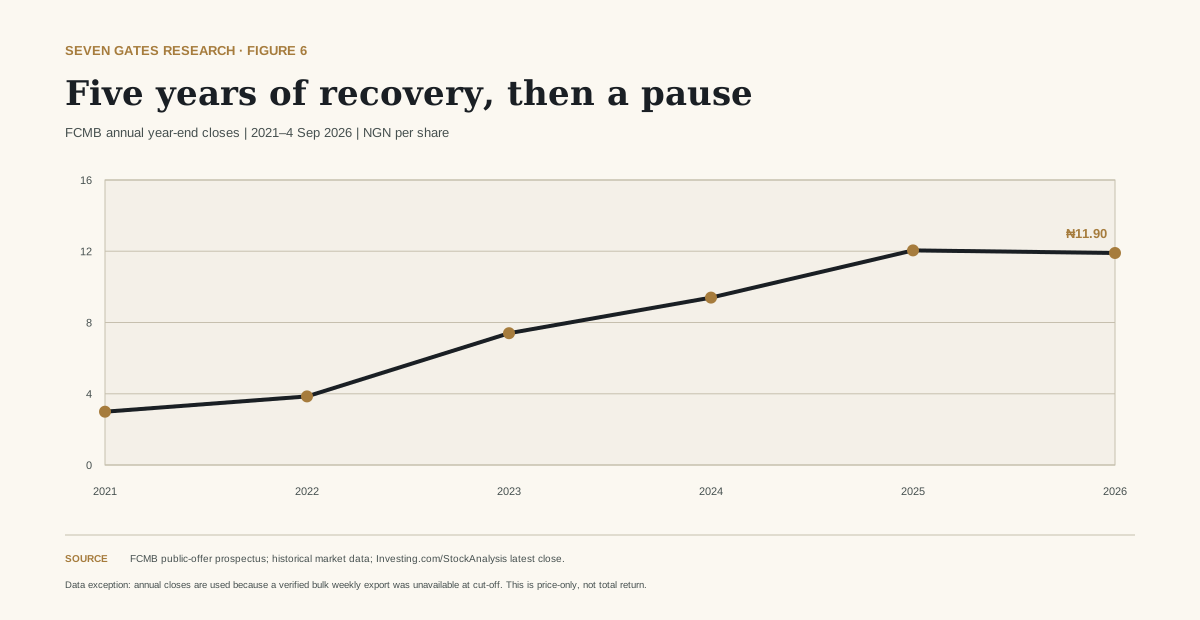
Five-year chart. Seven Gates normally publishes daily or weekly five-year closing data. A verified bulk weekly export was not available to this publication workflow at cut-off, so Figure 6 uses annual year-end closes and explicitly records the exception. The observations are cross-checked against FCMB’s 2024 public-offer prospectus and historical market-data sources. This figure should be upgraded to weekly closes when a verified bulk series is available.
Dividend and investor ledger. The 1,000-share ledger uses FCMB/Proshare corporate actions and nominal cash dividends. The investor is assumed not to subscribe to later capital raises and not to reinvest dividends. Gross dividends are shown before withholding tax.
USD TSR. The dollar total-return series is a reconstruction using annual end-period price/dividend observations and period-appropriate Nigerian FX benchmarks. It is intended to show the scale and direction of hard-currency wealth erosion, not to imply daily-exact execution.
Capital raises. FCMB issued 19.803bn shares at ₦7.30 in the 2024 public offer, taking issued shares to 39.605bn. In September 2025, 3.166bn additional shares were listed following conversion of a mandatory convertible loan. The 2025/26 public offer ultimately allotted 23.183bn shares at ₦10, taking issued shares to 65.955bn. Sources: FCMB 2024 offer completion, NGX September 2025 listing bulletin, March 2026 allotment announcement.
Valuation. Fair-value ranges are Seven Gates estimates based primarily on sustainable ROE, book value, earnings normalisation, credit cost and a demanding Nigerian cost of equity. They are not management guidance.
Principal disconfirming evidence
The thesis weakens materially if sustainable ROE falls below 20%, NPLs rebuild materially above 6%, impairment charges remain structurally elevated, low-cost deposit share reverses sharply, another large equity raise becomes necessary despite the current capital buffer, or the enlarged equity base fails to translate into per-share earnings growth.
Key sources
- FCMB H1 2026 results announcement
- FCMB Q2 2026 interim financial statements
- FCMB 2024 public-offer completion
- FCMB March 2026 allotment announcement
- FCMB 2009 Annual Report share-capital history
- Proshare FCMB corporate actions
- StockAnalysis FCMB market data
- Investing.com FCMB historical price
- Fitch May 2026 rating commentary via MarketScreener