SEVEN GATES RESEARCH · THEMATIC ESSAY
The Republic of 30%
Ponzi, Nigeria and the Eternal Return of the Beautiful Lie, 1914–2026
At a Glance
| Question | Seven Gates view |
|---|---|
| What is the product? | The feeling of being early. |
| What is the structural test? | Ask where the return came from. |
| What kills a high-return Ponzi? | Slowing inflow growth can be enough, even while deposits are still rising. |
| Historical anchors | P. Crentsil (1920-21), Umanah / Resources Managers (1991), MMM (2016), CBEX (2025-26). |
| Evidence discipline | Official facts, court allegations, investor claims and media estimates are kept separate. |
A note on the trigger
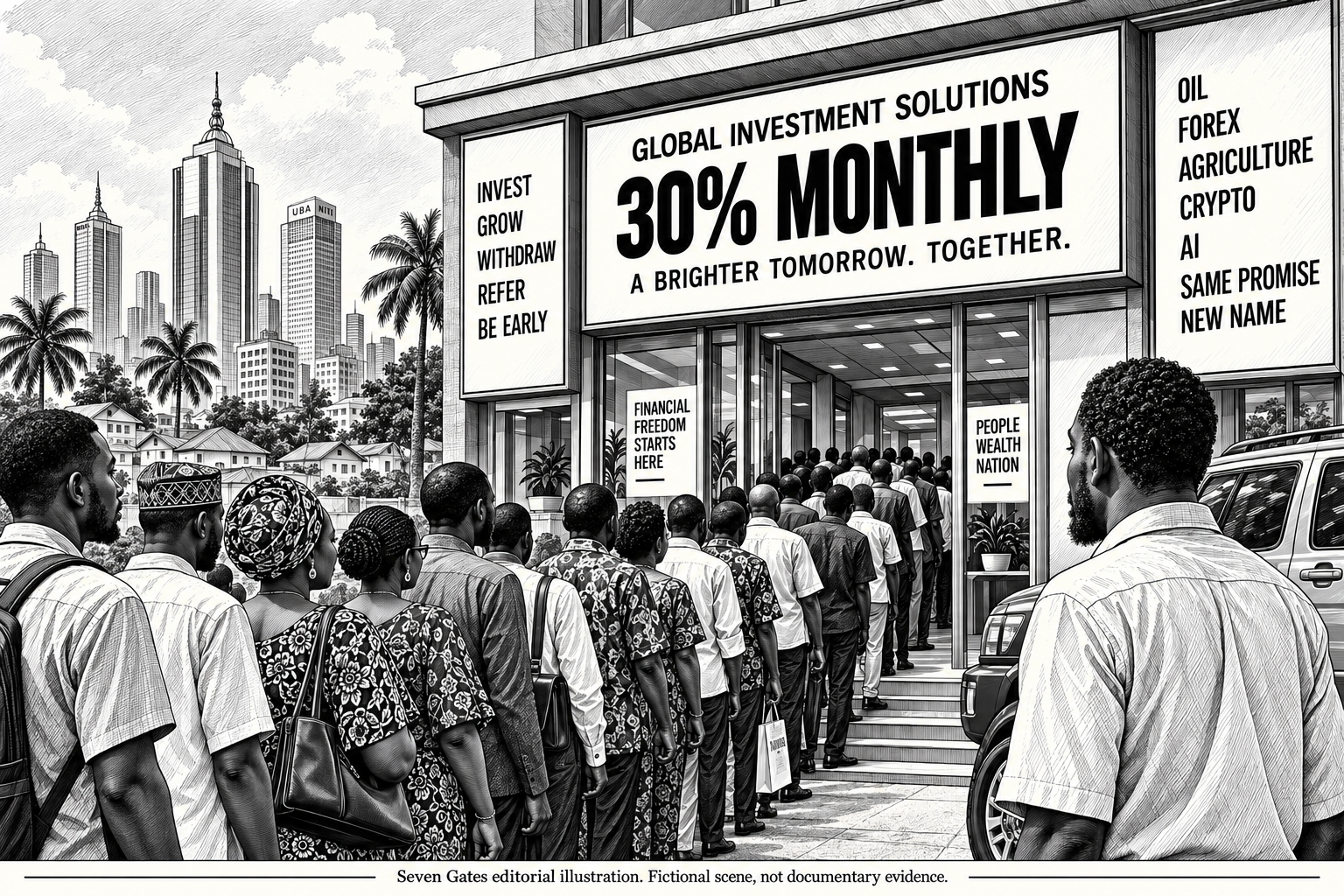
PXES was the immediate reason I finally sat down to write this essay. Not because it is the largest or most ingenious name in this history. Quite the opposite. It was a name I had barely registered until videos and reports began circulating from Yola and Kabba, showing crowds of people who said they had invested in the platform gathering at its offices after withdrawals reportedly failed, with some carrying away furniture and equipment. The official scale of the losses was still unclear when this update was prepared. What caught me was not the number. It was the familiarity of the ending. Nigeria had seen this photograph before.
The useful question was not why people arrived at the office after the money stopped moving. It was what had happened on the day before anybody imagined there would be a crowd.
The most dangerous day in a Ponzi scheme is the day it pays you.
A man puts one million naira into an investment he does not completely understand. This is not unusual. Most of us participate in systems we do not completely understand. Electricity. Monetary policy. Airline pricing. Marriage.
Thirty days later, his phone buzzes.
Credit alert: ₦300,000.
The arithmetic has arrived before the explanation.
He stares at the balance for a moment, because money on a screen has a peculiar authority. Then he takes a screenshot. This is the first ritual. The second is distribution. His wife sees it. A colleague sees it. His brother in London receives it with the caption, I told you these people are serious. By evening it has entered an alumni WhatsApp group. By Sunday, depending on the investor, it may have acquired a theological dimension.
We are inclined to call this man a victim. He may eventually become one. But on the day he is paid, he has been promoted.
He is now evidence.
He is distribution.
He is a salesman who does not know he is on commission.
The first payout is not merely a return. It is customer-acquisition spending.
This is why the conventional question about Ponzi schemes, why are people so gullible, is not only rude but analytically lazy. A successful fraud does not begin by demanding belief in an absurdity. It manufactures evidence. It pays somebody. It rents an office. It registers a company. It produces a certificate. It hires a receptionist. It places an intelligent friend between the promoter and your scepticism. It surrounds one fictional thing with twenty real things.
Everything can be genuine except the return.
Nigeria has spent more than a century learning this lesson in different accents. The country has changed flags, currencies, constitutions, banks, presidents, military rulers, mobile networks and financial technologies. The beautiful lie has proved more conservative. It has merely changed clothes.
Oil. Wonder banks. Mutual aid. Forex. Agriculture. Cryptocurrency. Artificial intelligence.
The product is rarely the point. The costume changes with the national mood.
The product is the feeling of being early.
To understand why this machine works, we should go backwards. Not to MMM. Not even to Umana-Umana. Back to a country that had just been assembled on paper.
Before Ponzi Had a Name
In 1914, the British amalgamated the Northern and Southern protectorates into Nigeria. There is no honest reason to pretend a Nigerian Ponzi scheme began that year. The date matters because a new administrative territory was being tied together by institutions that made distance financially consequential: a colonial bureaucracy, postal and telegraph networks, formal banking, taxation and a more standardized monetary order.
Long before these arrived, Nigerians already possessed financial institutions of their own.
Ajo, esusu and related rotating savings systems were not primitive approximations of banking. They were social technologies. A group contributed money at known intervals. The pot rotated. Reputation mattered. Repetition mattered. Default carried social cost. Everybody could see, at least in broad terms, where the money came from and why it moved.
This distinction is more profound than it first appears.
In ajo, everyone knows where the money comes from.
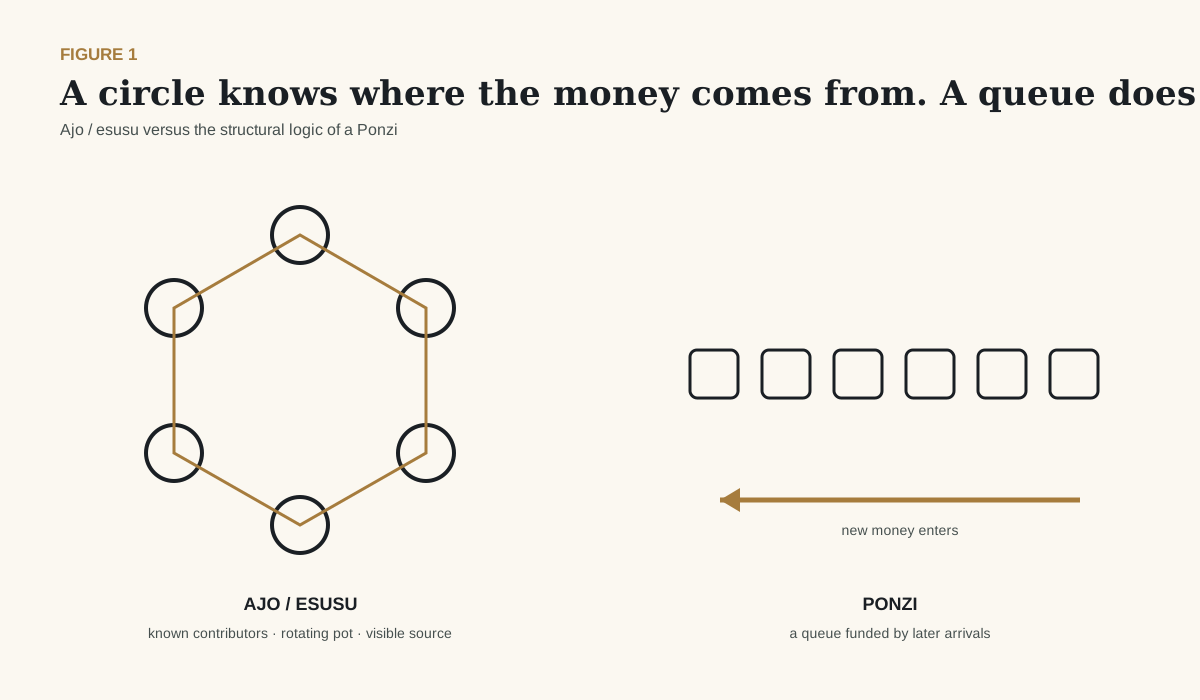
Figure 1. A circle knows where the money comes from. A queue does not.
Source: Seven Gates schematic. Conceptual illustration, not to scale.
A Ponzi scheme depends on your eventually becoming too enchanted by the return to ask the same question.
The modern fraud required something different from ajo: distance. Not merely geographic distance, but epistemic distance, the gap between the story and the mechanism. The post made that gap scalable.
The earliest properly documented 419-style letter in Nigerian archival history predates the charge that made the number famous. On 18 December 1920, P. Crentsil, a former employee of the colonial Marine Department in Lagos and probably originally from the Gold Coast, wrote to a contact there describing magical powers available for a fee. He signed himself "P. Crentsil, Prof. of Wonders." In December 1921 the police charged him on three counts under various provisions of the criminal code, including section 419. The magistrate cautioned him on one count and acquitted him on two for lack of corroboration. Crentsil was not running a Ponzi scheme. To call him one would flatten the record into a clever anecdote. His business belonged to the genealogy of advance-fee fraud: distance, claimed authority, a modest payment now and an extravagant imagined benefit later.
The technology would improve considerably over the next century. Human firmware would prove more stubborn.
Charles Ponzi himself, operating in Boston in 1920, also sold distance. His story involved international reply coupons, postal instruments obscure enough to sound plausible and difficult enough for ordinary investors to audit. He promised returns of roughly 50 percent within a few months. The coupons were the costume. The true cash flow came from later investors.
This is an important rule of fraud. The explanatory mechanism must be understandable enough to repeat at dinner and complicated enough not to inspect after dinner.
Nigeria would become very good at supplying both audiences.
When Buildings Learned to Lie
There is a temptation to draw a straight line from Nigerian bank failures to Nigerian Ponzi schemes. We should resist it. A failed bank is not automatically a Ponzi. A badly managed bank can have real assets, real loans, real deposit liabilities and still become insolvent. A fraudulent bank can steal. A Ponzi is structurally different: its promised returns are financed substantially by later participants rather than by economic earnings.
The distinction matters to accountants. It matters less to a depositor standing outside a locked building.
Nigeria's banking history supplied many such people. The Nigerian Deposit Insurance Corporation says twenty-one of twenty-five indigenous banks operating in the 1950s closed their doors, inflicting severe losses on small depositors. Decades later, the distress returned in another form. By the end of 1995, according to NDIC's own institutional history, about one in every two Nigerian banks was distressed, and the authorities had taken control of two dozen troubled banks between 1991 and 1996.
Again, this did not make the banks Ponzi schemes.
It did something more psychologically interesting.
It damaged calibration.
A citizen does not experience "poor asset quality," "capital impairment," "liquidity mismatch" and "fraudulent investment scheme" as separate entries in a graduate finance examination. He experiences a promise, a building, a person in a tie, a receipt, and then missing money.
Repeated institutional failure does not necessarily destroy trust. Sometimes it merely redirects it.
Bank to family member.
Family member to colleague.
Colleague to pastor.
Pastor to professional association.
Association to influencer.
Influencer to WhatsApp administrator.
The formal system imagines that trust is a substance stored in licensed institutions. In reality, trust behaves more like water. Block one channel and it finds another, sometimes cleaner, sometimes considerably worse.
This helps explain why registration can become strangely powerful in a low-trust environment. A Corporate Affairs Commission certificate proves that a legal entity exists. It does not prove that the entity has discovered a loophole in compound interest. Yet the document can be used to launder authenticity. A real certificate becomes collateral for a fictional economic proposition.
Fraud does not always succeed by looking fake. The expensive versions succeed by looking administratively boring.
Then came a man in Port Harcourt who understood the difference.
Before Telegram, There Was Aba Road
On 20 May 1991, Umanah E. Umanah and five others were arrested after police investigations into Resources Managers Nigeria Limited, the Port Harcourt investment company that had been offering 60 percent on 30-day deposits. By 31 July, a special military tribunal had begun hearing the case. An August 1991 issue of Citizen, preserved by Nigeria's National Library repository, put the money involved at about ₦330 million and reported that police had recovered ₦82.2 million from company strongrooms, ₦47.2 million from Umanah's bank account and ₦196.8 million held in the company's name. Those are contemporary reported figures, not a later forensic reconstruction.
The proposition itself was brutally simple. Umanah had experimented with the model as a student in Calabar in the early 1980s: invest ₦5, receive ₦8 after a month. By 1989 he had incorporated Resources Managers Nigeria Limited and scaled the idea. Conventional bank returns were a fraction of the 60 percent being promised every thirty days.
The depositor count was disputed even at the time, which is useful. A Ponzi story does not become more accurate merely because a later retelling supplies a satisfying round number. The stronger contemporary fact is social: the Rivers State government said RMNL's depositors included members of the armed forces, police, civil servants, judges and magistrates.
This was not competition. It was a declaration of war on multiplication.
The Central Bank had rejected RMNL's application to operate in the form it wanted and warned that advertising for and collecting deposits were activities reserved for licensed banks. Yet payment had become its own defence. Contemporary and later accounts describe depositors resisting the shutdown because the company had, until then, been paying. This is the mature Ponzi's political trick: the regulator does not merely confront a promoter. It confronts thousands of recent success stories.
The scene reveals the political economy of a Ponzi at maturity. By then the promoter is entangled with society. A paid customer has a reputation to defend; an official who invested is no longer observing from outside; a civil servant who recruited relatives has social capital at risk. Closing the scheme means declaring thousands of recent testimonials false.
There was another feature of the environment. Port Harcourt was an oil city in an oil country, one where extraordinary wealth could be both visible and obscure. Fortunes did appear through contracts, services, allocations, trading, political proximity and petroleum. A person could see wealth without seeing the balance sheet that produced it.
This gives us the surplus-cash paradox.
It is shallow to say Ponzi schemes are products of poverty. Poverty can increase desperation, but a Ponzi also requires investable money. The scheme lives at the intersection of aspiration and liquidity. It wants people anxious enough to seek an escape and solvent enough to fund one.
Oil economies are particularly good at producing a certain kind of plausibility. When legitimate fortunes can be spectacular and their mechanisms opaque, illegitimate spectacular returns can borrow the same aura.
Where extraordinary legitimate wealth is visible but poorly understood, extraordinary illegitimate returns can borrow its plausibility.
The 1991 story also complicates our lazy distinction between the educated and the gullible. Commercial bankers understood the arithmetic and some powerful people still participated. Expertise is not a vaccine against motivated reasoning. Sometimes expertise simply gives desire a better vocabulary.
Planwell in Edo became part of the same early-1990s wonder-bank folklore. The record is thinner and the numbers more disputed, so it is wiser not to build a cathedral of certainty on it. What matters is that Nigeria had already developed a recognizable genre: the investment house promising returns far beyond normal finance, surrounded by offices, paperwork and paid early customers.
Then the buildings got better.
The Wonder Bank Republic
By the 2000s, the Nigerian wonder bank had learned an important lesson from respectable capitalism: presentation is part of the product.
Consider Nospetco Oil & Gas. Court records describe agreements in which an investor paid ₦450,000 for a "slot" and was promised ₦40,000 every month. The money was ostensibly to finance supplies of industrial fuel. That is about 8.9 percent a month before compounding, still a number capable of making a normal portfolio manager develop a facial twitch.
Thousands invested. Litigation that followed the SEC's intervention eventually concerned more than thirteen thousand investors and tens of billions of naira held in connection with the matter. The legal history became long and complicated, which is itself instructive. Fraudulent or unauthorized investment can leave behind real bank accounts, real contracts, real court disputes and real assets. The presence of reality around a scheme does not validate the engine at its centre.
Call this authenticity laundering.
The office is real.
The letterhead is real.
The registration is real.
The bank account is real.
The employees are real.
The fuel tanker is real.
The first payout is very real.
The yield-generating business may be imaginary, insufficient or irrelevant.
The scam does not need to fake the entire world. It only needs to fake the source of profit.
This is why the recurring question matters more than the décor: Where did the return come from?
A bond pays because a borrower taxes, sells, earns or refinances.
A share can rise because a company generates future cash flows that investors value more highly.
A rental property produces rent.
A business earns a margin because it sells something for more than it costs to supply.
A Ponzi scheme pays because the next person has arrived.
That is not a semantic difference. It is the whole machine.
Ponzi is not pyramid, and neither is ajo
The terms are often mixed together because the disasters rhyme. Their mechanics differ.
| Structure | Where the money moves | What keeps it alive |
|---|---|---|
| Ponzi | A central operator pools new money and pays earlier participants | Continued inflows and confidence |
| Pyramid | Participants recruit other participants; rewards depend heavily on recruitment layers | Exponential expansion of recruits |
| Bubble | Buyers bid up the price of a real asset because they expect resale at a higher price | Continued demand and rising expectations |
| Ajo / esusu | Members contribute known amounts to a rotating pot | Reciprocity, rules and repeated relationships |
| Investment fund | Investors own claims on actual portfolio assets | Asset returns, fees and market value |
A hybrid fraud can contain both Ponzi and pyramid features. MMM, for example, had a central matching architecture and powerful referral dynamics. But the distinction remains useful.
Pyramids are especially rude to population statistics. Suppose every participant must recruit three people. The layers become:
3, 9, 27, 81, 243, 729, 2,187, 6,561, 19,683, 59,049, 177,147, 531,441, 1,594,323, 4,782,969, 14,348,907, 43,046,721, 129,140,163.
At level seventeen, one new layer alone needs about 129 million people.
Nigeria has a large population. It is not mathematically cooperative enough.
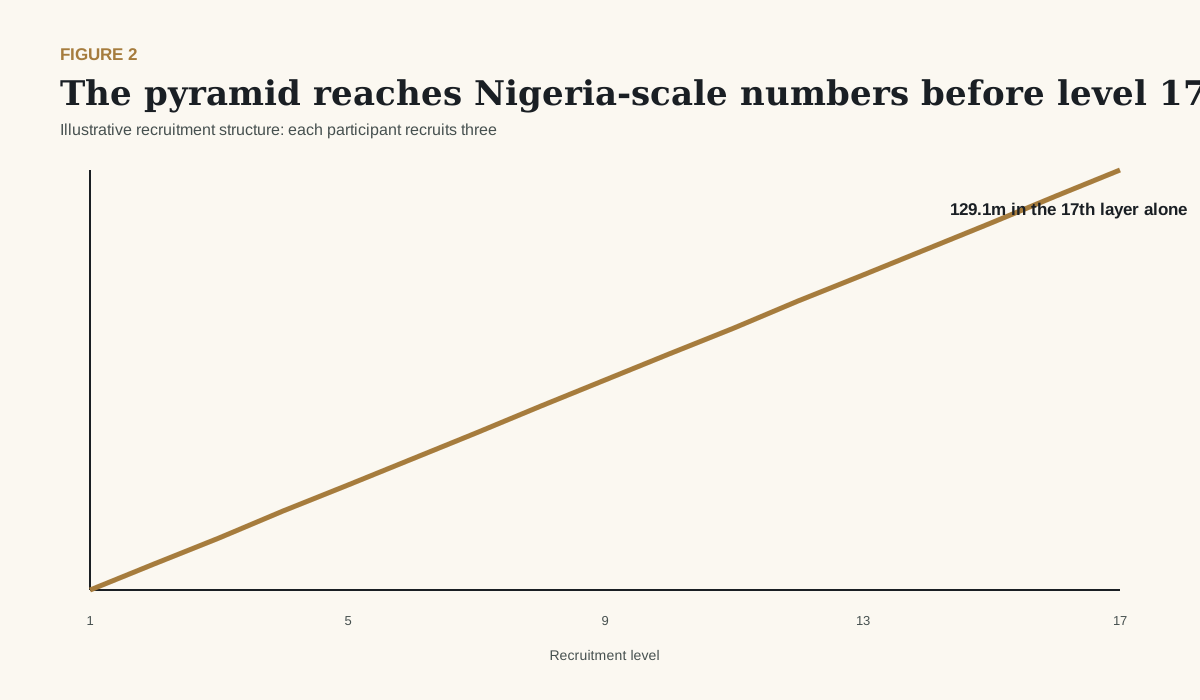
Figure 2. The pyramid reaches Nigeria-scale numbers before it reaches level 17.
Source: Seven Gates arithmetic. 3^n participants in layer n.
And yet geometric impossibility can feel distant while a bank alert is immediate.
Which brings us to MMM.
MMM: The Recession Gets a Social Network
In August 2016, Nigeria's Securities and Exchange Commission issued a public warning about MMM Federal Republic of Nigeria. The regulator described the platform's own language: a "mutual aid financial network" promising 30 percent monthly.
The choice of words was brilliant.
MMM did not merely sell investment returns. It offered an explanation for why finance itself was corrupt. Banks were greedy. Government was unreliable. Conventional finance was exploitative. Participants were "providing help" and "getting help." Money passed between peers. The scheme became a community and, crucially, a moral argument.
The cleverest Ponzi schemes do not merely explain why you should trust them. They explain why everyone else is untrustworthy.
The timing helped. Nigeria entered recession in 2016. The Central Bank recorded a 1.5 percent GDP contraction, continued naira depreciation and headline inflation that rose from 9.62 percent in January to 18.55 percent in December. The World Bank described it as the country's first full-year recession in roughly a quarter century.
It would be foolish to say recession caused MMM. Bad economies do not mechanically produce 30 percent monthly fantasies. Plenty of people in recessions buy no Ponzi at all. But macroeconomic instability can alter the felt value of time.
This is the shortening of financial time.
If prices rise faster than your salary, waiting becomes expensive. If the currency repeatedly weakens, money saved for tomorrow appears to evaporate today. If jobs are uncertain, ten-year plans begin to look like science fiction written by somebody with a pension.
Economic instability does not make 30 percent a month rational. It can make patience feel irrational.
This is one reason the simple sermon, "people should learn compound interest," often misses the emotional setting in which the decision is made. The person understands that 30 percent is extraordinary. That is why he is there. What he may not understand is the exact relationship between extraordinary promised return and extraordinary required inflow.
So let us do the arithmetic.
It Is Still Growing. It Is Already Dead.
Forget MMM's actual cash flows for a moment. The following is an illustrative MMM-style model, not a reconstruction of the platform's books.
Let:
N_t = new money entering during month t
and let the promised monthly return be:
r = 0.30
If last month's new cohort must receive principal plus 30 percent, the amount due is:
P_t = (1 + r) N_(t-1)
Now suppose new money itself grows at rate g_t:
N_t = (1 + g_t) N_(t-1)
Ignoring other expenses for the moment, the change in cash reserve is:
ΔC_t = N_t - P_t
Therefore:
ΔC_t = (g_t - r) N_(t-1)
For a 30 percent monthly promise:
ΔC_t = (g_t - 0.30) N_(t-1)
This is the part that should be printed on the wall of every investment seminar promising miraculous monthly income.
The Ponzi does not need deposits to fall before it starts dying.
It only needs deposit growth to slow below 30 percent.
Here is a simulation beginning with ₦1 billion of new money:
| Month | New money | Growth | Previous cohort due | Monthly surplus / deficit | Cash reserve |
|---|---|---|---|---|---|
| 0 | ₦1.000bn | - | - | +₦1.000bn | ₦1.000bn |
| 1 | ₦1.600bn | 60% | ₦1.300bn | +₦300m | ₦1.300bn |
| 2 | ₦2.400bn | 50% | ₦2.080bn | +₦320m | ₦1.620bn |
| 3 | ₦3.360bn | 40% | ₦3.120bn | +₦240m | ₦1.860bn |
| 4 | ₦4.536bn | 35% | ₦4.368bn | +₦168m | ₦2.028bn |
| 5 | ₦5.897bn | 30% | ₦5.897bn | ₦0 | ₦2.028bn |
| 6 | ₦7.371bn | 25% | ₦7.666bn | -₦295m | ₦1.733bn |
| 7 | ₦8.845bn | 20% | ₦9.582bn | -₦737m | ₦996m |
| 8 | ₦9.730bn | 10% | ₦11.499bn | -₦1.769bn | -₦773m |
Month eight is the joke mathematics tells after everyone else has stopped laughing.
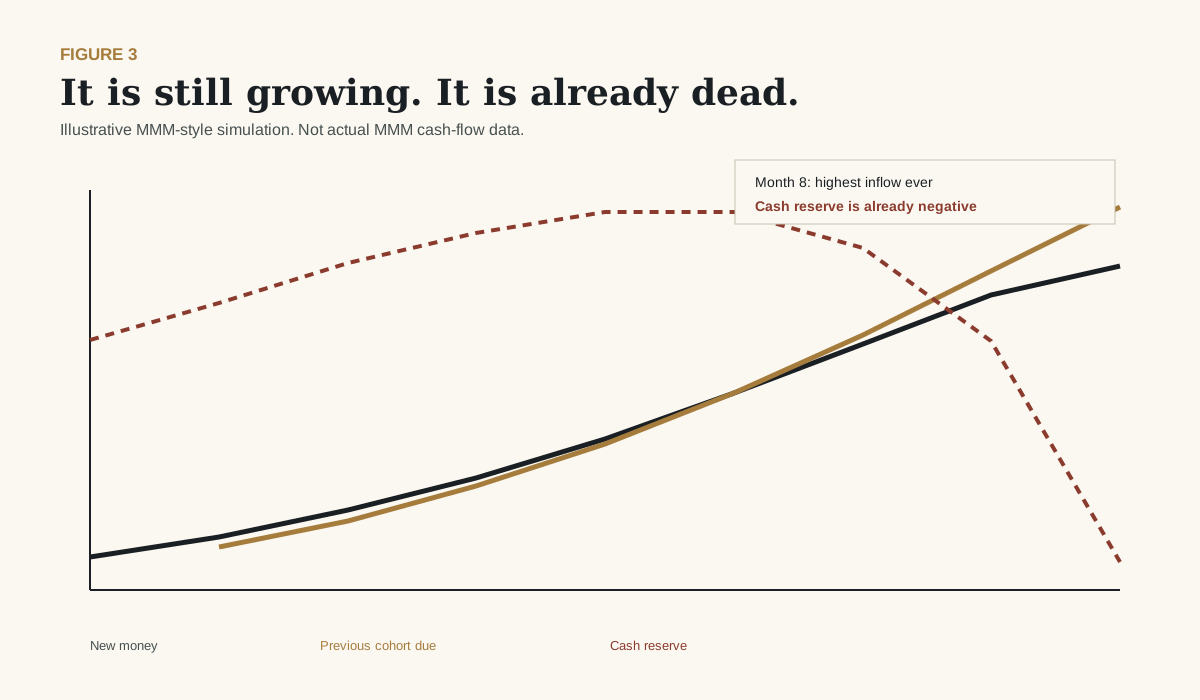
Figure 3. It is still growing. It is already dead.
Source: Seven Gates illustrative model. Not actual MMM cash-flow data.
The scheme receives more new money than in any previous month: nearly ₦9.73 billion. Newspapers could describe "record investor interest." Promoters could show growth charts. WhatsApp groups could celebrate adoption. Yet the machine is insolvent under the simplified model because liabilities are outrunning inflows.
The Ponzi did not run out of believers. It ran out of acceleration.
Now compound ₦100,000 at 30 percent monthly:
100,000(1.3)^n
| Period | Apparent value |
|---|---|
| Start | ₦100,000 |
| 1 month | ₦130,000 |
| 3 months | ₦219,700 |
| 6 months | ₦482,681 |
| 12 months | ~₦2.33m |
| 24 months | ~₦54.3m |
| 36 months | ~₦1.26bn |
| 48 months | ~₦29.5bn |
| 60 months | ~₦686bn |
At this point the sensible question is no longer whether the investment is legitimate. It is why Aliko Dangote bothered building a refinery.
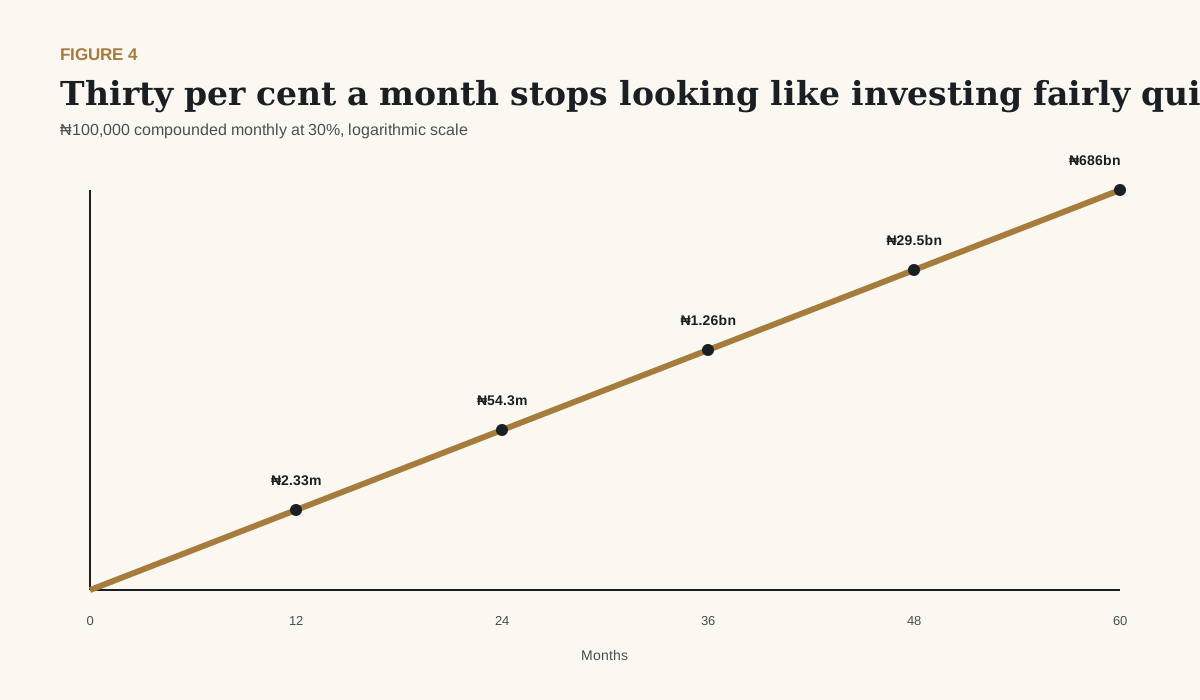
Figure 4. Thirty per cent a month stops looking like investing fairly quickly.
Source: Seven Gates arithmetic. 100,000 x 1.3^n; rounded display values.
Real schemes are messier. There are commissions, operating expenses, theft, referral bonuses and, most dangerous of all, unexpected withdrawals. Add them:
C_t = C_(t-1) + N_t - (1+r)N_(t-1) - W_t - E_t
where W_t is unexpected withdrawals and E_t is expenses, commissions, fraud and leakage.
Then confidence turns from a marketing variable into a liquidity variable.
Withdrawal requests create delays.
Delays create rumours.
Rumours create more withdrawals.
More withdrawals create worse delays.
A solvency problem acquires a run.
There is a useful banking distinction here. A bank can be economically solvent but temporarily illiquid: its assets may exceed its liabilities even though the assets cannot be converted to cash fast enough to meet withdrawals. A classic Ponzi has the more embarrassing problem. It is typically illiquid because its economics were never solvent in the first place.
The crisis does not create the fraud. It forces the arithmetic to speak aloud.
MMM froze participants' access in December 2016 and subsequently collapsed as a mass phenomenon. In 2017, the NDIC said an estimated three million Nigerians had put about ₦18 billion into it. Those figures are estimates, not an audited final national ledger, but the scale is enough.
Nigeria had learned something important.
Unfortunately, so had the scammers.
The Scam Learns to Dress for Dinner
After MMM, crude promises did not disappear. They acquired professional nouns.
Forex was useful because foreign exchange is real, profitable for some firms, volatile, technical and difficult for outsiders to verify. The complexity is not an inconvenience. In fraud, complexity can become camouflage.
MBA Forex became one of the most prominent examples. Nigeria's SEC listed MBA Forex and Investment Ltd among unlawful operators and said the entity was unregistered for capital-market activity. Investor accounts and later reporting described promises around 15 percent monthly, with loss claims ranging into the hundreds of billions of naira. The exact aggregate remains contested, and it should be described as a claim, not a settled loss figure.
The structural attraction is easier to verify than the national tally.
"Forex" answers the question what is the money doing? with a word that sounds like an explanation while concealing a thousand unanswered questions.
Which currency pairs?
What leverage?
What drawdown?
What broker?
Where are the audited statements?
Who is custodian?
What is the strategy's capacity?
How does it guarantee 15 percent in a market where professional funds regard a few percentage points of monthly alpha as exceptional?
A sufficiently sophisticated noun can cause an investor to feel unsophisticated for asking ordinary questions.
Agriculture offered a different camouflage. Its power came from familiarity.
Ovaioza Farm Produce Storage Business presented a proposition people could see in their heads: buy produce cheaply in season, store it, sell when prices rise. Garri. Plantain. Rice. Egusi. Corn. Cashew. This was not an invisible derivative in London. It was food.
That mattered in an era of rising food prices, agricultural crowdfunding and social-media entrepreneurship. Police charges later alleged that Imu Ovaioza Yunusa and her company induced investors with claims of roughly 70 percent returns from food processing and storage. The 2022 charges then before the court alleged about ₦408 million across identified counts, while investor and media estimates of exposure were much larger. The SEC's own list records Ovaioza Farm Produce Storage Business among schemes it sealed in 2022.
The legal qualifiers matter. An allegation is not a conviction. A media total is not an audited loss. Precision is a moral obligation in a story about fraudulent precision.
But the costume remains revealing.
During a period in which food inflation was a national anxiety, the investment story wore food itself.
The national mood chooses the wardrobe.
Then came the influencer. This innovation was less about the asset than the distribution channel.
A promoter no longer needed to build trust from zero. He could rent it.
A celebrity post, a verified account, an admired entrepreneur, a church member, a colleague or a respected professional could lend credibility to a scheme without understanding its balance sheet. This is borrowed moral capital.
Affinity fraud is leverage applied to reputation.
The intermediary may be innocent. That can make the transmission stronger, because sincere belief is more persuasive than paid advertising. The person who tells you, "my cousin has withdrawn three times," is not reading copy. He is describing family evidence.
Crypto then solved an older problem for promoters: it made opacity look modern.
In traditional fraud, not understanding the mechanism can feel like a warning. In technology fraud, not understanding the mechanism can be reframed as proof that the mechanism is advanced.
Blockchain. Arbitrage. AI bot. Quant engine. Smart contract. Liquidity mining. Automated trading.
Opacity becomes sophistication.
The Professor of Wonders has acquired a dashboard.
Every Era Gets the Ponzi It Deserves
A useful way to read a country's investment frauds is not as a police blotter but as a catalogue of aspiration.
| Era or anxiety | Fraudulent costume |
|---|---|
| Colonial correspondence | Distant magical or commercial services |
| Oil wealth | Oil and petroleum investment |
| Liberalisation | Investment houses and wonder banks |
| Recession | Mutual aid and peer solidarity |
| FX scarcity | Forex trading |
| Food inflation | Agricultural storage and crowdfunding |
| Social media | Influencer-backed schemes |
| Crypto boom | Exchanges, tokens and digital assets |
| AI era | Bots, algorithms and automated trading |
Ponzi schemes are accidental archives of national aspiration.
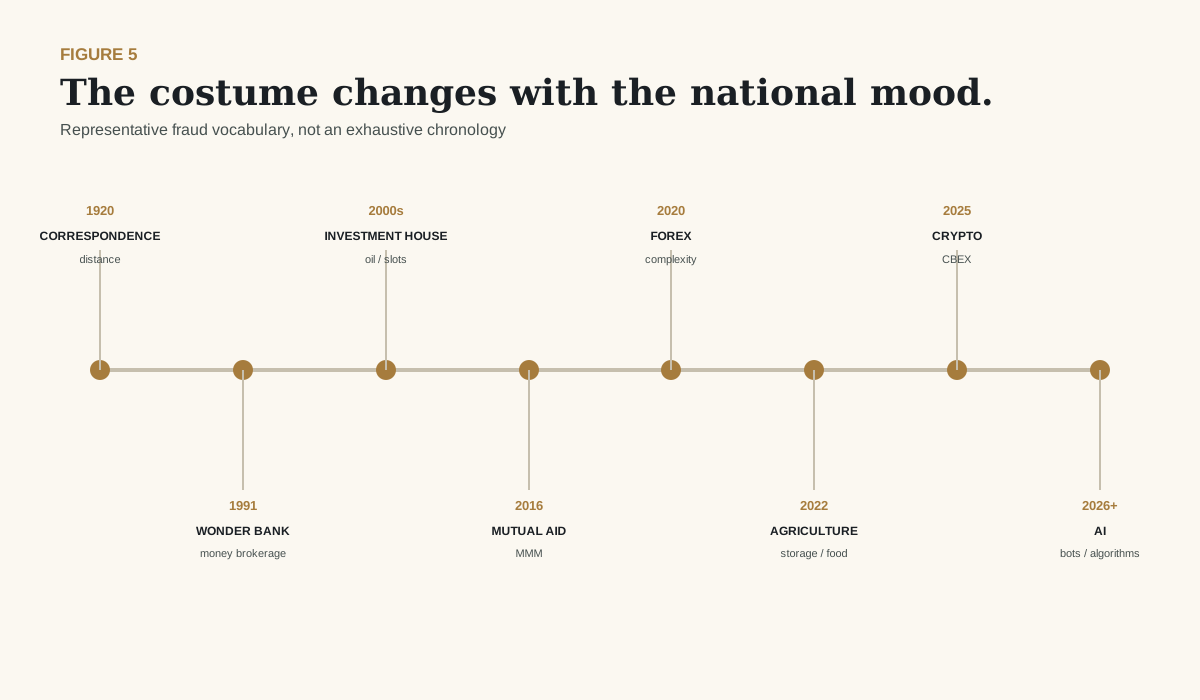
Figure 5. The costume changes with the national mood.
Source: Seven Gates synthesis of documented cases discussed in the essay.
The promoter rarely invents tomorrow's prestigious industry. He borrows today's. He studies the sector society already believes can create unusual wealth, then attaches a guaranteed yield to it.
This is why the product is never the point.
Oil can be legitimate.
Agriculture can be legitimate.
Forex trading can be legitimate.
Crypto assets can be legitimate or speculative without being Ponzi schemes.
Artificial intelligence is real.
The fraud enters when the existence of a real sector is used as evidence for a return that the economics cannot support.
The costume needs to pass only one test: can the investor imagine somebody getting rich this way?
Nigeria has supplied many affirmative answers.
CBEX and the Digital Present
By 2025, the latest major Nigerian episode arrived with a globally fluent name: Crypto Bridge Exchange, commonly called CBEX.
The Securities and Exchange Commission said CBEX and related identities, including ST Technologies International Ltd, were not registered to operate as a digital asset exchange or solicit investments from Nigerians. The regulator's preliminary investigation said the operation created a false perception of legitimacy and promised implausibly high guaranteed returns. A Federal High Court later ordered the arrest and remand of six alleged promoters after an EFCC application. In that proceeding, the EFCC alleged promises of up to 100 percent returns in thirty days and described the suspected scheme as reaching about $1 billion.
Then came the number that travelled fastest: ₦1.3 trillion.
It appeared in media reports as an estimate of what roughly 600,000 Nigerians may have put into CBEX. By March 2026, the EFCC was still pursuing funds abroad, according to Punch reporting. But the ₦1.3 trillion figure should remain exactly where it belongs: in the category called reported estimate, not audited national loss.
Why the caution?
Because Ponzi accounting is an enemy of clean statistics.
A platform balance may include fictitious profit that never existed.
An investor may report both principal and fake accrued return as a loss.
The same money can be counted in a promoter's inflow estimate and again in a victim claim.
Some losses are never reported.
Some investors withdraw more than they invested before collapse.
Some assets are recovered.
Some money sits abroad.
Some court filings allege amounts that later evidence may revise.
Exchange rates change the naira value of dollar claims.
The national Ponzi accounts are regrettably not maintained to IFRS standard.
How much has Nigeria actually lost?
The intellectually respectable answer is a range of categories, not one heroic number.
Documented or official estimates. Examples include NDIC's 2017 estimate that three million Nigerians had put about ₦18 billion into MMM.
Court allegations. Ovaioza's filed charges alleged hundreds of millions in identified transactions. CBEX proceedings have referred to an alleged $1 billion-scale fraud.
Investor claims. MBA Forex victims have advanced figures well above ₦100 billion, with some reporting placing the exposure above ₦200 billion.
Media estimates. CBEX's frequently repeated ₦1.3 trillion sits here unless and until an authoritative reconciliation establishes a firmer number.
Unknown and unreported losses. These are not a footnote. Shame, cash transactions, informal recruitment and incomplete records make under-reporting inevitable.
The defensible conclusion is less theatrical but more useful: at least hundreds of billions of naira can be tied to documented major schemes and formal claims; if the larger estimates around newer failures are included, apparent exposure moves into trillion-naira territory. Any single precise national total should be treated with suspicion.
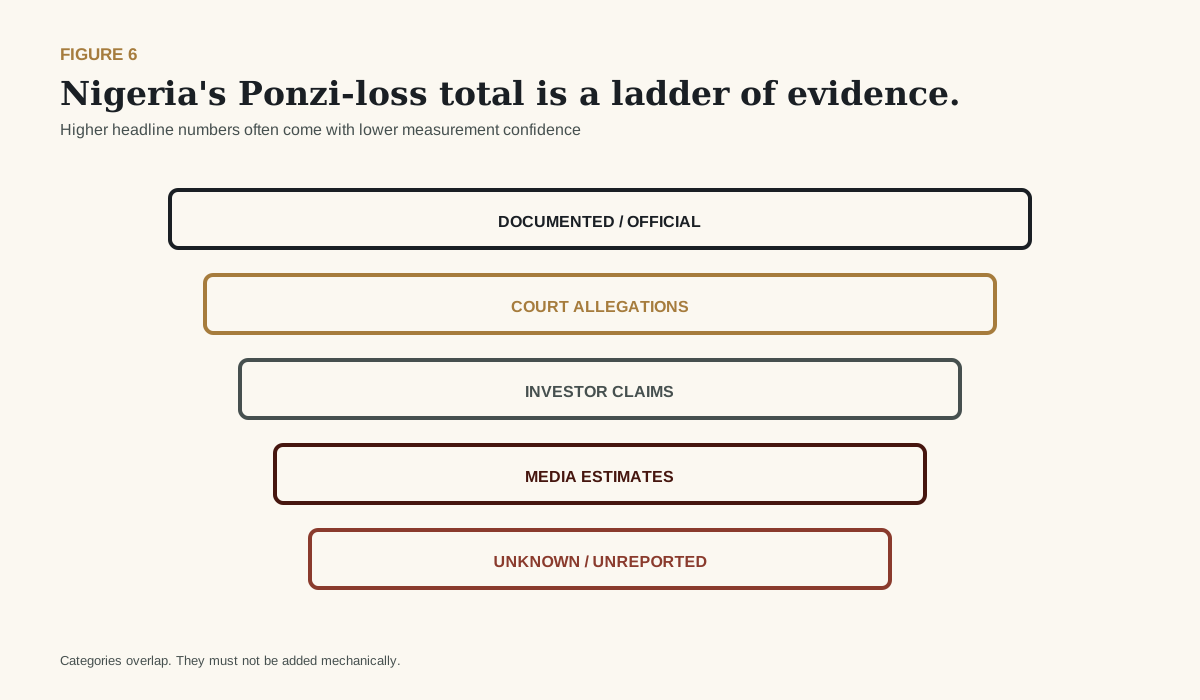
Figure 6. Nigeria's Ponzi-loss total is a ladder of evidence, not one clean number.
Source: Seven Gates evidence taxonomy. Categories overlap; do not add them mechanically.
The fraudster loves precision in the sales pitch. The historian should be more careful.
A Short Visit to New York
Bernie Madoff is useful because he looked nothing like a Nigerian wonder-bank promoter. His promise was quieter: respectable, stable, exclusive. The lie wore an expensive suit and did not shout 30 percent a month.
When the global financial crisis hit in 2008, clients wanted their money. Madoff could not meet billions of dollars of redemption requests. He confessed that the advisory business was a fraud and that earlier investors had been paid with later investors' principal.
It is often said loosely that the crisis "caused" Madoff to fail. That gives the market crash too much credit.
The mathematics was already fraudulent. The crisis forced the balance sheet to confess.
What if Madoff had simply invested the money?
There is no clean counterfactual without reconstructing every deposit and withdrawal. A real portfolio would have suffered real, measurable market losses in 2008. Madoff's statements described fictitious trading and fictitious gains. The problem was not a legitimate strategy enduring a bad year. The assets never supported the liabilities written on the statements.
This distinction also explains why recovery after Madoff was unusual. Years of litigation, forfeiture and clawbacks recovered enormous sums. In December 2024, the U.S. Justice Department said the Madoff Victim Fund's final distribution brought recoveries for its eligible victims to 93.71 percent of their recognized fraud losses, more than $4.3 billion across 40,930 victims in 127 countries. Separate bankruptcy-trustee recoveries added further billions under a different claims process.
Nigeria's victims usually do not enjoy anything close to that administrative afterlife.
The Madoff comparison is useful for another reason. It destroys the fantasy that fraud belongs to the financially unsophisticated. Madoff's clients included wealthy individuals, funds and professional intermediaries.
Intelligence is not immunity.
If anything, clever people can be unusually skilled at manufacturing reasons for a conclusion they prefer.
Which brings us to the psychology nobody likes to admit.
The Queue
The simplest theory of Ponzi participation is greed plus ignorance.
It is also one of the least interesting.
Meet the Early Winner.
"I've withdrawn three times."
This person is formidable because he has evidence. Telling him the scheme is fraudulent sounds, to him, like arguing with his bank statement.
Meet the Late Joiner.
"Everybody was making money."
This is not an entirely irrational observation. Social proof is evidence in many areas of life. We choose restaurants because they are full, doctors because friends recommend them, software because colleagues use it. The problem is that in a Ponzi, popularity is not independent evidence of solvency. Popularity is part of the funding mechanism.
Meet the Influencer.
"They paid people."
True, at first. That is what the scheme needs to do.
Meet the Regulator.
"We issued warnings."
Also true. A warning competes poorly with a credit alert.
Meet the Sceptic.
"I knew it would collapse."
The sceptic is the most interesting character because sometimes he joins.
He is not mistaken about the ending. He is mistaken about his location in the story.
"Of course it will collapse," he says. "But not before I withdraw."
This converts the investment from a belief problem into a queueing problem.
Some participants are not wrong about the collapse. They are wrong about their place in the queue.
The game now contains overconfidence, optimism bias and a form of strategic delusion. Each participant imagines himself earlier, faster or more informed than the median participant. It is Lake Wobegon with withdrawal requests.
FOMO adds time pressure. Scarcity removes reflection. Sunk costs make exit painful. Consistency pushes an early believer to reinvest rather than admit doubt. Reciprocity makes a paid investor feel obliged to tell others. Authority bias supplies the pastor, celebrity, banker or professional. Envy supplies the neighbour's new car. Status supplies the private WhatsApp group.
Narrative bias does the rest.
Human beings do not naturally experience finance as discounted cash flows. We experience it as stories about causation.
The government is ruining the naira.
Banks are exploiting us.
Food prices always rise after harvest.
This trader has a secret strategy.
The algorithm never loses.
The crypto exchange arbitrages global markets.
Each sentence contains enough truth to support the next false sentence.
That is how motivated reasoning works. It rarely begins with a complete lie. It assembles a bridge from selected truths.
Borrowed Moral Capital
Nigeria's strongest social networks are also powerful financial networks. Families pool money. Churches support members. Alumni groups finance emergencies. Professional associations create opportunity. Ethnic and hometown associations solve problems the state often does not.
These networks are not causes of fraud. They are infrastructure, and infrastructure can carry clean water or contaminated water.
Affinity fraud exploits the fact that trust is transferable.
A promoter need not persuade you directly if your brother has already been paid.
He need not prove competence if your pastor believes him.
He need not survive due diligence if the chairman of your alumni association has already introduced him.
This is borrowed moral capital.
The intermediary does not have to be a person. Sometimes it is a masthead.
In November 2021, Vanguard published an interview that introduced Ovaioza Yunusa as a "fierce young Nigerian agro entrepreneur" and described her farm-produce-storage business, its public partnership model, awards and her claim that proper licensing and legal requirements were observed. The article was a profile, not an audit, and it did not purport to certify an investment. But readers do not always preserve that distinction. A profile is not due diligence. In an investor's WhatsApp group, it can arrive wearing due diligence's clothes.
Less than two years later, Vanguard was reporting the Federal Government's case and SEC allegations that Ovaioza and her company had operated an unregistered collective investment scheme valued above ₦2 billion. That does not make the press a co-conspirator. It makes the press another possible trust intermediary. Sometimes journalism amplifies a promoter; sometimes the publication itself becomes collateral in the trust trade, its masthead borrowed as proof of legitimacy it never intended to provide. The same reputational leverage applies: the promoter does not need to manufacture all credibility from zero.
Its darkest feature is that the intermediary may be innocent. A cynical paid promoter can trigger suspicion. A sincere friend produces intimacy. The best distribution agent is someone whose own money is at risk and who therefore has every reason to sound convinced.
Return to the man with the first ₦300,000 payout.
When he forwards the screenshot, he is not lying.
That is why it works.
The scheme has converted a true event into evidence for a false proposition.
Yes, he was paid.
No, that does not establish where the return came from.
Always return to the question.
Where did the return come from?
The Regulator Arrives on Horseback
Fraud and regulation operate on different clocks.
Ponzi time looks like this:
post -> viral clip -> deposit -> payout -> screenshot -> referral -> explosion.
Regulatory time looks like this:
complaint -> jurisdiction -> investigation -> evidence -> freezing order -> arrest -> charge -> trial -> appeal.
The scam runs on internet time. The state runs on legal time.
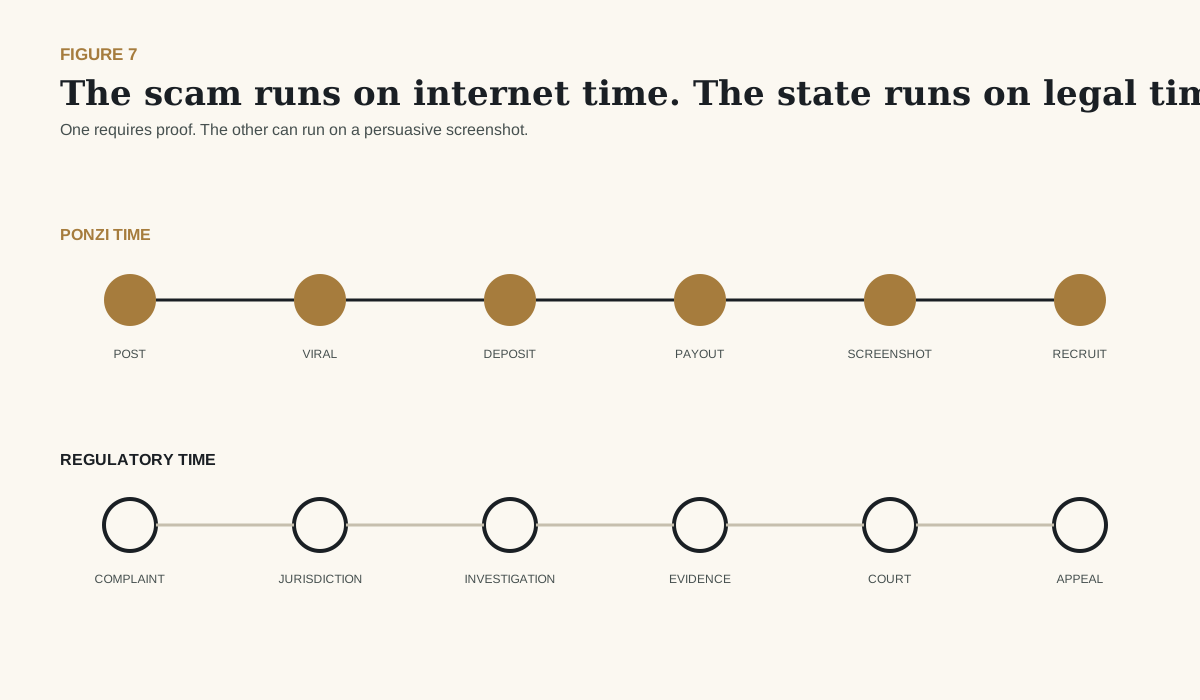
Figure 7. The scam runs on internet time. The state runs on legal time.
Source: Seven Gates schematic. Procedural sequence simplified for illustration.
This is not an excuse for Nigerian regulatory failure. Warnings have sometimes arrived after schemes were already large. Agencies can overlap, pass responsibility, act inconsistently or struggle to freeze assets before money moves. Weak prosecution and slow courts alter expected consequences. Corporate registration is too easily misunderstood as investment approval. Digital platforms can reach millions before field officers locate an office.
But the asymmetry is real.
A regulator must establish facts.
A promoter needs one screenshot.
A regulator may need jurisdiction over a company, a bank account and a person.
A promoter needs a Telegram link.
The state has tried to narrow the gap. SEC publishes lists of known illegal operators and repeatedly warns against unregistered schemes. Section 196 of the Investments and Securities Act 2025 gives the Commission power to enter and seal prohibited schemes and seek orders to freeze and forfeit their assets. A promoter or operator convicted under that section faces a fine of not less than ₦20 million, imprisonment for ten years, or both. By May 2026, the Commission was warning specifically about unregistered schemes spreading through WhatsApp, Instagram, Telegram, Facebook and TikTok.
The language has caught up with the distribution system.
Whether enforcement can catch up is a different question.
CBEX is almost a laboratory demonstration. SEC warned in April 2025. Enforcement and court action followed. Yet by June, the regulator had to warn again because reports said the platform had resurfaced and was asking some users to pay another $100 or $200 before withdrawals could be processed.
This is the final insult of a mature fraud: the victim is asked to finance the recovery of the money already taken from him.
It sounds absurd from outside the system. Inside, it is framed as the last small obstacle between the investor and his trapped fortune.
Sunk cost has found a payment gateway.
The Helicopter View
Nigeria is not uniquely gullible. The global history of financial fraud is a long argument against national vanity.
Charles Ponzi found American investors in 1920 with international mail coupons.
Bernie Madoff found sophisticated investors with stability and exclusivity.
Albania in 1996-97 showed what happens when pyramid finance becomes systemic. IMF research estimated the schemes' nominal liabilities at roughly half of GDP, with participation reaching a huge share of the population. When they collapsed, financial failure became political disorder.
Britain has had mini-bonds and investment scandals. France has had collectible and alternative-asset frauds. Crypto produced borderless versions because the sales funnel became global before the regulator could finish breakfast.
Human beings everywhere are attracted to yield, authority, novelty and the possibility that the crowd has discovered something before they have.
What differs is the local vocabulary of credibility.
In one country it is property.
In another it is wine, art or biotech.
In Nigeria it may be petroleum, forex, garri or crypto.
The universal mechanism puts on local clothes.
What Ordinary Returns Look Like
Miracle returns often survive because the benchmark is wrong. A legitimate investment can make 30 percent. The NGX All-Share Index rose 51.19 percent in 2025, but that was a volatile market return over a year, not a guaranteed monthly coupon.
At the 2 September 2026 Nigerian Treasury-bill auction, the one-year stop rate was 16.84 percent. That is an annual instrument, not a monthly promise. Money-market funds in the same period were also operating in an annual-yield world, not a 30-percent-every-thirty-days universe. The comparison is about orders of magnitude, not an endorsement of any particular asset.
The order of magnitude is the point.
| Instrument / claim | Typical or recent scale | What can go wrong? |
|---|---|---|
| Nigerian Treasury bills | 16.84% stop rate on the 364-day bill at the 2 Sep. 2026 auction | Inflation, reinvestment risk, rate changes |
| Money-market funds | Annualized yields linked to short-term market rates, not guaranteed monthly compounding | Rates fall, fees, portfolio/counterparty risk |
| Nigerian equities | Can gain or lose substantially; NGX ASI gained 51.19% in 2025 | Volatility and capital loss |
| Private business | Can produce very high returns | Operational failure, illiquidity, competition |
| "30% guaranteed every month" | ~2,230% effective annual return if compounded | Arithmetic |
Thirty percent a month is not 360 percent a year in the compounding sense. Reinvested monthly, it turns ₦1 into about ₦23.3 after a year, an effective gain above 2,200 percent. Legitimate assets can occasionally deliver exceptional returns. Fraud changes the grammar by guaranteeing the exceptional and pretending volatility, uncertainty and loss have been abolished.
That is when the investor should stop asking, "How high is the return?" and ask, "What economic activity is productive enough, scalable enough and stable enough to pay this to everyone, repeatedly?"
Where did the return come from?
The question is almost embarrassingly simple.
That may be why complexity is so useful to the promoter.
Memory, or the Lack of It
J. K. Galbraith famously wrote about the brevity of financial memory. Nigeria's case adds an unpleasant refinement: memory can be perfectly intact and still fail to protect us.
A person may remember MMM and buy forex.
He may remember forex and buy agriculture.
He may remember agriculture and buy crypto.
He believes he has learned the old lesson because the new product looks different.
But the old lesson was never "avoid Russian acronyms" or "do not trust garri warehouses." The lesson was about cash flows.
Where did the return come from?
The costume encourages categorical forgetting. We remember the previous brand instead of the previous structure.
This is why the phrase "another MMM" is both useful and dangerous. Useful because it alerts people to recurrence. Dangerous because the next scheme's first task is to explain why it is not MMM.
Of course it isn't.
It has offices.
It has audited-looking PDFs.
It trades foreign exchange.
It stores food.
It uses artificial intelligence.
The last fraud teaches the next fraud what objections to pre-answer.
Financial sophistication evolves on both sides of the table.
The Republic of 30 Percent
Why, then, does the beautiful lie keep returning?
Because it is not one lie.
It is a bundle of truths arranged around one impossible conclusion.
Yes, inflation is destructive.
Yes, conventional institutions sometimes fail.
Yes, banks can be exploitative.
Yes, elites have made fortunes through obscure channels.
Yes, early investors really received money.
Yes, the company may be incorporated.
Yes, the promoter may own an office.
Yes, the influencer may genuinely have invested.
Yes, forex traders can make money.
Yes, food prices can rise in storage.
Yes, crypto assets can appreciate.
Yes, AI can automate trading tasks.
The fraud's genius lies in making the final proposition feel like merely one more truth in the chain.
Therefore, 30 percent every month is sustainable.
No.
That is where arithmetic resumes jurisdiction.
Every Ponzi scheme sells the same financial product: the feeling of being early.
The early investor is not merely richer. He is smarter. He saw it before the sceptics. He can send the screenshot to the group. He possesses a form of status that conventional saving rarely provides. Nobody takes a selfie with a Treasury bill.
This is why fraud competes not only with investments but with identity.
To reject the scheme can feel like rejecting the possibility that the world has changed in your favour.
To join is to purchase an option on escape.
From inflation.
From salary.
From class.
From the humiliating slowness of accumulation.
That last word matters most: slowness.
Wealth, in normal economies, has an offensive relationship with time. It takes time to build a business, accumulate equity, repay debt, train for a profession, compound savings, acquire customers, improve productivity. This is unsatisfying in a society where sudden wealth is publicly visible and its backstory is often concealed.
The Ponzi offers harvest without season.
Return without productivity.
Status before accumulation.
The miracle is not high yield.
The miracle is the abolition of waiting.
And Nigeria, after decades of inflation, devaluation, institutional disappointment, oil booms, recessions and policy shocks, has produced many citizens for whom waiting does not automatically feel virtuous. Waiting can feel like watching money decay.
That does not excuse the arithmetic. It explains the seduction.
The Circle and the Queue
There is another way to end this story, and it does not require a new app.
Return to ajo.
Long before modern Nigeria encountered Ponzi finance, Nigerians understood how to move money through networks of trust. No algorithm was required. No guaranteed 45 percent. No invisible arbitrage. No warehouse dashboard. No crypto bridge.
The members knew the source of the pot.
The system imposed discipline, but it did not claim to manufacture wealth from circulation itself. The money moved. It did not multiply by magic.
That is why the contrast is so clean.
Ajo ends when everyone has had their turn. A Ponzi ends when someone does not.
One is a circle.
The other is a queue pretending to be a circle.
And the queue always has a last person.
Every generation believes it has finally discovered the technology that repeals the ancient relationship between time and wealth. In one age the promise arrives in a letter. In another it comes from an oil company, a forex trader, a warehouse full of garri, a cryptocurrency exchange or an algorithm that has apparently solved capitalism before lunch.
The costumes improve because the audience does.
The bargain does not.
Somebody arrives early. Somebody gets paid. Somebody tells his friends. And somewhere, just outside the photograph, there is always one more person who has not yet discovered that he is late.
The schemes change. Mathematics does not.
Research notes and selected sources
Data cut-off: 5 September 2026. Allegations are described as allegations. Investor and media estimates are not promoted into audited loss figures. The MMM cash-flow model and compounding examples are Seven Gates illustrations, not recovered scheme ledgers.
- Securities and Exchange Commission, Nigeria, "Public Alert on the Activities of MMM Federal Republic of Nigeria", 30 August 2016. https://sec.gov.ng/for-investors/keep-track-of-circulars/public-alert-on-the-activities-of-mmm-federal-republic-of-nigeria-nigeriammmnet/
- Securities and Exchange Commission, Nigeria, Known Investment Scams and enforcement notices, accessed 5 September 2026. https://www.sec.gov.ng/for-investors/known-investment-scams/
- Nigeria Deposit Insurance Corporation, NDIC History, on 1950s indigenous-bank failures and 1990s distress. https://ndic.gov.ng/about/ndic-history/
- Salewa Olawoye-Mann, "Alajo Shomolu: Money, Credit, and Banking the Nigerian Ajo Way", Oxford University Press, 2022.
- Stephen Ellis, This Present Darkness: A History of Nigerian Organized Crime, Oxford University Press, 2016; archival reference to P. Crentsil's letter of 18 December 1920 and December 1921 prosecution.
- Citizen, 5 August 1991, pp. 6-7, digitised by the National Library of Nigeria repository, contemporary reporting on Resources Managers Nigeria Limited and Umanah E. Umanah. https://nigeriareposit.nln.gov.ng/
- Archivi.ng, "The Nigerian Ponzi King of 1991", 7 February 2026, used as a secondary reconstruction alongside the contemporary Citizen record.
- Supreme Court of Nigeria, Nospetco Oil & Gas Ltd v. Olorunnimbe & Ors (2021), on ₦450,000 slots, ₦40,000 monthly returns and the collective-investment structure.
- Central Bank of Nigeria and World Bank material on the 2016 Nigerian recession, inflation and exchange-rate stress.
- NDIC estimate reported in March 2017 that about three million Nigerians had put roughly ₦18 billion into MMM; treated as an estimate rather than an audited final tally.
- SEC Nigeria, "Activities of Unlawful Market Operators", 26 March 2020, listing MBA Forex and Investment Ltd among unlawful/unlicensed operators. https://home.sec.gov.ng/for-investors/keep-track-of-circulars/activities-of-unlawful-market-operators/
- FCT Police/Federal High Court charge reporting on Ovaioza Farm Produce Storage Business, July 2022: 28 counts, about ₦408.25 million in identified allegations and claims of 70 percent returns.
- SEC Nigeria, CBEX / ST Technologies public alert, 17 April 2025, and Illegal Operator Alert, 11 June 2025. https://home.sec.gov.ng/for-investors/keep-track-of-circulars/cbexcrypto-bridge-exchange-super-technology-st-technologies-international-ltd/
- Federal High Court / EFCC allegations reported by Premium Times, 25 April 2025, concerning six CBEX promoters, alleged promises up to 100 percent in 30 days and an alleged $1 billion scheme.
- Punch, 29 March 2026, on continuing EFCC efforts to trace CBEX-linked funds abroad. The widely repeated ₦1.3 trillion exposure remains a media estimate, not an audited loss total.
- Investments and Securities Act 2025, section 196, on prohibited schemes, sealing/freezing powers and penalties. https://sec.gov.ng/documents/1326/INVESTMENT-AND-SECURITIES-ACT-NIGERIA-2025_1.pdf
- SEC Nigeria, Public Notice: Unregistered Online Investment Schemes, 14 May 2026. https://sec.gov.ng/for-investors/keep-track-of-circulars/public-notice-unregistered-online-investment-schemes/
- U.S. Securities and Exchange Commission, Bernard Madoff enforcement releases, December 2008 onward.
- U.S. Department of Justice, 10th and final Madoff Victim Fund distribution, 30 December 2024, reporting 93.71 percent recovery of recognised fraud losses for eligible MVF victims. https://www.justice.gov/archives/opa/pr/justice-departments-10th-distribution-brings-total-provided-over-43b-nearly-full-recovery
- IMF, Christopher Jarvis, "The Rise and Fall of Albania's Pyramid Schemes", Finance & Development, March 2000.
- Nigerian Exchange Group, 2 January 2026, reporting a 51.19 percent gain in the NGX All-Share Index during 2025. https://ngxgroup.com/ngx-group-steering-market-to-world-beating-51-19-rally-in-2025/
- Nigerian Treasury-bill primary-market reporting for 2 September 2026: 364-day stop rate 16.84 percent.
- RNN, "Angry Investors Storm Alleged PXES Office In Yola After Scheme Collapse", 5 September 2026, and Silverbird Television, "Panic in Yola: Angry Investors Storm Collapsed PXES Office, Cart Away Equipment", 5 September 2026; used only to explain the immediate trigger for this essay. No national participant or loss total is inferred from these reports. https://rnn.ng/angry-investors-storm-alleged-pxes-office-in-yola-after-scheme-collapse/
- Vanguard, "Women still cannot own land - Ovaioza Yunusa", 30 November 2021. The piece is treated as a profile/interview, not as evidence that the investment proposition was legitimate. https://www.vanguardngr.com/2021/11/women-still-cannot-own-land-ovaioza-yunusa/
- Vanguard, "N2bn Investment scam: Court adjourns trial of agric entrepreneur to next week", 5 July 2023, reporting Federal Government and SEC allegations regarding an unregistered collective investment scheme valued above ₦2 billion. https://www.vanguardngr.com/2023/07/n2bn-investment-scam-court-adjourns-trial-of-agric-entrepreneur-to-next-week/