SEVEN GATES RESEARCH · ESSAY
Refining Squeeze: The Middle of the Barrel Has Taken Hostages
The refining squeeze of 2026, and why a diesel shortage now reaches from Russian airfields to Nigerian farms, Congolese mines, French supermarkets and Chinese car factories.
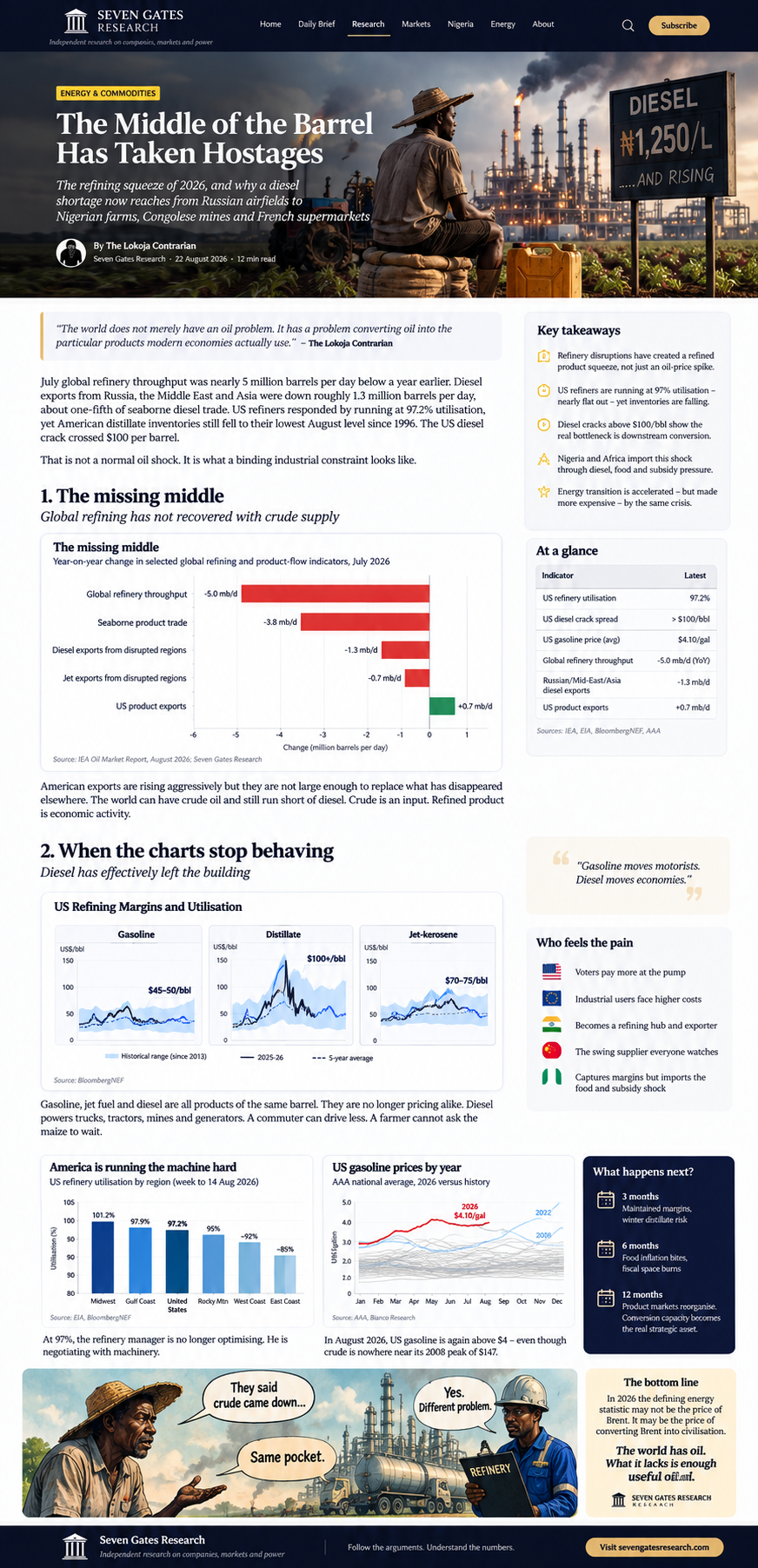
The short version. The world does not merely have an oil problem. It has a problem converting oil into the particular products modern economies actually use. July global refinery throughput was nearly 5 million barrels per day below a year earlier. Diesel exports from Russia, the Middle East and Asia were down roughly 1.3 million barrels per day. US refiners responded by running at 97.4% utilisation, yet American distillate inventories still fell to their lowest August level since 1996. The US diesel crack crossed $100 per barrel. That is not a normal oil shock. It is what a binding industrial constraint looks like.
The barrel has developed a middle-class problem
Refineries are not glamorous. Oilfields have flames. Tankers have scale. OPEC has ministers. Traders have television studios and expressions suggesting they have personally discovered scarcity.
Refineries mostly have columns, furnaces, compressors, catalysts and people who become nervous whenever somebody says, “Can we defer the turnaround?” Yet in the summer of 2026, the refinery has become one of the most consequential pieces of industrial infrastructure in the world.
The world can possess crude oil and still run short of diesel. It can own millions of barrels in strategic storage and still struggle to fuel tractors. It can release Brent from a cavern and discover that a Boeing remains unimpressed.
Crude oil is an input. Refined product is economic activity.
What exactly is a crack spread?
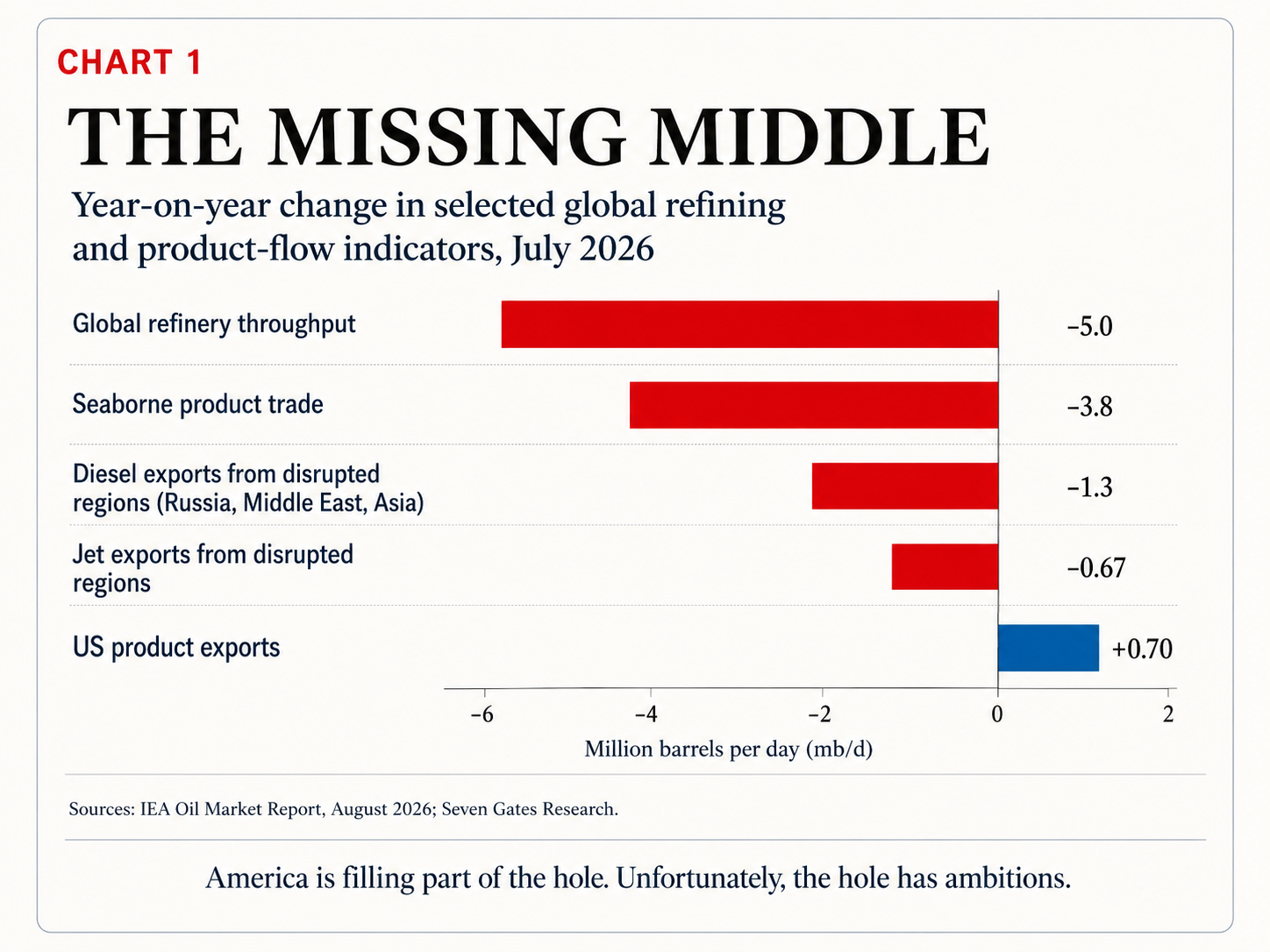
A refinery purchases crude oil and turns it into gasoline, diesel, jet fuel, LPG, naphtha, fuel oil and petrochemical feedstocks. A common shorthand for refinery economics is the 3-2-1 crack spread: three barrels of crude become roughly two barrels of gasoline and one barrel of distillate. The indicative crack is the value of those products minus the crude feedstock cost.
Useful. Not divine revelation. Every refinery differs. A complex Gulf Coast plant with a hydrocracker, catalytic cracker, coker and abundant hydrogen has considerably more flexibility than a simple hydroskimming refinery. Crude slate, API gravity, sulphur, hydrogen availability, energy cost, product specifications, yields, maintenance and freight all matter.
The 3-2-1 crack tells you whether the bakery is making money. It does not tell you exactly which oven is hottest.
When the charts stop behaving
Gasoline, diesel and jet fuel are all products of the same barrel. They are no longer pricing remotely alike. The BloombergNEF data supplied with this article show gasoline refining margins around $45–50/bbl in August, jet-kerosene around $70–75/bbl, and distillate margins approaching or breaching $100/bbl. Diesel has effectively left the historical range.
Diesel powers heavy trucks, tractors, combines, irrigation, mines, construction machinery, generators and much of the physical economy. A commuter can sometimes drive less. A farmer halfway through harvest cannot ask the maize to wait until the crack spread improves.
Why refiners cannot simply make more diesel
A refinery cannot look at a $100 diesel crack, gather the morning meeting and announce: “Gentlemen, from Tuesday we shall manufacture only diesel.” The crude barrel does not contain a menu.
Atmospheric distillation separates crude by boiling range. Complex refineries then use hydrocrackers, fluid catalytic crackers, cokers, hydrotreaters and hydrogen plants to convert heavier fractions. Refiners can optimise hydrocracker severity, cut points, feed allocation, blending, crude slate and unit throughput. But hardware imposes limits.
A catalytic cracker designed mainly around gasoline production does not become a diesel machine because Bloomberg terminals have become excited. Hydrogen becomes a constraint. Compressor duty becomes a constraint. Furnace duty becomes a constraint. Catalyst activity becomes a constraint. Eventually the relevant conversation is no longer with the trader. It is with metallurgy.
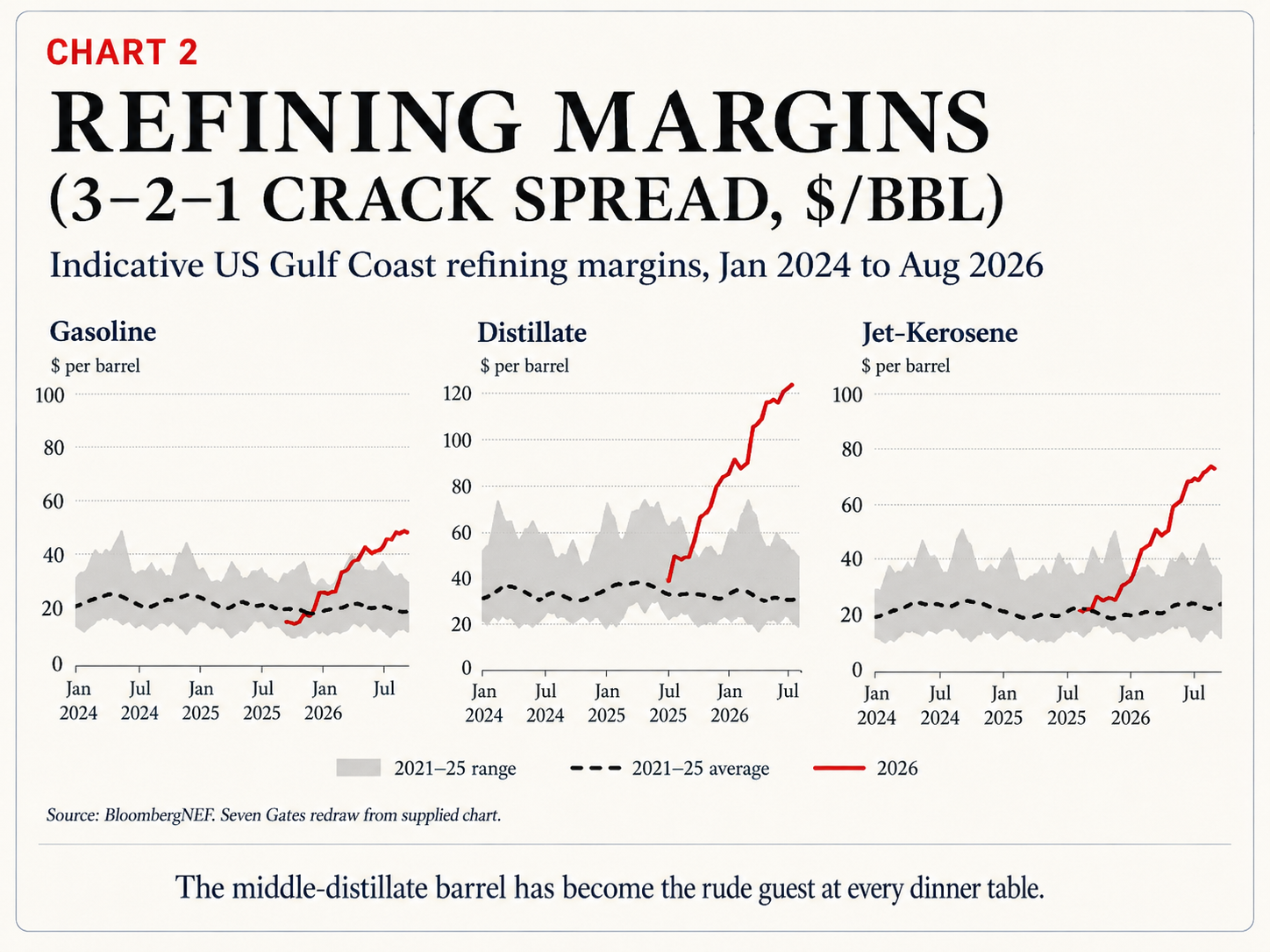
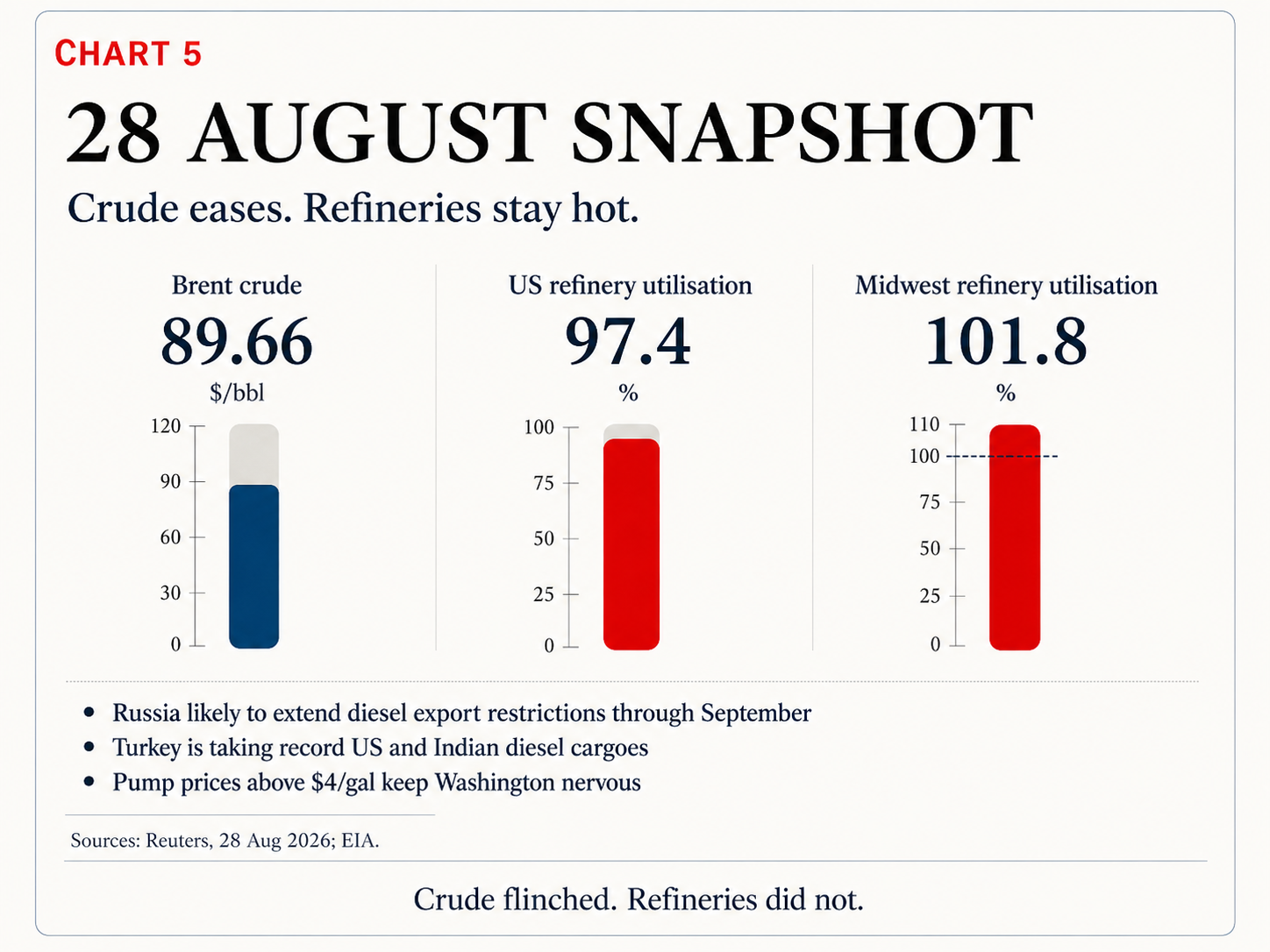
A reading above 100% does not mean the Midwest has repealed thermodynamics. EIA measures gross input against nominal operable capacity, and debottlenecking can push actual throughput above that nominal base. The important point is that the Midwest is now at 101.8%, the Rockies at 101.4%, the Gulf Coast at 97.0% and the national system at 97.4%. There is still regional variation, but the high-complexity US system is being worked hard.
The outlier Washington cannot ignore
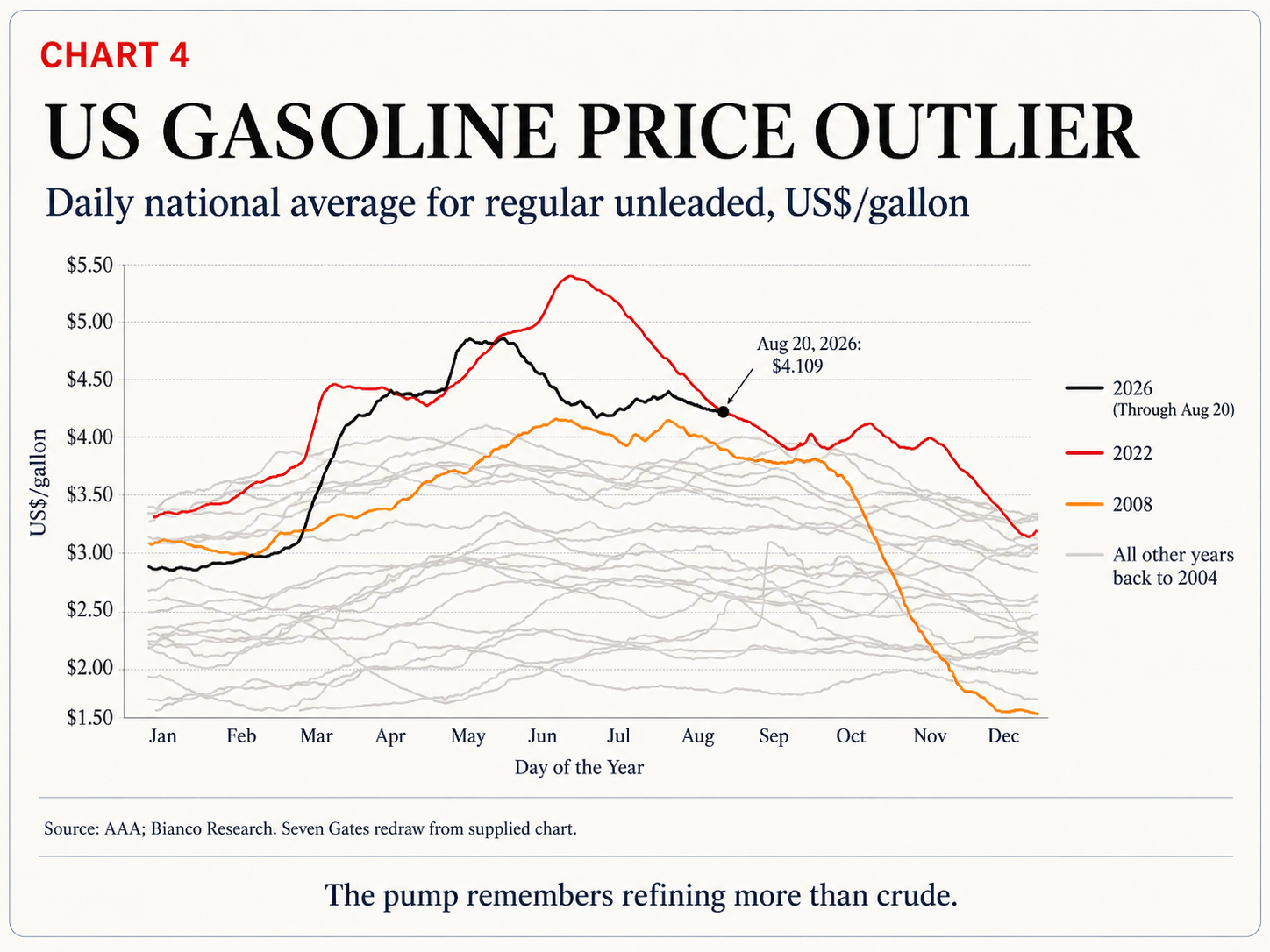
AAA's national average gasoline price was around $4.10 per gallon in late August. The 2026 line has moved into territory normally associated with exceptional energy shocks even though crude has retreated materially from its peak.
28 August update
Crude has eased; the product problem has not. Brent was around $89.66 on 28 August, down more than 5% on the week, as partial Gulf flows and diplomacy reduced the crude risk premium. Yet refined-product tightness remains acute enough that the White House is meeting refiners and fuel retailers over pump prices above $4 per gallon.
Russia is still exporting scarcity. Moscow is preparing to extend its diesel export ban through September after further Ukrainian strikes and domestic fuel stress.
Trade is rerouting in real time. Turkey, which sourced roughly 85% of its diesel imports from Russia in 2025, is taking record August volumes from India and the United States. That is the freight-and-refining thesis becoming visible on a map.
How did we get here?
1. Russia is being de-refined from the air
Ukraine has increasingly targeted Russian refining infrastructure. That is strategically different from hitting an oilfield. Damage the field and crude production falls. Damage the refinery and crude may still be produced and exported while diesel, gasoline, jet fuel and fuel oil disappear from domestic and international markets.
Russia can therefore remain one of the world's largest oil producers while suffering local product shortages. The country owns the wheat. Somebody keeps hitting the bakery. By late August, Moscow was preparing to extend the diesel export ban through September, with a longer extension still under discussion. Turkey's response is instructive: Russian diesel's share of Turkish imports has collapsed while US and Indian barrels have surged to record monthly levels.
2. The Middle East has become a downstream problem
The Gulf crisis is usually discussed through crude: Hormuz, tankers, OPEC. Those matter. But disrupted refining capacity is a different problem. Another producer may replace crude. Another refinery must physically make replacement diesel, gasoline or jet fuel. Spare conversion equipment is currently rather busy.
Damaged equipment must still be repaired. Catalysts may need replacing. Specialist parts must arrive. Compressors, with admirable indifference to geopolitics, cannot be repaired by communiqué.
3. Freight has become part of the commodity
Once nearby product supply disappears, buyers reach farther away. Europe searches for more US and Indian diesel. Africa competes for cargoes. Asian trade routes reorganise. Voyages lengthen. This creates tonne-mile inflation.
If a cargo once travelled 2,000 nautical miles and now travels 8,000, the tanker is occupied four times as long. Effective fleet availability falls even if not one vessel is scrapped. Insurance, financing and working capital rise.
Scarcity is not merely fewer barrels. It is also the same barrels spending longer at sea.
The geography of pain
United States: the emergency refinery
America has become the refining system of last resort. US product exports have risen while international supply has contracted. That is excellent news for refinery margins and less excellent for American motorists. The refinery owner wants the global price. The voter wants the domestic price. Both believe they have discovered capitalism.
Europe, Britain and France: geography sends an invoice
Europe entered this shock after years of refinery rationalisation. Many closures were individually logical. Collectively, they reduced resilience. Replacement diesel must now travel farther from the US Gulf, India and remaining exporters.
A supermarket does not purchase “diesel inflation”. It purchases lettuce. The lettuce arrives by truck. Eventually the accountant discovers energy policy.
India: the accidental energy diplomat
India's large, sophisticated refineries can purchase crude, process it efficiently and redirect products toward deficit markets. This produces more than refinery EBITDA. A country that delivers diesel when others are discussing strategic partnerships acquires influence. Africa will remember the cargo that arrived.
China: the valve
China is potentially the world's largest discretionary balancing mechanism. Its refining capacity is enormous, but product exports remain influenced by quotas and policy. If Beijing increases runs and exports, the shortage eases. If it prioritises domestic security, the rest of Asia and Africa must bid harder.
Japan: the boring virtues return
Japan has worried about energy security for half a century. Strategic inventories, supplier diversification, efficiency, nuclear restarts and electrification all look more sensible when shipping lanes, refineries and alliances become variables. Boring systems often look unnecessarily expensive until the exciting system stops working.
Malaysia, Indonesia and Thailand: palm oil meets diesel
Palm production is diesel-intensive. Higher diesel raises the cost of producing palm oil and can alter biofuel economics. Diesel becomes expensive. Palm oil becomes expensive. Biofuel becomes more attractive. Food and energy begin bidding against each other. A palm fruit has accidentally joined the National Security Council.
Africa: where second-order effects become first-order problems
Africa is not one energy market. Nigeria is not Congo. Congo is not South Africa. But much of the continent shares weak grids, diesel-intensive transport, limited fiscal space, imported fuel exposure and high food shares in household spending. That combination makes energy shocks travel quickly.
Nigeria: this time actually is different
Nigeria deserves more nuance than “African fuel importer”. For decades it performed one of petroleum economics' more elaborate circular journeys: export crude, import refined product, subsidise the product, consume foreign exchange, then establish a committee to investigate what had happened.
Dangote changes the strategic equation. Nigeria now has refining capacity large enough to influence Atlantic Basin product trade. Dangote is operating near its roughly 700,000 b/d test-production level and is preparing for an October IPO targeted at around $5 billion. It can displace imports, export products, capture refining margins, earn foreign currency and supply regional neighbours. But roughly 30–40% of its crude is currently imported, and domestic crude pricing can be unexpectedly expensive. Nigeria has built a very large refinery; it has not abolished feedstock economics.
But a litre of diesel has no patriotic instinct. Domestic buyers still compete with export parity. Nigeria can therefore be a winner at the refinery gate and a loser at the farm gate.
South Africa: when rail trouble meets expensive diesel
South Africa has lost significant domestic refining capacity while persistent rail problems have pushed freight onto roads. Poor rail performance means more trucking. More trucking means more diesel. Energy shocks usually find something else that was already broken.
Congo: the electric-car paradox
The Democratic Republic of Congo supplies materials essential to electrification, but mines contain haul trucks, excavators, generators, pumps and road transport. Much of it still burns diesel. Higher diesel therefore raises the cost of producing the materials required for EVs, batteries, grids and renewable generation.
The energy transition is being built using machinery from the energy system it intends to replace.
The fourth-order problem is food
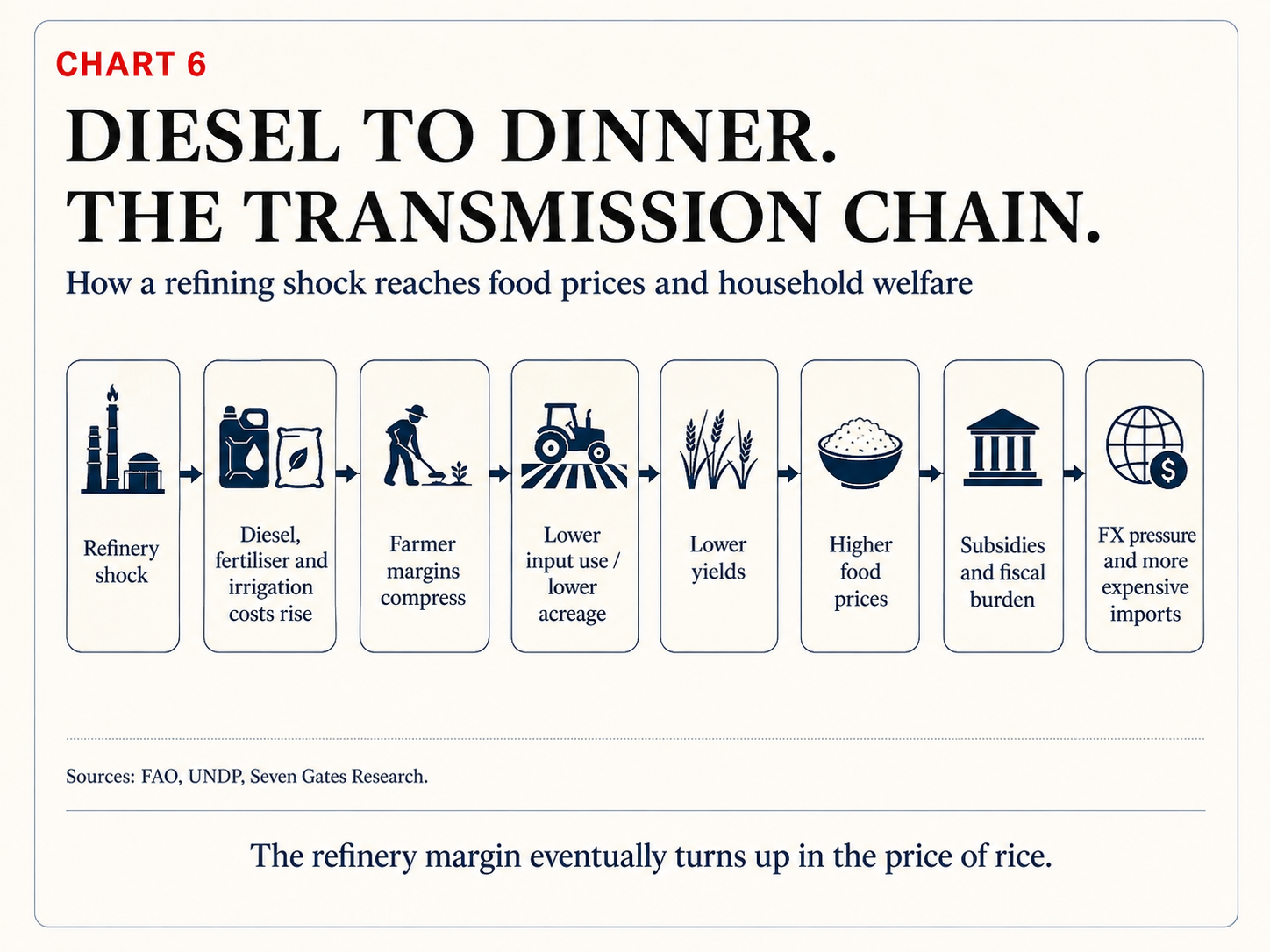
Agriculture consumes energy repeatedly: natural gas enters fertiliser production; tractors use diesel; irrigation consumes fuel or electricity; combines harvest; crops must then be dried, refrigerated, trucked and shipped.
The more troubling feature is the lag. A fuel shock today changes fertiliser application, irrigation time, acreage, harvest frequency, farmer borrowing and next season's planting decisions. By the time CPI notices, the agronomy may already have happened.
Three months, six months, one year
3 months
Cracks remain elevated. Maintenance season cuts some runs. Inventories struggle to rebuild. Winter distillate risk rises. Poorer markets face more subsidy pressure and rationing.
6 months
Food inflation becomes visible. Temporary subsidies become budget lines. Central banks face a nastier inflation-growth trade-off. Refining capacity receives strategic valuations.
1 year
Trade routes reorganise structurally. India and the US gain product-market share. China's swing-supplier role grows. Africa revisits storage, refining, pipelines and strategic stocks.
Markets often “adapt” by pricing somebody out. That person is rarely the refinery owner.
What happens to electric vehicles?
Expensive gasoline and diesel are excellent advertising for EVs. Passenger EV economics improve because fuel savings become more valuable. But the difficult diesel applications — long-haul trucking, mines, tractors, construction, marine transport and remote power — electrify more slowly.
Then comes the materials problem. More EVs require copper, lithium, nickel, graphite, cobalt and grid infrastructure. Mining and moving those materials consumes diesel. Higher fuel prices accelerate electrification while also raising the cost of building it. Markets occasionally tolerate two ideas at once.
Nuclear: the boring uncle has become interesting again
Nuclear benefits from one increasingly valuable property: it does not require daily hydrocarbon deliveries. The constraint remains execution: financing, licensing, skilled labour, enrichment, supply chains and construction discipline. Nuclear's longstanding enemy has not always been radiation. Sometimes it has been the project schedule.
Solar: particularly interesting in Africa
High diesel prices strengthen the economics of solar plus batteries versus diesel generation. Across weak-grid economies, solar often competes not against a pristine national grid but against generator fuel, maintenance, theft, noise and failure.
The problem is upfront capital. A generator is expensive every day. A solar system is expensive on day one. Many households and SMEs can finance the first arrangement but not the second.
The farmer and the refinery
“They said crude came down.”
“So why is diesel still expensive?”
“Yes.”
“Different problem.”
“Same pocket.”
The Seven Gates transmission map
| Order | Initial event | Transmission |
|---|---|---|
| 1st | Refinery outages | Diesel, gasoline and jet supply falls |
| 2nd | Crack spreads explode | Remaining refiners maximise throughput |
| 3rd | Trade routes lengthen | Freight and insurance rise |
| 4th | Diesel-intensive activity costs more | Agriculture, mining and logistics inflate |
| 5th | Governments intervene | Subsidies, tax cuts and export controls |
| 6th | Fiscal and FX pressure rises | Imported energy becomes still more expensive |
| 7th | Capital reallocates | Refineries, EVs, solar, storage and nuclear gain strategic value |
What would break the thesis?
The squeeze could unwind faster than expected if Middle Eastern refinery capacity returns quickly, Hormuz shipping normalises, Russian repairs accelerate, China materially raises product exports, US inventories rebuild or global demand weakens sharply.
The most powerful bearish force may not be new refining capacity. That takes years. It is demand destruction. At a $100 diesel crack, the market starts looking for the user least able to pay. Eventually it finds one.
For investors: follow the constraint, not the headline
Direct beneficiaries include complex refiners, hydrocracker-heavy systems, refinery maintenance, catalysts, process technology, storage, product pipelines and clean-product tankers. Second-order beneficiaries include solar-plus-storage, selected grid infrastructure and nuclear life-extension. Exposed industries include airlines, road freight, agriculture, marginal mines and fuel-importing governments.
This is not an invitation to buy every refinery whose website contains a flattering photograph of stainless steel. Refining remains brutally cyclical. Today's $100 crack can become tomorrow's disappointing earnings call. But the analytical principle matters: when a chain breaks, value accrues to the surviving bottleneck.
Conclusion
The defining energy statistic of 2026 may not ultimately be the price of Brent. It may be the price of converting Brent into civilisation.
A tractor does not consume proved reserves. A Boeing does not burn an upstream production forecast. A Congolese haul truck cannot run on an OPEC communiqué. A Nigerian generator remains unmoved by the nation's reserve-to-production ratio.
That is why crude can retreat while diesel remains expensive. It explains why American refiners are running almost flat out; why India suddenly matters more; why Russia can possess enormous oil reserves and still ration products; why China's export policy affects farmers thousands of miles away; why Nigeria's refinery has become strategically more important; why Congo's copper mines belong in an article about EVs; and why the energy transition is both accelerated and made more expensive by the same crisis.
Energy commentary gravitates toward spectacle: wars, presidents, OPEC meetings, tankers, oilfields. Industrial systems usually reveal their vulnerabilities somewhere less cinematic: a hydrogen plant, a hydrocracker, a compressor, a berth, a tanker route, a turnaround schedule.
Crude oil is wealth in the ground. Refined product is cash in hand.
And, for the moment, the man with the functioning refinery gets to decide who is next in the queue.
Sources
International Energy Agency, Oil Market Report, August 2026; US Energy Information Administration weekly refinery utilisation data; BloombergNEF refinery margin and utilisation charts supplied to Seven Gates Research; AAA national gasoline-price data; Bianco Research historical gasoline comparison; Reuters reporting through 28 August 2026 on Russian diesel-export restrictions, Turkey's record US/Indian diesel imports, US pump-price politics, Gulf rerouting, crude prices, Dangote Refinery and tanker markets; FAO food-security and fertiliser analysis; UNDP analysis of fiscal and development risks.
At a glance
US refinery utilisation
97.4%
Midwest utilisation
101.8%
US diesel crack
~$100+/bbl
US gasoline
~$4.10/gal
Global refinery throughput
~5 mb/d below July 2025
Who feels the pain
🇺🇸 US: refining winner, consumer pain
🇪🇺 Europe: import + freight exposure
🇮🇳 India: refining hub
🇨🇳 China: swing supplier
🇳🇬 Nigeria: winner at refinery gate, exposed at farm gate
🇿🇦 South Africa: trucking + imports
🇨🇩 Congo: diesel-intensive mining
Tags
RefiningDieselOilNigeriaAfricaGeopoliticsFreightAgriculture