SEVEN GATES RESEARCH · ESSAY
Project Gazelle: Tomorrow's Oil, Today's Dollars and the Republic of Refinancing
Nigeria has not run out of crude. It has run short of crude that is simultaneously available, unencumbered and economically sensible to sell.

The Lokoja Contrarian30 August 202624 min read

Project Gazelle without the PowerPoint: cash on the table, crude already spoken for, refinery sourcing elsewhere.
The question is no longer how much oil Nigeria produces. It is how much of tomorrow's oil has already been sold to pay for today's dollars.
Editorial note: This essay analyses a public-finance transaction from disclosed documents, official statements, audited figures and attributed reporting. It does not allege illegality, corruption or an electoral motive by any person. Where the contract is not public, the absence is identified rather than filled with accusation. This is not an assessment of candidates or political parties.
Two Nigerian oil numbers arrived in August wearing different suits.
The first was $5 billion, the amount Dangote Petroleum Refinery is expected to seek in an October initial public offering. The second was $4.5 billion, the size of the newly approved refinancing of NNPC Limited's Project Gazelle oil-backed facility.
One enterprise wants money to expand a refinery that needs crude. The other wants money secured against crude that the country expects to produce later. Reuters reports that 30% to 40% of Dangote's feedstock has been imported, even though Nigeria remains Africa's largest producer. It also reports that much of NNPC's joint-venture crude is tied to oil-backed loans and pre-export arrangements. Investors are therefore examining feedstock cost with the concentration normally reserved for a surgeon approaching an artery. They are correct to do so. Reuters
Put the stories together.
One entity needs Nigerian crude. Another has monetised future Nigerian crude. Then add joint-venture ownership, production-sharing-contract economics, royalties, taxes, cost recovery, operating obligations, domestic supply rules and other offtake commitments. The apparent absurdity of Africa's largest refinery importing foreign crude begins to look less like absurdity and more like a sovereign balance-sheet footnote that has escaped into the physical market.
Nigeria is not short of barrels in the same way a bakery is short of bread. It is short of barrels that are all of the following at once: owned by the Federation, deliverable, unpledged, of the required grade, available at the required terminal, and priced on terms that make domestic refining worthwhile. A national production headline cannot answer that question. It is geology presented as cash flow.
Project Gazelle is where the distinction becomes expensive.
I. The animal itself
Project Gazelle I was a crude-backed pre-export finance facility sponsored by NNPC Limited. The public headline was $3.3 billion. The actual funded amount reported by Afreximbank reached $3.175 billion, comprising an initial $2.25 billion and a later $925 million accordion disbursement in June 2024. Afreximbank described it as Nigeria's largest crude-backed facility and one of Africa's largest syndicated debts. Afreximbank | Reuters
The borrower was Project Gazelle Funding Limited, an orphan special-purpose vehicle established offshore. NNPC was the sponsor and seller. The security came from future royalty and tax oil accruing to the Federation from offshore production-sharing contracts. The transaction earmarked up to 90,000 barrels per day for five years. That is 32.85 million barrels a year and 164.25 million barrels over the stated tenor.
TheCable reported an annual interest rate of 11.85%, a 2% arranging commission worth $66 million and a further 2% annual default penalty. It calculated that the pledged quantity represented 38.58% of five years of the relevant royalty and tax oil. TheCable
This is the point at which public debate usually becomes arithmetically excitable. At $77.93 per barrel, 164.25 million barrels would be worth about $12.8 billion. Therefore, the refrain goes, Nigeria pledged nearly $13 billion of oil for a $3.3 billion loan.
That is a fine slogan and an incomplete description.
The Federation did not contractually surrender the entire gross value of every pledged barrel to the lenders as interest. The transaction presentation states that crude-sale proceeds pass through a documented waterfall. Financing costs, debt service and reserve requirements are paid first. Up to 90% of excess cash, called the price balance, is released to the sponsor's nominated CBN accounts, while 10% goes toward prepayment. The same deck says there was no crude-price hedge in the structure then presented. Project Gazelle transaction deck
So the proper question is not, “Was $12.8 billion handed over for $3.3 billion?” The documents say no. The proper questions are:
- How much entered the waterfall?
- How much paid principal, interest, fees and reserve accounts?
- How much price balance returned to the Federation, and when?
- What grades, realised prices and differentials were applied?
- What was the opportunity cost of trapping those revenues inside the structure?
The Republic has received an FAQ. The Republic still requires a ledger.
II. What was the money used for?
The official description has changed emphasis without quite changing vocabulary. Project Gazelle was presented as immediate dollar financing for NNPC's operational needs, including the advance payment of taxes and royalties to the Federal Government. It was also described as support for foreign-exchange-market stability and the wider reform programme. The government's FAQ said the structure could fund operating expenditure, production costs, investment, taxes and royalties. Presidency and NNPC explainer
These categories are broad enough to accommodate half of Abuja and still leave parking space.
The mechanics are clearer than the final use. The transaction deck says disbursements moved from the offshore SPV account into NNPC's nominated accounts at the CBN, net of transaction costs. NNPC's 2024 accounts, as reported by Punch, showed roughly N4.9 trillion drawn, crude worth N991 billion delivered and an outstanding balance of about N3.8 trillion at year-end. The Presidency said in August 2026 that approximately $1.5 billion remained outstanding under Gazelle I. Punch | Reuters
Those numbers show repayment. They do not provide a public, project-level reconciliation of ultimate expenditure.
The distinction matters. If borrowed dollars financed a temporary reserve buffer, cleared verified FX arrears or brought forward taxes and royalties already due, the effect is principally liquidity and timing. If they financed projects that raise future production or permanently reduce imports, the transaction can create an asset or a recurring dollar stream. If they financed recurrent gaps without a future cash yield, the country exchanged a slice of tomorrow's export revenue for yesterday's bills.
Aristotle distinguished oikonomia (οἰκονομία), the prudent management of a household's resources toward a good life, from chrematistike (χρηματιστική), acquisition or money-making pursued as an end in itself. A modern state may sensibly borrow, but the financing is the instrument, not the achievement. The polis is not improved merely because the treasury has briefly become photogenic. Greek vocabulary adds sophistication; it does not refinance the principal.
III. Gazelle II: the refinancing that both frees oil and borrows more
In August 2026, the National Economic Council approved Project Gazelle II, a new $4.5 billion facility. According to the Presidency, about $1.5 billion will refinance the outstanding Gazelle I balance and $3 billion will provide fresh liquidity for reserves, fiscal priorities and infrastructure. The daily crude commitment falls from 90,000 barrels to about 78,750 barrels, releasing 11,250 barrels per day. Officials described the new terms as more favourable. Reuters | Premium Times
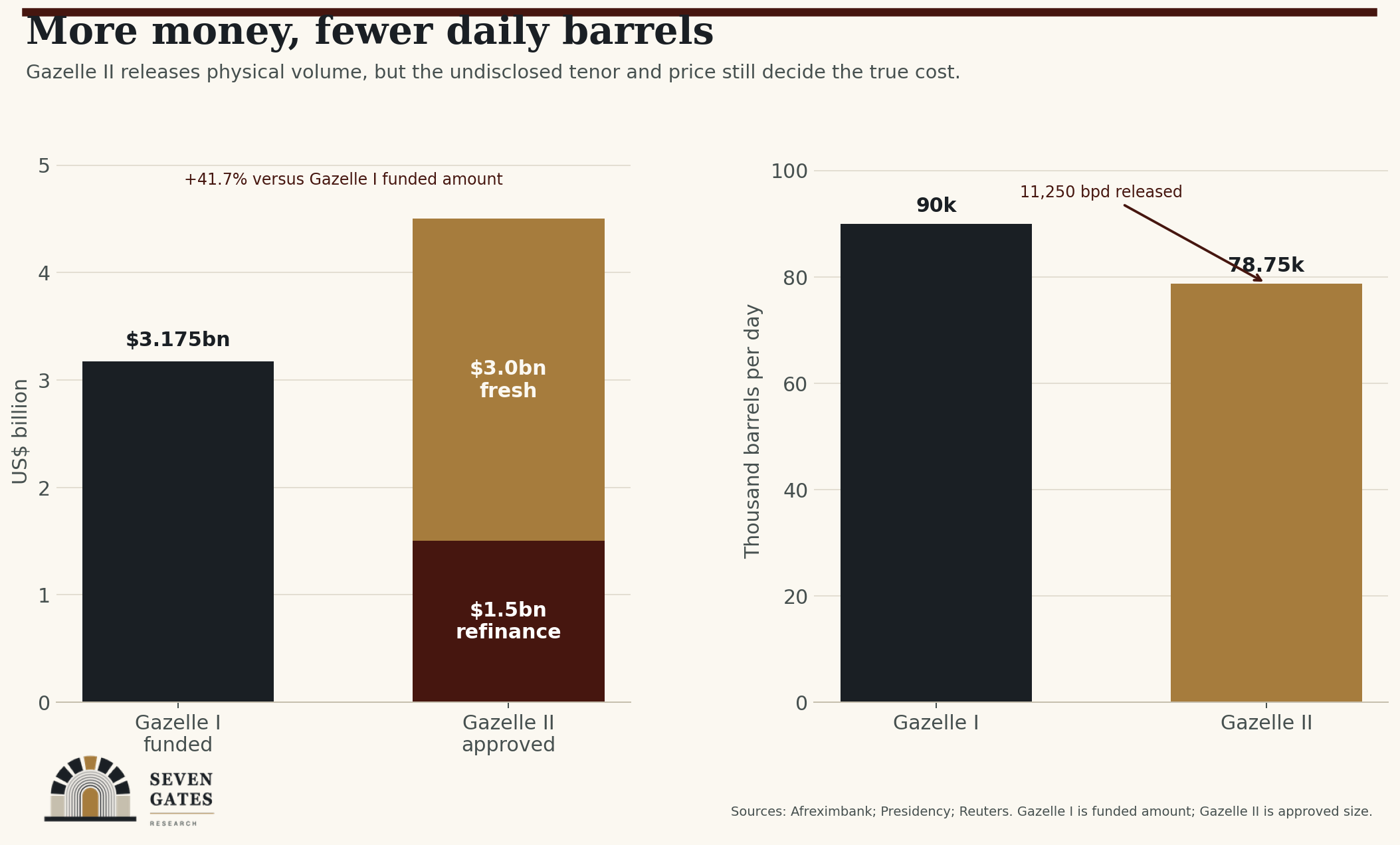
The daily pledge falls 12.5%. The approved facility size rises 41.7% against Gazelle I's funded amount. That combination can be sensible, but only the undisclosed price and tenor can tell us whether it is cheaper.
The improvement is real in one narrow sense. A lower daily pledge leaves more crude outside the facility. At different oil prices, the gross annual value of the released volume is:
| Assumed realised price | Gross value of 11,250 bpd released | Naira value at N1,337.29/$* |
|---|---|---|
| $55/bbl | $226 million | N302 billion |
| $65/bbl | $267 million | N357 billion |
| $80/bbl | $329 million | N439 billion |
Illustrative gross values before production costs, differentials, ownership splits, taxes, royalties and other deductions. The exchange rate is the CBN's 28 August 2026 NFEM rate. CBN
But a refinancing is not a debt baptism. The old liability does not emerge sinless from the water. It is replaced, extended or repriced, while another $3 billion is added to available liquidity.
As of 30 August, the public announcement had not confirmed financial close or disbursement, and had not disclosed Gazelle II's interest rate, fees, final maturity, amortisation schedule, grace period, oil-price assumption, grades, price differentials, offtakers, debt-service reserve, hedging terms, cash waterfall or default provisions. “More favourable” is a comparative adjective, not a term sheet.
The reduction in barrels is therefore welcome but not sufficient to establish the reduction in total cost. A facility can require fewer barrels each day and still last longer. It can charge a lower spread and still cost more in total because the principal is larger. It can release physical volume while preserving a senior claim over cash. Without the full terms, one cannot tell whether Nigeria bought cheaper money, longer time, or merely a more elegant sentence.
IV. How much oil is actually unpledged?
Here is the legally and arithmetically defensible answer: the exact current balance is not publicly knowable from a single reconciled source.
Lokoja offers a useful accounting lesson. Two rivers can meet without becoming one line item. National production and Federation entitlement occupy the same map, but they are not the same water.
Three calculations are possible, but they answer three different questions.
1. The historical Gazelle PSC pool
If Gazelle I's 90,000 barrels represented 38.58% of the relevant five-year royalty and tax-oil pool, that pool implied roughly 233,300 barrels per day. On that historical denominator:
- Gazelle I left about 143,300 bpd outside its pledge.
- Gazelle II would leave about 154,500 bpd outside its pledge.
- The improvement is the disclosed 11,250 bpd.
This is an inference from the original reported percentage. It assumes the PSC entitlement pool is unchanged, which may not be true. Production, price, cost recovery, fiscal terms and field mix change. More importantly, “outside Gazelle” does not mean “free for the budget” or “available to Dangote.” Other claims remain.
2. NNPC's wider economic entitlement
The original transaction deck cited an independent forecast of NNPC net crude entitlement of 520,000 to 550,000 bpd through 2027. Against that old forecast, Gazelle II alone would absorb about 14% to 15%. The identifiable envelopes for Gazelle II, Eagle Subsequent 2, Project Yield and Project Leopard total about 201,750 bpd. Add Project Panther's 23,500 bpd JV-linked pledge and the figure reaches about 225,250 bpd.
That would leave a rough 295,000 to 348,000 bpd before other obligations, depending on the denominator and whether Panther belongs in the same economic pool. This is not a current entitlement statement. It is an illustration of how quickly apparently abundant barrels acquire prior appointments.
3. National production
NUPRC put July 2026 production at 1.505 million bpd of crude and about 170,000 bpd of condensate, for 1.67 million bpd combined. Gazelle II is about 4.7% of that headline. Even a 225,250 bpd identified commitment would be about 13.5%. NUPRC
This is the most tempting calculation and the least useful. National production includes barrels economically belonging to joint-venture partners and PSC contractors. It ignores cost oil, profit-oil splits, royalties, taxes, operating finance, grades and terminal constraints. It is rather like estimating a household's disposable income from the turnover of every business on its street.
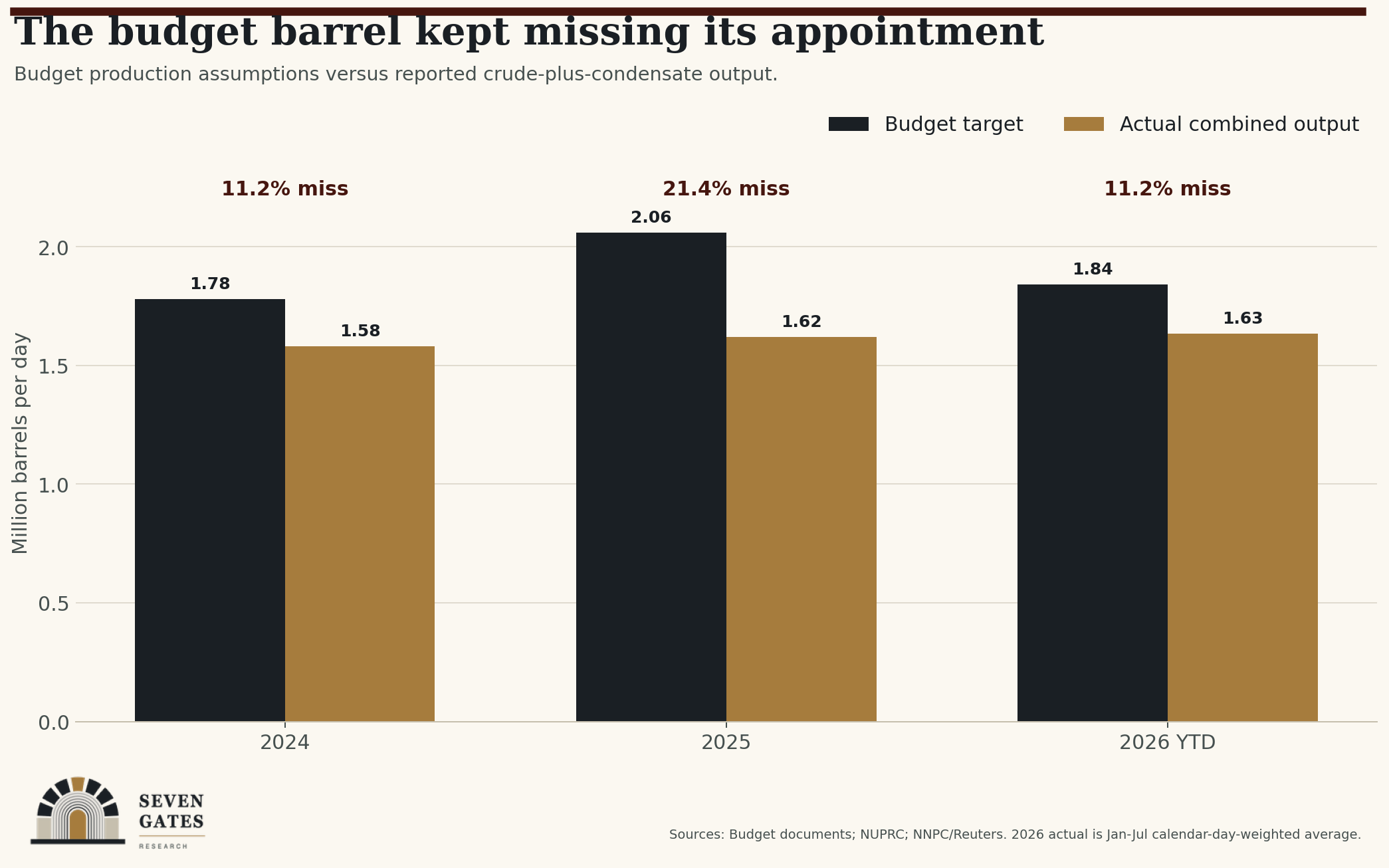
The production miss is visible before ownership and encumbrances are deducted. Gross output is therefore the generous version of the sovereign story.
The barrel model must therefore run in two stages:
Gross Nigerian production
less JV partner entitlement
less PSC contractor cost and profit entitlement
less operating and financing obligations
equals Federation and NNPC economic entitlement
Then:
Federation and NNPC economic entitlement
less Gazelle barrels
less other crude-backed borrowing
less forward offtake commitments
less domestic and other pledged volumes
equals genuinely discretionary Federation barrels
The last line is the number the budget needs. It is also the number a refinery, lender and sovereign analyst should care about. Yet public reporting still offers pieces of the bridge rather than the bridge.
V. How many other deals are there?
NEITI's 2024 review and NNPC's later accounts identify a small menagerie:
| Facility | Reported size or draw | Crude commitment | Status in the cited disclosure |
|---|---|---|---|
| Project Eagle original | $935m facility; $841m drawn | 30,000 bpd | Repaid September 2023 |
| Project Eagle subsequent | $635m | 6,000 bpd | Repaid September 2023 |
| Project Eagle subsequent 2 | $900m; $838m outstanding at July 2024 | 21,000 bpd | Maturity stated as 2028 |
| Project Bison | $1.04bn | 35,000 bpd | Repaid June 2024 |
| Project Yield | $950m | 67,000 bpd equivalent of refined products | Outstanding at July 2024; refinery-linked |
| Project Panther | $1.4bn facility; $359m drawn | 23,500 bpd | JV project financing; maturity stated as 2029 |
| Project Leopard | Reported five-year forward sale | 35,000 bpd | Outstanding in NNPC's 2024 accounts |
| Project Gazelle I | $3.175bn funded | 90,000 bpd | Being refinanced |
| Project Gazelle II | $4.5bn | 78,750 bpd | Approved August 2026; replaces Gazelle I |
Source: NEITI 2023 industry report presentation, NNPC 2024-account analysis and Reuters.
The rows cannot simply be added. Some facilities were repaid, some commenced later, some are JV or project financing rather than direct Federation prepayments, some use refined-product equivalents, and Gazelle II replaces Gazelle I. Reuters reported in June 2025 that Nigeria was using at least 300,000 bpd to service five existing oil-backed loans, with one expected to end that month. It also reported that a proposed $5 billion Aramco-backed facility, which would have required at least another 100,000 bpd, had been delayed after lower oil prices unsettled prospective banks.
That is the transparency problem in one paragraph. The country can identify transactions retrospectively. It still lacks a live public register showing, for every facility, the original amount, drawn balance, principal outstanding, total cash cost, barrels pledged, asset and grade, start and end dates, monthly deliveries, realised prices, returned price balance and remaining encumbrance.
In January 2026, a Federal High Court ordered NNPC to disclose further Gazelle details, including anticipated benefits, short- and long-term implications, crude grades, exchange-rate treatment and the quantity and quality of collateral. The court described the requested information as simple and harmless. Punch
When a court must explain that a $3 billion public-resource transaction has public consequences, subtlety has packed its bags.
VI. The budgets believed the gross number
Nigeria's budgets are constructed around production, benchmark price and exchange rate. That is necessary, but it is no longer sufficient.
First, the financing gap. The figures below compare each approved budget at enactment with its stated or arithmetically implied deficit. They are planned deficits, not the realised year-end fiscal balances, which can be larger or smaller once revenue and execution have had their argument.
| Fiscal year | Approved spending | Planned deficit | Deficit as share of budget |
|---|---|---|---|
| 2021 | N13.59tn | N5.60tn | 41.2% |
| 2022 | N17.13tn | N6.39tn | 37.3% |
| 2023 | N21.83tn | N11.34tn | 51.9% |
| 2024 | N28.77tn | N9.18tn | 31.9% |
| 2025 | N54.99tn | N13.08tn | 23.8% |
| 2026 | N68.32tn | N31.46tn | 46.0% |
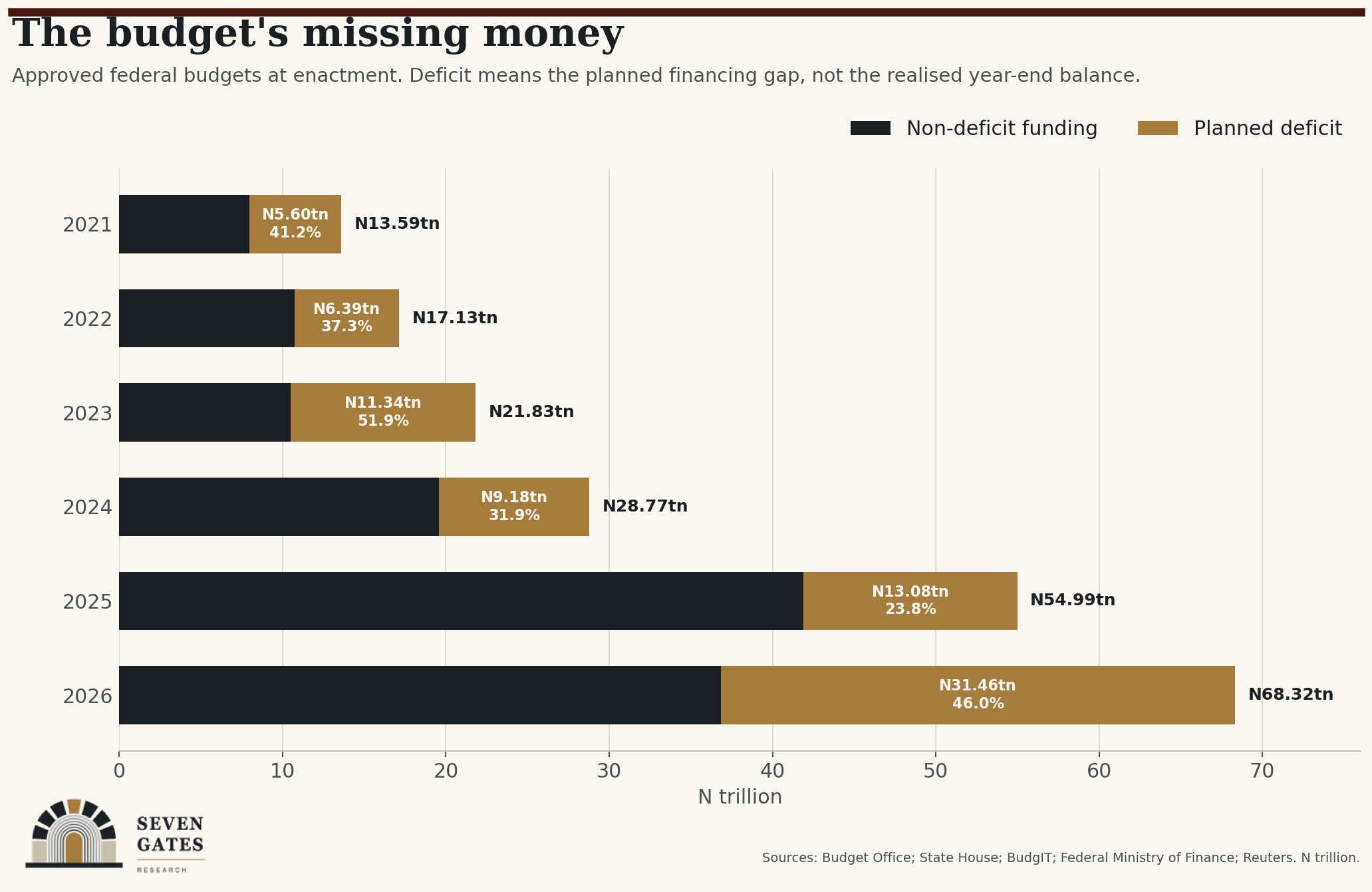
Sources: 2021 approved budget, 2022 enacted spending, 2022 financing gap, 2023 approved budget, 2024 budget documents, 2025 approved budget, and 2026 budget and deficit. Supplementary appropriations and later extensions are excluded to keep the series comparable. The 2025 budget was subsequently reported at N59.99 trillion with a N14.10 trillion deficit. Reuters
Then the oil assumptions that were expected to help fund the last three budgets:
| Fiscal year | Budget oil case | Actual crude plus condensate | Production miss |
|---|---|---|---|
| 2024 | 1.78m bpd at $77.96/bbl | 1.58m bpd | 0.20m bpd, or 11.2% |
| 2025 | 2.06m bpd at $75/bbl | 1.62m bpd | 0.44m bpd, or 21.4% |
| 2026 | 1.84m bpd at $64.85/bbl | 1.63m bpd, January to July | 0.21m bpd, or 11.2% |
The corresponding exchange-rate assumptions were N800/$, N1,500/$ and N1,400/$. Sources: 2024 assumptions and spending, NUPRC reports archive, 2024 NUPRC annual-report mirror, 2025 assumptions, 2025 production, 2026 assumptions, NUPRC June production, and NUPRC July production. The 2026 actual is a calendar-day-weighted average of NUPRC's monthly series through July.
Production definitions matter. OPEC's annual series excludes condensate and puts Nigerian crude-only output at 1.35 million bpd in 2024 and 1.43 million bpd in 2025. The table uses the broader crude-plus-condensate measure because that is the closer comparison with Nigeria's fiscal production assumptions. On the OPEC-only measure, the misses would be 24.2% and 30.6%, but that is not a clean like-for-like comparison. OPEC Annual Statistical Bulletin 2026
Even the fairer comparison is not the sovereign denominator. It measures molecules produced, not barrels economically available to the Federation. It still sits above JV and PSC entitlements, operating obligations, pledged cargoes and other forward commitments. The budgets did not merely assume ambitious output. They treated the gross national number as though every barrel arrived at the Treasury alone, carrying its passport and a bank draft.
The 2026 budget deserves special attention. The National Assembly raised the spending plan to N68.32 trillion, with a deficit reported at about N31.46 trillion, more than 6% of GDP. The fresh $3 billion under Gazelle II is worth about N4.0 trillion at the 28 August NFEM rate, equivalent to nearly 6% of the enacted budget and about 13% of that reported deficit. Those comparisons show scale, not destination. The announcement divides the money among reserves, fiscal priorities and infrastructure, so it should not be treated as though every dollar will become budget cash. Reuters | State House
Borrowing is not revenue merely because it arrives wearing dollars. Gazelle II may finance a slice of the gap, reinforce reserves or fund productive projects. It does not, by itself, shrink the underlying deficit. If any proceeds support public expenditure, the ordinary questions remain: which appropriation line, which implementing entity, which asset, which repayment cost and which future revenue stream has been diverted? Otherwise the country risks acquiring a second budget, one with better tailoring and fewer witnesses.
This is where The Richest Man in Babylon becomes less a personal-finance book than an unsolicited audit observation. Arkad's rules begin with retaining part of current income, controlling expenditure, making capital productive and protecting future income. Resource-backed budget support can become the reverse: spend part of future income, enlarge present expenditure, and trust that the next barrel will arrive with both an export certificate and a cheerful disposition.
Joseph stored grain during the seven fat years because famine does not accept supplementary budgets. Nigeria's more adventurous innovation is to invoice part of the next harvest during the lean years and book the proceeds as breathing room. This can be rational during a genuine liquidity crisis. It cannot become the permanent theology of the exchequer.
VII. Does it fix the naira, or merely rent calm?
Gazelle I did not permanently stabilise the currency. The naira moved from roughly N775 per dollar officially when the facility was announced in August 2023 to about N1,498 by the June 2024 accordion disbursement. That does not prove the facility failed. The currency was also absorbing exchange-rate unification, backlogs, inflation, negative real rates, weak oil receipts and a wholesale repricing of Nigerian risk. It does show that a one-off inflow cannot overpower a continuing stock-flow imbalance.
Gazelle II's fresh $3 billion is still macroeconomically relevant. It equals roughly 5.6% of the recently reported $53.1 billion of gross reserves and 8.6% of the CBN's $34.8 billion end-2025 net reserves. It can improve spot dollar supply, reinforce confidence, help meet obligations and reduce disorderly volatility. Nigeria's external position is also materially healthier than in 2023: the CBN says net reserves rose sharply, while Moody's has moved the sovereign outlook to positive on stronger reserves, growth and external resilience. Reuters on reserves | Reuters on Moody's
But borrowed reserves are not earned reserves. Gross reserves rise today; future oil receipts are routed through debt service tomorrow. The proper sovereign lens is net, not cosmetic. Wu-Tang compressed the street version into one enduring acronym: cash rules everything around the structure, including the waterfall nobody has published monthly.
Could the facility help carry the currency through the 2027 election cycle? Mechanically, a large dollar inflow before an election can support market liquidity during a politically sensitive period. The timing makes the question legitimate. The evidence reviewed does not establish that this is the transaction's purpose, and the official rationale is reserves, fiscal liquidity and infrastructure. A cynic may notice the calendar. A responsible analyst must also notice the absence of proof.
Even if temporary stability extends beyond polling day, the liability does not vote and go home. It remains at the collection account.
VIII. Is Gazelle a repo, a yen defence or something else?
Not really. The analogies are useful only if kept on a short leash.
A repurchase agreement is normally short-term secured funding against liquid securities. The borrower sells securities and agrees to repurchase them, with haircuts and margin mechanics around marketable collateral. Gazelle is a multi-year pre-export or sales-receivable structure against future physical crude and its cash proceeds. Oil must be produced, lifted, sold and passed through a waterfall. The collateral cannot be delivered by a mouse click from a custodian.
Currency intervention is different again. A central bank defending the yen can sell foreign reserves and buy its own currency. Gazelle initially adds dollars by borrowing against future exports. One spends an existing reserve asset; the other creates present liquidity and a future claim.
The common thread is balance-sheet time travel. Each converts one form of asset or future cash flow into immediate liquidity. The risks then migrate into tenor, collateral, market price and confidence. They are cousins in the bookkeeping sense. They should not be invited to pose as twins.
IX. When does the model break?
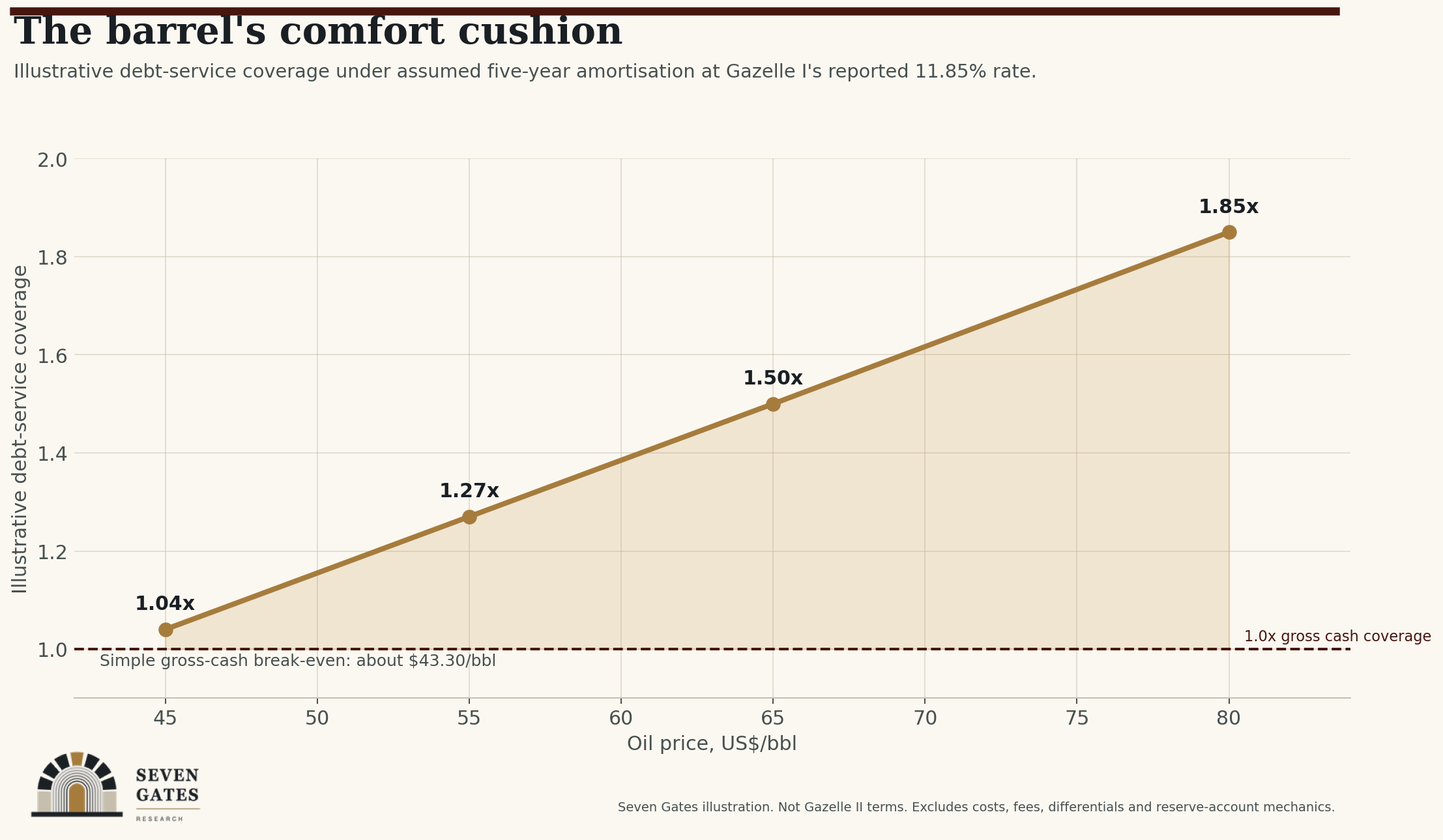
The new Gazelle II rate and tenor are undisclosed, so no honest analyst can calculate an actual break-even oil price. An illustrative stress test can still show the physics.
Assume, only for illustration, a $4.5 billion five-year loan amortising in equal annual payments at Gazelle I's reported 11.85% rate. Annual debt service would be about $1.244 billion. The 78,750 pledged barrels generate 28.744 million barrels a year.
| Oil price | Gross annual pledged-crude proceeds | Illustrative debt-service coverage* |
|---|---|---|
| $45/bbl | $1.293bn | 1.04x |
| $55/bbl | $1.581bn | 1.27x |
| $65/bbl | $1.868bn | 1.50x |
| $80/bbl | $2.300bn | 1.85x |
Not the actual Gazelle II terms. Excludes operating costs, grade differentials, fees, reserve accounts, timing mismatches and other waterfall deductions. On these deliberately simplified assumptions, gross cash break-even is about $43.30 per barrel.
Back-of-envelope terminal cost: what may ultimately leave the till?
The annual interest ranges in the public discussion are useful, but they do not show the full bill. To expose the order of magnitude, we model three deliberately simplified amortising structures on the entire $4.5 billion: a good case at 8.25% for seven years with a 2% upfront fee; a base case at 9.5% for six years with a 3% fee; and a stressed case at 12.35% for seven years with a 4% fee. Equal annual debt service is assumed. These are scenario midpoints, not leaked terms wearing a false moustache.
Illustrative financing cost by final maturityInterest plus upfront fee, excluding principal
Good8.25% · 7 years · 2% fee
$1.69bn
Base9.50% · 6 years · 3% fee
$1.74bn
Worse12.35% · 7 years · 4% fee
$2.66bn
$0$1bn$2bn$2.66bn
| Parameter | Good case | Base case | Worse case |
|---|---|---|---|
| All-in rate | 8.25% | 9.50% | 12.35% |
| Assumed tenor | 7 years | 6 years | 7 years |
| Oil-price lens | $70–75/bbl | $65/bbl | $55–60/bbl |
| Annual gross crude value | $2.01–2.16bn | $1.87bn | $1.58–1.72bn |
| Upfront fee assumed | $90m | $135m | $180m |
| Annual debt service | $872m | $1.02bn | $997m |
| Total interest | $1.60bn | $1.61bn | $2.48bn |
| Total financing cost* | $1.69bn | $1.74bn | $2.66bn |
| Total cash paid incl. principal* | $6.19bn | $6.24bn | $7.16bn |
| Coverage character | Strong if volumes hold | Adequate at $65 | Price and production sensitive |
*Illustrative nominal dollars. “Total financing cost” is interest plus the assumed upfront fee; “total cash paid” adds repayment of the $4.5bn principal. The model excludes default interest, reserve-account funding, legal and agency costs, grade differentials, hedging, delayed cargoes and refinancing costs. If lower production extends repayment rather than merely reducing coverage, the stressed bill can rise further. That is precisely why the term sheet matters.
The arithmetic produces two useful cautions. First, a longer good-case tenor can make annual service easier while leaving total interest surprisingly close to the shorter base case. Liquidity relief is not the same thing as a discount. Second, the stressed case adds roughly $970 million of financing cost above the good case. By maturity, a transaction announced as $4.5 billion could therefore require about $6.2 billion to $7.2 billion in principal, interest and assumed upfront fees before the other items excluded above have taken their seats.
The model begins to strain before formal default in five ways:
- Price falls. The official Gazelle explainer itself says lower prices slow repayment. With no hedge disclosed for Gazelle I, price weakness lengthens exposure or consumes coverage.
- Production or entitlement falls. The risk is not only national output. It is whether the specific royalty and tax barrels pledged to the structure are produced, unencumbered and deliverable.
- Operating obligations rise. Lower prices or higher costs can require NNPC to allocate more crude or cash to partners, narrowing what remains for debt and the Federation.
- Refinancing becomes habitual. Rolling $1.5 billion into $4.5 billion may be sensible liability management once. Repeating the manoeuvre turns maturity into a national renewable resource.
- The new money earns less than it costs. If the $3 billion supports productive infrastructure, reserve repair or projects that expand dollar earnings, future capacity can improve. If it mostly bridges recurrent cash gaps, the country owns no corresponding asset when the barrels fall due.
The lenders demonstrated this logic in 2025. Reuters reported that lower Brent prices and concern over available cargoes delayed the proposed $5 billion Aramco facility. Markets can admire a nation's reserves in the abstract and still ask where Tuesday's cargo is coming from.
Nigeria is presently enjoying the flattering end of a commodity cycle. Higher crude prices, helped by Middle East disruption, strengthen export receipts and make the pledged-barrel arithmetic look comfortably upholstered. But oil is cyclical. It does not sign permanence clauses. In August alone, prices could fall 7% on the prospect of diplomacy and climb again when regional tension returned. A budget, a refinery and an oil-backed lender are therefore looking at the same barrel through three different windows. Reuters on the August fall | Reuters on the subsequent rise
The danger is not that high prices are imaginary. The danger is mistaking a cyclical windfall for structural income and borrowing as though the wind had signed a long lease. When the price turns, the lender still has the waterfall, the current government has already enjoyed the liquidity, and somebody else may be holding the short end when the bill comes due: a future budget, a state waiting for FAAC, a refinery waiting for feedstock, or a taxpayer who was never invited to the closing dinner.
X. Dangote is not a side story
The refinery is the physical audit of the sovereign model.
Reuters reports that local crude can cost Dangote more than imported alternatives after benchmark pricing, freight conventions and trading-arm charges. Nigerian authorities are considering changes that would allow nearby producers to supply refiners directly and would remove freight and handling costs that domestic buyers do not incur. Producer compliance with domestic supply allocation has reportedly improved, but the regulator's metric measures delivery against allocated volumes, not the share of total refinery demand satisfied. Reuters
This is not just a question of patriotism at the loading terminal. A refinery is a spread business. It needs the right crude at the right price and place. Administrative allocation cannot manufacture economic entitlement. If the state has already pledged barrels, if partners own the cargo, if the grade is wrong, or if domestic pricing imports foreign freight into a local transaction, a directive may move paper faster than molecules.
The obvious investment exposure is therefore not a generic “Nigeria produces more oil” trade. It is dollar-generative downstream infrastructure and logistics: storage, terminals, coastal shipping, crude optimisation, blending, swaps, scheduling and the systems that turn fragmented entitlements into dependable feedstock. The operational risk is that policy tries to solve an ownership and pricing problem through allocation. The business opportunity is to solve the logistics and optimisation problem without pretending away title.
Dangote's product exports have already changed regional trade. Reuters, citing the US Energy Information Administration, reported a sevenfold rise in Nigeria's seaborne petroleum-product exports since 2023, driven by the refinery. That is the positive version of borrowing: capital becomes productive steel, productive steel becomes export cash, and the cash can service capital. Reuters
XI. How the transaction would look under ordinary sunlight
Sunlight is the best disinfectant.
Consider a brief Lokoja parable. A man sold one goat to two buyers and, when both arrived on market day, called it refinancing. The goat called it overcrowding. The buyers asked the only useful question: who owns the next hoof?
Project finance is more complicated than livestock, but title, prior claims and cash waterfalls obey the same moral law. If one public goat has several appointments, publish the diary.
The Extractive Industries Transparency Initiative says resource-backed loans can supply development finance but can also reduce future revenues, weaken budget flexibility and obscure debt risks. Its standard calls for disclosure of the parties, key terms, values and volumes transferred, repayment schedule, renegotiated terms, lender-selection process and budget treatment. The World Bank similarly warns that these facilities require cost-risk analysis, debt-sustainability testing and transparent contracts. EITI guidance | World Bank
Applied to Gazelle II, those standards would make the following information public:
- the signed term sheet or a non-confidential summary with all economic terms;
- rate, reference rate, margin, fees, tenor, grace period and total expected debt service;
- crude grades, assets, daily and total barrels, pricing formula and differentials;
- offtakers, lender selection, reserve-account rules, hedging and default remedies;
- monthly barrels delivered, realised prices and each step of the cash waterfall;
- principal retired, interest and fees paid, and price balance returned to CBN accounts;
- the precise allocation of the fresh $3 billion and the projects or fiscal lines funded;
- a live register of every overlapping NNPC and Federation crude commitment;
- stress tests at lower production and oil prices, with the effect on FAAC and the budget;
- independent reconciliation by the finance authorities, NEITI and the Auditor-General.
This is not exotic governance imported from a Swiss mountain. It is the information required to distinguish liability management from liability camouflage.
XII. A positive ending, since permanent outrage is poor portfolio construction
Project Gazelle II need not end badly.
The disclosed reduction in pledged crude is an improvement. If the financing cost has genuinely fallen, the tenor is sensible, the $3 billion is deployed into reserve repair and productive assets, and the monthly price balance returns transparently to the Federation, the refinancing could smooth a difficult transition while preserving more barrels for sale. Nigeria's reserves and external position have improved. Oil output has recovered from earlier lows. In February, the government directed that oil and gas revenues owed to the state flow directly into the Federation Account, with operating costs funded through appropriated fees. That reform, if implemented and reconciled, addresses the very habit of invisible deductions that makes Gazelle difficult to model. Reuters
There is also a route out of the barrel trap: create more genuinely discretionary barrels and more non-crude dollars. New deep-water projects, lower production costs, reliable evacuation, transparent partner funding and domestic refining can expand the numerator. Product exports, gas, services and non-oil exports can reduce the country's need to ask crude alone to perform as commodity, collateral, budget, reserve, industrial policy and national emotional-support animal.
Project Gazelle's central problem is not that borrowing against future oil is automatically foolish. Commodity producers have used pre-export finance for decades, sometimes well. The problem is that Nigeria is trying to operate a modern sovereign balance sheet with a public disclosure system that still behaves as though citizens become confused by columns.
They do not.
They become suspicious when the columns are missing.
And that is where the gazelle should finally stop running.
Seven Gates analytical notes
- Known facts: $3.175bn funded under Gazelle I; 90,000 bpd original pledge; about $1.5bn reported outstanding before refinancing; $4.5bn Gazelle II approved; $3bn fresh liquidity; 78,750 bpd revised pledge.
- Inference: The historical 38.58% figure implies a relevant PSC royalty and tax-oil pool near 233,300 bpd. That is not a current official entitlement forecast.
- Illustration: The $43.30/bbl cash break-even uses assumed five-year annuity repayment at 11.85%. It is not a forecast of Gazelle II.
- Unknowns: Gazelle II's financial close and disbursement, rate, fees, tenor, oil-price formula, grades, maturity, hedging, offtakers, waterfall and exact use of proceeds were not publicly disclosed in the reviewed announcement.
- Confidence: High on headline facility figures and disclosed daily crude volumes. Medium on historical facility comparisons. Low on any precise current “unpledged barrel” total because the required live entitlement and encumbrance register is not public.
Core sources
- Reuters: Nigeria approves $4.5bn Gazelle refinancing
- Reuters: Dangote IPO investors focus on feedstock
- Afreximbank: $925m accordion disbursement
- Project Gazelle transaction presentation
- NEITI: NNPC loan and guarantee disclosures
- EITI: resource-backed-loan disclosure guidance
- OPEC: Nigeria crude-production series, 2024 and 2025
- Federal Ministry of Finance: 2026 spending, revenue and deficit
- NUPRC: July 2026 crude and condensate production