SEVEN GATES DAILY BRIEF
Dangote's IPO is an investor-retention test
Nigeria's largest share offer could multiply the active investor base, but lasting market depth requires retained accounts, reliable access and more listings after the campaign ends.
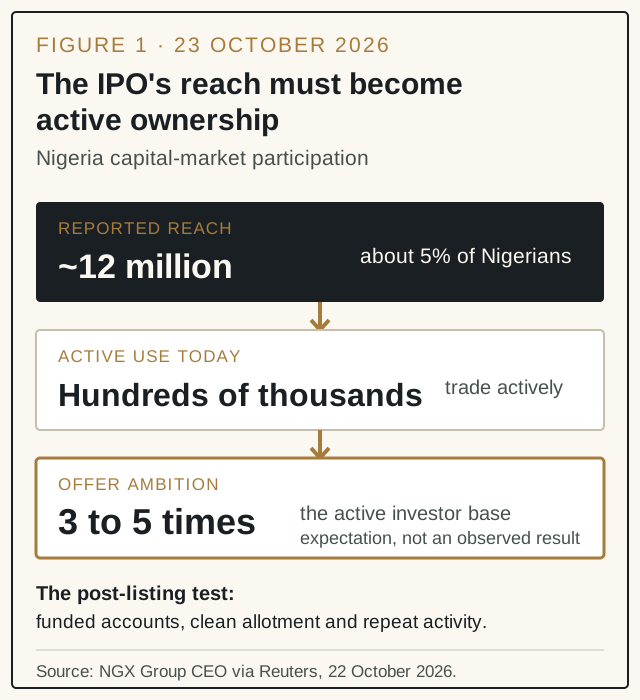
Nigeria's largest share offer is being asked to do more than raise money. The head of NGX Group says it could multiply the country's active investor base by three to five times. That would be a structural gain only if new buyers remain funded, receive their shares cleanly and trade after the launch campaign ends.
1. Dangote's IPO must convert access into repeated participation
NGX Group chief executive Temi Popoola said on 22 October that about 12 million Nigerians, roughly 5% of the population, participate in capital markets, while only hundreds of thousands trade actively. He expects the $1.6 billion Dangote Petroleum Refinery offer to expand the active base by three to five times. Distribution through basic phones, point-of-sale terminals and messaging channels lowers the access barrier.
The hard part follows subscription. Account verification, allotment, refunds, custody and dependable secondary trading determine whether a campaign becomes market depth. The SEC has told investors to use only approved channels and to verify operators. NGX also expects fewer than ten Nigerian listings over the next year, so one large issue cannot by itself create a durable supply of securities.
Sources: Reuters, 22 October; Nigeria SEC investor notice, 14 September; NGX offer announcement, 15 September.
2. Oil at $113 gives Nigeria a mixed exposure
Brent settled 4.0% higher at $113.17 a barrel on 22 October, its highest close since 4 May, after Houthi attacks on Saudi infrastructure renewed fears of disruption. Middle Eastern crude exports were estimated at about 17 million barrels a day last week, below the roughly 18 million average in the year before the Iran war.
Higher oil can improve Nigeria's export receipts and fiscal inflows if production and remittances hold. The offset arrives through imported refined products, transport, backup power and inflation. Yesterday's small Russian diesel arrangement does not remove that exposure. The useful Nigerian indicators are realised export volumes, official oil revenue and delivered fuel costs, rather than Brent alone.
Source: Reuters, 22 October.
3. The AI trade is separating suppliers from spenders
The Nasdaq fell 2.60% and the Philadelphia semiconductor index dropped 6.7% on 22 October as investors questioned the financing and returns behind large AI budgets. Yet Western Digital reported quarterly revenue of $4.38 billion, up 55% year on year, and free cash flow of $1.38 billion. It expects second-quarter revenue of about $5.1 billion and attributes momentum to storage demand and pricing.
The contrast matters more than a one-day index move. AI spending can produce cash for component suppliers while weakening the free cash flow of customers building infrastructure. Nigerian technology buyers should expect storage and cloud capacity to remain costly where supply is concentrated. Investors should distinguish current supplier earnings from management's forecast of durable demand.
Sources: Western Digital results, 22 October; Reuters market close, 22 October.
4. China's investment gap is narrowing, not closing
China's commerce ministry reported foreign direct investment of 548.8 billion yuan, or $82.2 billion, for the first nine months of 2026, down 4.3% from a year earlier. The decline was smaller than the 5.3% fall recorded for the first eight months. Outbound non-financial direct investment reached $101 billion.
The improvement in the rate of decline is useful, but it is not a return to growth. For African governments seeking Chinese capital, the composition matters: projects must compete with China's outbound priorities while foreign investors remain cautious about committing inside China. Nigeria's opportunity is therefore project-specific, particularly where export earnings or credible offtake can support repayment.
Source: Reuters, 22 October.
Three numbers worth remembering
- 3 to 5 times: NGX Group's expected increase in Nigeria's active investor base from the Dangote offer.
- $113.17: Brent's 22 October settlement, the highest close since 4 May.
- $1.38 billion: Western Digital's fiscal first-quarter free cash flow.
What could change everything?
Published allotment data and funded-account activity after listing would test whether the IPO created lasting investors. A sustained loss of Gulf export capacity would make the oil shock more severe; restored security would remove part of the premium. Western Digital's next quarter will test whether high pricing and demand survive new supply. A positive Chinese FDI reading would turn a slower decline into an actual reversal.
Prepared for 23 October 2026 using information available by 6:00 a.m. London. Company guidance, exchange expectations and market prices are labelled. Nigerian transmission and judgements are Seven Gates analysis.