SEVEN GATES DAILY BRIEF
Nigeria's 7% growth target needs bankable projects
Nigeria turns to private capital for faster growth. A small Russian diesel deal leaves a large supply gap, Meta couples record AI spending with a new non-voting share class, and Sudan's pound falls to 10,000 per dollar.
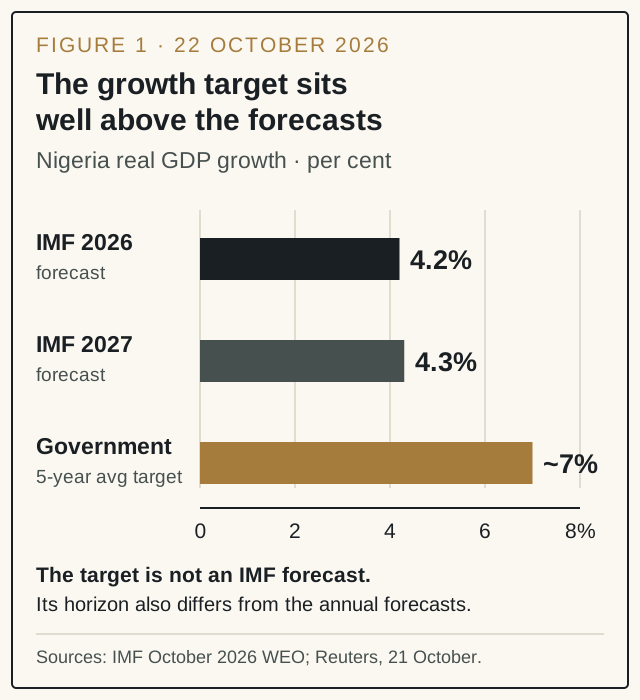
Nigeria says private capital, rather than more state borrowing, must finance the next phase of growth. That is directionally sound. It is not yet a financing result. The test is whether projects can produce contractual cash flows, survive Nigeria's currency and regulatory risks, and reach financial close.
1. A 7% target requires transactions, not only confidence
Finance Minister Taiwo Oyedele told a Chatham House event on 21 October that the petrol subsidy is gone, private capital will drive the next phase, and the government is targeting average growth of about 7% over five years. Reuters reported the IMF's October forecasts at 4.2% for 2026 and 4.3% for 2027.
The gap is not a verdict that 7% is impossible. It shows the scale of execution required. The government's infrastructure portal lists 65 projects worth $78.5 billion, but a pipeline is not disbursed capital. Investors still need enforceable contracts, credible user charges or offtake, access to foreign exchange and predictable rules. Government guarantees may unlock financing, but they can also return project risk to the public balance sheet.
The scorecard should therefore move from announced value to signed equity, committed debt, first disbursement, construction milestones and operating cash flow. Oyedele also said about 10 million households are receiving cash transfers. Coverage, payment regularity and purchasing power matter more than the headline count. Private financing can expand productive capacity; it cannot by itself establish that reform gains have reached households.
Sources: Chatham House event record, 21 October; Reuters, 21 October; Federal Ministry of Finance project portal, checked 22 October; IMF World Economic Outlook, 13 October.
2. The Russian diesel cargo is too small to reset prices
The initial US-Russia diesel arrangement covers 300,000 tonnes, about 2.25 million barrels. Spread across a month, analysts put that near 73,000 barrels a day. Kpler estimates that roughly 400,000 barrels a day of additional supply would be needed to ease prices materially. September disruptions to Russian and Middle Eastern exports reached 1.3 million barrels a day.
This is a volume mismatch, not a diplomatic judgement. Nigerian businesses should not budget for rapid relief from one cargo programme. Imported diesel feeds road freight, backup generation and industrial costs. The relevant evidence is delivered supply and sustained product prices, not the announcement alone.
Source: Reuters, 21 October.
3. Meta's AI bill now comes with a governance instrument
Meta reported third-quarter revenue of $64.60 billion, up 26%, and capital expenditure of $34.91 billion. Free cash flow was negative $2.12 billion, while the company raised and narrowed its 2026 capital-spending outlook to $135 billion to $145 billion.
It also announced a publicly listed, non-voting Class C share, expected to begin trading on 19 January 2027 after a one-for-one stock dividend to existing Class A and B holders. The dividend does not itself dilute each holder's economic interest. Future issuance could fund employees, acquisitions or investment without reducing Mark Zuckerberg's voting control.
For Nigerian advertisers and developers, Meta's scale can improve products while increasing dependence on its pricing, data access and distribution rules. Investors should separate strong advertising growth from the cost and governance of financing the AI build-out.
Source: Meta third-quarter results, 21 October.
4. Sudan's pound records the economic damage of war
Sudan's pound fell to 10,000 per US dollar on the parallel market, from about 8,000 a month earlier. The official rate is roughly 4,200, while the pre-war rate in April 2023 was about 600.
The collapse reflects destroyed production, scarce export receipts, import demand and gold moving outside official channels. The official-market gap indicates rationed access, not currency stability. For households already facing displacement and disrupted services, depreciation raises the local price of imported food, medicine and fuel. Regional costs also travel through refugee support, trade disruption and insecurity.
Source: Reuters, 21 October.
Three numbers worth remembering
- 7%: Nigeria's targeted average growth rate over five years.
- 73,000 bpd: the approximate daily flow from the initial Russian diesel arrangement.
- 10,000: Sudanese pounds per US dollar on the parallel market.
What could change everything?
Financial closes and first disbursements would convert Nigeria's project list into investable evidence. Diesel cargoes approaching the supply shortfall could change the price outlook. Meta's 2027 budget and any Class C issuance will show the financing burden of its AI programme. In Sudan, a durable ceasefire and restored production would matter more than an administrative exchange rate.
Prepared for 22 October 2026 using information available by 6:00 a.m. London. Forecasts, company results, government targets and reported market rates are labelled. Nigerian transmission and judgements are Seven Gates analysis.