SEVEN GATES DAILY BRIEF
Nigeria's Ebola response has 44 contacts to monitor
Nigeria confirms an imported Ebola case in Abuja. Oil reverses after new six-month highs, a dual-policing bill reaches legal review, the UN prepares a military-AI forum, and Reuben Fasoranti dies at 100.
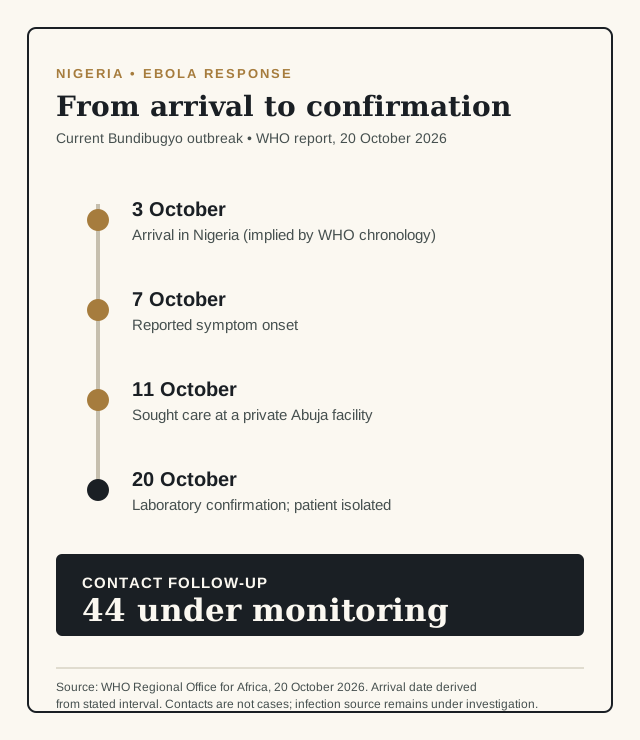
Nigeria has confirmed an imported case of Bundibugyo Ebola virus disease in Abuja. The most useful question this morning is not whether one case constitutes a national outbreak. It is whether health authorities can identify every exposure, protect health workers and interrupt any onward transmission.
1. Nigeria's response now depends on the contact follow-up
The WHO chronology implies that the patient arrived in Nigeria on 3 October. She developed symptoms on 7 October, sought care at a private facility on 11 October and received laboratory confirmation on 20 October. She is isolated and receiving care. Authorities have identified 44 contacts for monitoring.
This is Nigeria's first confirmed case in the regional outbreak and makes the country the fifth to detect the virus. It does not establish community spread. It does establish a nine-day interval between reported symptom onset and confirmation, including time in a private health facility. That places infection prevention, complete staff and visitor records, and daily contact follow-up at the centre of the response.
The patient's recent travel through Uganda does not determine where she was infected. WHO says the likely source and full exposure history remain under investigation. Public communication should preserve that uncertainty while giving health workers a clear reporting route.
The economic transmission is initially operational, not macroeconomic. Hospitals may need protective equipment and isolation capacity; airlines and employers may revise procedures. Broad travel restrictions would require evidence of sustained transmission, not a single imported case. The next material facts are symptomatic contacts, test results and whether monitoring reaches all 44 people every day.
Source: WHO Regional Office for Africa, 20 October.
2. Oil touched fresh highs, then closed lower
Brent approached $112 a barrel and WTI exceeded $110 on 20 October before closing down 0.7% and 1.8%, respectively. Reuters also reported WTI almost 80% above its level a year earlier. The reversal followed the day's reports of Iran-Pakistan talks, but it did not remove the supply risk behind the earlier move.
For Nigeria, higher crude can improve export receipts while simultaneously raising imported-product, freight and power costs. The direction of the fiscal benefit depends on realised production, domestic supply arrangements and the gap between market prices and retail pricing. One volatile session cannot settle that balance. Importers should stress-test cash needs against sustained prices, not the closing move alone.
Source: Reuters, 20 October.
3. State policing advances to legal review, not enactment
The presidential working group sent a draft National Policing Bill and 29 consequential amendment bills to the Justice Ministry for review. The package proposes federal and state police services. The ministry is due to return validated drafts by 30 October before presidential consideration and possible transmission to the National Assembly.
This is a drafting milestone, not a new policing system. State houses are still considering the related constitutional alteration, which the Presidency says must be completed first. The central design questions remain command authority, funding, recruitment standards, complaints handling and protection against partisan deployment. Security decentralisation without enforceable accountability could relocate abuse rather than reduce it.
Source: State House, 20 October.
4. The UN is building a forum for military AI
UNIDIR will launch expressions of interest for a standing Forum on AI, Peace and Security on 22 October. The forum is designed for governments, industry and other organisations to exchange evidence and contribute to consultations on military uses of AI.
It is not a treaty, regulator or prohibition. Its value will depend on whether it produces usable norms for human control, testing and incident disclosure. For African governments buying surveillance, targeting or decision-support systems, participation could improve access to emerging standards before procurement choices become difficult to reverse.
Source: UNIDIR event notice, 22 October.
5. Reuben Fasoranti dies at 100
Pa Reuben Fasoranti, educator, former old Ondo State finance commissioner and Afenifere leader, has died aged 100, the Presidency announced on 20 October. His public life connected the Awolowo political tradition, demands for federal reform and the civic authority of South-West elders.
The immediate political question is institutional rather than ceremonial: whether Afenifere can preserve influence across its internal divisions and translate a revered elder's authority into a coherent position ahead of 2027. Tributes establish respect. Organisational decisions will show where that authority moves.
Source: State House tribute, 20 October.
Three numbers worth remembering
- 44: identified contacts under monitoring after Nigeria's confirmed Ebola case.
- $112: the level Brent approached before reversing on 20 October.
- 29: consequential amendment bills accompanying the draft National Policing Bill.
What could change everything?
A symptomatic contact or additional negative tests would materially change the health assessment. Sustained oil supply disruption would alter Nigeria's export and cost calculations. Publication of the policing drafts would permit scrutiny beyond official summaries. The UN forum will matter only if states and suppliers convert consultation into verifiable operating rules.
Prepared for 21 October 2026 using information available by 6:00 a.m. London. Official claims, reported market levels and future dates are attributed. Nigerian transmission and judgements are Seven Gates analysis.