SEVEN GATES DAILY BRIEF
Two ship losses expose Hormuz's wider cargo risk
A container ship and a bulk carrier sink near Hormuz as US inflation accelerates, the IMF demands fiscal action and a West African fraud operation reveals trafficking victims behind online scams.
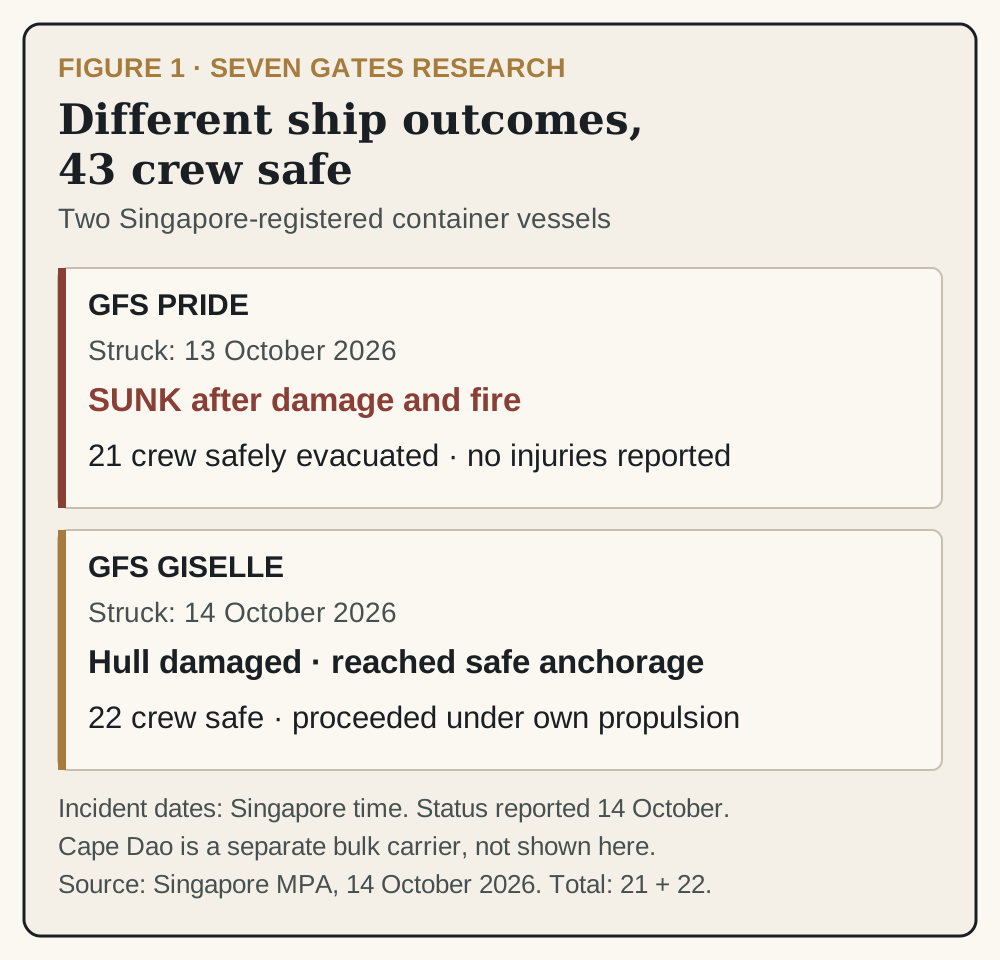
All 21 crew from GFS Pride are safe. The container ship has sunk. Another vessel reached anchorage with hull damage. The latest Hormuz reports concern ordinary cargo as well as fuel, with consequences for delivery schedules, insurance and inventory financing.
1. Two ships sink, but their attack dates differ
Singapore's maritime authority confirmed on Wednesday that GFS Pride had sunk after damage and fire, while GFS Giselle reached safe anchorage under its own propulsion. All 43 crew across those two container ships were safe. Unknown projectiles reportedly struck them on 13 and 14 October, Singapore time.
Separately, Reuters reported that bulk carrier Cape Dao had also sunk near Hormuz. It was struck on 23 September; one crew member was killed in that earlier attack. Two sinkings reported within a day do not establish two fresh attacks that day.
For Nigerian importers, the exposure includes delayed inputs, higher freight and longer inventory financing. An oil-price decline would not remove those costs. The attacker in each incident remains unconfirmed, and a vessel reaching anchorage is evidence of survival, not a safe shipping corridor.
Sources: Singapore MPA, 14 October · Reuters, 14 October.
2. US inflation accelerates, with gasoline doing much of the work
September consumer prices rose 0.6% month on month, seasonally adjusted, and 3.7% annually. Gasoline increased 9.1% in the month and accounted for more than half the headline increase. Core prices rose 0.3% monthly, unchanged from August's pace, although annual core inflation increased to 2.6% from 2.4%.
The counterargument to a broad inflation alarm is visible in the release: food prices were unchanged and monthly core inflation did not accelerate. The energy shock is substantial, but the evidence does not justify calling every category overheated. For Nigeria, persistent US inflation could sustain expensive dollar funding and constrain refinancing even if domestic inflation eases. Nigeria's next CPI release must be judged on its own basket, exchange-rate exposure and food conditions, not inferred from American petrol prices.
Source: US Bureau of Labor Statistics, 14 October.
3. The IMF's fiscal warning now demands a funded response
At Wednesday's Fiscal Monitor briefing, the IMF urged governments with high fiscal risk to act before borrowing conditions force a more painful adjustment. It warned that advanced-economy fiscal indiscipline raises costs beyond national borders, and rejected a general need for additional fiscal stimulus.
Its preferred household relief is limited, targeted, temporary and transparent. Nigeria should apply that test to fuel support: disclose the beneficiary, duration, funding source and settlement obligation. A price ceiling with an unpaid supplier obligation merely postpones recognition of the fiscal cost. Equally, indiscriminate spending cuts can damage essential services. The useful adjustment protects productive maintenance and vulnerable households while eliminating poorly targeted commitments. Borrowing terms and actual revenue collection matter more than reassurance about a manageable debt ratio.
Source: IMF Fiscal Monitor briefing, 14 October.
4. West African scam raids reveal forced labour behind the accounts
US authorities reported 28 arrests, including 19 in Ghana and nine in Nigeria, during an international disruption operation. In Ghana, investigators identified 117 trafficking victims awaiting repatriation to Nigeria. Meta said it removed more than 3.7 million accounts, pages and groups.
Those figures measure different things. Digital accounts are not individual offenders, arrests are not convictions, and identified funds are not recovered compensation. Some people operating scams were themselves coerced. Nigeria's response therefore needs victim protection alongside prosecutions, asset tracing and rapid preservation of financial evidence. Banks and platforms should measure prevented losses and restitution, not only blocked accounts. The operation demonstrates useful cross-border cooperation; whether it permanently disables the organisers remains an open question.
Sources: US Justice Department, 13 October · Meta, 13 October.
5. AI election safeguards face a multi-step abuse problem
Anthropic's 14 October election update says tests found Claude could refuse an overtly harmful request yet miss a deceptive operation split across apparently innocuous tasks. The company says it added classifiers and enforcement measures, and plans to integrate official US voting information later this month.
These are vendor-reported findings and planned features, not proof of safety. The Nigerian implication is institutional: election information needs dated, authoritative sources and clear correction channels. Evaluation should examine an entire workflow, including publication and distribution, rather than score isolated answers. US-specific integrations do not establish readiness for Nigerian languages, local election procedures or independently verified results.
Source: Anthropic, 14 October.
Three numbers worth remembering
- 43: crew safe across GFS Pride and GFS Giselle.
- 3.7%: September US annual headline inflation.
- 117: trafficking victims identified in Ghana awaiting repatriation to Nigeria.
What could change everything?
Verified repeatable passage through Hormuz would change delivery risk. Sustained core-price acceleration would make the US inflation problem broader. Published Nigerian support costs would clarify the fiscal exposure. In the fraud operation, victim repatriation, prosecutions and money returned would demonstrate progress beyond takedown totals. Independent testing could establish whether AI safeguards detect deceptive activity across a complete workflow.
Prepared for 15 October 2026 using information available by 5:55 a.m. London. Official and company claims are attributed; economic transmission and policy judgements are Seven Gates analysis.