SEVEN GATES DAILY BRIEF
INEC's appointments need scrutiny before speed
Nigeria's electoral appointments enter Senate scrutiny before January's polls. Aden's airport is struck again, the IMF backs tighter policy despite steady global growth, and NVIDIA launches local-AI laptops.
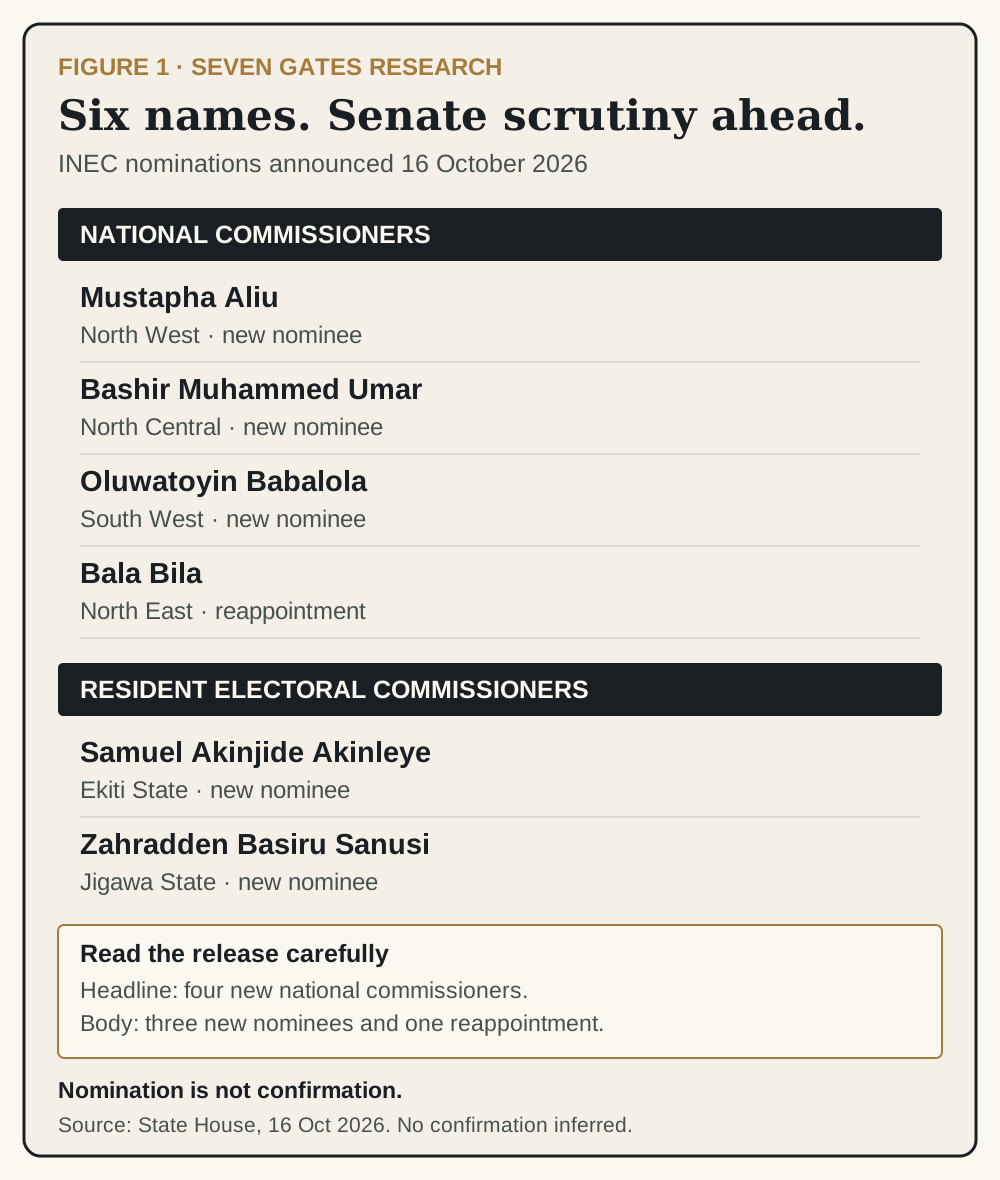
The next consequential election document may be a Senate screening record. Nigeria's presidency wants electoral appointments expedited before January's general elections. Speed can prevent vacancies. It cannot establish competence or independence. Published questions, answers and decisions would give citizens something more useful than another assurance that preparations are proceeding.
1. INEC nominations make the confirmation process an immediate test
The State House's 16 October announcement names Mustapha Aliu, Bashir Muhammed Umar and Oluwatoyin Babalola as new national commissioner nominees, alongside Bala Bila's reappointment. Samuel Akinjide Akinleye and Zahradden Basiru Sanusi are the two resident electoral commissioner nominees. All face Senate scrutiny.
There is a drafting inconsistency: the headline calls four national commissioners new, while the body identifies three new nominees and one reappointment. That should be clarified rather than reproduced as a settled count. Cornelius Ajayi's tenure expires on 24 October, according to the release; that is not a general confirmation deadline.
The practical issue is continuity without abbreviated examination. Senators should test relevant experience, conflicts and independence, then publish their reasoning. INEC must also explain handovers and readiness. Neither a presidential nomination nor a rapid vote demonstrates that election administration has improved. For businesses, credible administration reduces uncertainty around the transfer of political authority; appointments alone provide no basis for changing a Nigerian asset valuation.
Source: State House, 16 October.
2. Aden's airport is struck again, exposing civilian access
Aden security authorities reported that two missiles landed inside the international airport's grounds on 16 October, blaming the Houthis. Their preliminary statement reported no loss of life. It described the second such incident within a week and highlighted patients travelling abroad for treatment. This is the Saudi-backed government's Saba agency, not the Houthi-run outlet with the same name.
Even without reported fatalities, repeated strikes threaten an essential exit route. An airport can remain nominally open while airlines, crews and passengers judge individual journeys too dangerous. Medical access and family reunification can deteriorate before a formal closure appears.
For Nigerian employers with regional staff, the relevant check is a viable itinerary, including connections, rather than an airport's published status alone. Alternative routes require verified availability and security advice. This report does not establish a new oil-production loss, and the initial casualty statement should not be treated as a final investigation.
Source: Aden security statement via government Saba, 16 October, Arabic.
3. The IMF sees steady growth, but endorses tighter policy
Kristalina Georgieva's 16 October plenary address puts global growth at 3.1%, unchanged from the forecast made a year earlier. She describes opposing forces: energy disruption weakens activity while AI investment supports it. The aggregate therefore conceals sharply different national experiences.
More immediately for borrowers, the IMF endorses recent tightening by major central banks and argues for fiscal consolidation in most highly indebted countries, while protecting vulnerable people. The speech is policy advocacy, not a new Nigerian programme or an interest-rate decision.
Nigeria cannot infer cheap external funding from respectable global growth. Higher benchmark yields can increase refinancing costs even if domestic inflation eases. Oil receipts may benefit from higher prices, but expenditure pressures and financing costs still need separate assessment. Borrowing plans should be tested against actual maturity schedules and available revenue, not a growth projection alone.
Source: IMF Managing Director's plenary address, 16 October.
4. Local AI becomes a hardware purchase, with new responsibilities
NVIDIA says RTX Spark laptops became available on 16 October from six manufacturers, starting at $2,599, with configurations offering up to 128GB of unified memory. Its accompanying Nemotron release includes a model designed to run locally in 24GB. These are vendor specifications and availability claims, not independently verified productivity gains.
For Nigerian engineering, finance and legal teams, local processing may reduce the need to upload sensitive files and avoid some metered cloud usage. The economics still include imported hardware, electricity, maintenance and staff time. A local model also needs controlled access to documents and tools; physical possession of the computer does not make an autonomous workflow safe.
A useful trial measures completed work, errors, latency and total cost against the existing method. Memory capacity is a purchasing specification, not an acceptance test.
Sources: NVIDIA laptop launch, 16 October · NVIDIA model release, 15 October.
Three numbers worth remembering
- 24 October: Ajayi's stated tenure expiry, not a blanket appointment deadline.
- 3.1%: the IMF's 2026 global growth forecast.
- $2,599: NVIDIA's announced starting laptop price, before Nigerian landed costs.
What could change everything?
Published Senate scrutiny could substantiate or weaken confidence in the nominations. Reliable civilian flights would improve Yemen's humanitarian access. Lower benchmark yields would ease refinancing pressure. Independently measured local-AI performance could justify procurement, or show that an existing cloud service remains cheaper.
Prepared for 17 October 2026 using information available by 5:55 a.m. London. Official statements and vendor claims are attributed; transmission mechanisms and judgements are Seven Gates analysis.