SEVEN GATES DAILY BRIEF
Kenya's new Ebola cases were already in quarantine
Early detection offers a qualified sign of containment in Kenya. Egypt seeks authority to defend Saudi Arabia if asked, IMF members call for financing support, and an extraordinary AI growth claim needs an evidence test.
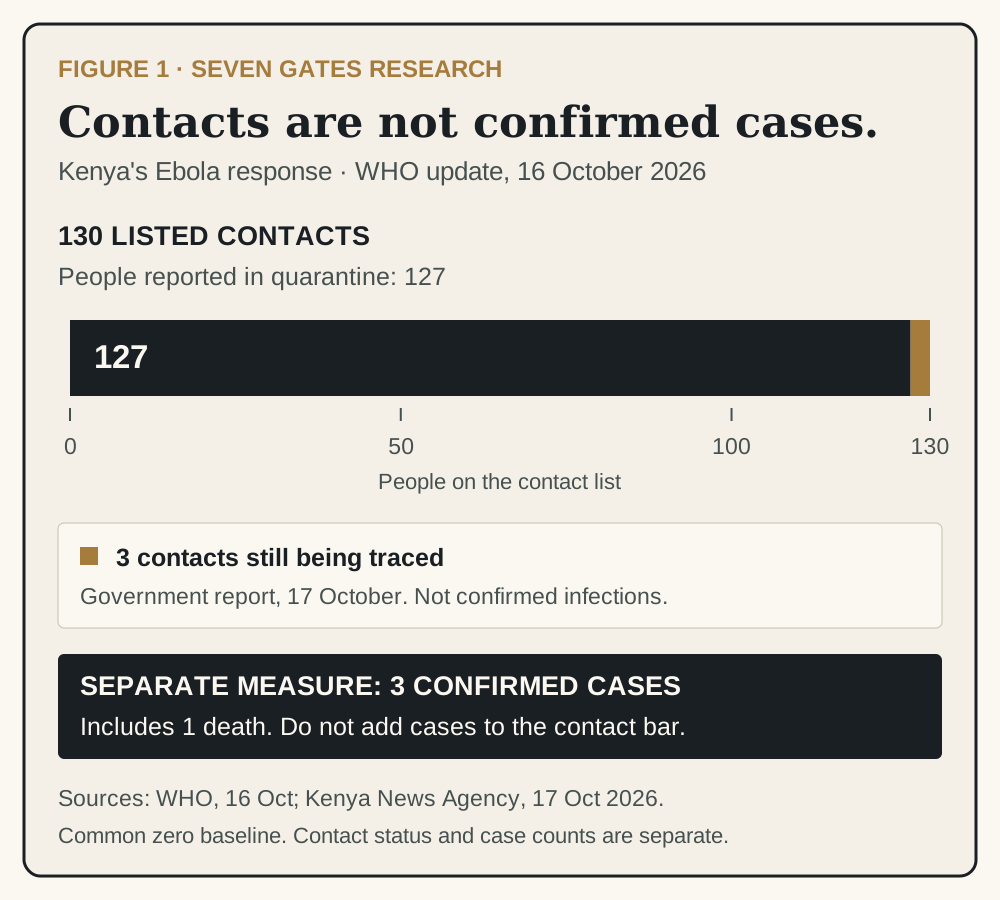
Kenya's latest Ebola cases were detected among people already in quarantine, official reports say. That offers a qualified sign that contact tracing is working, without establishing that transmission has ended. Where patients are found can tell us more about containment than a rising total alone.
1. Kenya detects two linked Ebola cases under observation
WHO's 16 October update records second and third Bundibugyo Ebola cases, confirmed on 14 and 16 October. Both were relatives of the first patient and already quarantined. Kenya's total was three confirmed cases, including one death.
Of 130 listed contacts, 127 were reported in quarantine by 16 October. Kenya News Agency's 17 October report says efforts continued to trace the remaining three. They are not three additional confirmed infections. WHO advises against border closures or trade restrictions.
For Nigeria, the operational lesson is to maintain usable contact records and prompt referral arrangements, rather than substitute broad travel restrictions for surveillance. A case found outside known contacts would change the assessment more sharply than another diagnosis within a monitored household. Public communication should explain that difference without promising zero risk. Employers with regional operations need current official advice and arrangements for staff to report illness, not improvised exclusion policies based on nationality.
Sources: WHO Africa, 16 October · Kenya News Agency, 17 October.
2. Egypt seeks conditional authority to defend Saudi Arabia
On 17 October, President Abdel Fattah al-Sisi offered to defend Saudi Arabia if requested and sought parliamentary authorisation. Parliament scheduled a plenary for 10:00 GMT on 18 October, without disclosing its agenda, Reuters reported. Egypt's presidency separately confirms the military graduation ceremony at which he spoke.
This raises the prospect of a wider state response to the Saudi-Houthi conflict. It does not establish a Saudi request, parliamentary approval or deployment. Those stages need separate confirmation before anyone treats Egypt as newly committed to combat.
The commercial effect depends on what follows. Additional defence could improve protection for infrastructure and shipping; a broader campaign could also increase disruption. Nigerian importers should obtain route-specific transit and insurance terms before revising delivery assumptions. A statement of military solidarity cannot determine when a delayed cargo will arrive. Businesses should also distinguish Suez and Red Sea exposure from Hormuz exposure: the geography, routes and alternatives are not interchangeable.
Sources: Reuters, 17 October · Egyptian presidency, 17 October.
3. IMF members favour support for financing shocks, not unconditional lending
Reuters reports that the IMF committee chair's 17 October statement encourages more support for countries with sustainable debt and strong reform agendas that face short-term financing difficulties. The official press briefing also stresses war-related trade disruption, fiscal resilience and protection for vulnerable people.
The eligibility language is consequential. A temporary shortage of funding and an unsustainable debt burden require different responses. Refinancing may bridge the former; repeated lending without a credible repayment basis can worsen the latter. The statement announces no Nigerian allocation.
For Nigerian borrowers, the relevant exercise remains a dated schedule of debt service against accessible foreign-currency receipts. Aggregate reserves, expected export earnings and cash available to a particular debtor are different quantities. A supportive international statement should not be entered as committed financing. Watch for named facilities, approved amounts, conditions and disbursement dates.
Sources: IMF press briefing, 17 October · Reuters, 17 October.
4. An AI founder's growth scenario is not a national forecast
Anthropic co-founder Jack Clark described an internal model in which US output could approach $44 trillion by 2030, conditional on continuing technological improvement, Reuters reported on 17 October. He also called for international safeguards. This is a company-linked scenario, not an IMF forecast or an observed productivity result.
The upside deserves examination, but the number alone cannot explain adoption costs, implementation delays or how gains are distributed. Nigerian organisations considering AI should ask which tasks become cheaper, how errors are detected and who retains the savings. Buying computing capacity does not automatically create a competitive service business.
A credible investment case needs customers, reliable power, enforceable contracts and measured task performance. Test the strongest alternative: existing software or a smaller deployment may deliver most of the benefit at lower cost. Extraordinary economy-wide possibilities are a reason to investigate, not permission to omit project economics.
Source: Reuters, 17 October.
Three numbers worth remembering
- 127 of 130: Kenya's listed contacts reported in quarantine on 16 October.
- 10:00 GMT: Egypt's scheduled parliamentary plenary today, not an approval already granted.
- $44 trillion: Clark's conditional US output scenario for 2030, not a consensus forecast.
What could change everything?
An Ebola case outside known contacts would alter containment confidence. A Saudi request followed by Egyptian authorisation would change the military picture. Actual financing approvals would substantiate the IMF support language. Independently measured productivity and cash returns would give the AI growth case firmer support.
Prepared for 18 October 2026 using information available by 6:00 a.m. London. Official reports, conditional proposals and company-linked scenarios are attributed; Nigerian transmission and judgements are Seven Gates analysis.