SEVEN GATES DAILY BRIEF
Nigeria's food prices fell in September. Relief remains uneven
The NBS records a monthly fall in food prices, but annual food inflation remains high. Saudi diplomacy is disrupted, AI credit costs rise despite strong chip sales, and Google expands paid news partnerships.
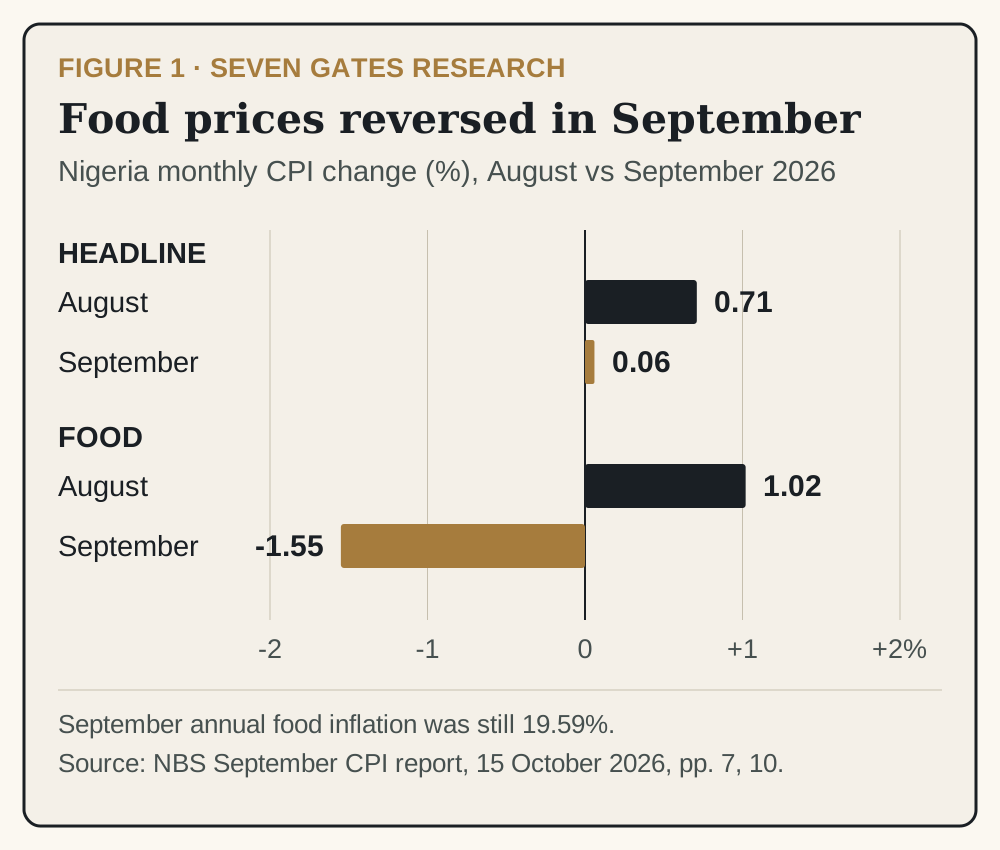
A Nigerian food-price decline is worth reporting precisely. The NBS says its food index fell 1.55% in September from August. That does not mean food became affordable, or that every market recorded a decline. It does mean the latest report contains more than a favourable annual comparison.
1. Nigeria records monthly food relief, with a stubborn annual increase
Headline inflation fell to 14.63% annually, from 15.39% in August. The overall index rose just 0.06% during September, against 0.71% the previous month. Food inflation remained 19.59% annually, but its monthly movement reversed from a 1.02% increase to a 1.55% fall.
The NBS report matters here: the 2.57-point figure is the change between those monthly food rates, not August's inflation rate. Confusing the two exaggerates the starting point.
For households, the price level and income still determine purchasing power. For businesses, a slower cost increase may ease working-capital pressure, but one month's national average does not justify assuming sustained margin improvement. The useful next test is whether the food-price decline persists across locations while transport and energy costs remain elevated. Monetary easing also needs evidence on underlying inflation, rather than a mechanical response to one headline number.
Sources: NBS September CPI release, 15 October, downloadable report · NBS report catalogue · Reuters, 15 October.
2. Saudi security disruption now affects summit diplomacy
The European Council postponed the EU-Gulf Cooperation Council summit scheduled for 24 October in Riyadh, without announcing a replacement date. Its statement reaffirmed the partnership but did not specify the reason. Reuters separately reported that the GCC cited aviation threats and Riyadh airport's closure.
Meanwhile, Yemen's government reported five deaths and 16 injuries after an attack on Aden's presidential complex. The Houthis said they targeted a Saudi military headquarters; Reuters could not verify that description.
Postponement is a concrete institutional consequence of the security crisis, not evidence that negotiations have ended. For businesses with Gulf exposure, continuity depends on actual flight availability, staff safety and alternative logistics. Nigerian travellers and contractors should verify individual routes rather than infer operational safety from a diplomatic statement. Neither an administrative-building strike nor a postponed summit establishes a specific loss of Saudi oil production.
Sources: European Council, 15 October · Reuters on the summit, 15 October · Reuters on Aden, 15 October.
3. Strong chip sales do not settle the AI debt question
TSMC reported $46.72 billion of third-quarter revenue and guided to $52.3 billion to $54.3 billion for the fourth quarter. Those operating figures argue against treating the AI sell-off as proof that demand has vanished. Guidance remains a forecast, not booked revenue.
Yet Reuters reported CoreWeave's five-year default-protection spread above 1,100 basis points, with its 2031 bond yield briefly reaching 16% before retreating towards 14%. These are volatile 15 October observations, not universal financing rates. A market-implied default probability would additionally depend on recovery assumptions; it is not an observed frequency.
The businesses occupy different positions: a chip supplier can sell strongly while a leveraged computing provider struggles to finance its assets. Nigerian data-centre sponsors should test utilisation, contracted cash receipts, debt maturity and currency exposure separately. Hardware demand alone cannot demonstrate that an individual project's funding structure survives.
Sources: TSMC results and guidance, 15 October · TSMC filing, 15 October · Reuters credit-market report, 15 October.
4. Google expands paid news licensing; distribution economics remain undisclosed
Google says more than 400 publications now participate in its News AI pilot. New partners include CNN, Axios, the Financial Times and Forbes. The company says it pays publishers for enhanced content used in features such as article overviews and customisable audio briefings, with attribution and direct links.
Payment establishes a commercial model, but the announcement does not disclose enough to assess individual publishers' returns. Referral traffic, renewal terms and control over reuse will determine whether licensing supports reporting or mainly compensates for lost visits. Nigerian publishers need to value their archives, specialist reporting and distribution independently before agreeing terms. A link beside an AI summary is not evidence that readers follow it. Licensing revenue and audience retention should be measured separately.
Source: Google, 15 October.
Three numbers worth remembering
- 14.63%: Nigeria's September annual headline inflation.
- -1.55%: September's monthly food-price change, not the annual rate.
- 1,100 basis points: the level exceeded by CoreWeave's five-year default-protection spread on 15 October.
What could change everything?
A sustained monthly food-price decline would strengthen Nigeria's relief story. Restored reliable Gulf flights would improve business continuity. Completed AI customer payments, refinancing and cash generation would test the financing fears more directly than share-price rebounds. For news licensing, disclosed payments and referral outcomes would reveal who captures the value.
Prepared for 16 October 2026 using information available by 5:55 a.m. London. Official data, company claims, forecasts and reported allegations are attributed; transmission mechanisms and judgements are Seven Gates analysis.