SEVEN GATES DAILY BRIEF
Nigeria's growth upgrade leaves the food-price problem unresolved
The IMF raises Nigeria's growth forecast as another Hormuz attack lifts oil, US senators challenge Russian diesel relief and Kyiv suffers fresh strikes. Memory-chip competition adds a separate risk to the AI trade.
The IMF added 0.1 percentage point to Nigeria's growth forecast. Its warning about poverty belongs beside the upgrade, not beneath it. An oil exporter can record stronger national income while its citizens struggle to buy food and fuel.
1. Nigeria's growth forecast improves; household relief needs delivery
The IMF's October outlook puts Nigeria's 2026 real GDP growth at 4.2%, up from 4.1%. Improved macroeconomic stability and favourable terms of trade support the revision. At Tuesday's briefing, the Fund also advocated targeted, temporary income support for vulnerable Nigerians facing higher essential costs.
That is a defensible response to an uneven shock. Higher crude prices improve export receipts, but transport, fertiliser, processing and distribution costs can rise before additional public revenue reaches households. A broad fuel-price intervention can absorb fiscal resources without reliably reaching the poorest. Cash support needs accurate beneficiary records, prompt payments and a published fiscal envelope.
The strongest objection is implementation: targeting can exclude people who need help. The test should therefore be coverage and purchasing power, with payment failures disclosed. A growth forecast cannot establish that wages, farm income or household consumption have improved.
Sources: IMF October WEO data · IMF briefing, 13 October · TheCable's Nigeria briefing report, 13 October.
2. Further Hormuz attacks keep fuel relief uncertain
Brent reached $106.32 a barrel at 03:45 UTC on Wednesday, after a tanker and container ship were reported struck by unknown projectiles in Hormuz. Iranian officials told Reuters they were changing their tactics against vessels. Attribution for the individual attacks remains unresolved. Saudi Arabia also reported a limited fire at an Aramco administrative building in Dhahran; that is not evidence of lost refinery output.
Nigeria's fiscal benefit depends on saleable production, export volumes and revenue collection. The consumer cost depends on product prices, freight and the exchange rate. Those channels need separate measurement. Additional Russian diesel could ease product tightness, but it cannot guarantee safe passage through a strait. Buyers should monitor completed cargo deliveries and insurance terms before assuming announced supply will reduce replacement costs.
Sources: UKMTO maritime warnings, checked 14 October · Reuters, 14 October, 03:45 UTC price update.
3. Kyiv's strikes and a Senate challenge weaken the diesel bargain
Russian ballistic missiles hit a Kyiv residential building and a power facility on Tuesday. Reuters reported two deaths and 21 injuries. Ukraine's presidency said advance warning had again been absent. Washington says it continues to share intelligence; the public evidence does not establish why warnings failed.
Separately, twelve US senators, including six Republicans, asked President Trump to rescind his Russian diesel agreement and implement the sanctions authorised last month. Their letter disputes the deal's benefit to American consumers and argues it will finance Russia's war. It is political pressure, not a revoked licence. Reuters reports an 18 October sanctions-or-waiver deadline.
The negotiation now faces tests of civilian protection, intelligence coordination and congressional durability. Nigeria's exposure is through fuel availability and financing conditions, not a direct military commitment. An energy agreement that leaves power stations under attack has not demonstrated compliance. Civilian protection should be assessed through observed attacks and functioning infrastructure, independently of whether cheaper diesel arrives.
Sources: Ukraine presidency, 14 October · Reuters casualty update, 13 October · US Senate letter, 13 October · Reuters sanctions report, 13 October.
4. Memory-chip competition unsettles the AI investment case
US chip shares fell on Tuesday as reports of progress at China's CXMT raised competition concerns. The Philadelphia semiconductor index was down 1.5% during Reuters' report, its fifth successive decline, though still more than 70% higher for the year. These are intraday observations, not closing returns.
CXMT's own newsroom confirms earlier production announcements, but does not independently settle the latest reported breakthrough. Commercial qualification, reliable yields and customer shipments remain the evidence to demand. A competitor's advance can lower hardware costs while reducing incumbent margins. For Nigerian cloud buyers and technology firms, that creates possible procurement savings, not an immediate licence to expand spending. Evaluate delivered performance and total operating cost, including electricity, currency exposure and support. Cheaper memory cannot repair an unreliable power supply.
Sources: Reuters via MarketScreener, 13 October, intraday · CXMT newsroom, production announcements dated 7 and 20 September.
Three numbers worth remembering
- 4.2%: the IMF's revised 2026 growth forecast for Nigeria.
- $106.32: Brent at 03:45 UTC on 14 October, not a daily close.
- 12: US senators seeking reversal of the Russian diesel agreement.
What could change everything?
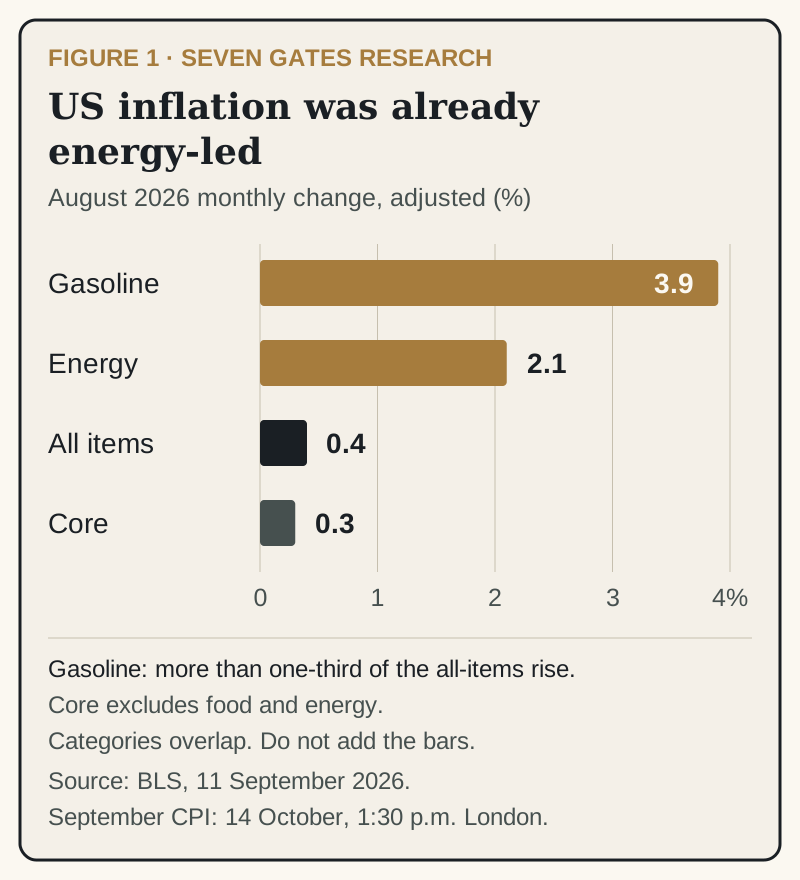
September US CPI arrives today at 1:30 p.m. London. August headline inflation was 3.4% annually, against 2.4% excluding food and energy. Watch whether energy pressure broadens into core prices: that would weaken the case for easier dollar funding. Verified safer transits, delivered diesel cargoes and the 18 October sanctions decision could alter fuel expectations. In Nigeria, publish who actually receives support and how quickly. In technology, customer-qualified shipments would carry more weight than another breakthrough report.
Inflation sources: BLS August release, 11 September · BLS October release calendar.
Prepared for 14 October 2026 using information available by 5:55 a.m. London. Forecasts, official claims and reported allegations are attributed. Transmission mechanisms and policy judgements are Seven Gates analysis.