SEVEN GATES DAILY BRIEF
A military escort did not make the road safe
A fatal ambush exposed the economic reach of insecurity as the IMF mapped a narrower global recovery, Dangote Refinery extended Africa's largest share sale and Joseph Kabila took a formal role in Congo's insurgency.
The convoy had soldiers, police officers and civil defence personnel. It still did not reach Nasarawa market intact. Gunmen killed at least 20 people on the road from Gwashi in Zamfara State, including 12 civilians and eight security officers. Nineteen others were wounded.
1. The Bukkuyum ambush reached beyond the casualty count
The attack occurred on Saturday afternoon and was reported on Monday. A military source confirmed the toll to Reuters, but military and police authorities had not issued a public response at the research cut-off.
The immediate obligation is an investigation, support for the wounded and protection for the bereaved. The economic damage extends farther. A trader who needs an armed convoy to reach a market already bears a security cost through fewer journeys, smaller loads, higher transport charges and lost trading days. When the escort itself is overwhelmed, commerce retreats. Abuja and Zamfara need route-level evidence: attack frequency, response time, reopened roads and the volume of trade restored. Operations announced after an ambush are not the same as a safer road.
Source: Reuters via MarketScreener, 12 October.
2. Global growth survived, but became more concentrated
The IMF raised its 2026 world-growth forecast slightly to 3.1%, with 2027 at 3.4%. It estimates that emergency energy substitution and reserve releases prevented growth from falling to 2.5%. Yet only 32 countries now account for 95% of global growth, down from 54 in April, and 47% of economies have been downgraded since then.
Sub-Saharan Africa is forecast to grow 4.3%, but the aggregate can conceal weak household outcomes and expensive imported energy. Nigeria receives an oil-revenue benefit and a fuel-price shock at the same time. The useful policy response is to preserve foreign-exchange stability, protect targeted households and avoid turning temporary oil receipts into permanent spending.
Sources: IMF World Economic Outlook database, 13 October · Reuters, 13 October.
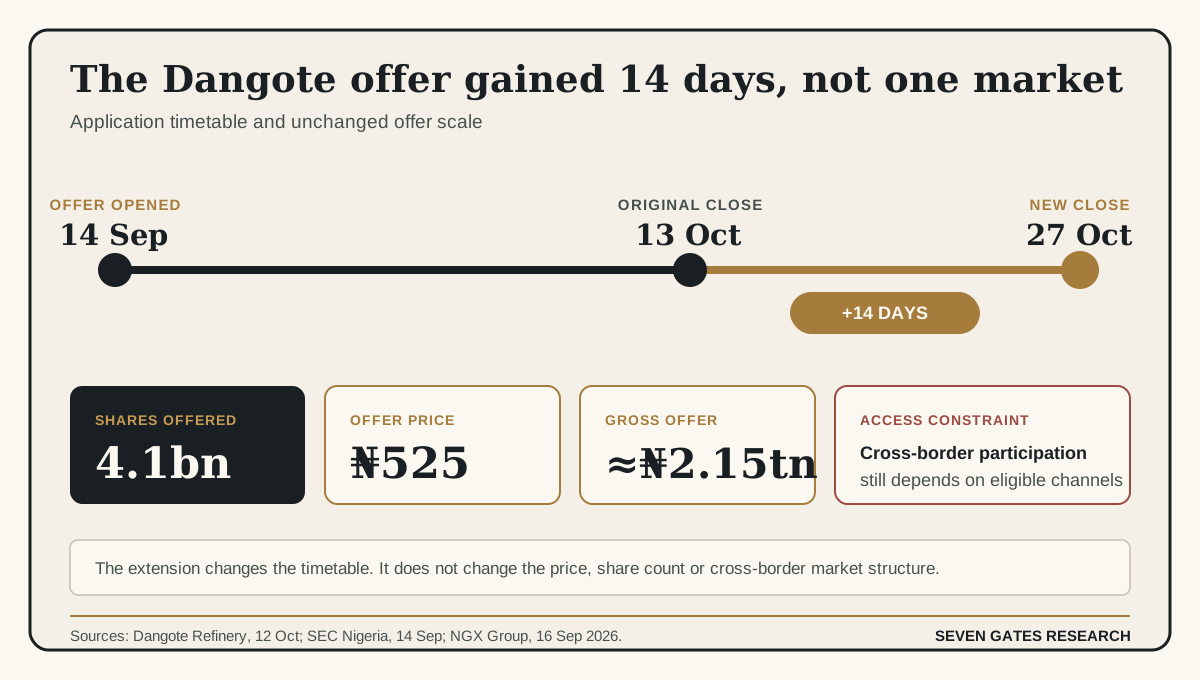
3. Dangote Refinery gave its IPO two more weeks
The company moved the closing date from 13 to 27 October after SEC approval, saying the extra time would widen access across African markets. The terms remain 4.1 billion shares at ₦525 each, or roughly ₦2.15 trillion before costs. Dangote has said it wants as many as 10 million retail investors.
The extension solves a timetable problem. It does not by itself solve cross-border settlement, account opening, currency conversion or the fact that the offer is not registered as a public offer outside Nigeria. Final subscription, allotment concentration and trading liquidity will show whether enthusiasm became durable ownership. Investors should use only channels approved by the SEC and read the prospectus rather than treat a longer offer as new valuation evidence.
Sources: Dangote Refinery, 12 October · SEC Nigeria, 14 September · Reuters, 12 October.
4. Joseph Kabila moved inside Congo's armed opposition
The former Democratic Republic of Congo president launched the Front for the Refoundation of the Nation in Goma. The political-military coalition succeeds the AFC structure, includes M23 leaders and says force remains available. Kabila now holds an explicit leadership role in an insurgency he had previously stopped short of openly backing.
That raises the political stakes beyond control of eastern territory. The African Union had held mediation consultations in Goma only days earlier. Nigeria has no direct military exposure, but a wider conflict would deepen displacement, interrupt mineral supply chains and test the credibility of African-led mediation.
Sources: Reuters, 12 October · UN Security Council, AFC listing · African Union, 9 October.
5. AI investment is becoming a balance-sheet question
The IMF says hyperscalers now provide 10% of global investment-grade bond issuance, up from less than 1% in 2024. A reassessment of AI profitability could therefore spread through credit, equities and forced selling rather than remain a technology-sector correction. Its stress test also found weak capital at banks representing 22% of global banking assets, up from 18% in 2025.
For Nigeria, the lesson is selective adoption. Borrowing heavily for imported compute before power, customers and productivity gains are visible transfers technology risk onto scarce capital. Smaller tools in agriculture, health, education and business services can be useful without copying the hyperscaler funding model.
Sources: IMF Global Financial Stability Report, 13 October · Reuters, 13 October.
Three numbers worth remembering
- 20: people killed in the Bukkuyum market-convoy ambush.
- 3.1%: the IMF's forecast for global growth in 2026.
- ₦2.15 trillion: approximate gross size of the Dangote Refinery share offer.
What could change everything?
An official account of the Bukkuyum attack, with a credible route-security plan, would establish whether the convoy was isolated or the system failed. The IMF outlook assumes energy mitigation continues; a renewed supply shock would weaken that base case. Dangote allotment and post-listing data will test the breadth of ownership. In Congo, any operational move by the new coalition, or a verified split within it, would show whether the reorganisation changes the battlefield or only its letterhead.
Prepared for 13 October 2026 from sources published or updated through 13 October, 5:45 a.m. London time. Official and company claims are attributed; transmission mechanisms and judgements are Seven Gates analysis.