SEVEN GATES DAILY BRIEF
They sailed toward a war. At least 139 people died
A shipwreck exposed the human cost of the Horn's overlapping crises as oil priced an unverified energy ceasefire, the World Bank prepared wider crisis support and AI investment kept global growth near 3%.
At least 139 migrants, including 15 children, died after a boat carrying 305 people capsized north of Obock in Djibouti. Eighty-four people remain missing and 82 survived. They were sailing toward Yemen while thousands of Yemenis were fleeing in the opposite direction. Those opposing flows measure the absence of safety and economic possibility on both shores.
1. The Eastern Route recorded another mass death
The vessel capsized during the night of 8 to 9 October. The International Organization for Migration said search, medical assistance and burials were continuing. More than 900 people died or disappeared on the Eastern Route in 2025; migrants interviewed in Djibouti last month cited drought, hardship, conflict and forced recruitment among the pressures driving them onward.
Rescue and accountability come first. The policy failure runs farther back: unsafe labour channels, trafficking networks and conflict have made a passage toward an active war appear viable. The African Union, Ethiopia, Djibouti and Gulf governments need coordinated search capacity, lawful recruitment routes and protection for people who turn back. A border policy that begins only at interception arrives too late.
Sources: Reuters, 11 October · IOM, 5 October.
2. Oil priced an energy ceasefire before Russia confirmed it
President Donald Trump said Ukraine and Russia had agreed to stop attacking each other's energy infrastructure. Ukraine said it was ready to comply and had issued military orders, but reported Russian strikes on energy facilities after the announcement and awaited Moscow's response. Brent fell 1.47% to $103.18 a barrel early Monday.
The price move reflects possible future supply, not verified compliance. A durable pause could reduce refinery damage, diesel scarcity and some inflation pressure. For Nigeria, lower product prices would ease the cost of petrol support and transport, while lower crude prices would trim export revenue. Until both sides publish and observe reciprocal orders, Abuja should treat the move as a scenario rather than a budget assumption.
Sources: President of Ukraine, 11 October · Reuters, 12 October.
3. The World Bank is preparing for a broader crisis call
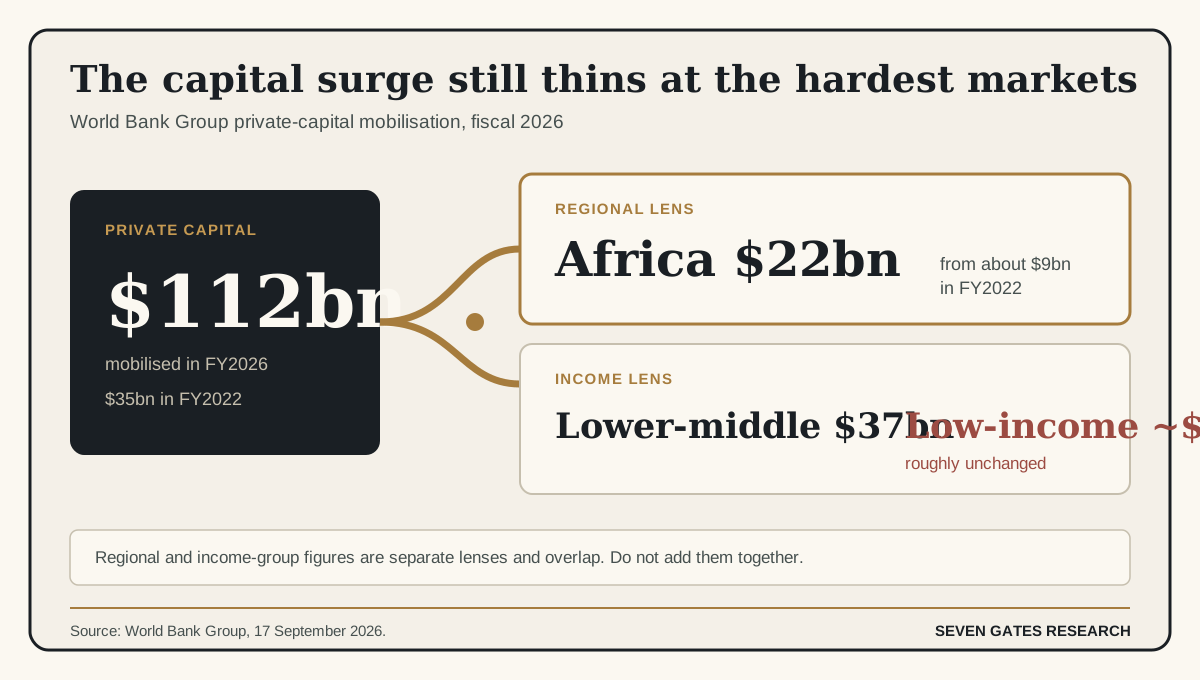
World Bank President Ajay Banga said 30 to 40 countries were discussing possible support for energy and price shocks. The Bank initially made $25 billion available and says as much as $100 billion could be deployed if conditions worsen. Separately, it mobilised a record $112 billion of private capital in FY2026; Nigeria was among the ten largest recipient countries, though its amount was not disclosed.
Nigeria's useful route is risk reduction, not another general loan. Political-risk guarantees, local-currency financing and project-level structures can move private money into power, logistics, agribusiness and healthcare without placing every risk on the sovereign balance sheet. The chart also gives the warning: only about $3 billion reached low-income countries, where protection is thinnest.
Sources: World Bank, 17 September · Reuters, 11 October.
4. AI investment is supporting growth, unevenly
IMF Managing Director Kristalina Georgieva said AI infrastructure investment is helping keep global growth near 3% despite the energy shock. The Fund estimates an uplift of 0.5 to 1 percentage point for advanced Asian economies and 0.2 to 0.8 point for emerging Asian economies that supply hardware and infrastructure.
Nigeria sits outside the strongest hardware supply chain. Its near-term gains will depend on reliable power, fibre, data-centre capacity and firms that can sell services into the investment cycle. Imported compute without productive adoption adds capital cost and electricity demand; local skills and exportable services turn it into growth. The policy target should be measurable productivity, not a count of AI announcements.
Sources: Reuters, 12 October · IMF meetings schedule, 12 October.
5. Nigeria's SEC warned investors about WayvePay
The Securities and Exchange Commission said WayvePay is not registered to solicit investments or operate in Nigeria's capital market, and advised the public not to transact with it. The warning matters during a major retail IPO, when familiar headlines and digital payment journeys can lend credibility to unrelated platforms.
The Commission should also correct or clarify the web reference in its notice, which currently points to a news article rather than an apparent platform domain. Investor protection depends on records that are both prompt and precise. Savers should verify every intermediary on the SEC register before transferring funds.
Source: SEC Nigeria, signed 9 October.
Three numbers worth remembering
- 139: confirmed deaths in the Djibouti shipwreck, with 84 people still missing.
- $103.18: Brent crude after the energy-ceasefire announcement.
- $112 billion: private capital mobilised by the World Bank Group in FY2026.
What could change everything?
A public Russian order followed by a monitored halt in energy strikes would turn the ceasefire claim into evidence. Revised rescue figures may change the scale, but not the policy failure, on the Eastern Route. Named countries, terms and projects will show whether World Bank crisis finance builds resilience or merely adds debt. For Nigeria, disclosed project-level capital mobilisation and a corrected SEC record would make two institutional claims independently testable.
Prepared for 12 October 2026 from sources published or updated through 12 October, 5:45 a.m. London time. Official claims are attributed; transmission mechanisms and judgements are Seven Gates analysis.