SEVEN GATES DAILY BRIEF
Nigeria is smoothing petrol prices. The funding rule now matters
Abuja offered households a temporary petrol cushion as Russian diesel returned to the US market, Ethiopia and Eritrea moved closer to war, and OPay filed for New York.
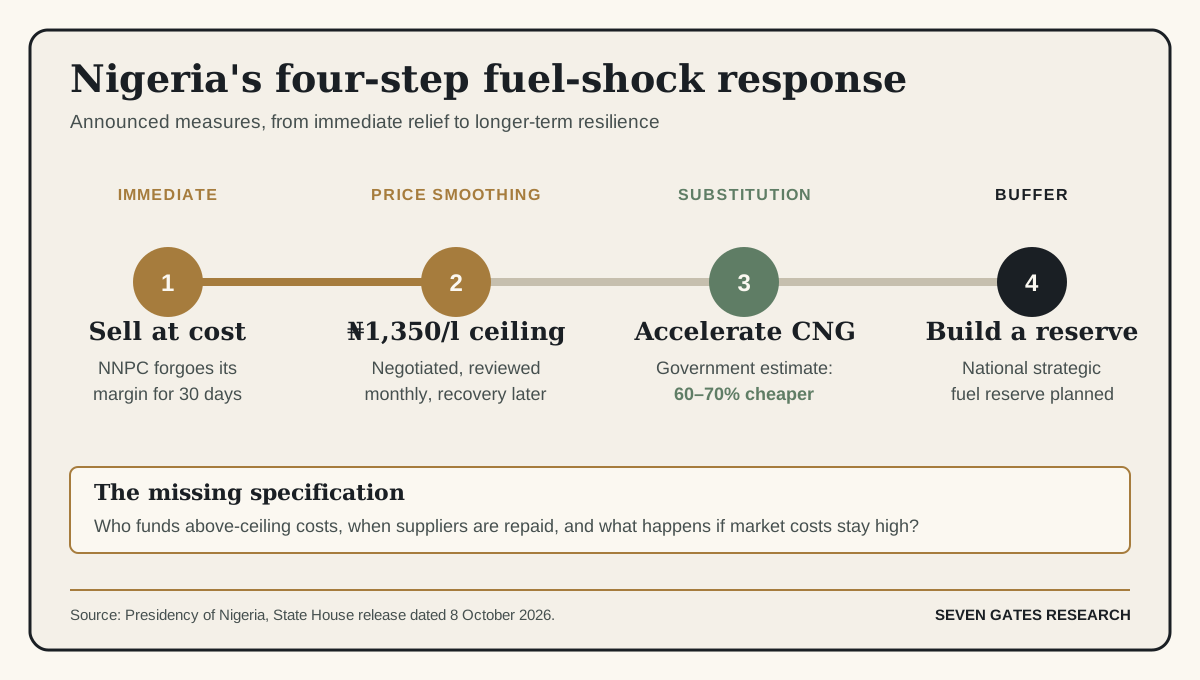
Nigeria has chosen to soften the petrol shock before it reaches every bus fare and food delivery. That is defensible emergency policy. It is not yet complete policy. A ceiling of ₦1,350 per litre means someone carries the difference when landing or refinery costs are higher. Until Abuja publishes the recovery formula, funding source and settlement timetable, households have a cushion but investors have an unpriced government-linked claim.
1. Nigeria introduced a 30-day petrol intervention
The federal government says NNPC Retail will forgo its margin and sell petrol at cost for 30 days. It is also negotiating a ₦1,350-per-litre ceiling on ex-gantry and landing costs, reviewed monthly. Refiners and importers would absorb any shortfall first, then recover it if costs later fall. Officials insist this is neither a subsidy nor price control.
The accounting label cannot resolve the economic question. If market costs remain above the ceiling, the policy needs a solvent counterparty and a published settlement rule. The near-term benefit is real: slower transmission into transport and food prices. The risk is arrears, weaker private supply or an eventual fiscal charge. Faster CNG conversion and a strategic fuel reserve could reduce future exposure, but both require delivery rather than announcement.
Sources: State House, 9 October · Financial Times, 10 October.
2. Washington reopened a sanctioned diesel channel
Donald Trump said Russia would supply the United States with more than 300,000 metric tonnes of diesel immediately. The Treasury licence authorises transactions involving Russian-origin diesel until 7 April 2027, including US imports. Diesel futures fell nearly 5% after the announcement.
The price effect is useful; the policy precedent is costly. Washington has relaxed an energy sanction to relieve a domestic shortage while Russia continues its war in Ukraine. That weakens the credibility of future restrictions and gives Moscow revenue. For Nigeria, additional Atlantic supply may eventually ease imported diesel costs, but the volume, delivery dates and lasting effect on regional prices still need confirmation.
Sources: US Treasury, 9 October · Reuters, 9 October.
3. Ethiopia said Eritrean troops advanced into Tigray
Ethiopia told the United Nations that Eritrean forces had moved as far as 60 kilometres into Tigray and described the operation as an invasion. Eritrea accused Ethiopia of seeking access to the Red Sea and did not directly answer the deployment claim. Witnesses reported Eritrean troops and explosions near Adigrat.
This is the sharpest escalation since the 2020 to 2022 Tigray war, in which hundreds of thousands died. Immediate priorities are civilian protection, independent verification and withdrawal from populated areas. A wider war would test African Union diplomacy, destabilise the Horn and add risk around trade routes already strained by insecurity farther north in the Red Sea.
Source: Reuters, 9 October.
4. OPay filed for a New York listing
Nigeria-focused fintech OPay reported first-half revenue of $467.1 million, up from $197.5 million a year earlier, and net income of $90.9 million. It has filed for a New York Stock Exchange listing under OPAY, with a Nigerian secondary listing planned later. Offer size and price have not been set.
The filing gives global investors a rare direct test of Nigerian consumer-finance scale. It may also create foreign price discovery for a later local listing. Growth is impressive, but a filed prospectus is not a completed flotation. Governance, customer concentration, regulatory exposure and the final valuation will decide whether rapid adoption becomes durable public-market value.
Sources: Reuters via MarketScreener, 9 October · Renaissance Capital, 9 October.
5. Navi Pillay won the Nobel Peace Prize
South African jurist Navi Pillay, 85, received the prize for advancing peace and international law. Her career includes service as a judge at the Rwanda tribunal and International Criminal Court, and as UN human-rights chief. She is the fifth South African peace laureate.
The award does not repair weakened institutions. It does mark the Nobel committee's judgement that legal accountability matters precisely when powerful states resist it. For Africa, Pillay's record also rejects the false choice between continental ownership and universal standards: African jurists can shape both.
Source: Reuters, 9 October.
Three numbers worth remembering
- ₦1,350 per litre: Nigeria's proposed petrol-cost ceiling, subject to monthly review.
- 300,000 tonnes: the immediate Russian diesel supply announced for the United States.
- $467.1 million: OPay's first-half 2026 revenue, before any IPO pricing.
What could change everything?
Nigeria could publish a funded, auditable settlement mechanism for the petrol ceiling, or reveal that private suppliers must carry open-ended risk. Actual Russian cargo arrivals could validate the diesel relief, while non-delivery would expose the announcement's limits. Verified Eritrean withdrawal would reduce the gravest human risk. OPay's amended filing will supply the share count and valuation that turn a growth story into an investable proposition.
Prepared for 10 October 2026 from sources published or updated through 10 October, 5:45 a.m. London time. Official claims are attributed; transmission mechanisms and judgements are Seven Gates analysis.